
EHR-integrated patient intake systems save time, reduce errors, and improve compliance.
Unlike standalone tools, which require manual data entry and create inefficiencies, integrated systems sync patient information directly into EHRs.
This approach cuts data entry time from 15–20 minutes to under 60 seconds, reduces errors by up to 70%, and ensures all required fields and signatures are completed.
Key Highlights:
Time Savings: Intake time reduced by 50%.
Accuracy: Eliminates transcription errors common in manual processes.
Compliance: Creates secure, audit-ready records for HIPAA and regulatory standards.
Efficiency: Streamlines workflows, reducing staff workload by up to 30%.
Quick Comparison:
|
Feature |
Standalone Tools |
EHR-Integrated Systems |
|---|---|---|
|
Data Entry Time |
15–20 mins/patient |
Under 60 seconds |
|
Error Rate |
High (manual transcription) |
Reduced by 70% |
|
Workflow Efficiency |
Limited |
Improved |
|
Compliance |
Partial |
Fully enforced |
Integrated systems are particularly useful in behavioral health settings, where accurate, real-time data is critical for patient safety and regulatory compliance.
Tools like Opus Behavioral Health EHR combine patient intake with clinical, administrative, and billing workflows, offering a streamlined solution for modern healthcare facilities.
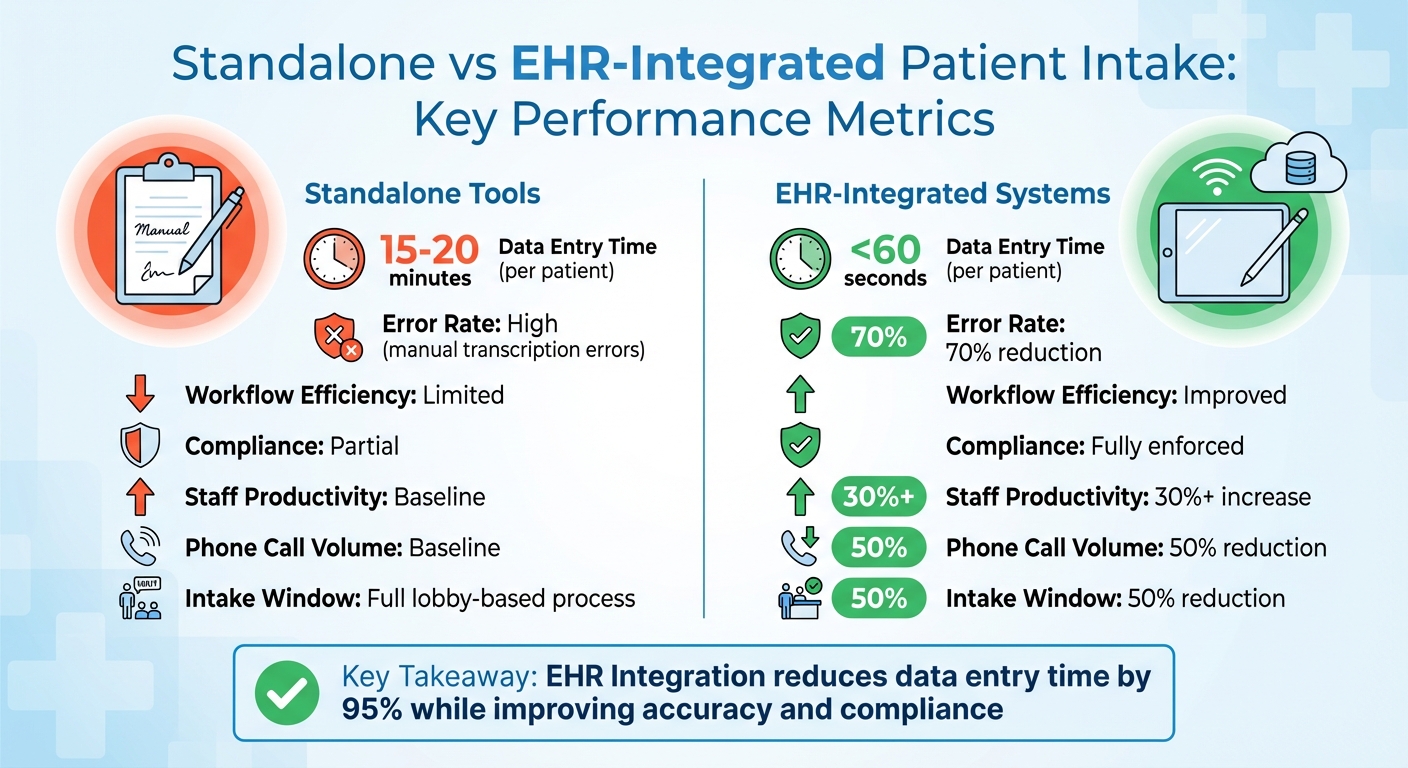
Standalone vs EHR-Integrated Patient Intake Systems: Time Savings and Efficiency Comparison
1. Standalone Patient Intake Tools
Standalone patient intake tools like Jotform and Typeform allow patients to complete forms online before arriving at a healthcare facility.
While they eliminate the need for handwritten forms, they often create data silos because the information doesn’t flow directly into the electronic health record (EHR). This means staff must manually enter the data into the EHR, a process that typically takes 15–20 minutes per patient compared to under 60 seconds with integrated systems[6].
Let’s dive deeper into how this impacts data accuracy, compliance, and workflow efficiency.
Data Accuracy
Manually transferring data opens the door to "transcription drift", where errors creep in as staff interpret, retype, or misread patient information[1].
Studies show manual transcription error rates range between 1% and 5%[8].
As Curogram explains:
"A single misread digit can change a patient's life. In detox, that digit might be a medication dose. In mental health intake, it could be a suicide risk score."[1]
Common errors include confusing medications like "Xanax" and "Zanaflex" or entering incorrect dosages[1][2].
Repetitive data entry also increases the likelihood of mistakes. For example, staff often re-enter basic information - like names, dates of birth, and addresses - across multiple screens, making it easy for typos to slip through unnoticed[1].
These errors not only jeopardize patient safety but also create extra work for staff, who must correct these mistakes later. Additionally, standalone forms often have missing fields or signatures that go undetected until audits weeks later. Integrated systems avoid this issue by requiring all fields to be completed before submission[1][2].
Compliance and Security
Standalone tools do provide some compliance benefits. They enforce mandatory field logic, ensuring patients can’t submit forms without completing required fields or providing signatures for HIPAA and 42 CFR Part 2 compliance[1][2].
They also maintain version control for consent forms, ensuring patients sign the latest, legally approved documents[1].
Secure archiving features, like time-stamped images of IDs and insurance cards, help reduce the risk of misplaced "shadow files" that are common with paper systems[1][2].
However, disconnected systems still have gaps. Without a unified audit trail, it’s harder to demonstrate compliance with HIPAA and CMS guidelines during inspections[10].
Manual data transfers can also lead to missing critical details, like updated medication lists, during handoffs[11]. Additionally, managing separate logins for messaging, email, and intake tools creates security silos and fragmented workflows[11].
While these tools address some compliance risks, they fall short of solving broader workflow challenges.
Workflow Efficiency
Standalone tools may reduce the need for paper forms at the front desk, but they don’t eliminate repetitive tasks. These tools often lack clinical validation logic, meaning errors like improperly formatted data can slip through and require cleanup later by clinicians.
This inefficiency adds to the administrative workload, which already accounts for about 25% of total U.S. healthcare spending, with nearly 30% of that tied to inefficiencies[9]. Without integration with EHR systems, these tools leave much of the administrative burden untouched.
2. EHR-Integrated Patient Intake Automation
When patient intake automation connects directly to an EHR (Electronic Health Record), it transforms the data entry process. Patient information is mapped directly into specific record fields, cutting manual input time from 15–20 minutes to less than a minute [6].
This integration not only speeds things up but also improves accuracy, ensures compliance, and streamlines workflows.
Data Accuracy
Standalone tools often require manual transcription, which can lead to errors. In contrast, EHR integration eliminates this issue, reducing data entry mistakes by as much as 70% [5].
Instead of static PDFs that need manual interpretation, this system maps each piece of information directly into the correct field in the patient chart [1][5].
Built-in validation logic ensures that data meets the EHR’s required format before it’s saved. For example, it verifies NPI numbers and insurance policy formats, helping to avoid billing problems later on [6].
Standardized clinical assessments like PHQ-9 and GAD-7 are scored automatically, removing the risk of manual calculation errors. High-risk responses - such as suicide indicators or seizure history - trigger automatic alerts for clinical review, ensuring that critical issues are flagged before the intake session begins [1][2].
Compliance and Security
Digital intake systems create tamper-proof, timestamped audit trails for every signature and data update. This feature makes it easier to prepare for audits by organizations like the Joint Commission and CARF, as well as state regulators, while also meeting HIPAA and 42 CFR Part 2 requirements [1][2].
As Curogram explains:
"Digital intake acts as a 'truth filter' for addiction treatment documentation. The result is cleaner clinical records that hold up during CARF, Joint Commission, and state audits." [1]
Patients can securely upload photos of IDs and insurance cards through encrypted links, reducing the risk of lost physical documents [2][3].
Workflow Efficiency
EHR-integrated automation doesn’t just enhance accuracy and compliance - it also makes workflows more efficient. Patients can complete intake forms before arrival using secure mobile links, cutting the intake process by up to 50% [2].
This reduces front-desk bottlenecks and helps ease waiting room stress, which is particularly helpful for patients in early recovery who may find such environments overwhelming.
Clinicians benefit from real-time access to patients’ medical histories, substance use profiles, and screening scores before the first in-person session [1][2].
Facilities using this technology report over a 30% boost in staff productivity [2] and a 50% drop in phone call volume [2].
Features like instant cancellation alerts allow waitlist notifications to be sent out quickly, reducing no-shows. SMS reminders, integrated with the EHR, have proven to reduce behavioral health no-shows by as much as 30%, with response rates reaching 90% compared to about 40% for phone calls [4][12].
|
Operational Metric |
Manual/Paper Workflow |
EHR-Integrated Automation |
|---|---|---|
|
Data Entry Time |
15–20 minutes per patient [6] |
Under 60 seconds [6] |
|
Error Rate |
High risk of transcription errors |
Up to 70% reduction [5] |
|
Intake Window |
Full lobby-based process |
Reduced by up to 50% [2] |
|
Staff Productivity |
Baseline |
30%+ increase [2] |
|
Phone Call Volume |
Baseline |
Up to 50% reduction [2] |
Platforms like Opus Behavioral Health EHR integrate patient intake automation into clinical, administrative, and billing workflows. This ensures that data flows seamlessly from the first patient interaction all the way through treatment and billing.
With features like discrete data mapping, clinical scoring, and real-time validation, these systems reduce administrative burdens while maintaining high standards of accuracy and compliance.
Advantages and Disadvantages
Deciding between standalone patient intake tools and EHR-integrated systems can significantly affect data accuracy, compliance, and workflow efficiency - key aspects of any clinical setting.
Standalone tools like Jotform or Typeform are quick to set up and generally budget-friendly. However, they fall short when it comes to seamless data integration, often requiring manual re-entry, which introduces delays and increases the risk of errors.
As Parker Gawne, Founder of Syntora, points out, "the core issue is not a lack of tools, but that these tools are not built for the specific data structures and compliance needs of a clinical environment" [6].
On the other hand, EHR-integrated systems are designed to streamline these processes. Patient-entered data automatically maps to specific fields - details like allergies, medications, and insurance information are updated in the patient’s chart in under a minute [6].
These systems also ensure compliance by enforcing mandatory fields and capturing legal signatures (such as HIPAA and 42 CFR Part 2) with unalterable timestamps [1][2].
Additionally, real-time clinical alerts can flag high-risk responses - such as suicide risk or potential medication interactions - before the clinician even begins the intake session [1].
However, integration isn't without its challenges. For instance, outdated EHR APIs can complicate the process, sometimes requiring browser automation instead of direct data pipelines. This workaround can be fragile and difficult to maintain [6].
Furthermore, native EHR forms often lack the flexibility of advanced conditional logic needed for complex clinical screenings. For example, they may not automatically display a GAD-7 questionnaire if a patient’s PHQ-9 score crosses a specific threshold [6].
Here’s a quick comparison of the two approaches:
|
Feature |
Standalone Patient Intake Tools |
EHR-Integrated Automation |
|---|---|---|
|
Data Entry |
Manual transcription (15–20 mins/patient) [6] |
Automated sync to discrete fields (<60 seconds) [6] |
|
Data Integrity |
High risk of errors like typos and "transcription drift" [1][6] |
Eliminates manual errors; ensures consistent data [1] |
|
Clinical Visibility |
Data remains siloed; delays as admin enters data [2] |
Immediate data availability in the chart [2] |
|
Compliance |
||
|
Implementation |
Easy setup and low initial costs |
Dependent on EHR API quality; may require a technical review [6] |
Opus Behavioral Health EHR addresses these challenges by offering features like discrete data mapping, automated clinical scoring, and real-time validation.
This ensures that the information collected during intake flows seamlessly across clinical, administrative, and billing workflows, eliminating the need for staff to juggle multiple platforms or re-enter data manually.
Conclusion
Integrating patient intake workflows with EHR systems has reshaped how healthcare providers manage data.
By streamlining processes and reducing manual input, EHR integration enhances data accuracy, ensures compliance, and boosts overall efficiency. This creates a unified record that seamlessly ties together clinical, administrative, and billing operations.
For behavioral health providers, the benefits are clear: intake times shrink dramatically, and compliance becomes easier to maintain. Automation reduces data entry time from over 15 minutes per patient to less than 60 seconds [6], while front-desk workload decreases by up to 80% [7].
Dr. Jennifer Williams, a Mental Health Practice Owner, highlighted the impact in February 2026: “Since implementing Opus EHR, our providers spend 35% less time on documentation while capturing more comprehensive clinical data” [13].
On the compliance front, integrated systems enforce mandatory fields for HIPAA and 42 CFR Part 2 consents, generating secure audit trails.
These trails meet the rigorous standards of CARF, Joint Commission, and state surveys [1][2]. Unlike standalone tools that often create inefficiencies like "shadow files" or scanning queues, integrated platforms ensure every signature is timestamped and every required field is completed before submission.
Opus Behavioral Health EHR takes this a step further by combining CRM, EHR, and RCM into one cohesive system. This eliminates data silos and reduces errors.
Key features like discrete data mapping, AI-driven documentation (Copilot AI), and real-time clinical alerts for high-risk responses further optimize workflows. Providers can explore these benefits with a 21-day free trial [14] to see how integration can transform their processes.
It’s time to evaluate your current workflows and move toward integrated automation. With EHR-integrated systems, your team gains accurate, compliant, and instantly accessible clinical records when they need them most.
FAQs
What data should be mapped into discrete EHR fields first?
The initial information to integrate into specific EHR fields includes patient demographics, insurance details, and unique identifiers such as IDs. This approach helps maintain accurate and structured data entry from digital patient intake forms, boosting both data accuracy and workflow efficiency.
How does EHR-integrated intake handle HIPAA and 42 CFR Part 2 consents?
EHR-integrated intake systems help maintain compliance with HIPAA and 42 CFR Part 2 by incorporating automated consent management tools.
These tools handle detailed consent settings, monitor disclosures, and enforce restrictions on re-disclosure. Built-in alerts ensure patient privacy is safeguarded and that practices stay aligned with the latest regulations, including the updated 2024 final rule.
What EHR integration method works if the EHR API is outdated?
If the EHR API feels like a relic of the past, there are still ways to work around it. You can turn to methods like browser automation or build a HIPAA-compliant processing pipeline for integration. The right path depends largely on the API's documentation and how intricate it is. These approaches can bridge the gap, ensuring secure and efficient patient intake automation - even when dealing with older systems.



- Behavioral Health
- EHR Systems
- Addiction Treatment EHR
- mental health
- Telehealth
- addiction treatment
- Behavioral health facility
- Substance Abuse Disorder
- behavioral Health center
- HIPPA Compliant
- ehrsoftware
- PTSD
- behavioral health ehr
- Depression
- hipaa
- Anxiety
- MentalHealthMatters
- RCM
- claim denials
- clinical documentation
- mental health awareness
- screening tools

September 15, 2026

September 15, 2026

September 14, 2026

September 11, 2026

September 10, 2026

September 09, 2026
Recommended Posts
Sunday, December 14, 2025
AI in Patient Intake: What Clinics Need to Know
AI-powered patient intake systems are changing how clinics handle data collection and patient interactions. These tools ...

Monday, March 16, 2026
How AI Automates Progress Notes for Therapists
AI tools are transforming how therapists handle progress notes, saving time and reducing burnout.

Thursday, May 07, 2026
Common Issues with Chatbot-EHR Integration
Integrating chatbots with Electronic Health Record (EHR)systems can simplify workflows, reduce errors, and improve care ...