Cognitive testing provides measurable insights into brain functions like memory, attention, and decision-making, helping clinicians make accurate diagnoses and track progress over time.
Unlike subjective assessments, these tools rely on objective data to identify subtle cognitive issues, improve treatment accuracy, and monitor recovery.
Key takeaways:
Cognitive Baselines: Tools like MoCA (90% sensitivity for mild cognitive impairment) and MMSE help establish benchmarks for tracking changes over time.
Misdiagnosis Reduction: Objective testing has reduced ADHD misdiagnoses by 30%, distinguishing cognitive issues from conditions like anxiety or sleep disorders.
Treatment Monitoring: Digital assessments streamline workflows, track therapy outcomes, and ensure effective interventions.
Behavioral Health Integration: Embedding cognitive tests into EHR systems automates processes, saves time, and improves data accuracy.
Cognitive testing bridges the gap between perception and reality, ensuring better patient care through data-driven insights.
Setting Cognitive Baselines for Long-Term Monitoring
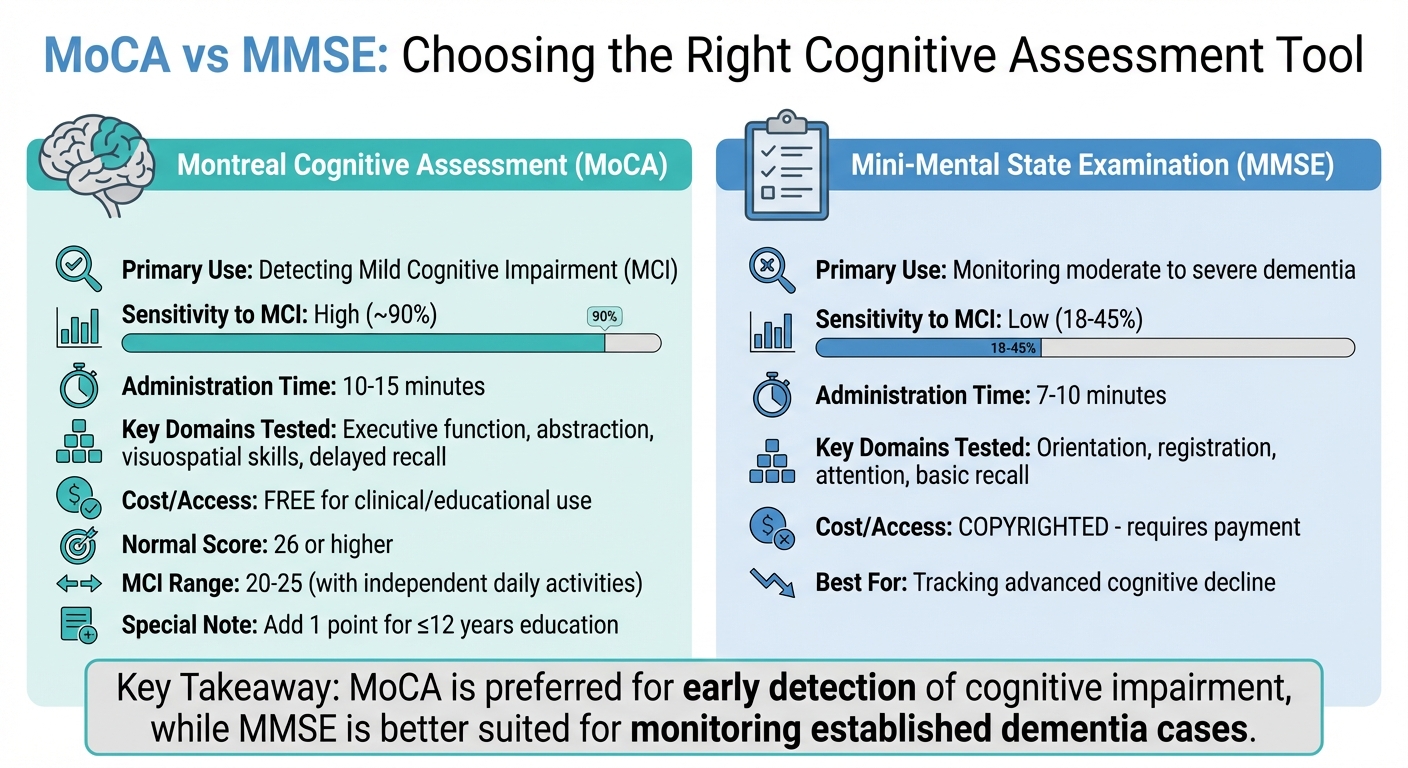
MoCA vs MMSE Cognitive Assessment Tools Comparison
Creating a cognitive baseline provides a snapshot of a patient’s mental function at a specific moment, serving as a benchmark for tracking changes over time. These baselines are essential in behavioral health settings, especially for distinguishing between normal aging and early signs of Alzheimer’s disease.
As LoneStar Neurology puts it:
"Establishing baseline function: Documenting cognitive status before surgery or starting new medications provides a reference point for future comparisons." [10]
Baseline assessments are particularly useful before significant clinical events, such as starting a new medication or undergoing surgery, where cognitive shifts might occur.
They are especially important for individuals aged 55 and older or those displaying early warning signs like memory lapses or increased irritability [12].
Alarmingly, about 30% of dementia patients are unaware of the extent of their cognitive decline, highlighting the critical role of baseline data in effective care planning [7].
Using MoCA and MMSE for Baseline Assessment
Two widely used tools for cognitive baseline screening are the Montreal Cognitive Assessment (MoCA) and the Mini-Mental State Examination (MMSE). Each tool serves a distinct purpose in assessing cognitive health.
The MoCA is excellent for detecting early-stage impairment, evaluating areas such as executive function, abstraction, visuospatial skills, and delayed recall. It takes 10 to 15 minutes to administer and has a sensitivity of about 90% for identifying mild cognitive impairment (MCI) [10].
A score of 26 or higher is typically considered normal, while scores between 20 and 25 may indicate MCI in patients who can still manage daily activities independently [13].
To adjust for educational differences, clinicians add one point for individuals with 12 years or less of formal education [10].
On the other hand, the MMSE focuses on simpler tasks like orientation, registration, attention, and basic recall. It’s quicker to administer - taking about 7 to 10 minutes - but it identifies only 18% to 45% of MCI cases.
This makes it more suitable for monitoring moderate to severe dementia rather than catching subtle early changes. Unlike the MoCA, the MMSE is copyrighted and requires payment for use, whereas the MoCA is freely available for clinical and educational purposes [10].
Here’s a quick comparison of the two tools:
|
Feature |
Montreal Cognitive Assessment (MoCA) |
Mini-Mental State Examination (MMSE) |
|---|---|---|
|
Primary Use |
Detecting Mild Cognitive Impairment (MCI) |
Monitoring moderate to severe dementia |
|
Sensitivity to MCI |
High (~90%) |
Low (18–45%) |
|
Administration Time |
10–15 minutes |
7–10 minutes |
|
Key Domains |
Executive function, abstraction, visuospatial skills, delayed recall |
Orientation, registration, attention, basic recall |
|
Cost/Access |
Freely available for clinical/educational use |
Copyrighted; requires payment |
By employing standardized tools like MoCA and MMSE, clinicians can establish a solid baseline, enabling more accurate and informed decisions as they monitor cognitive changes over time.
Tracking Changes Over Time to Identify Early Risk Factors
Once a cognitive baseline is set, regular follow-ups allow clinicians to monitor trends and spot early signs of decline.
This ongoing data is especially important for detecting mild cognitive impairment or early Alzheimer’s. Subjective cognitive decline (SCD), a potential early indicator of dementia, affects approximately 11.7% of adults over 65 and 10.8% of those aged 45 to 64 [1].
Tracking changes over time also helps clinicians evaluate whether treatments or therapies are slowing cognitive decline or if further deterioration is occurring [11].
For example, GT Healthcare integrated digital cognitive assessments into their workflow, allowing clinicians to make diagnostic decisions within two to three online appointments while saving about one hour of administrative work daily [7].
Gabrielle Thompson, FNP-C and Founder of GT Healthcare, shared:
"What Creyos helps with most is helping me confirm what I think is going on and find out if there's a possibility of something else causing the same symptoms. I can narrow down a diagnosis using measurements like scoring." [7]
Digital platforms offer distinct advantages over traditional paper-based tests. They randomize test items, reducing the risk of practice effects - where patients perform better simply because they’ve become familiar with the test rather than due to genuine cognitive improvement [1][3].
Improving Diagnosis and Treatment Accuracy
Cognitive testing plays a key role in refining diagnostics and personalizing treatment plans. By going beyond subjective reports, it provides measurable data on areas like executive function, processing speed, attention, and memory [9].
These insights are essential for identifying subtle cognitive deficits and tracking how well treatments are working.
This is especially critical when you consider that nearly 40% of individuals with major psychiatric disorders are misdiagnosed, with major depressive disorder being the second most common misdiagnosis [9].
Digital assessments take this a step further by distinguishing between different types of cognitive deficits. For instance, they separate "cold cognition" (non-emotional deficits) from "hot cognition" (emotionally influenced biases).
This differentiation helps pinpoint whether symptoms are linked to conditions like depression, anxiety, ADHD, or something else entirely [14].
Identifying Subtle Cognitive Deficits in Mental Health Conditions
Traditional screening tools often miss subtle impairments, especially in high-functioning individuals. Digital assessments bridge this gap by evaluating specific cognitive domains and comparing them against a broad normative database [5][1].
For example, one study showed that using a specialized protocol reduced ADHD misdiagnoses by over 30%. It revealed that many attention problems were actually due to anxiety or sleep disorders [8].
Objective testing like this is vital for avoiding both over-diagnosis and under-treatment. This is particularly relevant when considering that approximately 1 million children in the U.S. may be misdiagnosed with ADHD due to reliance on subjective evaluations [6].
Monitoring Medication and Therapy Effectiveness
Cognitive testing also helps assess whether treatments - be it medication or therapy - are genuinely effective. Digital platforms often use randomized task generation, which eliminates "practice effects", where repeated testing leads to artificial improvements simply from familiarity with the tasks [15].
For instance, GT Healthcare has successfully integrated Creyos digital assessments alongside tools like the PHQ-9 and GAD-7. This approach allows for accurate diagnoses and treatment plans within just two to three visits, all while reducing administrative workload [4].
Supporting Rehabilitation and Recovery Outcomes
Cognitive testing plays a key role in improving rehabilitation outcomes by guiding recovery efforts for conditions like psychosis, substance use disorders, and brain injuries.
For instance, cognitive deficits affect between 20% and 80% of individuals with substance use disorders, influencing their ability to stick with treatment and increasing the risk of relapse [17].
Similarly, 60% to 98% of patients with schizophrenia experience cognitive challenges [18]. These impairments can hinder essential aspects of recovery, such as engagement, memory recall, and decision-making.
Patients struggling with executive function, memory, or attention may find it harder to actively participate in treatment programs [17].
Without early identification of these challenges, clinicians might overestimate a patient’s abilities, leading to treatment plans that don’t align with their actual needs. Cognitive profiling bridges this gap, enabling more personalized rehabilitation strategies.
Assessing Cognitive Strengths and Weaknesses
A detailed cognitive profile highlights a patient’s strengths and areas needing support. This information helps clinicians choose evidence-based treatments right from the start [18].
For example, identifying deficits in executive functioning or visual memory allows for targeted interventions, such as tailored cognitive behavioral therapy (CBT) or the use of visual aids [16][19].
Substance-specific cognitive impacts also guide treatment. Opioid addiction, for instance, often affects the prefrontal cortex and temporal lobe, leading to difficulties with planning, decision-making, and visual memory [19].
Meanwhile, cocaine and methamphetamine use typically impair working memory and cognitive flexibility [19]. Recognizing these patterns allows therapists to adjust therapy pacing and structure accordingly. Dr. Ronnit Nazarian from Fifth Avenue Psychiatry explains:
"Neuropsychological testing assists the therapist to better understand the impact of the concern on the client's life across different settings... which can in turn influence the therapeutic treatment to be centered around the client's needs" [19].
Cognitive testing can also uncover co-occurring conditions, such as PTSD, anxiety, or bipolar disorder, that may drive substance use. This insight enables more integrated recovery plans tailored to the individual.
Tracking Stability After Treatment
Once a patient’s cognitive profile is established, regular assessments help track recovery progress. Because recovery doesn’t follow a straight path, these ongoing evaluations are crucial.
Short follow-up tests (lasting 10–15 minutes) can monitor cognitive health without overwhelming the patient [18]. Tools like the Repeatable Battery for the Assessment of Neuropsychological Status (RBANS) provide alternate test formats, ensuring that improvements reflect true recovery rather than familiarity with the test [17].
For example, a study on alcohol use disorder found that 93% of patients showed clinical impairments at the start of treatment, and 73% remained impaired in at least one area 10 days after detox [17].
Frequent testing during periods of rapid change, such as the first 10 days of detox, is vital for capturing shifts in cognition. While memory often improves within six weeks, executive functions may take longer to recover [21]. By monitoring these changes, clinicians can confirm long-term progress.
The Montreal Cognitive Assessment (MoCA) is particularly effective for long-term tracking, as it can predict psychological distress up to five years after treatment begins [20]. This data helps clinicians determine whether a patient is ready to resume activities like returning to work, driving, or managing finances - or if additional support is still necessary.
Integrating Cognitive Testing into Behavioral Health EHR Systems
Adding cognitive testing directly into a behavioral health EHR system eliminates the hassle of juggling multiple platforms or manually entering data.
Thanks to collaborations between cognitive assessment providers and data interoperability platforms, tools like the MoCA and MMSE now sync effortlessly with existing clinical workflows. This integration ensures real-time updates for test results, clinical notes, diagnoses, and lab data across connected systems[22][23].
By offering point-of-care access, these assessments are embedded into the daily routines of clinicians, speeding up decision-making and enabling quicker interventions. Marc Lipton, CEO of Creyos, highlights the operational impact:
"To deliver on the promise of value-based care, we need tools that don't just work clinically but also work operationally. This partnership with Redox eliminates the workflow and integration barriers that have slowed adoption for years."[22]
This type of integration lays the foundation for automated workflows and more advanced reporting capabilities.
Automating Cognitive Testing Workflows
Automating cognitive testing processes not only saves time but also minimizes errors. Digital versions of assessments like the MoCA and MMSE remove the need for manual scoring, which typically takes 7–12 minutes per test.
With automated scoring, results are instantly available in the EHR, cutting intake times by 50% and boosting staff productivity by over 30%[25][28].
A study conducted at UMass Memorial Medical Center in January 2025 illustrates the impact of such integration. Researchers screened 150 participants (average age 74) using a core cognitive evaluation tool.
The results identified 40 individuals with borderline scores and 7 with signs of cognitive impairment, leading to actionable steps like neurology referrals and brain MRIs. All participating primary care providers expressed their intent to continue using the tool[27].
Amanda Wilson, Director of Clinical Services at a mental health and substance use treatment center, shared how this automation improves operations:
"This process will simplify our operations to save so much time. We will no longer have to manually pull so many charts per quarter and have a timelier billing process for quicker reimbursements."[24]
Automated systems also ensure compliance by creating clean audit trails with timestamped electronic signatures, meeting standards like JCAHO, CARF, and 42 CFR Part 2[26].
Additionally, smart logic features tailor questions to a patient’s care level - such as detox versus outpatient - improving both completion rates and data accuracy[28].
Using Advanced Reporting for Outcome Measurement
Advanced reporting tools make it easier to track cognitive performance over time, supporting evidence-based care. For instance, platforms like Opus Behavioral Health EHR offer over 140 detailed reports, providing instant feedback on patient progress.
These reports help streamline insurance authorizations and measure outcomes effectively by visualizing changes in cognitive function over time[24][29].
Natural Language Processing (NLP) plays a key role by extracting cognitive scores from unstructured clinician notes and converting them into structured, reportable data.
Research shows NLP algorithms can extract MoCA scores with 97% accuracy and MMSE scores with 100% accuracy. Without such automation, only 11% of dementia patients had a documented cognitive measure in the five years leading up to their diagnosis[29].
Real-time dashboards further enhance care by identifying clinical trends and patterns, enabling data-driven triage and better specialist referrals. Andrea Horwitz, Clinical Director, explains how weekly treatment results provide valuable insights:
"Reviewing weekly treatment results shows me what is really happening with my clients, even if they are not able to express it in session... We were able to work together to prevent a relapse, a crisis, and potential tragedy due to the Opus Patient Engagement system."[26]
These features collectively enhance patient care and streamline outcomes, setting the stage for more efficient and informed clinical practices.
Conclusion
The strategies discussed highlight how objective cognitive testing can reshape patient care.
By establishing baselines and monitoring changes, clinicians can distinguish between normal aging and early signs of impairment, allowing for timely and effective interventions. This is especially important considering that 30% to 80% of patients with substance use disorders also face cognitive impairments[4].
Using objective measurements gives providers actionable data to refine diagnoses and tailor treatments. These insights can guide adjustments in medications, evaluate therapy outcomes, and enhance rehabilitation efforts[2].
Digital tools further close the gap between quick screeners and comprehensive evaluations, offering a middle ground that’s both efficient and thorough[5][6].
When integrated with platforms like Opus Behavioral Health EHR, these assessments become even more impactful. Clinicians gain instant access to cognitive scores without juggling multiple systems or manual data entry. With over 140 reporting options available, the platform delivers instant insights into patient progress, streamlining workflows and supporting more informed clinical decisions.
Measurement-based care also equips clinicians to detect worsening symptoms early, helping to prevent relapses or crises. As Andrea Horwitz, Clinical Director at Opus Behavioral Health, explained:
"Reviewing weekly treatment results shows me what is really happening with my clients, even if they are not able to express it in session."[26]
FAQs
How often should cognitive testing be repeated?
Cognitive testing is usually done every 1 to 2 weeks at the start. For ongoing monitoring, it might be scheduled at intervals of 6, 12, and 18 months, depending on the situation. Talk to your healthcare provider to figure out the timing that works best for you.
Can cognitive tests tell ADHD from anxiety or poor sleep?
Cognitive testing plays a key role in distinguishing ADHD from conditions like anxiety or sleep disorders. By assessing areas such as attention, executive control, and impulse regulation, these tests provide valuable insights. That said, overlapping symptoms - like restlessness and trouble focusing - can make it tricky to pinpoint the exact issue. The best results come when cognitive testing is paired with clinical evaluations and behavioral questionnaires, creating a well-rounded method to sharpen diagnostic accuracy and tease apart these similar conditions.
How do cognitive test results flow into Opus Behavioral Health EHR?
Cognitive test results are seamlessly incorporated into Opus Behavioral Health EHR through automated outcomes assessment tools. These tools simplify the process of collecting and analyzing data, while providing real-time updates. This ensures that patient records remain current and easily accessible for care providers.



- Behavioral Health
- EHR Systems
- Addiction Treatment EHR
- mental health
- Telehealth
- addiction treatment
- Behavioral health facility
- Substance Abuse Disorder
- behavioral Health center
- HIPPA Compliant
- ehrsoftware
- PTSD
- behavioral health ehr
- Depression
- hipaa
- Anxiety
- MentalHealthMatters
- RCM
- claim denials
- clinical documentation
- mental health awareness
- screening tools

September 15, 2026

September 15, 2026

September 14, 2026

September 11, 2026

September 10, 2026
September 09, 2026
Recommended Posts
Thursday, July 16, 2026
Real-Time Feedback Tools for Behavioral Health
Timing is extremely essential in healthcare. If feedback comes in too late, it can’t change care.
Friday, July 17, 2026
Bipolar Screening Tools: Outcome Tracking Guide
Bipolar disorder is often missed for years, and that delay can affect safety, treatment choices, and long-term care.

Sunday, March 08, 2026
Improving Pediatric Outcomes with Anxiety Scales
Millions of children in the U.S. face anxiety and depression, yet many don’t receive adequate care. Tools like the ...