

A free EHR can work at first - but only for a small, simple mental health practice. If you're solo, cash-pay, and just starting out, a $0 plan may help you avoid a monthly software bill.
But once you need insurance billing, telehealth, e-prescribing, staff access, or stronger compliance controls, the hidden costs can show up fast.
What you need to know:
Free EHRs can help with startup costs in the first 6 to 12 months
They often include basic scheduling, notes, intake forms, and reminders
They may cut no-shows by 30% to 40% with automated reminders
But many free plans leave out claims, EPCS, reporting, and custom workflows
Some charge $0.14 to $0.25 per claim
Switching later can cost $500 to $2,000 in export or migration fees
A missing BAA or weak support can create compliance and day-to-day problems
If you treat substance use patients, 42 CFR Part 2 adds another layer of rules
Ask one simple question first: Will this system still work once my caseload grows, I add insurance, or I hire another clinician? If the answer is no, “free” may only delay a bigger cost.
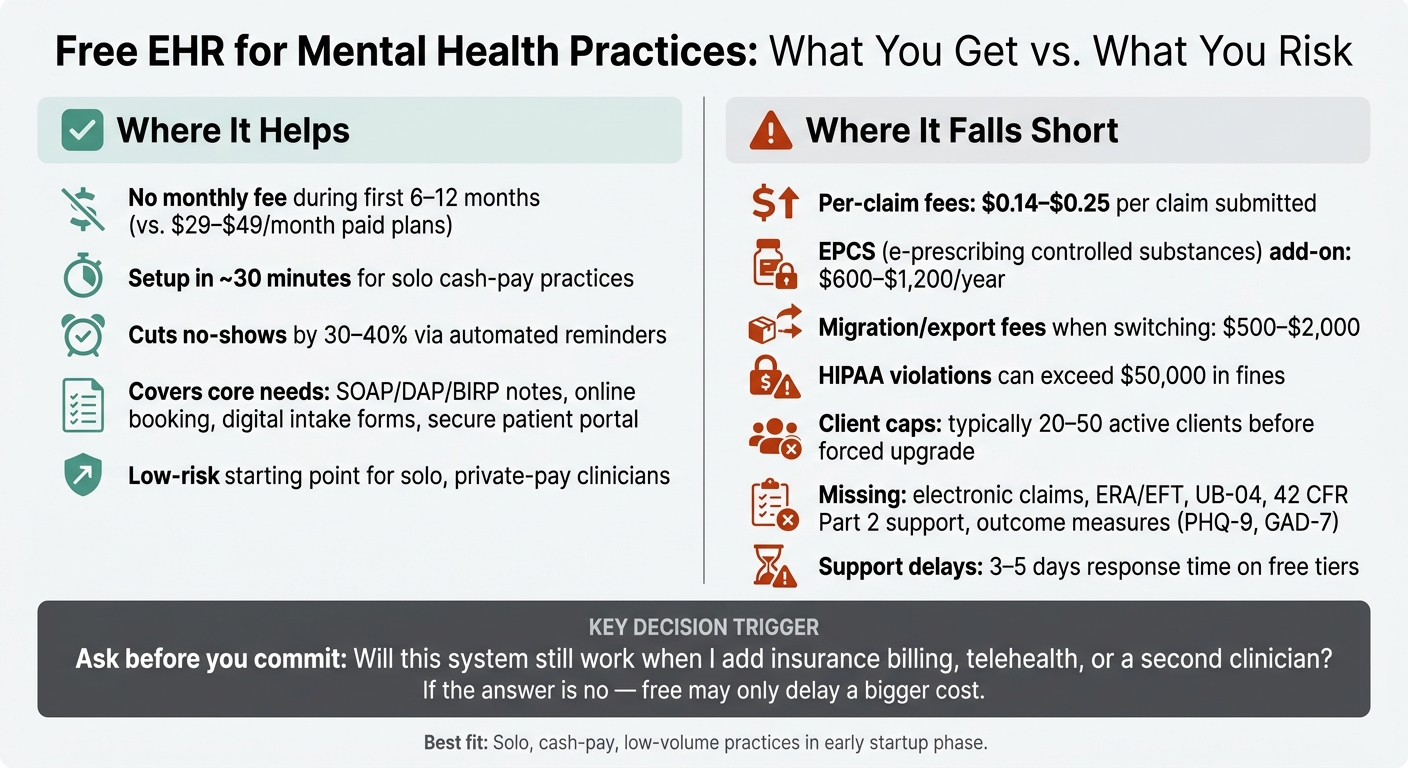
Free EHR for Mental Health: Pros, Cons & Hidden Costs at a Glance
Quick Comparison
|
Area |
Free EHR: Where It Helps |
Free EHR: Where It Falls Short |
|---|---|---|
|
Startup cost |
No monthly fee upfront |
Hidden costs can show up later |
|
Documentation |
Basic SOAP, DAP, or BIRP notes |
Limited custom templates |
|
Scheduling |
Online booking and reminders |
Some tools may sit behind paid plans |
|
Telehealth |
Sometimes included |
Often limited or sold separately |
|
Billing |
Fine for cash-pay or superbills |
Claims, ERA/EFT, and UB-04 may be missing |
|
E-prescribing |
May cover basic needs for some practices |
EPCS is often extra, around $600 to $1,200/year |
|
Compliance |
Can support HIPAA-aligned use |
BAA, audit logs, and Part 2 support may be weak |
|
Growth |
Good for solo, low-volume use |
Client caps, single-user limits, and forced upgrades |
Bottom line: Treat a free EHR as a short-term option, not an automatic long-term fix. The right choice depends less on the $0 sticker and more on whether the platform fits your daily work without adding extra admin, billing problems, or compliance risk.
The Pros of Using a Free EHR for Mental Health
Lower Upfront Cost and Faster Startup
For a solo therapist or counselor just getting started, skipping a $29–$49/month software fee can make a difference.
A free EHR cuts that recurring cost while still supporting HIPAA-aligned workflows from day one. That matters when you need to get your practice up and running without adding fixed overhead.
In many cases, a basic free account can be set up in about 30 minutes once your services, availability, and note templates are in place. On paper, Google Docs or spreadsheets can look like the cheaper route. But the hidden cost shows up later: manual scheduling, missed invoices, no-shows, and hours spent entering data by hand.
Core Features That Work for Simple Workflows
Free EHR plans aren't just empty starter accounts. For a therapist running a simple cash-pay practice, the core tools often handle most day-to-day work.
The table below shows how common free-tier features connect to everyday tasks:
|
Free EHR Feature |
Everyday Task It Supports |
|---|---|
|
Online booking page |
Clients self-schedule 24/7 and cut down on phone tag |
|
Automated SMS/email reminders |
Cuts no-show rates by 30–40% [4] and protects billable hours |
|
SOAP/DAP/BIRP note templates |
Keeps documentation standardized and records in order |
|
Digital intake forms |
Lets clients fill out paperwork before the first session |
|
Secure patient portal |
Supports HIPAA-compliant messaging and document sharing |
Mental health providers spend an average of 37% of their working hours on clinical documentation [7]. Built-in behavioral health templates won't make that work disappear. But they can cut the time spent formatting notes and keeping records organized by hand.
A Short-Term Option for New or Very Small Teams
Free tiers usually make the most sense for solo clinicians and very small teams with simple cash-pay workflows. Some plans also let you move to a paid version without rebuilding your records from scratch. That gives you a low-risk way to start, with a smoother path if your practice grows.
That setup works well only as long as your workflow stays simple. Once billing, reporting, or custom setup becomes a bigger part of the job, the limits tend to show up fast.
The Cons of Using a Free EHR for Mental Health
Gaps in Behavioral Health Workflows
Free EHRs tend to center on general medical use. That sounds fine at first, but in mental health practice, the cracks show up fast.
Therapists, psychiatrists, and psych NPs often need built-in support for treatment plans, psych-focused notes, e-prescribing, and telehealth. Free plans often offer only part of that, or lock key tools behind paid upgrades [1][2].
The practical issue is simple: can a free EHR handle intake, notes, claims, and compliance without slowing down care? In many cases, the answer is shaky.
E-prescribing is a good example. DEA-compliant electronic prescribing for controlled substances, or EPCS, is often missing from free plans. When it is sold as an add-on, the cost can run $600–$1,200 per year [2]. For psychiatrists and psychiatric nurse practitioners, that’s not a small gap. It can interrupt medication workflows and push staff into extra steps they don’t have time for.
Those weak spots usually hit hardest once billing and reporting enter the picture.
Billing, Reporting, and Customization Limits
Billing is one of the biggest pain points with free tiers. Many don’t include electronic claims or ERA/EFT posting, which means more manual billing work for staff [1][2][4]. That extra admin work can lead to mistakes, slower payment cycles, and more denied claims.
Some free plans also tack on $0.14–$0.25 per claim submitted [6]. That may not look like much on paper, but in an insurance-heavy practice, those charges can pile up fast. And some systems only support CMS-1500 claims, which blocks billing for IOP, PHP, or residential services [8].
Reporting can be just as limited. Without stronger reporting tools, it becomes much harder to monitor balances, denials, and lost revenue [2][3]. You’re left trying to run a business with only part of the dashboard working.
Customization is another common snag. Free plans often limit custom forms and advanced note templates, which can trap clinicians in stiff workflows that don’t match the way behavioral health care is delivered [1][3][6]. That can slow documentation and make everyday charting more frustrating than it needs to be.
The table below shows how common free-plan limits can affect a practice:
|
Drawback in Free EHR |
Likely Business Impact |
|---|---|
|
Forced migration once client volume grows |
|
|
No insurance claims or ERA/EFT |
Manual billing errors, delayed payments, higher denial rates [4] |
|
Per-claim fees ($0.14–$0.25) |
Unexpected costs that scale with practice volume [6] |
|
No UB-04 support |
Can't bill for IOP, PHP, or residential programs [8] |
|
Limited reporting |
No visibility into revenue cycle or clinician productivity [2][3] |
|
Rigid note templates |
Slower documentation and a poorer fit for specialized behavioral health workflows [1][6] |
Once billing turns manual, support and compliance stop being side issues. They become daily operational problems.
Support, Security, and HIPAA Concerns
Free plans often come with email-only support, and response times can stretch to 3–5 days [2]. In a busy practice, that’s a long time to wait when staff can’t access records, fix claim issues, or deal with a broken workflow.
Security is the bigger issue. Any platform that handles protected health information (PHI) should offer a signed Business Associate Agreement (BAA). Some free or consumer-grade tools don’t. If that’s missing, the practice may carry extra liability if there’s a vendor-side security problem. HIPAA fines can exceed $50,000 [3].
For substance use treatment, the bar is even higher. Practices also need to deal with 42 CFR Part 2, which requires confidentiality controls that go beyond standard HIPAA rules [5]. In other words, “HIPAA-ready” may still not be enough.
Data ownership can create one more trap. Export fees of $500 to $2,000 can make switching systems expensive [3][2]. Add that to compliance risk and support delays, and the “free” plan may stop looking cheap pretty fast.
Use these limits as a gut check for your daily workflow.
How to Decide if a Free EHR Fits Your Practice
Questions to Ask Before Choosing a Free Platform
Before you sign up for a free EHR, map out the workflows your practice uses every day. That’s the quickest way to see if the system handles the basics out of the box or if your team will be patching holes by hand. A free plan can look good at first glance, but if it forces extra steps, the “savings” can disappear fast.
Start with documentation. Does the platform support the note formats you already use, like SOAP, DAP, or BIRP? Can you tweak templates so they match your clinical style, whether that’s CBT, EMDR, or something else? Then look at the client side. Is the intake portal simple to use on a phone? Can clients fill out forms before the first session, or will staff still need to type everything in later?
It also helps to ask a few direct, practical questions before you commit:
Telehealth: Is it built in, or does it need a separate login and manual session linking?
E-prescribing: Is EPCS part of the plan, or is it an add-on? If it costs extra, how much?
Claims: Can the system send electronic claims, or are you stuck with superbills and manual invoices?
Staff access: Can more than one clinician use it with role-based permissions, or is it just for a solo provider?
Data portability: Can you export notes, treatment plans, and billing data in a structured format at no charge?If reminders, intake, or billing live outside the EHR, your staff will feel that drag almost right away.
Signs You Will Outgrow a Free EHR Quickly
Free plans tend to work best for solo providers with light caseloads. Once a practice starts growing, the weak spots show up pretty quickly. A simple way to test the fit is to ask: What’s the first workflow that breaks?
|
Growth Trigger |
Why It Breaks a Free Plan |
|---|---|
|
Adding a second clinician |
Most free tiers are single-provider only; adding staff usually requires a paid upgrade [9][2] |
|
Credentialing with insurance |
ERA/EOB processing and claim tracking are rarely included in free versions [9][10] |
|
Hitting client volume caps |
Free plans often cap active clients at 20–50; reaching that limit forces an upgrade [2][4] |
|
Needing outcome measures |
Free plans often don't support outcome measures like PHQ-9 or GAD-7 that populate the chart [10] |
|
Managing prior authorizations |
Free systems almost never include prior authorization workflows or payer-specific tracking [5][4] |
|
Opening a second location |
Multiple clinicians across sites require reporting capabilities that free plans don't offer [3] |
|
Prescribing controlled substances |
EPCS is usually a premium add-on, not a free-tier feature [2] |
If your practice already checks off several of these growth triggers, it’s less about saving money now and more about how soon you’ll have to switch systems.
Conclusion: Free EHR Can Lower Cost, but Fit and Risk Matter More
After you look at features, billing, support, and compliance, this choice comes down to fit. A free EHR can make sense as a short-term starting point for a solo, private-pay practice.
But once you add insurance billing, telehealth, or more staff, the math changes fast. At that point, many free plans stop fitting the way the practice actually runs.
The money you save up front can disappear if the system adds friction, extra manual tasks, or more compliance risk.
And compliance brings its own hidden workload. In many free or open-source setups, the clinician has to handle secure hosting, backups, and encryption. One HIPAA mistake can lead to fines above $50,000 [9][3].
That kind of risk won't show up on a simple feature list.
The key point is simple: the real question isn't just what costs less today. It's what your practice can run safely and grow with, without chaos later.
Look at your caseload, insurance billing needs, telehealth setup, e-prescribing workflow, and staff access before you commit. Pick the system that matches how your practice works now and where it's headed next, not just the lowest monthly price.
FAQs
When does a free EHR stop making financial sense?
A free EHR stops making financial sense when the time, setup, upkeep, and hidden costs - like hosting, support, and missing features - end up costing more than a paid system.
In many cases, total yearly costs can land at $1,700 to $3,400 or more.
What should I verify before trusting a free EHR with PHI?
Check that the free EHR provider encrypts data at rest and in transit, provides a clear Business Associate Agreement (BAA), and uses secure hosting and sound data management practices.
You should also confirm role-based access controls and detailed audit logs to help protect PHI.
How hard is it to switch from a free EHR later?
Switching away from a free EHR later can get expensive fast. For small practices, the move may cost $5,000 to $25,000 and take 2 to 4 months. That usually includes data migration, downtime, and staff retraining.
There’s often more to it, too. You may need to export and import patient data, run both systems at the same time for a while, and pay data export fees.
So yes, switching is possible. But in practice, it can bring a lot of time, cost, and disruption for a small team.



- Behavioral Health
- EHR Systems
- Addiction Treatment EHR
- mental health
- Telehealth
- addiction treatment
- Behavioral health facility
- Substance Abuse Disorder
- behavioral Health center
- HIPPA Compliant
- ehrsoftware
- PTSD
- behavioral health ehr
- Depression
- hipaa
- Anxiety
- MentalHealthMatters
- RCM
- claim denials
- clinical documentation
- mental health awareness
- screening tools

September 15, 2026

September 15, 2026

September 14, 2026

September 11, 2026

September 10, 2026

September 09, 2026
Recommended Posts

Tuesday, June 30, 2026
Save Thousands With These Mental Health EHR Features
A mental health EHR can cut costs in four main places: charting time, no-shows, claim denials, and unpaid patient ...
Friday, February 11, 2022
Top Considerations for Behavioral Health Treatment Centers When Switching EHR Systems
The world is cautiously beginning to open again after the Covid-19 shelter-in-place orders are lifted. While it’s ...

Monday, June 22, 2026
Signs Your Mental Health EHR Has Aged Out
Outdated EHR systems can hurt your practice more than you think. If your system slows down workflows, struggles with ...