

Choosing the right EHR system for mental health practices is critical.
The wrong choice can lead to billing issues, compliance challenges, and clinician burnout.
This article evaluates two prominent systems - Opus Behavioral Health EHR and alternatives like SimplePractice, TherapyNotes, and others - based on their features, usability, and pricing.
Key Insights:
Opus Behavioral Health EHR: Combines clinical documentation, billing, and patient management in one platform. Features include customizable tools, telehealth integration, and AI-powered documentation, but users report customer support delays and a steep learning curve.
Alternative Systems: Platforms like SimplePractice and TherapyNotes focus on usability and telehealth, with pricing starting as low as $29/month. Features include DSM-5 templates, role-based access, and remote patient monitoring.
Quick Comparison:
|
Criteria |
Opus Behavioral Health EHR |
Alternatives (e.g., SimplePractice) |
|---|---|---|
|
Customizability |
100+ tools, flexible workflows |
DSM-5 templates, role-based access |
|
Telehealth Integration |
One-click SMS links, group sessions |
Built-in, HIPAA-compliant options |
|
AI Tools |
Reduces documentation time by 40% |
Limited or additional cost |
|
Pricing |
Free tier; AI add-on $119/month |
$29-$99/month per clinician |
|
Support |
Reported delays (2+ weeks) |
Generally faster response times |
Selecting the right EHR depends on your practice size, needs, and budget.
Opus suits mid-size centers, while alternatives may be better for solo or smaller practices. Evaluate features, test demos, and consider total costs before committing.
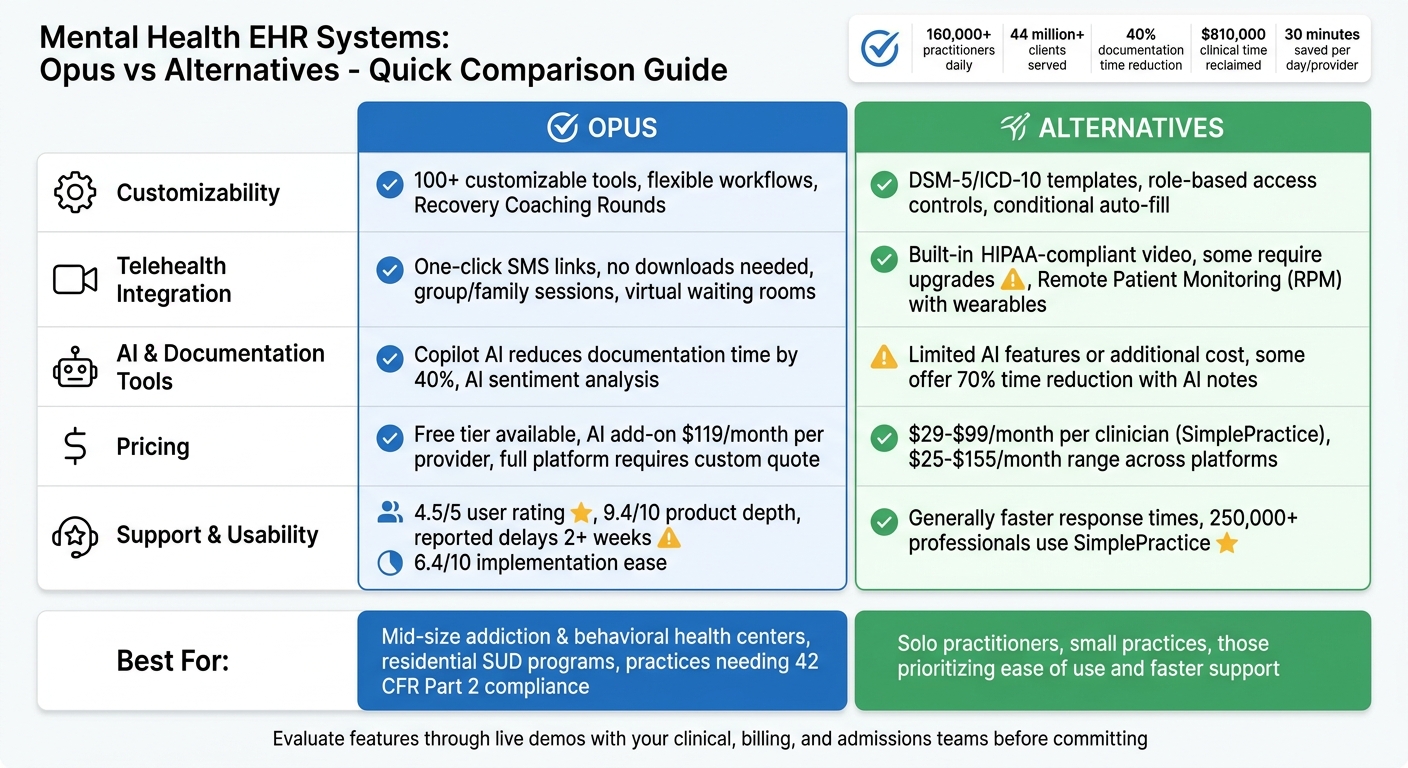
Opus vs Alternative Mental Health EHR Systems: Feature and Pricing Comparison
The Best Psychiatry EHR for your Mental Health Practice
1. Opus Behavioral Health EHR
Opus Behavioral Health EHR simplifies practice management by bringing clinical documentation, patient management tools, and billing together in one platform. This integration tackles a common issue in behavioral health - juggling multiple processes across disconnected systems.
With over 160,000 practitioners using it daily and more than 44 million clients served[10], Opus demonstrates its ability to handle large-scale demands while offering tailored features.
Customizability
Opus is designed to fit various practice models, giving providers the flexibility to mold the system to their specific needs.
Jennifer Gozy, PsyD, LP, Director of Clinical Systems and Compliance at Care Counseling Clinics, shares:
"We chose Opus because it is user-friendly and highly configurable. We are looking forward to designing a system that meets our agency's unique needs"[6].
The platform includes over 100 customizable assessment tools, such as AUDIT, DAST, and the Columbia Suicide Severity Rating Scale[5][2].
For residential substance use disorder programs, the Recovery Coaching Rounds feature allows staff to log observations and monitor patient progress across shifts[2]. Additionally, the telehealth module supports flexible care delivery with remote treatment options.
Telehealth Integration
Opus makes telehealth accessible by eliminating technical hurdles. Patients can join sessions via a single-click SMS link, avoiding the need for app downloads or logins[7].
This feature supports individual, group, and family therapy sessions, complete with virtual waiting rooms[7].
Andrea Baskin, Clinical Director, highlights its impact:
"The ability to run groups online has enabled us to create a digital IOP program, with flexible after hours for our clients. We don't have to worry about transportation logistics, office hours, or staff availability"[9].
Telehealth sessions follow the same documentation workflow as in-person visits, and the platform automatically organizes telehealth-specific CPT codes for accurate billing.
Outcomes Tracking
Opus empowers practices to track and improve patient outcomes. Its visual progress tracking module creates graphs from standardized assessments like PHQ-9 and GAD-7, seamlessly linking them to treatment plans.
The platform also uses AI sentiment analysis to evaluate emotions in text and speech, helping predict outcomes and identify mental health risks early.
Judd Carey, Director of Operations at Mindful Health, notes:
"By automating the quality of internal data, and applying an algorithm, it will cut back on errors to not miss a thing, especially from group sessions"[10].
Real-time dashboards and alerts further assist clinicians in responding quickly to critical changes in patient conditions.
Revenue Cycle Management
Opus connects clinical documentation with billing workflows to enhance billing accuracy and speed. Dara Scott, VP of Operations at Mindful Health, shares:
"We now have standardized scheduling with Opus EHR"[6].
The Copilot AI tool included in the platform reduces clinical documentation time by up to 40%[6][2], which also helps improve billing efficiency.
Opus has a 4.5/5 user rating and a 7.2/10 composite score on EHR Source[2]. However, some users have reported delays in customer support, sometimes exceeding two weeks[2], and others have found the scheduling system challenging for complex setups[8].
Pricing includes a free tier for basic scheduling and billing, with full platform access available via custom quotes. The Copilot AI add-on is priced at $119 per month per provider[2][8].
2. Alternative Mental Health EHR
When considering alternative mental health EHR systems, it's crucial to look for platforms that cater specifically to behavioral health needs while remaining user-friendly.
The ideal system should align with your practice model - whether you're a solo therapist, part of a residential treatment center, or managing multiple locations. Features like template customization, billing efficiency, and telehealth integration are key to streamlining daily operations.
Customizability
Customization plays a big role in creating efficient workflows for mental health care. The best systems include DSM-5 and ICD-10 compliant templates designed for therapy, psychiatry, and group sessions[3].
Some advanced platforms even offer conditional templates that auto-fill fields based on logic[3]. Role-based access controls are another must-have, ensuring sensitive therapy notes remain secure by limiting access based on staff roles - keeping administrative and clinical documentation separate[12].
At the same time, these systems should strike a balance between flexibility and compliance safeguards to avoid issues with audits or regulations[11]. If prescribing medication, make sure the system supports EPCS (Electronic Prescribing for Controlled Substances) and integrates with PDMP workflows[11].
Telehealth Integration
Look for EHR platforms with built-in, HIPAA-compliant telehealth features. Systems like SimplePractice and Pabau allow for one-click video sessions directly within the platform[3][13].
Others, such as TherapyNotes, may require additional upgrades for telehealth functionality[1][13]. Platforms like OmniMD go a step further, using wearable devices for Remote Patient Monitoring (RPM) to track patient mood, sleep, and anxiety trends[3].
Some modern systems even incorporate AI to convert session recordings into structured progress notes (e.g., DAP or SOAP formats), potentially cutting documentation time by up to 70%[3]. As of 2026, SimplePractice serves over 250,000 health and wellness professionals[13], highlighting the growing importance of integrated telehealth tools.
Outcomes Tracking
A good EHR system should include dashboards that display real-time, long-term treatment progress[3]. Some platforms pair this with Remote Patient Monitoring, which uses wearable devices to track mood and anxiety levels[3].
This kind of measurement-based care not only helps demonstrate treatment success to payers but also meets patient expectations - 38% of patients surveyed in 2025 expressed a desire for easier ways to stay in touch with their healthcare providers[12].
Revenue Cycle Management
For smoother operations, billing and clinical documentation should use a single unified database. This reduces manual data entry, speeds up revenue cycles, and minimizes claim denials[1].
Look for systems that offer features like real-time insurance eligibility checks, automated superbills, claims scrubbing, denial management, per-diem billing, utilization review tracking, and compliance with 42 CFR Part 2[1][3][4].
By bridging billing with clinical functions, these tools enhance both financial and operational efficiency.
For example, in 2025, Balance Point Wellness - a mental health practice with six offices in Maryland and over 90 providers - switched to Tebra's EHR+ platform.
Within weeks, they processed 1,000 intakes and 600 claims, cutting note-writing time by 30 minutes per day for each provider. This change reclaimed an estimated $810,000 worth of clinical time[14]. CFO Brandi Tanasescu explained:
"Mental health providers were spending time managing systems when they could have been focusing on care"[14].
Pricing
Pricing for alternative EHR systems can vary significantly. For instance:
Vozo EHR: $25/month (Basic) to $60/month (Premium)[4]
SimplePractice: $29 to $99/month per clinician[1]
TherapyNotes: Around $59/month for solo practitioners[1]
ICANotes: $75 to $155/month per user[1]
When evaluating costs, factor in implementation fees, clearinghouse charges, and any additional module expenses to get a clear picture of total ownership costs[1][11].
Advantages and Disadvantages
Opus Behavioral Health EHR offers a mix of strengths and challenges, particularly for mid-size addiction and behavioral health centers. Let’s break down the key benefits and areas where the platform falls short.
Strengths focus on its all-in-one design, combining CRM, EHR, and RCM systems seamlessly. This integration connects admissions, clinical documentation, and billing processes, simplifying operations.
Features like Recovery Coaching Rounds digitize residential program logs, eliminating paper-based tracking. Additionally, the Copilot AI tool can cut documentation time by up to 40%[2][5], and the system includes over 100 customizable assessment tools, such as ASAM criteria, PHQ-9, and GAD-7[2][5].
Dr. Jennifer Williams, a mental health practice owner, highlighted the impact of these tools:
"Since implementing Opus EHR, our providers spend 35% less time on documentation while capturing more comprehensive clinical data"[5].
Despite these advantages, the platform has some drawbacks.
Weaknesses include delays in customer support, with some issues reportedly taking over two weeks to resolve. The lack of native ERP tools for property management, HR, and bed tracking means residential facilities may need additional software[8].
Moreover, the AI add-on comes with an extra cost of $119 per month per provider[8]. Finally, the platform's extensive features contribute to a steep learning curve, reflected in a 6.4/10 score for implementation ease[2].
Here’s a quick summary of the pros and cons:
|
Aspect |
Opus EHR Strengths |
Opus EHR Limitations |
|---|---|---|
|
Architecture |
Unified CRM, EHR, and RCM in one platform |
Lacks built-in ERP (HR, property management) |
|
Clinical Tools |
Recovery Coaching Rounds; 100+ assessments; 42 CFR Part 2 compliance |
Scheduling can be difficult for complex programs |
|
AI Documentation |
Copilot AI reduces documentation time by 40% |
Costs an additional $119/month per provider |
|
Support |
24/7 support button available |
Reported delays of over two weeks for resolutions |
|
Pricing |
Complimentary user tier available |
Full platform requires a custom quote |
User feedback gives Opus Behavioral Health EHR a 4.5/5 rating, with a 9.4/10 score for product depth, showcasing its robust features.
However, its 6.1/10 economic value rating indicates that total ownership costs might be a concern. For organizations prioritizing SUD workflows and integrated billing, the platform delivers clear benefits. That said, those needing advanced ERP features or faster support should weigh these limitations carefully.
These factors demonstrate how Opus Behavioral Health EHR impacts clinical and operational workflows, offering both efficiencies and challenges.
Conclusion
Choosing an EHR that fits your practice's specific needs is crucial. Opus Behavioral Health EHR caters to mid-size addiction and behavioral health centers, offering an integrated platform that combines CRM, clinical documentation, and billing workflows.
Features like Recovery Coaching Rounds and compliance with 42 CFR Part 2 make it particularly suitable for residential substance use disorder programs.
Additionally, the Copilot AI tool can ease documentation workloads, though its added monthly cost warrants a careful budget review. These points highlight the system's strengths while emphasizing areas to evaluate during the selection process.
Involve your clinical, billing, and admissions teams in live demos, using realistic scenarios to assess the system's performance. This hands-on approach can reveal trade-offs, such as balancing detailed documentation with billing efficiency, that might not surface in standard vendor presentations. It's also critical to request live demonstrations of claim submissions,
especially if your practice frequently uses codes for intensive outpatient or partial hospitalization services.
The system's implementation ease score of 6.4/10 reflects a learning curve, so budgeting around 20 hours for staff training during rollout can help achieve a 40% productivity boost [15]. To minimize risk, test the free tier for scheduling and billing features before committing fully.
Support responsiveness is another key factor. With reported support delays, it's wise to establish service level agreements and test vendor responsiveness during the trial period. While the platform's 4.5/5 user rating and 9.4/10 product depth score highlight its strong clinical functionality, overall costs should be weighed carefully.
For residential substance use disorder programs, Opus Behavioral Health EHR offers specialized tools that streamline workflows where general medical systems might fall short.
However, if your facility also needs integrated property management, HR, or staff scheduling features, additional software might be required. These insights can help your practice select an EHR that improves patient care and operational efficiency.
FAQs
How do I know if Opus is the right fit for my practice size?
Opus caters to outpatient mental health and substance use treatment providers, whether you're running a small practice or managing a larger organization.
It includes features like behavioral health-focused workflows, integrated scheduling, billing tools, and customizable forms to meet diverse practice needs.
For larger practices or those with multiple locations, Opus offers expanded capabilities to support growth. Reach out to the provider to learn more about features tailored to your practice's specific size and future plans.
What should I test in a live demo before signing a contract?
When trying out a live demo of Opus Behavioral Health EHR, it's important to zero in on the features that directly affect your workflow and patient care.
Start by testing clinical documentation - check how efficient and customizable it is for your practice. Explore the telehealth functionality to see if it integrates smoothly into your operations. Dive into billing processes, especially claim submissions, to ensure they are straightforward and reliable.
Also, take a close look at the user interface - is it intuitive and easy to navigate? Test the reporting tools to see if they provide meaningful insights that can guide decisions. Lastly, assess the customer support - how responsive and helpful are they?
These aspects are key to deciding if the system aligns with your practice's needs.
What hidden costs should I budget for beyond the monthly fee?
When budgeting for software, it's not just about the monthly fee. You also need to consider hidden costs that can sneak up on you.
These might include:
Implementation and training: Setting up the system and training your team to use it effectively.
Ongoing technical support: Costs for maintenance or resolving issues as they arise.
Customization: Tailoring the software to fit your specific needs.
Data migration: Transferring your existing data into the new system.
Compliance-related expenses: Ensuring the software meets industry regulations or standards.These additional expenses can have a big impact on the total cost of ownership, so it’s important to factor them into your budget from the start.



- Behavioral Health
- EHR Systems
- Addiction Treatment EHR
- mental health
- Telehealth
- addiction treatment
- Behavioral health facility
- Substance Abuse Disorder
- behavioral Health center
- HIPPA Compliant
- ehrsoftware
- PTSD
- behavioral health ehr
- Depression
- hipaa
- Anxiety
- MentalHealthMatters
- RCM
- claim denials
- clinical documentation
- mental health awareness
- screening tools

September 15, 2026

September 15, 2026

September 14, 2026

September 11, 2026

September 10, 2026

September 09, 2026
Recommended Posts

Sunday, April 12, 2026
Comparing the Best EMR for Behavioral Health for Small Clinics
Choosing the right EMR for a small behavioral health clinic can save time, reduce costs, and improve patient care.

Thursday, June 11, 2026
Best Mental Health EHR for Small Practices
Finding the right EHR for your small mental health practice is critical to saving time, reducing administrative ...

Tuesday, June 09, 2026
EHR Mental Health Platforms That Reduce Admin Burden
Behavioral health providers spend 37% of their time on administrative tasks like documentation, cutting into patient ...