

AI is reshaping how behavioral health providers manage payer communication, tackling time-consuming tasks like eligibility checks, prior authorizations, and denial management.
By automating repetitive processes, it reduces errors, speeds up workflows, and improves revenue recovery.
Here's what you need to know:
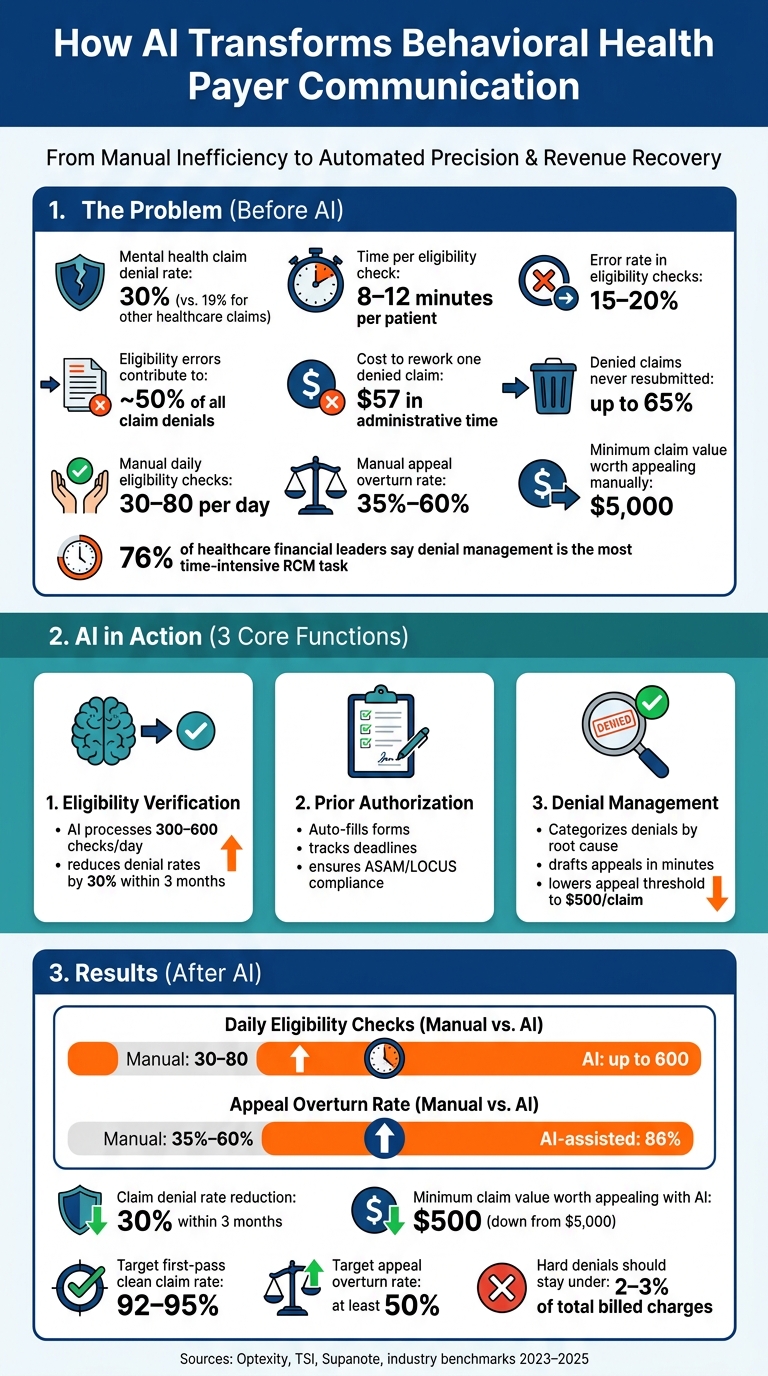
Eligibility Verification: AI can process 300–600 checks daily, flagging issues like inactive coverage and cutting claim denial rates by 30%.
Prior Authorizations: Automates form submissions, tracks deadlines, and ensures compliance with payer-specific requirements.
Denial Management: AI categorizes denials, drafts appeals in minutes using clinical data, and improves overturn rates from 35%-60% to 86%.Behavioral health billing is uniquely complex, with high denial rates and payer-specific rules. AI tools integrated into platforms like Opus Behavioral Health EHR streamline these workflows, saving time and protecting revenue. Providers must ensure clean data, clear processes, and compliance protocols to maximize AI's benefits.
AI in Behavioral Health Billing: Key Stats & Impact
How Payer Communication Works Today
Key Steps in Payer Communication
The process of payer communication in behavioral health follows a structured sequence, but each step comes with its own set of challenges. It begins with verifying insurance coverage and benefits, followed by securing prior authorization.
Clinicians then document services, capture charges, and assign codes - often based on time or per diem rates. Once this is done, claims move to the back end for scrubbing, submission, and adjudication.
The real complexity lies in the steps in between. Behavioral health requires ongoing concurrent utilization reviews, which means treatment authorizations must be renewed frequently. These authorizations are typically limited to a set number of days and require timely clinical updates to extend them.
For example, when a patient transitions from residential care to a Partial Hospitalization Program (PHP) or Intensive Outpatient Program (IOP), the process starts over. New authorizations must be secured, complete with updated codes and clinical justifications [7]. If there are gaps in communication or enrollment, it can lead to denials like CO-B7 - "provider not certified" - even when the services rendered are appropriate [7].
Despite having a clear process, inefficiencies and fragmented systems make payer communication especially challenging.
Common Pain Points
One of the biggest hurdles is managing multiple payer portals. Behavioral health providers often deal with portals from commercial insurers, Managed Behavioral Health Organizations (MBHOs) like Optum, Carelon, Magellan, and Lucet, as well as state Medicaid programs - all for the same patient [3].
Each portal has its own login credentials, unique authorization rules, and quirks. This can result in providers spending over 10 minutes per patient just to verify coverage [5].
Another issue is the evolving nature of denials. Instead of simply stating "service not covered", payers increasingly cite "medical necessity not established", which shifts the focus to the quality of the clinical narrative. This type of denial is much harder to dispute [6].
In 2023, mental health claims faced a denial rate of 30%, compared to 19% for other healthcare claims. Additionally, 76% of healthcare financial leaders identified denial management as the most time-intensive revenue cycle task [8].
"A note missing one payer-required element can lead to reimbursement clawbacks." - Supanote [1]
The financial impact of these challenges is considerable. For instance, reworking a single denied claim costs an estimated $57 in administrative time. Worse yet, up to 65% of denied claims are never resubmitted, resulting in significant revenue loss [8].
To address these issues effectively, a strong data foundation is essential before implementing AI solutions.
What You Need Before Adding AI
AI's effectiveness depends entirely on the quality of the data and processes it interacts with. If your intake data is inconsistent, documentation templates lack structure, or workflows are unclear, AI could end up worsening the problem rather than solving it.
It's crucial to ensure every stage of the process is solidified to maximize AI's potential.
Table: Foundational Requirements for AI Integration
|
RCM Stage |
Foundational Requirement |
Why It Matters |
|---|---|---|
|
Front End |
Accurate intake data, VOB within 24 hours, carve-out identification |
Prevents eligibility errors and out-of-network rejections |
|
Clinical Bridge |
Documentation aligned with ASAM, LOCUS, or InterQual criteria |
Provides AI with structured input to detect gaps |
|
Back End |
Denial tracking by CARC/RARC codes, categorized by payer and CPT |
Supplies root-cause data for AI-driven appeal drafting |
In addition to clean data, you’ll need a signed Business Associate Agreement (BAA) with any AI vendor, along with HIPAA-compliant data handling protocols. Finally, human review checkpoints are essential to ensure AI-generated clinical content is verified by a clinician before submission [1].
What AI Does in Payer Communication
AI takes on three of the most time-intensive tasks in payer communication: eligibility verification, prior authorization, and denial management.
Automating Eligibility and Benefits Verification
On average, eligibility checks take 8–12 minutes per patient, with errors occurring in 15–20% of cases. These mistakes contribute to nearly half of all claim denials [11].
AI simplifies this process by querying payers using X12 270/271 standards. It extracts details like copays, deductibles, and coverage information, then updates the patient’s chart automatically - removing the need for manual data entry [11]. If it detects issues like inactive coverage or COB conflicts, the system flags the case for staff review and provides a concise summary [10].
This automation boosts efficiency significantly, increasing daily checks from 30–80 manually to 300–600 with AI [10]. Organizations using AI for eligibility verification have seen their claim denial rates drop by 30% within three months [10].
"When payers can deny claims in seconds using automated systems, your organization needs to verify eligibility and submit prior authorizations with the same speed and accuracy." - Optexity Team [5]
AI's role doesn’t stop there - it also transforms how prior authorizations are handled.
Simplifying Prior Authorization
AI takes the hassle out of prior authorization by auto-filling forms and attaching clinical documentation directly from the EHR [5]. For payers without API connections, such as certain state Medicaid portals, browser-native automation mimics the actions of a staff member, sidestepping the need for custom integrations [5].
Beyond submission, AI tracks expiration dates and concurrent review deadlines, notifying staff before potential gaps lead to denials. It also ensures documentation meets payer-specific guidelines, such as ASAM standards for substance use disorder or LOCUS criteria for mental health, before claims are submitted [3].
Platforms like Opus Behavioral Health EHR are integrating AI directly into revenue cycle management, allowing authorization tasks to happen seamlessly within the system clinicians already use.
"Integrating XY AI's agents directly inside Opus allows our customers to automate the work that has been holding them back and double down on what they do best." - Humberto Buniotto, CEO and Founder, Opus [12]
Improving Denial Management and Appeals
AI doesn’t just help prevent denials - it also improves how they’re managed. When a claim is denied, AI uses Intelligent Document Processing (IDP) to extract denial reason codes from remittance advice and Explanation of Benefits (EOB) documents [13].
It categorizes the denial by root cause - whether it’s a medical necessity issue, a prior authorization lapse, or a coding error - and prioritizes the denial based on financial impact and the likelihood of successful resolution [13].
Instead of spending hours drafting appeal letters, AI generates payer-specific appeals in minutes by pulling in progress notes, treatment plans, and assessments.
This efficiency drives an 86% success rate for overturning denials with AI-assisted appeals, compared to the industry’s manual baseline of 35%–60% [13]. AI also makes it cost-effective to contest smaller claims, reducing the threshold from $5,000 to $500 per claim [13].
Over time, the system learns which arguments and documentation are most effective with specific payers, improving outcomes even further [13].
"If AI can draft an appeal in minutes that previously took a specialist hours, more claims become worth pursuing." - TSI [13]
Putting AI to Work in Behavioral Health Organizations
Connecting AI to Your Existing Systems
AI has proven its value in automating repetitive tasks, but the real game-changer is how seamlessly it can integrate into your existing systems. This ensures smooth operations without unnecessary disruptions or the need for extensive retraining.
Take Opus Behavioral Health EHR, for instance. It combines EHR, CRM, and RCM functionalities into one platform, streamlining processes like clinical documentation and billing. This integration eliminates manual handoffs, reducing the risk of claim denials [4].
Through its collaboration with XY.AI Labs, Opus embeds AI agents directly into its platform. These agents work efficiently with payers using API connections and even accommodate systems without API support, such as certain state Medicaid programs [12].
"Our agents are built specifically for the complexity of healthcare workflows - not retrofitted from generic tools." - Lamara De Brouwer, Co-Founder and CTO, XY.AI Labs [12]
By embedding AI into familiar workflows, staff can continue using systems they’re accustomed to while AI takes over high-volume tasks like claims management, prior authorizations, and payment posting. No custom development is necessary [12].
Updating Staff Roles and Training
When AI takes over repetitive tasks - like data entry, eligibility checks, and authorization submissions - staff roles shift rather than disappear. The focus moves toward managing exceptions, reviewing AI-generated outputs, and addressing cases that require clinical expertise.
For example, physicians can reclaim hours previously spent on prior authorizations, redirecting that time to patient care or advanced case reviews.
However, effective training is essential. Staff need to understand how to interpret AI alerts, identify when a case should be escalated, and ensure AI-generated documentation aligns with actual clinical observations.
"Generic AI language can undermine credibility in appeals and audits. Never let AI introduce clinical facts that were not assessed or observed." - Supanote.ai [1]
Here’s how AI can reshape staff roles across the revenue cycle:
|
RCM Stage |
AI Enhancement |
Staff Role Shift |
|---|---|---|
|
Front End |
Eligibility & Auth verification |
Verifying AI flags for coverage changes |
|
Mid-Cycle |
Documentation gap detection |
Reviewing AI prompts for medical necessity |
|
Back End |
Denial triage & appeal drafting |
Finalizing evidence-mapped appeal "proof packets" |
While roles evolve, maintaining regulatory compliance and accuracy remains a top priority.
Staying Compliant and Managing Risk
AI doesn’t reduce compliance responsibilities - it changes how you approach them.
Monitoring audit trails and safeguarding data become critical. Before deploying any AI tool that accesses patient information, ensure the vendor signs a Business Associate Agreement (BAA) and limits data sharing to what’s absolutely necessary [1].
Audit trails are non-negotiable. Your AI system must log its suggestions, track what staff accept, and document any edits made. This ensures transparency for HIPAA compliance and payer audits [1]. With increased scrutiny from HHS-OIG on managed-care prior authorization denials and telehealth documentation, having detailed records is more important than ever [2].
In behavioral health, AI can also help identify if payers are unfairly applying stricter medical necessity criteria to behavioral health claims compared to similar medical services. This could signal a violation of the Mental Health Parity and Addiction Equity Act (MHPAEA) [14].
To stay ahead, map out your top 10 services by prior authorization volume and check each payer’s electronic prior authorization (ePA) pathway against CMS milestones. With payers required to implement ePA APIs by 2027, planning now can help you avoid disruptions down the road [2]. Solid compliance practices not only protect patient data but also strengthen the reliability of your AI-driven operations.
Key Performance Indicators to Monitor
Once AI is integrated into payer communication workflows, it’s crucial to track specific metrics to measure its impact and effectiveness.
For context, healthcare denial rates in 2025 averaged 12% [15]. In behavioral health, an optimal initial denial rate falls between 5–10%, while rates exceeding 15% indicate deeper issues [16]. Strive for a first-pass clean claim rate of 92–95%, and aim for an appeal overturn rate of at least 50% [16]. Additionally, "hard" denials - those deemed uncollectable - should remain under 2–3% of total billed charges [16].
Here’s a breakdown of key metrics to monitor:
|
KPI Category |
Metric |
What It Tells You |
|---|---|---|
|
Financial Impact |
Net Collection Ratio |
Measures total revenue recovered after AI-assisted appeals. |
|
Efficiency |
Cost per Claim |
Tracks reductions in labor costs for payer communications. |
|
Speed |
Average Time-to-Resolution |
Assesses how quickly AI resolves denials versus manual methods. |
|
Quality |
First-Pass Acceptance Rate |
Evaluates AI's effectiveness in pre-submission claim scrubbing. |
|
Staff Impact |
Employee Capacity Redirected |
Indicates how much staff time has shifted to strategic tasks. |
|
Clinical |
Clinician Addendum Frequency |
Highlights whether AI tools are capturing necessary data. |
A key metric unique to behavioral health is concurrent review denials, which occur when payers cut authorization mid-treatment. This issue is less common in general medicine but can significantly impact behavioral health operations [16].
Using AI Data to Improve Over Time
Tracking KPIs is just the first step. The real power of AI lies in its ability to generate actionable insights that drive continuous improvement.
Start by reviewing 60 days of denied claims, organized by reason code. In many cases, the top three denial reasons account for over 70% of the total denial volume [16].
This analysis can reveal patterns tied to issues like incomplete documentation, gaps in verification, or delayed authorizations. To address these, update scripts and prompts using Claim Adjustment Reason Codes (CARC), Remittance Advice Remark Codes (RARC), and payer portal notes [9].
AI can also uncover "silent" losses - such as downcoding or claim bundling - that don’t trigger standard rejection alerts but still reduce reimbursements. By analyzing remittance advice at the code level, instead of just looking at total payment amounts, these hidden issues can be identified and corrected early [1].
To maximize revenue recovery, review each identified denial within 7 days and submit appeals within 30 days [16]. Establishing these response times as standard procedures ensures recoverable revenue doesn’t slip through the cracks.
"Airtight claims are not about longer notes. They are about defensible alignment between authorization, coding, detailed documentation, and payer-specific requirements." - Supanote.ai [1]
Maintaining audit trails that log AI suggestions alongside staff edits is critical for compliance and spotting model drift. If clinicians frequently override the same AI prompts, it’s a signal to retrain the model or adjust templates.
Platforms like Opus Behavioral Health EHR support this with real-time analytics and detailed reporting tools, ensuring AI-driven improvements remain a continuous, data-driven effort. These refinements pave the way for even greater advancements in payer communication.
Conclusion: Moving Payer Communication Forward with AI
AI has become essential in behavioral health billing. Payers now rely on automated systems to quickly deny or downcode claims.
As Steve Filton, Executive Vice President and CFO of Universal Health Services, explained, "It allows us to reduce headcount. It improves outcomes as measured by revenue cycle metrics or reduction in readmissions." [17] Providers who fail to adopt equally precise tools risk ongoing, preventable financial losses.
Research shows that AI dramatically accelerates authorizations, cuts documentation time, and lowers collection costs [1][5]. These enhancements directly influence cash flow, free up staff resources, and ultimately improve the care organizations can provide.
AI's strength in behavioral health lies in its ability to handle the nuanced narratives that payers often use to justify denials. Tools like pre-submission risk scoring, detecting documentation gaps, and creating evidence-based appeals specifically address vulnerabilities that lead to claim rejections. These features align with earlier discussions about minimizing denials caused by incomplete documentation [1].
Building on these advantages, Opus Behavioral Health EHR consolidates these AI-driven capabilities into one seamless platform. Through its May 2026 partnership with XY.AI Labs, Opus became the first behavioral health platform to integrate AI agents that manage claims, postings, and scheduling entirely automatically [12].
Humberto Buniotto, CEO and Founder of Opus, highlighted this milestone:
"Integrating XY AI's agents directly inside Opus allows our customers to automate the work that has been holding them back and double down on what they do best." [12]
FAQs
What data is needed before using AI for payer communication?
To make the most of AI in payer communication, having accurate, centralized, and well-organized data is essential. This data should cover key areas like member details, claims history, benefit information, authorization updates, and clinical records. When data is reliable and structured, it helps maintain consistency, minimizes mistakes, and supports efficient automation.
How do we keep AI-assisted authorizations and appeals HIPAA-compliant?
To comply with HIPAA, AI tools must process clinical data in a secure and private setting, ensuring Protected Health Information (PHI) stays within the practice's infrastructure. It's crucial to verify that the AI vendor adheres to HIPAA regulations by obtaining a signed Business Associate Agreement (BAA). Furthermore, it's important to keep detailed audit trails and restrict data sharing to only what is absolutely necessary.
Which KPIs best prove AI is reducing denials and speeding payment?
Key performance indicators (KPIs) that show how AI is helping reduce denials and speed up payments include lower denial rates, increased first-pass clean claim rates, and better cash flow predictability. These metrics provide clear evidence of how AI enhances denial prevention and simplifies payment workflows.



- Behavioral Health
- EHR Systems
- Addiction Treatment EHR
- mental health
- Telehealth
- addiction treatment
- Behavioral health facility
- Substance Abuse Disorder
- behavioral Health center
- HIPPA Compliant
- ehrsoftware
- PTSD
- behavioral health ehr
- Depression
- hipaa
- Anxiety
- MentalHealthMatters
- RCM
- claim denials
- clinical documentation
- mental health awareness
- screening tools

September 15, 2026
September 15, 2026

September 14, 2026

September 11, 2026

September 10, 2026

September 09, 2026
Recommended Posts

Thursday, July 23, 2026
How Predictive Analytics Reduces Claim Denials
How Predictive Analytics Reduces Claim Denials Claim denials often start with small billing mistakes, and predictive ...

Monday, June 22, 2026
Want Fewer Billing Delays? Modernize Your EHR Mental Health Records
Billing delays in mental health practices can disrupt cash flow, increase administrative costs, and harm patient trust. ...

Tuesday, July 14, 2026
Best Practices for Payer Contract Reviews
Payer contracts directly impact your revenue. But many behavioral health organizations neglect regular reviews, leading ...