

Strong leadership is key to improving addiction treatment centers. It directly impacts patient outcomes, staff retention, and operational efficiency. Here's what you need to know:
Why It Matters: High staff turnover (30%-60%) disrupts care and strains resources. Effective leadership can stabilize teams and improve clinical results.
Core Skills: Leaders need expertise in clinical oversight, managing transitions between care levels, and ensuring regulatory compliance.
Using Data: Tracking metrics like retention rates, clinical outcomes, and financial performance helps leaders make informed decisions.
Building Leaders: Structured training, mentorship, and coaching programs are essential for developing leadership skills.
Technology's Role: Tools like EHR systems streamline workflows, support compliance, and provide actionable insights for leadership improvement.Leadership development isn't a one-time effort but an ongoing process. By focusing on skill-building, data-driven strategies, and supportive tools, addiction treatment centers can enhance care quality and team stability.
Core Leadership Competencies for Addiction Treatment Centers
Clinical and Operational Leadership Skills
Running an addiction treatment center requires a balanced mix of clinical expertise and operational know-how. On the clinical side, leaders must oversee Medication-Assisted Treatment (MAT) workflows. This includes ensuring DEA-compliant prescribing for medications like buprenorphine, methadone, and naltrexone, conducting regular drug screenings, managing medication checks, and adhering to strict regulations. These processes are essential for keeping programs compliant and effective.
Operationally, leaders must handle the entire continuum of care - spanning detox, residential treatment, intensive outpatient programs (IOP), and outpatient care. A major challenge is preventing patient dropouts during transitions between these stages. This is where warm handoffs become critical. By ensuring real-time communication between providers during high-risk transitions, such as moving from residential care to IOP, leaders can maintain continuity of care and improve outcomes.
Regulatory compliance underpins all these efforts, forming the backbone of successful leadership in addiction treatment centers.
"Substance use disorder treatment practice management sits at the crossroads of strict rules, tight budgets, and rising patient need." - Mira Gwehn Revilla [1]
Beyond technical expertise, effective leadership also hinges on strong supervisory and people management skills.
Supervisory and People Management Skills
Effective supervisors in addiction treatment go beyond basic scheduling tasks - they actively invest in the growth and development of their clinical teams. This means offering structured coaching, addressing conflicts promptly, and applying culturally responsive approaches to meet the diverse needs of patients.
One way to elevate performance is by standardizing successful practices. For example, if a clinician achieves a 90% patient retention rate while the program average is 58%, a skilled supervisor will analyze their scheduling, outreach, and engagement strategies. These insights can then be implemented across the program to boost overall retention rates [1].
Supervisors also play a key role in reducing staff burnout. Tools like secure two-way texting can significantly lower phone call volumes - by as much as 50% - allowing clinicians to focus more on patient care instead of administrative tasks [1].
To complement these efforts, data-driven strategies are essential for refining leadership effectiveness and improving outcomes.
Data-Driven Leadership and Quality Improvement
Strong leaders rely on data to monitor clinical outcomes, operational efficiency, and financial performance. Here's a breakdown of key metrics:
|
Core Data Category |
Specific Metrics to Track |
|---|---|
|
Clinical |
|
|
Operational |
30/90-day retention rates, no-show/cancellation rates, dosing-window flow |
|
Financial |
Cost of no-shows, billable hours per clinician, average revenue per patient |
|
Compliance |
Part 2 consent expiration, audit logs, drug screen documentation |
For example, a 90-bed outpatient program in 2026 faced challenges with a 52% 30-day retention rate. By analyzing scheduling data and implementing automated check-in texts on days 3, 7, and 14, the program improved retention to 68% within two quarters - without hiring additional staff [1].
Platforms like Opus Behavioral Health EHR simplify data tracking by centralizing key metrics such as 42 CFR Part 2 consents, MAT workflows, and clinical outcomes. This gives leaders the tools to make informed, timely decisions.
"You cannot improve what you do not measure. The best SUD programs track clinical, operational, and financial data in a tight loop." - Mira Gwehn Revilla [1]
How to Design a Leadership Development Program
Assessing Leadership Needs and Goals
Start by gathering input through staff surveys, direct observation, and performance data. For instance, ask clinical supervisors about the decisions they find most challenging. Combine this with metrics like retention rates, no-show trends, and compliance audit results. If several supervisors struggle with areas like MAT documentation or managing care transitions, these should become key curriculum topics rather than isolated coaching moments.
Regularly audit 10–20 random charts each month to check for documentation accuracy, adherence to 42 CFR Part 2 consent rules, and workflow consistency.
This diagnostic phase is critical because it ensures the curriculum targets the most pressing leadership gaps.
Building a Competency-Based Curriculum
A strong curriculum must align with the regulatory, clinical, and operational demands of SUD care. Below is a breakdown of core competency areas and their focus points:
|
Competency Area |
What to Train |
|---|---|
|
Regulatory Compliance |
42 CFR Part 2 consent requirements, DEA prescribing rules, state licensing audits |
|
MAT Workflow Oversight |
DEA-compliant prescribing, drug screening schedules, medication documentation |
|
Continuum-of-Care Management |
Warm handoff protocols, real-time secure messaging between care levels |
|
Measurement-Based Care |
Using PHQ-9, GAD-7, and retention data to guide clinical and operational decisions |
|
Patient Engagement |
Establishing 3–5 early engagement touchpoints within the first two weeks to reduce early dropout [1] |
The first 30 days of treatment are when patients are most likely to drop out of SUD care [1]. Training leaders to embed structured early engagement into their teams’ workflows can help reduce this risk. Similarly, compliance training should focus on making adherence to rules effortless:
"If staff must work around the rules to do their jobs, the rules will break. Design the system so compliance happens by default, not by effort." - Mira Gwehn Revilla, Curogram [1]
Using Technology to Support Leadership Development
Technology can play a key role in reinforcing curriculum goals by providing actionable insights. Tools like Opus Behavioral Health EHR centralize critical data, such as clinical outcomes, billing efficiency, compliance flags, and workflow patterns, all in one system.
With role-based access controls, each team member - whether a counselor, billing staff, or administrator - sees only the information relevant to their role, supporting the compliance-by-design philosophy.
For leadership development, Opus offers automated workflows and advanced reporting to track real-time metrics like retention rates, consent expirations, and clinician productivity.
For example, if a leader notices a rising no-show rate for a clinician, they can step in with proactive coaching to address the issue before it becomes a larger retention challenge. This shift from reactive to proactive leadership is exactly what a well-structured program aims to achieve.
Coaching and Mentorship for Leaders in Addiction Treatment
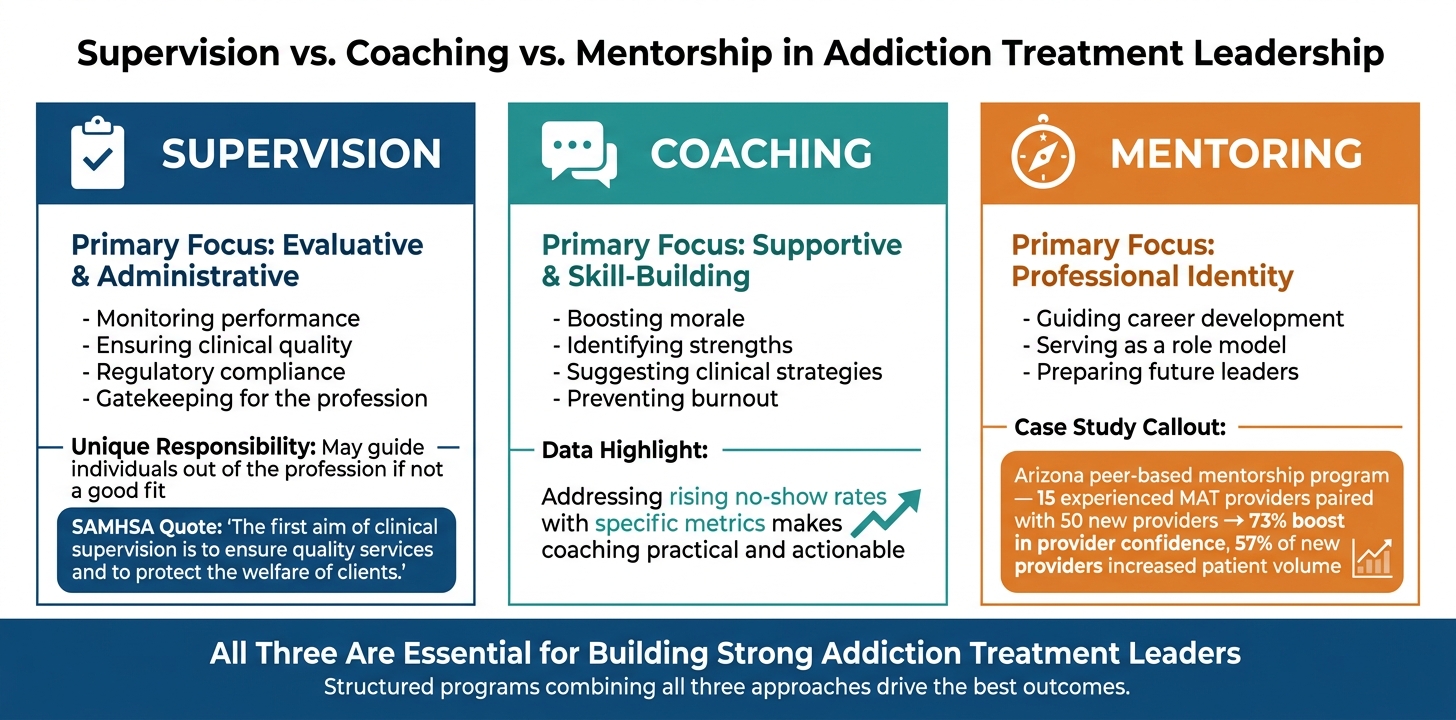
Supervision vs. Coaching vs. Mentorship in Addiction Treatment Leadership
Coaching, Mentorship, and Supervision: Key Differences
While these terms are often used interchangeably, they each play a distinct role in leadership growth.
|
Role |
Primary Focus |
Key Activities |
|---|---|---|
|
Supervision |
Evaluative & Administrative |
Monitoring performance, ensuring clinical quality, compliance, and gatekeeping for the profession [2] |
|
Coaching |
Supportive & Skill-Building |
Boosting morale, identifying strengths, suggesting clinical strategies, and preventing burnout [2] |
|
Mentoring |
Professional Identity |
Guiding career development, serving as a role model, and preparing future leaders [2] |
Supervisors have a gatekeeping responsibility that sets them apart. According to SAMHSA:
"The first aim of clinical supervision is to ensure quality services and to protect the welfare of clients." [2]
This means supervisors may have to guide individuals out of the profession if they aren't a good fit - something that mentors and coaches aren't tasked with.
With these distinctions in mind, structured mentorship becomes an essential step in cultivating effective leaders.
How to Set Up a Mentorship Program
Strong mentorship programs rely on structure, clear goals, and documentation. For instance, a peer-based mentorship initiative in Arizona paired 15 experienced MAT providers with 50 new providers through virtual consultations and structured collaboration.
The outcome?
A 73% boost in provider confidence, with 57% of new providers increasing the number of patients they treated [3].
To achieve similar results, focus on intentional design. Pair mentors and mentees based on specific skill gaps, such as clinical supervision or operational management, rather than defaulting to seniority.
Use a written agreement to formalize the relationship, detailing objectives, meeting schedules, and methods for tracking progress [2]. Consistent weekly meetings between new leaders and administrators help sustain the program [2].
Allow new supervisors a 90-day adjustment period to observe staff, settle into their role, and develop their leadership style before making significant changes [2]. Skipping this step often causes early conflicts that can derail the mentorship process.
Once mentorship is in place, coaching can take leadership development to the next level.
Using Coaching to Develop Emerging Leaders
Coaching builds on mentorship by focusing on ongoing skill development and measurable improvements. The most effective coaching uses real performance data rather than subjective impressions.
For example, addressing a rising no-show rate with specific metrics makes the conversation practical and actionable.
Tools like Opus Behavioral Health EHR can enhance coaching efforts by providing real-time data, such as retention trends and clinician productivity. This allows coaches to collaborate with emerging leaders on targeted improvement plans based on actual performance metrics [1].
Coaching also involves navigating resistance. When staff push back against new leaders or processes, reframing resistance as ambivalence toward change - rather than a personal issue - can lead to more productive discussions [2].
This approach, rooted in motivational interviewing principles familiar to many SUD clinicians, often helps resolve challenges more effectively than pure correction.
Measuring and Sustaining Leadership Outcomes
Key Metrics for Measuring Leadership Effectiveness
Leadership effectiveness isn't something you can gauge by instinct - it requires measurable outcomes. The most impactful metrics fall into three categories: staff retention, clinical performance, and operational efficiency. These metrics help refine leadership strategies that improve addiction treatment outcomes.
For example, strong leadership can lower staff turnover by fostering a supportive environment and addressing burnout. In terms of clinical performance, indicators like program completion rates, patient recovery progress, and successful aftercare transitions highlight the quality of care being delivered. Operational metrics, such as bed occupancy, time-to-admission, and billing accuracy, reveal how efficiently the treatment center is running.
|
Metric Category |
What to Track |
|---|---|
|
Staff Retention |
Turnover rate, average tenure, exit interview insights |
|
Clinical Performance |
Program completion rates, recovery progress, aftercare transitions |
|
Operational Efficiency |
Bed occupancy, time-to-admission, billing accuracy |
These metrics provide a solid framework to promote ongoing improvement and ensure leadership remains aligned with organizational goals.
Building a Culture of Continuous Improvement
Metrics alone won't drive change unless they're paired with action. Regular feedback loops - whether through monthly team meetings, quarterly leadership reviews, or structured check-ins - embed a mindset of continuous improvement into daily workflows.
When senior leaders actively seek and act on feedback, it sends a clear message: improving outcomes is everyone's responsibility.
Using Tools to Monitor Leadership Progress Over Time
To maintain leadership growth over time, leveraging technology is essential. Tools like Opus Behavioral Health EHR offer real-time data that simplify leadership evaluation.
For instance, Opus' AI-powered Copilot reduces time spent on clinical documentation by up to 40% [4][5], allowing leaders to concentrate on mentorship and strategic planning. With over 140 reporting options and more than 100 assessment tools, leadership teams can easily monitor KPIs like patient retention, billing accuracy, and clinical outcomes without the hassle of manual reporting [4][5].
Amanda Wilson, Director of Clinical Services at a Mental Health and Substance Use Treatment Center, highlighted the benefits:
"This process will simplify our operations to save so much time. We will no longer have to manually pull so many charts per quarter and have a timelier billing process for quicker reimbursements." [5]
Integrating EHR and RCM data bridges the gap between clinical and financial performance, giving leaders a holistic view of the organization's overall health [4]. This comprehensive approach ensures that leadership decisions are informed, efficient, and impactful.
Conclusion
Leadership development in addiction treatment is an ongoing process that directly impacts clinical outcomes, staff retention, and financial stability.
Strong leaders combine clinical knowledge, operational efficiency, and a people-first approach to navigate the complexities of this field. This guide has outlined the key skills and tools needed to cultivate such leadership - now it’s time to put those insights into practice.
The responsibility is immense. As the NAATP emphasizes:
"To demonstrate to the public, our patients, their families, payers, and policymakers that treatment is effective, we need clear quantitative evidence." [6]
Achieving this level of accountability starts with effective leadership. By prioritizing measurement, mentorship, and continuous improvement, organizations can significantly expand their influence and effectiveness.
FAQs
What should I teach new clinical supervisors first?
To excel in clinical supervision, it's crucial to master a blend of practical and interpersonal skills. Start by understanding the purpose of clinical supervision: guiding, mentoring, and supporting others in their professional growth. This involves learning how to mentor effectively, coach with intention, and provide feedback that is both constructive and actionable.
Mentoring and Coaching with Purpose
Effective mentorship goes beyond simply offering advice. It’s about fostering a relationship where supervisees feel supported and encouraged to develop their skills. Coaching, on the other hand, focuses on guiding individuals toward achieving specific goals. Together, these approaches empower supervisees to grow professionally and personally.
Providing Feedback That Drives Growth
Giving feedback is an art. Constructive feedback should be clear, actionable, and tailored to the individual’s needs. The goal is not just to point out areas for improvement but to highlight strengths and encourage progress. This balance helps build confidence while addressing challenges.
Leadership Through Trust and Teamwork
Strong leadership is at the heart of effective supervision. Building trust within the supervisory relationship is essential - it creates an environment where supervisees feel safe to share challenges and seek guidance. Encouraging teamwork and collaboration further strengthens this bond, fostering a sense of community and mutual support.
Promoting Wellness and Ethical Practices
Supervisors have a responsibility to prioritize the well-being of their supervisees. This means promoting wellness practices and maintaining an ethical approach in all interactions. A positive, growth-oriented environment doesn’t just benefit the supervisee; it also enhances the overall quality of care they provide.
By focusing on these core areas - mentorship, feedback, leadership, and wellness - you can create a supervision experience that nurtures growth, builds trust, and supports ethical, professional development.
How do I reduce patient drop-off between levels of care?
To keep individuals engaged during the shifts between levels of addiction treatment, it's crucial to ensure smooth transitions and maintain clear communication. Some effective strategies include assigning a dedicated care coordinator, utilizing secure messaging for regular updates, and establishing a straightforward consent process for sharing information.
Warm handoffs can make a big difference. For example, scheduling the next step in care before discharge or sending personalized follow-ups, like SMS check-ins, can help individuals stay connected to their treatment plan. Additionally, offering telehealth options and same-day appointments can simplify the process and increase the likelihood of continued participation.
What KPIs best demonstrate leadership impact in an addiction treatment center?
Leadership effectiveness can be measured through various clinical and organizational KPIs that highlight their role in shaping care quality and workplace dynamics.
Clinical KPIs focus on patient-related outcomes, such as:
Patient retention: Tracking 30-day, 90-day, and long-term retention rates.
Negative drug screens: Monitoring progress in substance use treatment programs.
Medication adherence: Ensuring patients follow prescribed treatment plans.Organizational KPIs reflect the broader impact of leadership on team performance and workplace culture. These include:
Staff adherence to evidence-based practices: Measuring how consistently teams follow proven methods.
Implementation fidelity: Evaluating how well new programs or protocols are executed.
Staff engagement: Gauging employee morale and involvement.
Turnover rates: Tracking staff retention to assess job satisfaction and workplace stability.
Patient satisfaction: Understanding patient perspectives on care quality.These indicators collectively offer insight into how leadership shapes both the quality of care provided and the organizational environment, as well as the effectiveness of mentorship and support systems.



- Behavioral Health
- EHR Systems
- Addiction Treatment EHR
- mental health
- Telehealth
- addiction treatment
- Behavioral health facility
- Substance Abuse Disorder
- behavioral Health center
- HIPPA Compliant
- ehrsoftware
- PTSD
- behavioral health ehr
- Depression
- hipaa
- Anxiety
- MentalHealthMatters
- RCM
- claim denials
- clinical documentation
- mental health awareness
- screening tools

September 15, 2026

September 15, 2026

September 14, 2026

September 11, 2026

September 10, 2026

September 09, 2026
Recommended Posts

Thursday, August 27, 2026
How Predictive Analytics Guides SUD Care Plans
Predictive analytics helps SUD providers act before relapse, dropout, overdose, or readmission.

Wednesday, July 29, 2026
How Real-Time Outcome Tracking Guides SUD Care
Outcome scores can signal that a patient is at risk of dropping out of treatment.

Tuesday, October 21, 2025
Telehealth vs In-Person: Best for SUD Treatment?
Telehealth vs In-Person: Best for SUD Treatment? Telehealth and in-person care both effectively treat Substance Use ...