

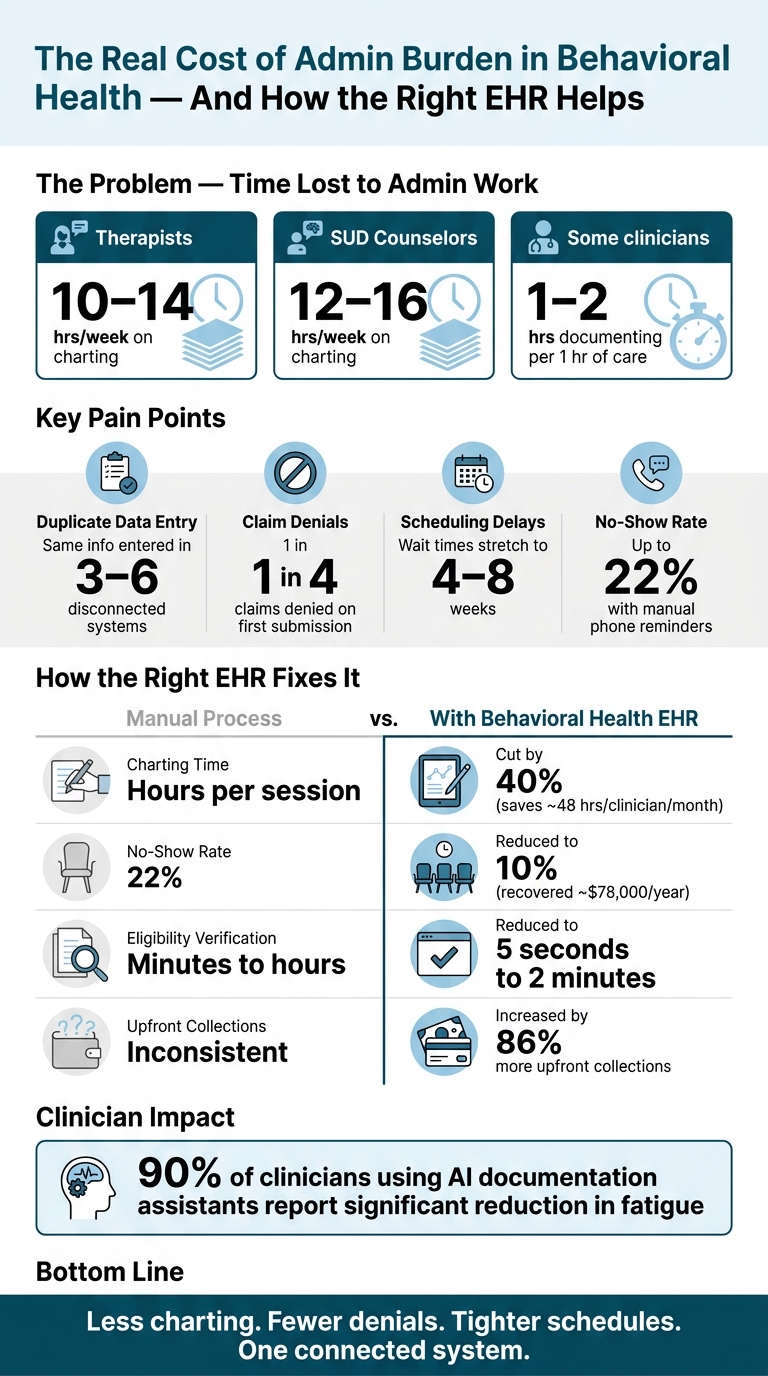
Behavioral health teams lose a huge part of the week to admin work. In many cases, therapists spend 10–14 hours a week on charting, SUD counselors spend 12–16 hours, and some clinicians spend 1–2 hours documenting for every hour of care.
If I had to sum up the fix in one line, it would be this: the right behavioral health EHR cuts duplicate work, shortens note time, tightens scheduling, and helps claims go out with fewer errors.
Here’s the short version:
Documentation is one of the biggest time drains, especially with long narrative notes.
Disconnected systems force staff to enter the same data in 3–6 places.
Manual billing leads to more denials, including 1 in 4 claims denied on first submission in some workflows.
Manual scheduling creates phone-tag, no-shows, and intake delays that can stretch wait times to 4–8 weeks.
AI note tools can cut charting time by 40% and save about 48 hours per clinician per month.
Automated SMS reminders can help lower no-shows, with one example dropping from 22% to 10%.
Built-in compliance and billing checks help staff spend less time fixing errors and pulling records for audits.What this changes is simple: less after-hours charting, fewer billing slowdowns, and a clearer view of notes, scheduling, claims, and compliance in one place.
The Real Cost of Admin Burden in Behavioral Health (And How EHRs Fix It)
Where Behavioral Health Teams Feel the Most Strain
Documentation, Scheduling, and Care Coordination Bottlenecks
A lot of that pressure lands on documentation, scheduling, and care coordination.
Behavioral health documentation is heavy on narrative, not simple checkboxes. That takes time, attention, and mental energy.
Across a full caseload, the workload piles up fast. Things get worse when clinicians have to enter the same diagnosis, CPT codes, and session length in 3 to 6 different points across disconnected clinical and billing systems [1]. It eats up time and increases the chance of mistakes. Those same disconnected handoffs also make scheduling and care coordination much harder to track.
Billing Rules, Prior Authorizations, and Compliance Pressure
Billing and compliance add even more strain.
Behavioral health billing has a lot of moving parts, and manual work often leads to denials. In fact, 1 in 4 claims are denied on the first submission when manual processes are in place [1].
Disconnected systems also make HIPAA, 42 CFR Part 2, accreditation, and outcomes reporting tougher to handle. When documentation, reporting, and audit prep are scattered across separate systems, admin work starts to feel nonstop.
How the Right EHR Cuts Administrative Work
The core issue is process friction. Duplicate entry, manual handoffs, and disconnected systems eat up time. A connected EHR keeps clinical, scheduling, and billing data in one place, so a single entry moves through the whole system. In most practices, the drag shows up first in documentation, scheduling, and medication workflows.
Faster Documentation with Behavioral Health Templates and AI Support
Documentation is where many clinicians feel the most pressure. Behavioral health templates give them a clear starting point instead of a blank screen. That alone can shrink note time and keep documentation structured the same way across the practice.
AI tools can push that even further. Opus Copilot AI automatically transcribes and organizes clinical notes from sessions, reducing charting time by 40% and saving an average of 48 hours per clinician per month [2][5]. That matters in day-to-day practice. Less time spent writing notes can mean better note completeness, less charting after hours, and fewer nights ending with a laptop still open.
The effect on staff is hard to ignore too. 90% of clinicians using AI documentation assistants report a significant reduction in fatigue [5]. Less after-hours charting means less burnout and a practice that’s easier to keep running week after week.
Automated Scheduling, Reminders, and Telehealth Workflows
Centralized scheduling and automated SMS reminders can replace a lot of phone-tag. They help cut no-shows and keep calendars from developing empty gaps.
One example makes the point well. A mid-sized Intensive Outpatient Program (IOP) facility in Texas cut its no-show rate from 22% to 10% after switching from manual phone calls to automated SMS reminders, recovering nearly $78,000 in annual revenue [6].
Automated reminders also have a response rate of roughly 90%, compared with just 40% for phone calls [6]. In plain terms, staff spend less time chasing confirmations, and the schedule stays tighter.
For group practices and team-based care, shared scheduling cuts down on the usual back-and-forth. Shared telehealth and group scheduling make it easier to run sessions without repeated coordination. And once those pieces are connected, prescribers and billers can move with less delay too.
E-Prescribing, Lab Integration, and Medication Workflows
Medication management brings its own pile of admin work, especially in psychiatry. When e-prescribing, lab results, and therapist updates all live in the same chart, prescribers can make decisions faster and billers have the detail they need to code with fewer slowdowns.
How EHR Workflows Improve Billing, Compliance, and Financial Performance
When documentation, scheduling, and medication details sit in one chart, billing usually gets cleaner. The biggest gains show up in the revenue cycle: fewer denials, faster payment, and stronger audit readiness.
From Completed Notes to Cleaner Claims and Faster Payment
When documentation and billing share the same system, completed notes can flow straight into charge capture. That cuts extra steps and helps teams send cleaner claims. Required-field checks flag missing details before a claim goes out, not after it comes back denied. And eligibility verification that used to take minutes, or even hours, over the phone or through payer portals can happen in seconds through automated EHR integration.
|
Workflow Area |
Manual / Fragmented Process |
Automated EHR Integration |
|---|---|---|
|
Eligibility Verification Speed |
Minutes to hours (phone/portals) |
5 seconds to 2 minutes |
|
Denial Rate |
High (roughly 1 in 4 claims) |
Significantly reduced |
|
Upfront Collections |
Inconsistent |
86% more upfront collections |
That shift changes how billing teams spend their time. Instead of cleaning up routine mistakes all day, billers can focus on the claims that need actual attention.
"This will cut chart pulls and speed reimbursement." - Amanda Wilson, Director of Clinical Services, Mental Health and Substance Use Treatment Center [4]
Built-In Compliance Tracking for Audits and Regulatory Requirements
The same connected workflow also makes audits and regulatory tracking much easier. Digital consents, releases, and mobile intake can save 2 to 4 admin hours per clinician each week while helping required paperwork get completed before treatment starts [1][3].
That means less scrambling later and fewer missing forms when someone needs to review a chart.
When records are requested, staff can pull notes, consents, and audit trails from one chart instead of hunting through separate systems. That saves time, lowers stress, and gives leaders a clearer view of what’s happening with denials, reimbursements, and audit turnaround.
Measuring Results and Building Stable Operations
Key Metrics Leaders Can Track Across Operations, Finance, and Care
Once documentation, scheduling, and billing start running better, leaders need proof that the changes are paying off. Less admin work sounds good on paper. But without data, it's hard to show what's changed.
The right EHR gives leaders one view across operations, finance, and care. That makes it easier to catch issues before they hurt productivity or cash flow.
|
KPI Category |
Example Metrics to Track |
|---|---|
|
Operations |
Note completion lag, unsigned notes, staff utilization rates, wait times for new appointments, no-show/cancellation rates |
|
Clinical Care |
|
|
Finance |
Clean claim rate, days in A/R, denial rates by reason, upfront co-pay collection % |
|
Patient Engagement |
Portal adoption rate, self-scheduling frequency, telehealth vs. in-person utilization |
Regular tracking helps leaders spot slowdowns early. For example, rising unsigned notes often point to charting friction. Rising no-shows usually point to reminder problems or scheduling gaps.
Conclusion: What the Right EHR Changes in Behavioral Health
With the right metrics in view, leaders can stop reacting all day and start managing with more control.
Administrative burden isn't just annoying. It's a clinical and financial risk that gets worse over time. If documentation slows down, claims get held up. If scheduling stays manual, no-shows keep piling up. If compliance tracking lives in too many places, audits become stressful and costly.
A behavioral health-specific EHR can address these pressure points head-on. Streamlined documentation with AI support can cut charting time by up to 40% [2]. Automated scheduling and reminders can reduce no-shows [6]. Built-in compliance tools can help keep records audit-ready [7].
The payoff is simple: less paperwork, fewer delays, and clearer data for better decisions.
FAQs
How does a behavioral health EHR reduce duplicate work?
A behavioral health EHR cuts duplicate work by connecting systems so data moves over on its own. That means less manual entry, fewer chances for mismatch, and more consistent information across documentation and day-to-day workflows.
Which EHR features help reduce no-shows and wait times?
Features like automated appointment reminders by SMS or email, sent 24 hours before appointments, can cut no-show rates by up to 50%.
Real-time calendar updates also help staff fill canceled slots fast, which can reduce wait times.
How can an EHR improve billing accuracy and audit readiness?
An EHR can make billing more accurate and help a practice stay ready for audits.
It does that in a few practical ways: it can verify insurance coverage at the time of service, pre-fill billing codes based on clinical documentation, and use claim-scrubbing tools to catch common mistakes before a claim is sent out.
That means fewer denials and better support for compliance.



- Behavioral Health
- EHR Systems
- Addiction Treatment EHR
- mental health
- Telehealth
- addiction treatment
- Behavioral health facility
- Substance Abuse Disorder
- behavioral Health center
- HIPPA Compliant
- ehrsoftware
- PTSD
- behavioral health ehr
- Depression
- hipaa
- Anxiety
- MentalHealthMatters
- RCM
- claim denials
- clinical documentation
- mental health awareness
- screening tools

September 15, 2026

September 15, 2026

September 14, 2026

September 11, 2026

September 10, 2026

September 09, 2026
Recommended Posts

Friday, February 11, 2022
Top Considerations for Behavioral Health Treatment Centers When Switching EHR Systems
The world is cautiously beginning to open again after the Covid-19 shelter-in-place orders are lifted. While it’s ...

Friday, July 10, 2026
The Numbers Don't Lie: What Clinics Save After Switching EHRs
An EHR switch is a money call before it is a software call. If I were sizing up a change, I’d focus on seven numbers: ...
Thursday, July 16, 2026
Real-Time Feedback Tools for Behavioral Health
Timing is extremely essential in healthcare. If feedback comes in too late, it can’t change care.