

Your EMR system should make your team’s work easier, not harder.
Behavioral health practices face unique challenges, like detailed, long-term documentation, compliance with strict regulations like 42 CFR Part 2, and the need for seamless collaboration between therapists, psychiatrists, and administrative staff.
A well-suited EMR platform addresses these needs with:
Customizable workflows to match your team’s processes, reducing redundant tasks and saving time.
Automation tools like reminders, billing triggers, and intake forms to cut down on administrative burdens.
Role-based dashboards that simplify access to relevant information for therapists, case managers, and billing teams.
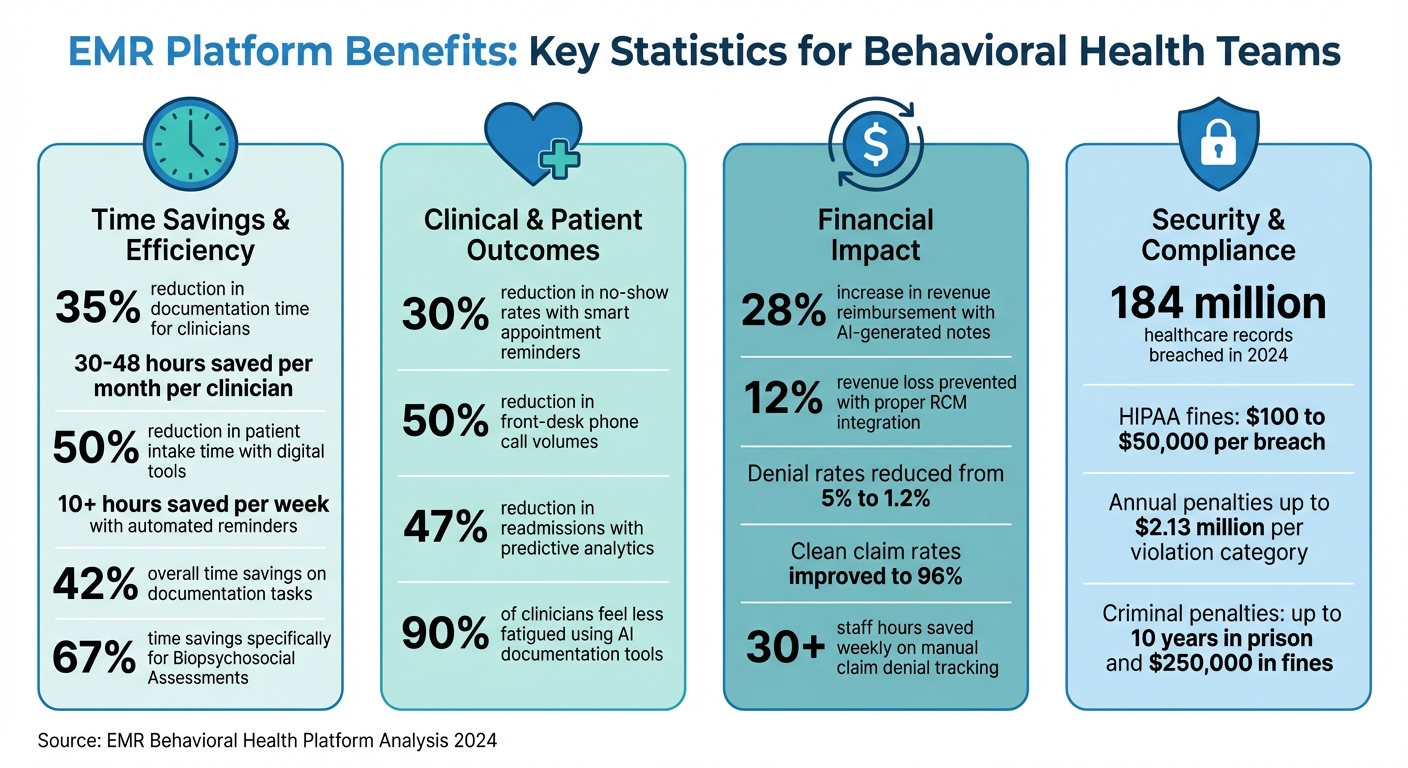
AI-powered tools for faster, more accurate documentation, saving up to 35% of clinicians’ time.
Integrated features for telehealth, e-prescribing, and billing, ensuring smooth operations and fewer errors.
Security and compliance measures like encryption, audit trails, and role-based access to protect sensitive data.
The right EMR system improves efficiency, reduces burnout, and ensures compliance while helping your team focus on patient care. Evaluate platforms based on these priorities and involve your entire team in the decision-making process to find the best fit.
EMR Platform Benefits: Key Statistics for Behavioral Health Teams
Customizable Workflows That Match Your Operations
Your platform should align with your team's unique workflows, not the other way around. When systems adapt to how your team operates, administrative burdens shrink, allowing staff to focus more on patient care.
For instance, workflows can trigger automatic generation of necessary paperwork when a client's status changes - like moving from "intake" to "active" - ensuring all required forms are completed seamlessly [5].
Automated triggers also help keep things on track by setting deadlines and alerting staff when crucial paperwork, such as progress notes or billing submissions, is overdue.
This eliminates the need for last-minute efforts at the end of the month [5]. Digital intake tools, for example, can cut patient intake time by up to 50% [7], while automated reminders can save staff over 10 hours per week [8].
"The ability to cross-reference clinical, case management, medical, and demographic information within the client file is a true benefit for clinical collaboration." - Deborah V., Clinical Director [1]
Examples of Workflow Automation
Automated workflows streamline processes like mobile onboarding, where patients can complete forms, sign HIPAA and 42 CFR Part 2 consents, and upload insurance or ID photos before their first visit. This data syncs directly into the EHR, saving time for both staff and patients [7].
Smart appointment reminders - sent via SMS at intervals like 48, 24, and 2 hours before visits - allow patients to confirm, reschedule, or cancel appointments through two-way texting. These reminders can reduce no-show rates by up to 30% and cut front-desk phone call volumes in half [6][7][8].
Strategic backfilling is another game-changer. When patients cancel, the system instantly alerts staff, who can then text individuals on the waitlist to fill the open slot [8].
Custom workflows also support the administration of tools like PHQ-9 or GAD-7 at regular intervals, meeting the growing demands of measurement-based care [2].
"By automating the quality of internal data, and applying an algorithm, it will cut back on errors to not miss a thing, especially from group sessions." - Judd Carey, Director of Operations, VirtualServices, Mindful Health [4][1]
These automated features also extend to user interfaces, which can be tailored to meet the specific needs of each team member.
Supporting Different Team Roles
Behavioral health teams are made up of therapists, psychiatrists, case managers, and administrative staff, each with distinct responsibilities.
Role-based dashboards ensure that everyone sees the information they need without unnecessary clutter.
For example, therapists can quickly access pending progress notes, while supervisors view team productivity metrics. Administrative staff focus on billing and insurance statuses, while clinicians see their caseloads and upcoming deadlines as soon as they log in.
This approach avoids the inefficiencies of one-size-fits-all templates, which often result in manual workarounds and unnecessary clicks. Role-based access controls also protect sensitive information, such as therapy notes, ensuring administrative staff cannot access clinical documentation.
This is essential for maintaining HIPAA and 42 CFR Part 2 compliance [2].
Additionally, when clinicians complete a treatment episode, the system can automatically generate discharge summaries and update outcome measurements. This seamless connection between tasks across roles fosters collaboration and improves patient care outcomes.
AI-Powered Tools That Save Time
AI tools built into clinical systems are helping clinicians cut down on time-consuming administrative tasks.
Features like Copilot AI and AI Notes Assist streamline clinical documentation by drafting detailed, context-rich progress notes for various sessions, including in-person, group, and telehealth. These drafts are often review-ready and even suggest appropriate CPT codes for billing purposes [9].
The result? Clinicians can save between 30 and 48 hours per month - a reduction of about 35% in documentation time - while collecting more comprehensive data [9][10][4].
AI for Documentation and Note-Taking
AI scribes take spoken details and turn them into well-structured, insurance-ready notes in formats like SOAP, DAP, and PROGRESS [10][12]. These tools follow strict compliance standards, including HIPAA, GDPR, SOC 2 Type 2, and ISO 27001, ensuring that sensitive audio and transcripts are not stored permanently [10]. Thanks to these advancements, clinicians report a 42% overall time savings on documentation tasks, with a 67% time savings specifically for Biopsychosocial Assessments [12].
For instance, Care Counseling Clinics adopted Opus EHR, which offers AI-assisted documentation and customizable assessment tools.
According to Rebeka Tolle, VP of Operations, and Jennifer Gozy, Director of Clinical Systems, their providers spend 35% less time on documentation while improving the depth of clinical data captured [1][4].
Additionally, AI-driven intake systems can flag high-risk responses - like suicide risk scores or seizure history - before the session ends, enabling immediate action [3].
The benefits go beyond just saving time. Studies show that 90% of clinicians using AI documentation tools feel less fatigued [10].
Moreover, detailed, AI-generated notes can improve revenue reimbursement by 28%, as they ensure insurance-friendly documentation that minimizes errors and transcription drift [10][3].
"Note Assistant enables greater focus on patient interaction versus note-taking and improves documentation time with quicker note completion."
Dr. Titus Tucker, Ed.D., LCSW, SAP, Director of Clinical Services, FHE Health [12]
But AI doesn't stop at documentation - it also uses data to provide actionable insights.
Using AI for Data Analysis
AI systems take streamlined documentation a step further by analyzing patient data to generate clinical insights.
For example, automated treatment planning tools compile patient history and physical details into ready-to-use templates, reducing manual effort [2].
Some platforms even offer "Chart Snapshots", which summarize treatment history, medications, and progress, making clinical reviews faster and more efficient [12].
Predictive analytics features can identify early signs of relapse, enabling timely interventions. Some systems have reported a 47% reduction in readmissions due to these capabilities [doc].
Automated quality assurance tools also improve the accuracy of clinical documents, reducing claim denials and contributing to a 28% increase in revenue [10].
Additionally, these systems support measurement-based care by tracking outcomes using tools like PHQ-9 or GAD-7, often required by organizations like the Joint Commission [2].
When choosing AI tools, look for platforms where AI is fully integrated and production-ready, rather than a beta feature. Opt for solutions that align with your team's existing workflows - such as those supporting behavioral health templates like SOAP or BIRP - to minimize manual adjustments [9][11].
Integrated Features That Connect Your Team
Integrated features take the benefits of automated workflows and AI-driven insights a step further, helping your team stay connected and deliver care more effectively.
When systems don’t communicate, your team ends up juggling multiple logins, re-entering the same data, and struggling with fragmented information.
An EMR that combines core functions into one platform eliminates these headaches. It ensures admissions, clinical, and billing teams all access the same real-time data, reducing errors and improving collaboration.
A unified CRM-to-RCM system supports the entire patient journey - from the first contact through recovery. For example, when a lead becomes a patient, their demographics, insurance details, and clinical history automatically transfer into their treatment record.
This eliminates manual data entry and ensures everyone - admissions staff, counselors, psychiatrists, and billing teams - works from the same up-to-date file [1][11]. By bridging clinical data and billing, the platform reduces gaps that could lead to claim denials.
Linking clinical documentation with billing has a measurable impact. Integrated systems can cut denial rates from 5% to 1.2% and boost clean claim rates to 96%, meaning faster reimbursements and less revenue lost due to documentation errors [13].
"Having our EHR seamlessly connected with billing has eliminated the documentation gaps that used to cause claim denials. Our clinicians document naturally, and the system automatically captures everything needed for proper reimbursement." - Lisa Chen, Practice Administrator, Behavioral Health Center [4]
Telehealth and E-Prescribing
Integrated telehealth tools make attending appointments easier for patients and reduce missed sessions.
A simple SMS link allows patients to join video visits instantly - no app downloads or logins required [15]. This browser-based access works even on older devices or limited data plans, making care more accessible.
"By making video visits as easy as clicking a text link, providers can keep patients engaged at every stage of their care journey." - Mira Gwehn Revilla [15]
E-prescribing integration enhances medication management by giving clinicians real-time access to medication histories, drug interaction checks, and allergy alerts - all within the prescribing workflow [14].
For Medication-Assisted Treatment (MAT) programs, Electronic Prescribing for Controlled Substances (EPCS) adds security and compliance while eliminating the need for manual faxes or pharmacy calls [14].
Clinicians can view notes, diagnoses, and lab results in the same system, reducing the risk of adverse drug interactions and improving treatment adherence.
Lab and CRM/RCM Integrations
Additional integrations, like lab and CRM/RCM features, simplify both patient care and reimbursement processes.
Bi-directional lab integration allows providers to order tests and view results directly within the EMR, avoiding the hassle of switching between portals or manually entering data [16].
Real-time lab results enable faster diagnoses and quicker responses to critical findings. Automated alerts for concerning results let clinicians intervene promptly, often preventing emergencies.
CRM integration streamlines admissions by automating insurance verification and lead tracking. Features like automated follow-up reminders and text updates help build patient trust and reduce no-shows by up to 50% [13].
On the billing side, RCM integration ensures claims are generated directly from clinical encounters, capturing all services accurately. Without these tools, behavioral health organizations risk losing up to 12% of revenue and wasting over 30 staff hours each week on manual claim denial tracking [13].
Together, these integrations create a seamless system, ensuring every part of your EMR supports teamwork and efficient care delivery.
Compliance and Security Features That Protect Your Data
When your EMR platform manages behavioral health records, compliance is more than just a box to check - it's the backbone of patient trust and legal safeguards. In 2024 alone, an alarming 184 million healthcare records were breached [19].
To ensure both security and efficiency, the right platform integrates compliance measures directly into your workflows, reducing the administrative load while protecting sensitive data.
A trustworthy system doesn’t just advertise "HIPAA compliance." It actively enforces protections through features like role-based access controls, automated audit trails, and encryption protocols.
"Your EHR vendor says they're HIPAA compliant. That doesn't mean you are." - The PIMSY Team [19]
HIPAA and 42 CFR Part 2 Compliance
Granular role-based access controls are key to staying compliant. For example, billing staff can view claims data while therapists access clinical details, ensuring adherence to HIPAA's "minimum necessary" standard and 42 CFR Part 2's strict rules for substance use disorder (SUD) records [19].
Automated audit trails are another essential feature, recording every instance of access, edits, or exports.
This creates a clear, comprehensive history for regulatory audits. For SUD records, this is especially critical: 42 CFR Part 2 mandates explicit written consent before sharing patient information, and your system should automatically flag these records to prevent unauthorized redisclosure [18][19].
As of February 16, 2026, updates to 42 CFR Part 2 have aligned its requirements with HIPAA, introducing a single consent model for treatment, payment, and operations. However, it still enforces strict protections against using SUD records in legal proceedings [20].
Your platform should automatically manage these nuanced consent requirements, including appending the federally mandated prohibition notice to any documents containing Part 2-protected data [20][21].
"The February 2024 final rule fundamentally restructured 42 CFR Part 2 by aligning it with HIPAA - implementing Section 3221 of the CARES Act. The compliance deadline was February 16, 2026." - EHR Source [20]
Advanced EMRs take compliance even further with data segmentation. By tagging sensitive information - like psychotherapy notes or SUD records - these systems ensure that such data doesn’t unintentionally merge with general medical records without specific authorization [18][19].
While compliance measures are essential, technical security features are equally important for protecting your data.
Data Security for Behavioral Health Teams
End-to-end encryption is a must, covering data both in transit and at rest. Look for platforms using 2048-bit TLS encryption and 256-bit session encryption, which make intercepted data unreadable [17].
To prevent unauthorized access, multi-factor authentication (MFA) is crucial. Combine MFA with features like automatic session timeouts and IP restrictions for an added layer of security [17][19].
Some systems even allow you to limit access based on geographic IP ranges. Behind the scenes, secure backups and intrusion monitoring work continuously, with real-time threat detection and encrypted backups ensuring data recovery in case of a breach [19].
Digital intake forms also play a role in security and compliance. These forms ensure complete and accurate records by requiring all mandatory fields - like 42 CFR Part 2 consents - be completed before submission.
This eliminates the risks of transcription errors from paper forms and ensures that critical information, such as allergies or suicide risk scores, is recorded accurately [3].
Non-compliance is costly. HIPAA violations can result in fines ranging from $100 to $50,000 per breach, with annual penalties reaching up to $2.13 million per violation category [20][21].
Criminal penalties for intentional violations can include up to 10 years in prison and fines of $250,000 [20]. A platform that automates compliance safeguards helps your team focus on what really matters: providing quality care to your patients.
Easy-to-Use Design and Mobile Access
Navigating a clunky system isn’t just frustrating - it’s a time sink. Physicians already dedicate over a third of their time to documenting patient data [2].
Add an inefficient EMR system into the mix, and frustration levels skyrocket. That’s why the best platforms feel intuitive, taking cues from everyday apps like Google search or Outlook calendars.
Mobile access is no longer a luxury - it’s a necessity. Whether it’s crisis intervention, community services, or remote therapy, clinicians need instant access to patient records from anywhere.
A true mobile-first design allows them to document care, review treatment plans, and access clinical data seamlessly - whether they’re in the office, visiting a patient’s home, or conducting a telehealth session on their phone [1][2].
"We chose Opus because it is user friendly workflow and it offers a great client experience." - Rebeka Tolle, VP of Operations, Care Counseling Clinics [1]
Customizable dashboards are another game-changer.
When billing staff see only claims data and therapists access clinical templates without wading through irrelevant menus, efficiency goes up. Role-based interfaces tailor the experience to each team member, cutting down on wasted time and frustration.
These thoughtful design features ensure tasks are completed quickly and easily, whether at a desk or on the move.
Mobile Support for Teams Working Remotely
A truly mobile-compatible platform delivers full functionality on phones - no compromises, no shortcuts.
For instance, browser-based telehealth eliminates technical hurdles by letting users join sessions through a secure SMS link. Patients can also complete digital intake forms on their phones, uploading insurance cards and signing consents before they even step into your office. This streamlines the entire intake process [7].
AI tools take it a step further by enabling clinicians to draft progress notes directly on their mobile devices, removing the need to follow up on a desktop later [4].
Customizable Interfaces for Different Users
Tailored interfaces make everyone’s job easier. For example, case managers can focus on referrals while psychiatrists access prescribing tools.
Platforms that allow this level of customization reduce training time, helping new staff hit the ground running. Users frequently praise systems that are "easy to teach to new staff" and "very easy to learn, use, and navigate" [1].
"Since implementing Opus EHR, our providers spend 35% less time on documentation while capturing more comprehensive clinical data." - Dr. Jennifer Williams, Mental Health Practice Owner [4]
Automation also lightens the load. Features like appointment reminders, insurance verification, and e-signatures for HIPAA and 42 CFR Part 2 consents take repetitive tasks off your team’s plate. This allows administrative staff to focus on what matters most - supporting patients [1][4].
Conclusion: Evaluating Your EMR for Team Compatibility
Your EMR should work with your practice, not against it. It should streamline processes and eliminate inefficiencies rather than create additional hurdles.
When choosing a platform, focus on the features that matter most - customizable workflows, AI-driven tools, and integrated capabilities that meet the unique demands of behavioral health. Look for solutions that support longitudinal documentation and regulatory compliance, steering clear of generic medical systems that often lead to frustrating workarounds.
Take the time to assess the entire patient experience, from digital intake and telehealth sessions to insurance claim submissions.
Don’t rely solely on polished demos; instead, test the system for common tasks. If simple actions - like starting a telehealth session or documenting progress notes - feel unnecessarily complicated, consider that a warning sign. These practical insights can fuel meaningful discussions with your team.
Speaking of your team, make sure everyone is involved in the decision-making process. Billing managers, front-desk staff, and other team members often bear the brunt of poorly integrated systems, so their feedback is invaluable.
Use a weighted scorecard to rank your top priorities, such as clinical documentation, care coordination, and compliance. Scoring vendors immediately after demos helps capture fresh impressions and ensures a more objective evaluation.
Finally, don’t overlook data portability. Before signing a contract, confirm that the platform allows you to export clinical records in a usable format and ensures data ownership remains with your practice.
This safeguard is essential if you ever need to switch vendors. The EMR you choose will impact not only your providers and administrators but also your patients. Make sure it aligns with your team’s workflow and long-term goals.
FAQs
How can we test EMR fit beyond the vendor demo?
To truly understand how an EMR platform performs beyond the polished vendor demos, it's essential to dive into hands-on testing.
Set up evaluations that mimic the actual workflows your team uses daily. Bring your team into the process by running simulated clinical scenarios. This approach helps you gauge the system’s usability, ability to customize, and how well it integrates with your existing tools.
Pay close attention to how the platform handles key tasks like documentation, scheduling, and telehealth in real-time.
These are critical functions that directly impact both efficiency and patient care. Make sure to gather feedback from the end-users - your team members - since their insights will reveal whether the platform truly meets your operational needs and supports smooth workflows.
What should we verify for 42 CFR Part 2 consent handling?
To ensure compliance with 42 CFR Part 2 and protect sensitive patient information, your EMR platform should include these critical features:
Accurate flagging of SUD records: The system must reliably identify and flag substance use disorder (SUD) records to ensure they are handled with the appropriate level of confidentiality.
Granular consent management: It should allow patients to provide detailed consent for sharing specific parts of their records, ensuring that only authorized information is disclosed.
Audit trail generation: The platform must track and document all disclosures, creating a clear audit trail to monitor who accessed the information and when.
Re-disclosure restrictions: To safeguard patient data, the system should enforce strict controls that prevent unauthorized re-disclosure of sensitive records.
These capabilities are essential for meeting regulatory requirements and protecting patient privacy effectively.
How can we ensure our data is exportable if we switch?
When choosing an EMR platform, it's crucial to check if it offers strong data export capabilities. The system should allow you to extract important information like patient records, clinical notes, and billing data in widely-used formats such as CSV, XML, or PDF.
Additionally, verify that the platform adheres to data portability standards like HL7 and FHIR. These standards ensure smoother transitions and help maintain compatibility with other healthcare systems, making it easier to integrate or migrate your data when needed.



- Behavioral Health
- EHR Systems
- Addiction Treatment EHR
- mental health
- Telehealth
- addiction treatment
- Behavioral health facility
- Substance Abuse Disorder
- behavioral Health center
- HIPPA Compliant
- ehrsoftware
- PTSD
- behavioral health ehr
- Depression
- hipaa
- Anxiety
- MentalHealthMatters
- RCM
- claim denials
- clinical documentation
- mental health awareness
- screening tools

September 15, 2026

September 15, 2026

September 14, 2026

September 11, 2026

September 10, 2026

September 09, 2026
Recommended Posts
Thursday, July 16, 2026
Real-Time Feedback Tools for Behavioral Health
Timing is extremely essential in healthcare. If feedback comes in too late, it can’t change care.
Friday, April 17, 2026
EHR Software That Simplifies Addiction Treatment Care
Addiction treatment centers face unique challenges, from strict privacy regulations under 42 CFR Part 2 to managing ...
Sunday, December 14, 2025
AI in Patient Intake: What Clinics Need to Know
AI-powered patient intake systems are changing how clinics handle data collection and patient interactions. These tools ...