
Behavioral health practices face higher claim denial rates than other specialties - 15–20% compared to 5–10%.
By 2025, 41% of providers reported denial rates above 10%, up from 30% in 2022. Denials often stem from strict insurer requirements for prior authorizations and documentation, costing an average of $25 per claim in administrative work. Manual management is no longer practical due to rising costs.
Automated denial management tools can prevent up to 45% of denials and recover 40–60% of denied claims. These platforms streamline workflows, reduce errors, and provide analytics to identify patterns and address root causes. Key players in 2026 include:
Opus Behavioral Health EHR: Integrates clinical documentation and billing with AI-powered tools for denial prevention.
Waystar: Uses predictive analytics and automation to prioritize and resolve denials efficiently.
NextGen Healthcare: Focuses on proactive error detection with advanced charge review and analytics.
FinThrive: Offers real-time denial risk scoring and payer-specific recommendations.
Veradigm: Supports smaller practices with denial tracking and actionable workflows.
Athenahealth: Features AI-driven claim scrubbing and automation for faster approvals.
AdvancedMD: Designed for smaller practices, offering automated claims scrubbing and reporting.
Tebra: Combines billing and EHR with real-time eligibility checks.
CureMD: Tailored for behavioral health, providing automated claim processing and denial tracking.These tools emphasize prevention, automation, and analytics, helping practices reduce claim denials, save time, and secure revenue. Practices should aim for a clean claim rate above 95% and focus on software that aligns with their size and needs.
1. Opus Behavioral Health EHR
Opus Behavioral Health EHR combines clinical documentation and billing into a single system, aiming to close gaps that often lead to claim rejections. Its integrated design ensures data flows smoothly from initial patient interaction to claim submission. Below is a closer look at how Opus uses advanced tools to streamline denial management.
AI-Powered Denial Identification and Resolution
The platform includes the Copilot AI assistant, which automatically creates clinical narratives and fills out progress notes. This feature reduces documentation time by 40% while ensuring compliance with payer requirements, helping to prevent denials tied to incomplete or incorrect documentation [5].
Lisa Chen, Practice Administrator at a Behavioral Health Center, shares her experience:
"Having our EHR seamlessly connected with billing has eliminated the documentation gaps that used to cause claim denials. Our clinicians document naturally, and the system automatically captures everything needed for proper reimbursement." [4]
Additionally, Opus offers real-time Recovery Coaching Rounds for residential care, allowing staff to log patient observations as they happen. This real-time documentation minimizes gaps that could result in denials related to clinical necessity [5].
Automation of Workflows for Denial Management
Opus simplifies the claims process with its integrated Revenue Cycle Management (RCM) engine. Claims are automatically generated from clinical encounters, and the system manages submission, ERA processing, and EOB tracking. This automation not only streamlines workflows but also provides data for analytics, helping practices identify patterns and make better decisions.
Advanced Reporting and Analytics for Denial Trends
With over 140 practice management reports and dynamic dashboards, Opus gives administrators real-time insights into revenue cycle performance [6]. These tools help identify trends in denials across providers and payers, addressing systemic issues rather than isolated claim problems.
Judd Carey, Director of Operations at Mindful Health, highlights the benefits:
"By automating the quality of internal data, and applying an algorithm, it will cut back on errors to not miss a thing." [6]
These features are tailored to meet the specific challenges of behavioral health care.
Behavioral Health-Specific Features
Opus is designed specifically for behavioral health and substance use disorder (SUD) treatment. It supports compliance with 42 CFR Part 2, handles complex per-diem residential billing, and includes over 100 customizable assessment tools like ASAM criteria and PHQ-9 [5].
For programs offering Medication-Assisted Treatment (MAT), the system supports Electronic Prescribing of Controlled Substances (EPCS), ensuring proper documentation for reimbursement [5]. Additionally, the integrated CRM verifies insurance eligibility at admission, reducing the risk of eligibility-related denials [5].
Amanda Wilson, Director of Clinical Services at a Mental Health and Substance Use Treatment Center, explains:
"This process will simplify our operations to save so much time... and have a timelier billing process for quicker reimbursements." [6]
Pricing: Opus offers a free basic user tier with scheduling and billing features. Full platform access - including EHR, CRM, RCM, Copilot AI, e-prescribing, and telehealth - requires a custom quote. The platform has a 4.5/5 user rating and scored 7.2/10 overall, with an impressive 9.4/10 for Product Depth [5].
2. Waystar Denial + Appeal Management
Waystar Denial + Appeal Management is a cloud-based platform that simplifies the denial process, from identifying problem claims to submitting appeals. By using automation and predictive analytics, it reduces manual effort and improves success rates for overturning denied claims.
AI-Powered Denial Identification and Resolution
Waystar leverages advanced AI to tackle claim denials efficiently. Its AltitudeAI™ engine uses predictive analytics to prioritize denied claims based on their potential cash value and likelihood of overturning.
This ensures billing teams focus on cases that offer the best returns. The platform also uses generative AI to draft appeal letters and reconsideration packages, cutting the time needed for 100 packages from 38 hours to just 2 hours - a 90% time savings. This approach has been shown to increase appeal overturn rates by 40% compared to traditional manual methods [7][8].
Automation of Workflows for Denial Management
Repetitive tasks are handled through automated, exception-based workflows, requiring human input only when deviations occur.
The platform supports batch processing for up to 100 similar appeals to the same payer and includes over 1,100 pre-filled, payer-specific appeal templates to minimize errors. Additional features include integrated eligibility checks and insurance searches, with daily updates syncing directly to the client's EHR or practice management system [8][9][10].
These automated tools enhance efficiency and accuracy, while also feeding into performance analytics.
Advanced Reporting and Analytics for Denial Trends
Waystar’s reporting tools help providers analyze denial trends and identify recurring issues, such as missing authorization numbers or documentation errors.
By addressing these problems proactively, providers can reduce future claim denials. Performance dashboards offer insights into staff productivity and follow-up success, while payer-specific tracking monitors denial rates for individual carriers.
These analytics are particularly beneficial for behavioral health providers handling large volumes of claims [8][9].
Pricing: Waystar provides four package options - Starter, Core, Performance, and Premium - tailored to practice size and feature requirements [9].
3. NextGen Healthcare
NextGen Healthcare focuses on preventing claim denials before they happen by improving claim accuracy through advanced charge review and analytics. At the heart of this system is the Charge Review Rules Engine, which is designed to catch billing errors early.
By leveraging artificial intelligence, the platform translates staff expertise into customized rules that detect coding discrepancies between the EHR and practice management system. Every charge is automatically reviewed for accuracy, with errors either corrected on the spot or flagged for further review [11].
This proactive approach not only minimizes denials but also saves time and resources compared to managing rejected claims later.
Automation of Workflows for Denial Management
NextGen Healthcare significantly reduces the workload tied to manual charge reviews, cutting the effort by 75% [14]. Its system enables real-time encounter editing before claims are submitted, ensuring cleaner claims and faster cash flow. For behavioral health organizations, the platform includes specialty-specific rules tailored to their unique clinical and financial needs [13][14].
Advanced Reporting and Analytics for Denial Trends
NextGen's financial analytics tools provide insights into the causes of increased accounts receivable days and highlight denial trends. These tools track key metrics such as denial volume, root causes, and appeal success rates, while also offering real-time clinical data analysis [12][13].
Jennifer Sander, Clinical Director at Arizona Youth & Family Services, shared how these analytics have transformed their operations:
"One of the biggest improvements is in the quality of our documentation. We can provide feedback to staff for quality improvement because we see it more quickly. Now we seek out cancellation and no-show rates and monitor them to determine how best to outreach families and improve care." [12]
With these robust analytics, NextGen adapts its tools to meet the specific needs of behavioral health providers.
Behavioral Health-Specific Features
NextGen Healthcare is a trusted name in behavioral health, supporting over 400 organizations ranging from outpatient counseling to intensive residential programs [12].
One standout feature is NextGen Ambient Assist, an AI-powered tool that converts natural patient conversations into structured SOAP notes. This not only improves documentation accuracy but also eases the clinical workload, reducing the risk of denials tied to documentation errors [12][13].
The platform also integrates seamlessly with reporting requirements for UDS+, CMS, CCM, MIPS/MACRA, and value-based payment models, allowing organizations to adapt to evolving regulatory demands [12].
Pricing: NextGen Healthcare provides customized pricing based on the size of the practice and the features required.
4. FinThrive
FinThrive uses AI and machine learning to predict potential claim rejections before submission, assigning denial risk scores in real time.
This proactive approach helps organizations address at-risk claims early, which is crucial considering the high costs of reworking denied claims - ranging from $25 to $118 - and appealing them, which averages around $181 [15][16].
AI-Powered Denial Identification and Resolution
In early 2026, FinThrive introduced its AI Predictive Denials feature, designed to flag potential denial risks at the line-item level. This tool identifies issues with specific codes, modifiers, or documentation for each service.
Additionally, the platform offers payer-specific recommendations, ensuring claims align with the unique requirements of different payers. John Yount, Chief Innovation Officer at FinThrive, highlighted this functionality:
"What makes FinThrive unique is our ability to unify these pain points into a single, actionable view, providing timely insights, intelligence, and seamless integration into workflows." [17]
Advanced Reporting and Analytics for Denial Trends
The Denials and Underpayments Analyzer from FinThrive goes beyond identifying denial occurrences by uncovering underlying causes like registration errors, missing authorizations, or coding mistakes.
For example, a study of 117 providers over 12 months found that more than 32% of medical claims were underpaid, leading to $5 billion in lost revenue [17]. The analyzer’s insights can increase revenue recovery by up to 20%, or even up to 40% when documentation issues are resolved [17].
These analytics are seamlessly integrated into workflows, making it easier for organizations to act on the findings.
Automation of Workflows for Denial Management
FinThrive embeds AI-driven insights directly into workflows through its Claims Manager and analyzer tools. Organizations can create unlimited custom edits and logic tailored to specific payer contracts, helping reduce denial rates to under 3% [18].
The platform integrates with major EHR systems like Epic and Oracle Cerner, breaking down data silos and enabling real-time claim validation [18]. This integration is particularly vital, as 90% of health systems identify denials as their biggest revenue cycle challenge [19].
Pricing: FinThrive provides customized pricing based on the size and needs of the organization.
5. Veradigm
Veradigm focuses on helping healthcare providers proactively address claim denials by offering tools that not only detect issues but also provide actionable workflows to resolve them.
Designed to support physician groups and smaller behavioral health practices, Veradigm manages over $4.2 billion in annual payments for more than 27,000 providers. Their efforts result in a 98% first-pass clean claims rate and a 99% net collections rate [3][22].
Advanced Reporting and Analytics for Denial Trends
Veradigm equips practices with monthly reports that break down data on rejected claims, allowing users to uncover trends and root causes.
With these insights, practices can identify whether denials stem from billing errors, coding mistakes, or registration issues. The platform also highlights patterns linked to specific staff members, making it easier to address training gaps.
Cheryl Reifsnyder, PhD, and Sandi Soucy, Vice President Solutions Management at Veradigm, emphasize the importance of this feature:
"Reporting is key because it provides information enabling you to address issues with staff - and staff won't realize they need to make changes if they don't see how they are affecting revenue."
Another standout feature is peer benchmarking, which enables practices to compare their performance against national averages.
This is particularly helpful when considering that about 90% of denied claims are preventable, yet up to 65% are never resubmitted. Real-time dashboards further enhance visibility, providing instant updates on accounts receivable aging, claim status, and payment trends [21].
These tools integrate seamlessly into automated workflows, making denial management more efficient.
Automation of Workflows for Denial Management
Veradigm leverages Robotic Process Automation (RPA) to handle repetitive, rule-based tasks like identifying potential denial risks and analyzing past rejections. Studies show that RPA can cut revenue cycle costs by 25% to 40% for healthcare organizations [23].
The platform is designed to work with any EHR system, integrating effortlessly with practice management tools and behavioral health EHRs. Most practices using Veradigm report a 3%–5% revenue increase within just 12 months [22].
6. Athenahealth
Athenahealth's athenaOne platform sets itself apart with an AI-native design that uses data from over 160,000 providers to address claim denials in real time.
Unlike older systems that work in isolation, athenaOne operates as a single-instance SaaS platform, meaning any updates or resolutions immediately benefit all users.
This shared system plays a key role in the move toward proactive denial management in behavioral health. Practices using athenaOne have achieved a median monthly claim denial rate of 5.7%, far below the industry average of 10–18% [24][26].
AI-Powered Denial Identification and Resolution
The platform’s rules engine includes over 30,000 automated validations that scan claims before submission to catch potential issues early. This process results in a 99.3% clean-claim submission rate [26].
Additionally, the "Coding Advice" tool offers AI-generated recommendations to address coding-related denials. Practices using this tool have reported a 30% increase in recovered payments, with staff adopting these AI suggestions 40% more often than previous human-generated advice [26].
Athenahealth also uses agentic AI to monitor payer portals for policy changes, and its AI-powered Optical Character Recognition (OCR) extracts data from patient insurance cards during intake.
This reduces registration errors, as highlighted by Tina Kelley, Director of Operations at Mountain View Medical Center:
"Automating insurance selection removes guesswork for our staff, ensures accuracy, decreases denials, and helps us get paid faster." [27]
This automation has led to a 15.6% drop in patient insurance-related denials [26].
Automation of Workflows for Denial Management
AthenaOne goes beyond just identifying denials by automating key workflows to simplify claim processing. The "Auto Claim Create" feature generates claims immediately after patient encounters, cutting the median charge entry lag by 66%. Users of this feature complete entries in just 2.17 days, compared to 6.7 days for non-users [27].
For prior authorizations, athenaOne’s Authorization Management tools have drastically improved efficiency.
South Texas Spinal Clinic, for example, reduced approval times from 6–8 weeks to as little as five days. This efficiency allowed the clinic to reduce its authorization staff from four people to just one.
Angela Szymblowski, Director of Clinical Operations, shared:
"We went down from having four people to do authorizations to one person being the gatekeeper for this platform." [27]
The Enhanced Claim Resolution (ECR) service further automates claim management by allowing athenahealth billing specialists to handle denials directly within the athenaOne system.
Equality Health in Phoenix, Arizona, saw days in accounts receivable for client holds drop from 106 days to just three, while the value of claims in hold status decreased from $1.5 million to $450,000.
These changes contributed to a 40% year-over-year increase in net income, all without adding staff [25].
7. AdvancedMD
AdvancedMD provides a cloud-based platform specifically designed for smaller behavioral health practices, making it easier to manage claim denials.
By combining automated claims scrubbing, behavioral health-focused templates, and integrated reporting tools, it helps practices prevent and address claim denials efficiently. As of 2026,
AdvancedMD is ranked among the top 10 solutions for claim denial management [3]. Its tools aim to simplify the denial process by offering both proactive and corrective solutions.
Automation of Workflows for Denial Management
AdvancedMD’s automated claims scrubbing system reviews claims against millions of common errors before submission, flagging potential issues for staff right away [28].
This proactive approach has led to an impressive 95% first-pass claim acceptance rate [29]. The system also updates ICD-10 codes automatically and generates denial worklists that help staff focus on high-priority appeals and unexpected payments [28][29].
Another standout feature is the automated ERA posting, which matches office visits with charges and posts payments automatically. This reduces bottlenecks in payment processing and quickly identifies discrepancies [29].
These automated tools integrate seamlessly with AdvancedMD's reporting system, offering clear insights into claim performance.
Advanced Reporting and Analytics for Denial Trends
AdvancedMD allows practices to set up automated reports that are sent directly to stakeholders, removing the need for manual report creation [28].
Customizable dashboards let users monitor financial metrics and identify denial patterns over time. The platform also tracks every step of a claim's lifecycle - from submission to final payment - giving practices a complete view of their revenue cycle performance [29].
Behavioral Health-Specific Features
In addition to its automation and reporting capabilities, AdvancedMD includes features tailored to behavioral health providers.
It offers customized EHR templates for conditions such as depression, anxiety, PTSD, and addiction, ensuring documentation meets payer requirements and reduces denials [28]. This is especially critical given that mental health claims faced a 30% denial rate in 2023, compared to just 19% for other medical specialties [30].
The platform also leverages AI and natural language processing (NLP) to improve clinical documentation and support medical necessity [28][30]. Other tools include teletherapy capabilities, HIPAA-compliant messaging, and ePrescribing with controlled substance database checks to ensure compliance with local and state regulations [28].
8. Tebra
Tebra stands out as a cloud-based platform designed specifically for independent behavioral health practices.
By seamlessly integrating clinical documentation with automated billing, it simplifies operations for both solo therapists and larger multi-provider groups. With a solid 4.4/5 rating, Tebra addresses the challenges of denial management while reducing the manual workload that often consumes up to 76% of billing teams' time [34][31].
Here’s a closer look at how Tebra’s automation and analytics enhance denial management.
Automation of Workflows for Denial Management
Tebra leverages robotic process automation (RPA) to streamline repetitive tasks like ERA posting, data transfers, and AR updates.
This not only reduces errors but also accelerates collections [34]. Its real-time eligibility verification spans over 2,700 payers, checking coverage, copays, and deductibles before appointments. By addressing potential issues upfront, the platform helps prevent claim denials from the start [34].
The platform also supports electronic claim submissions in batches, complete with built-in coding assistance to ensure claims are accurate and compliant before they’re sent to payers [34].
Another standout feature, AI Note Assist, speeds up the creation of precise clinical documentation tailored to meet payer requirements [33][34]. For example, Rick Kaufman, a social worker at Psychotherapy Associates of North Reading, reported an 82% reduction in data entry efforts while managing over 6,200 clients using Tebra’s integrated EHR and billing tools [33].
Beyond automation, Tebra’s advanced reporting tools empower practices to make informed revenue cycle decisions.
Advanced Reporting and Analytics for Denial Trends
Tebra’s Denials Detail Report offers an in-depth view of each claim denial, including posting dates, adjustment types, denial reasons, procedures, and payer details [35].
Users can analyze trends by date ranges - like Year to Date or the Previous 12 Months - and filter data by insurance company, provider, or patient [35].
The platform’s centralized dashboards provide real-time insights into denials, collections, and overall revenue cycle health. With AI-driven analytics, users can identify recurring claim rejection patterns and take corrective action [33][37].
Behavioral Health-Specific Features
Tebra also caters to the unique needs of behavioral health practices. It includes auto-scoring tools for assessments like GAD-7, PHQ-9, MDQ (bipolar), CAGE (substance abuse), AUDIT-C, ASRS (ADHD), and C-SSRS (suicide risk).
These scores are automatically saved to patient records, simplifying the documentation of clinical necessity for payers [32]. Customizable SOAP and DAP note templates aligned with DSM-5 further minimize documentation errors, while role-based access ensures data security [32][36].
The platform is compliant with 42 CFR Part 2 for substance use treatment records and supports HIPAA-compliant teletherapy [32][36].
Dr. Fabius Santos of Optimal Psychiatry and Wellness shared that Tebra’s streamlined processes saved his practice $32,500 on lab and e-prescription management, contributing to nearly $250,000 in total annual savings while managing 10 providers and 2,500 patients [33].
9. CureMD
CureMD offers a behavioral health RCM platform tailored specifically for psychiatrists, therapists, and counselors.
With a 98% clean claim rate and recognition as the #1 Practice Management and Electronic Health Records system by KLAS Research, this platform helps practices achieve a 30% revenue boost and triple the payment speed compared to manual methods [40][39][41]. Here's how CureMD addresses denials with its AI-powered tools and behavioral health-focused features.
AI-Powered Denial Identification and Resolution
CureMD’s AI-driven claim scrubbing system is designed to catch errors before claims are submitted. It flags issues like missing therapy modifiers, incorrect session limits, and payer-specific behavioral health requirements [38]. This proactive approach increases first-pass claim acceptance rates, reducing the likelihood of denials.
The platform’s Enhanced Claim Resolution (ECR) system integrates seamlessly into existing workflows, enabling billing teams to automatically rework denials and recover payments without requiring manual intervention [40].
Specialized denial tracking pinpoints recurring issues, such as "session limit exceeded" or "invalid POS", to prevent future errors [38]. In one case study, a practice improved its Gross Collection Rate from 42.3% to 53.8% and saved $1,475 in monthly billing costs, resulting in an annual net benefit of $187K [38].
On top of these AI-driven tools, CureMD provides advanced analytics for deeper insights into claim management.
Advanced Reporting and Analytics for Denial Trends
CureMD’s reporting tools include real-time interactive dashboards that monitor denial trends, collection rates, and payer performance [38][39].
Root-cause analysis helps practices identify patterns and implement actionable solutions [40].
Predictive analytics use machine learning and historical data to flag potential issues before claims are submitted, reducing the need for rework and preventing denials [42].
The platform also generates detailed monthly revenue reports to assist with growth forecasting, budget planning, and identifying operational bottlenecks [38].
Jessica Pigott, Clinic Manager at Young Minds Psychiatry, highlighted the system’s flexibility:
"Having the ability to add and customize is one of the reasons we decided to choose CureMD, that's why using the system is extremely efficient" [39].
These analytics are specifically designed for behavioral health practices, addressing common challenges like session limits and Place of Service codes that can lead to denials.
Behavioral Health-Specific Features
CureMD simplifies reimbursement by auto-applying psychiatry-specific CPT and ICD-10 codes, ensuring accurate, time-based payments. It also provides instant verification of patient insurance eligibility and pre-authorizations for behavioral health treatments and medication management [38].
By automating and integrating these processes, practices can reduce documentation time by up to 75%, allowing staff to focus more on patient care [39].
A dedicated team of clinical documentation specialists and nurses handles complex payer appeals, ensuring cases are presented with a strong clinical focus [40].
Joy Stotts, WIC Certifier/Clerk at Grundy County Health Department, shared her experience:
"The billing aspect has freed up quite a lot of time for us to work on other tasks as well" [39].
CureMD also offers customized pricing plans based on practice size, claim volume, and payer mix, with transparent pricing tailored to meet specific needs [38][40].
Denial Management Comparison Table
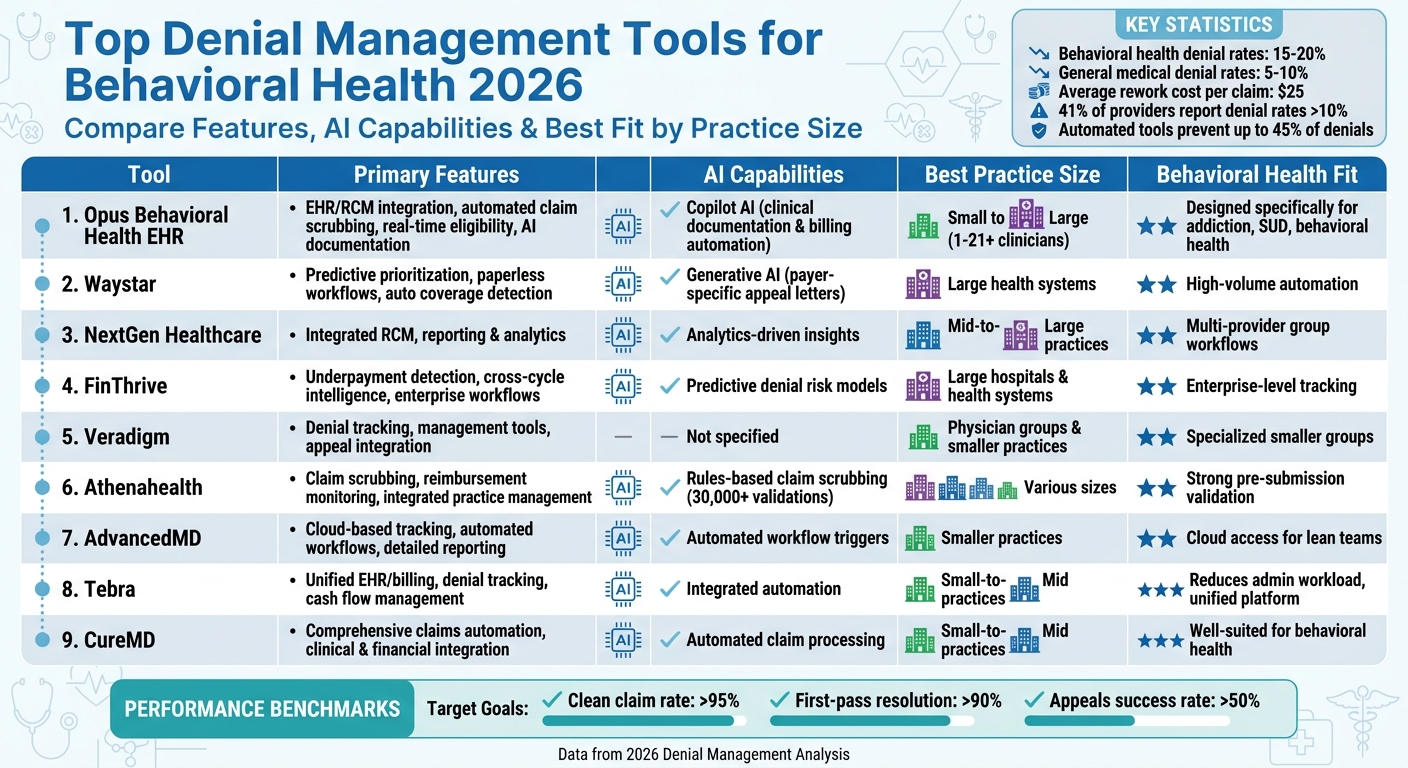
Denial Management Tools Comparison: Features, AI Capabilities, and Practice Size Suitability
Reflecting 2026 trends, denial management tools are increasingly using AI and automation to cut down claim denials and improve revenue workflows. Here's a side-by-side look at some of the leading tools and their standout features:
|
Tool Name |
Primary Denial Management Features |
AI Capabilities |
Recommended Practice Size |
Behavioral Health Suitability |
|---|---|---|---|---|
|
Opus Behavioral Health EHR |
Combines EHR/RCM, automated claim scrubbing, real-time eligibility checks, and AI-powered documentation |
Copilot AI for automating clinical documentation and billing |
Small to large behavioral health practices (1–21+ clinicians) |
Designed specifically for addiction, SUD, and behavioral health needs |
|
Waystar |
Predictive prioritization, paperless workflows, and auto coverage detection |
Generative AI for creating payer-specific appeal letters |
Large health systems |
Ideal for high-volume automation and complex appeals |
|
NextGen Healthcare |
Integrated RCM, reporting, and analytics tools |
Uses analytics for actionable insights |
Mid-to-large practices |
Optimized for multi-provider group workflows |
|
FinThrive |
Detects underpayments, cross-cycle intelligence, and enterprise workflows |
Predictive models to assess denial risks |
Large hospitals and health systems |
Tracks enterprise-level claims across multiple facilities |
|
Veradigm |
Offers denial tracking, management tools, and appeal integration |
Not specified |
Physician groups and smaller practices |
Best for specialized, smaller groups |
|
Athenahealth |
Claim scrubbing, reimbursement monitoring, and integrated practice management |
Rules-based claim scrubbing |
Suited for various practice sizes |
Strong pre-submission validation to minimize claim errors |
|
AdvancedMD |
Cloud-based tracking, automated workflows, and detailed reporting |
Automated workflow triggers |
Smaller practices |
Cloud access tailored for lean RCM teams |
|
Tebra |
Unified EHR and billing, claim denial tracking, and cash flow management |
Features integrated automation |
Small-to-mid practices |
Reduces administrative workload with a unified platform |
|
CureMD |
Comprehensive claims automation integrating clinical and financial workflows |
Automated claim processing |
Small-to-mid practices seeking single-vendor solutions |
Well-suited for behavioral health practices |
These tools provide a quick snapshot to help practices select the best fit based on size and specific needs.
For enterprise solutions, pricing typically depends on claim volume and facility size. Opus Behavioral Health EHR offers tiered plans (Basic, Standard, Premium), while CureMD provides custom pricing options.
The average initial denial rate in 2025 was 11.65%, meaning roughly one in nine claims were denied upon first submission [20]. In the behavioral health sector, 41% of providers reported denial rates exceeding 10% by 2025 [2], highlighting the growing need for specialized tools to safeguard revenue.
Conclusion
Selecting the right denial management software can make all the difference between losing revenue unnecessarily and maintaining a healthy cash flow.
With mental health claims facing denial rates of 15–20%, compared to the 5–10% average for general medical claims [1], behavioral health practices face unique hurdles. These range from proving medical necessity to navigating complex authorization processes.
Practice size plays a key role. Large health systems often benefit from enterprise-level platforms that support multiple facilities.
On the other hand, smaller practices may thrive with cloud-based solutions that integrate EHR and billing functions. It’s important to choose software that fits your current needs but can also grow alongside your practice. Tailored solutions are essential in addressing the specific demands of behavioral health.
When it comes to denial prevention, automation is your best ally. Tools like real-time eligibility verification can prevent around 25% of denials, while pre-submission claim scrubbing tackles about 12% of potential issues [1].
Considering the average rework cost is $25 per claim [1], and nearly 50% of denied claims are never reworked or appealed [43], investing in tools that focus on prevention can quickly pay off.
Focus on three critical features: seamless system integration, functionalities designed for behavioral health, and strong analytics capabilities. Generic platforms often fall short when it comes to the complexities of addiction treatment and outpatient mental health billing.
Set clear performance benchmarks: aim for a clean claim rate above 95%, a first-pass resolution rate over 90%, and an appeals success rate of at least 50% [1]. If your denial rate exceeds 10%, or if your billing team spends more time fixing issues than preventing them, it’s time to upgrade your software.
FAQs
Which denial metrics should a behavioral health practice track?
Behavioral health practices should keep a close eye on key denial metrics to fine-tune their revenue cycle management. Some critical metrics to track include:
Denial rate by reason: Understand why claims are being denied to address recurring issues.
Claim amount: Pinpoint which claims are costing the most in lost revenue.
Payer name: Identify patterns or trends with specific payers.
Date of denial: Spot timing-related issues that might affect claim processing.
Denial category: Classify denials to streamline follow-ups and appeals.By monitoring these elements, practices can uncover the root causes of denials and refine their processes to handle claims and appeals more effectively.
How do I choose the right denial tool for my practice size?
To pick the best denial management tool, start by evaluating your practice's claim complexity, patient volume, and overall revenue cycle requirements. For smaller practices, simpler tools like EHR reporting modules can help identify patterns and pinpoint root causes of denials.
On the other hand, larger practices or those requiring more automation should look into software designed to streamline workflows, monitor recurring issues, and provide actionable insights. Align the tool's features with your claim volume, staff capabilities, and automation goals to optimize revenue recovery.
What’s the fastest way to cut authorization and documentation denials?
The fastest way to cut down on authorization and documentation denials is to put strong denial tracking and management systems in place.
Tools such as structured tracking systems or EHR reporting modules can quickly pinpoint patterns and uncover root causes.
On top of that, automating denial workflows, routinely reviewing denial reasons, and tackling recurring problems head-on are smart steps to simplify processes, ease administrative workloads, and avoid future denials.



- Behavioral Health
- EHR Systems
- Addiction Treatment EHR
- mental health
- Telehealth
- addiction treatment
- Behavioral health facility
- Substance Abuse Disorder
- behavioral Health center
- HIPPA Compliant
- ehrsoftware
- PTSD
- behavioral health ehr
- Depression
- hipaa
- Anxiety
- MentalHealthMatters
- RCM
- claim denials
- clinical documentation
- mental health awareness
- screening tools

September 15, 2026

September 15, 2026

September 14, 2026

September 11, 2026

September 10, 2026

September 09, 2026
Recommended Posts

Monday, March 09, 2026
Case Study: Billing Errors Reduced with EHR Integration
Billing errors are a major headache for behavioral health centers,leading to claim denials, delayed payments, and lost ...

Tuesday, May 19, 2026
Behavioral Health EHR Billing Software Companies Ranked
Behavioral health billing is more complex than general medical billing, with challenges such as high denial rates, ...

Thursday, July 23, 2026
How Predictive Analytics Reduces Claim Denials
How Predictive Analytics Reduces Claim Denials Claim denials often start with small billing mistakes, and predictive ...