

Choosing the right EHR for your mental health practice matters.
It directly impacts how you manage clinical documentation, ensure compliance, and streamline billing.
Behavioral health practices require tools tailored to narrative-heavy documentation, long-term treatment plans, and strict privacy standards like HIPAA and 42 CFR Part 2.
Here’s what to look for:
Specialized Documentation: Support for SOAP, DAP, and BIRP note formats, ASAM Criteria, and tools for group therapy and psychiatry workflows (e.g., EPCS, PDMP).
Privacy and Security: Compliance with HIPAA and 42 CFR Part 2, role-based access controls, and data encryption to protect sensitive records.
Integrated Features: Telehealth, scheduling, billing, and client portals in one system to reduce administrative burdens.
Outcome Tracking: Built-in tools like PHQ-9 and GAD-7 for monitoring patient progress and improving care.
Scalability: Systems that adapt to solo practitioners, small practices, or large agencies with growing needs.Behavioral health-specific EHRs increase satisfaction by 35%, cut documentation time by 40%, and reduce no-show rates by up to 50%. Investing in the right system saves time, ensures compliance, and improves patient care.
Key Requirements for Behavioral Health EHRs
1. Documentation and Workflow Needs
Behavioral health documentation is unique, relying heavily on narrative-driven notes to track long-term treatment progress.
This contrasts with the concise, episodic notes commonly seen in primary care settings [1]. Your EHR should accommodate specific note formats like SOAP(Subjective, Objective, Assessment, Plan), DAP(Data, Assessment, Plan), and BIRP(Behavior, Intervention, Response, Plan)
[1][6][8].
These formats are crucial for accurately documenting therapy sessions, and forcing them into generic medical templates can disrupt workflows.
Treatment planning in this field typically follows the ASAM Criteria framework, which organizes information using the Problem-Goal-Objective-Intervention (PGOI) format. It’s important for the EHR to allow configurable review intervals for these plans [7].
For group therapy, the system should enable a single session entry while allowing individualized clinical observations for each participant [7].
Psychiatry practices, on the other hand, need features like EPCS (Electronic Prescribing of Controlled Substances), PDMP (Prescription Drug Monitoring Program) integration, and MAT (Medication-Assisted Treatment) workflows. Residential facilities benefit from tools like bed management, real-time census tracking, and medication pass workflows [5][7].
While tailored documentation is key, ensuring robust privacy measures is just as critical to protect sensitive behavioral health information.
2. Privacy and Security Compliance
Behavioral health data is particularly sensitive, requiring layers of protection that go beyond standard medical records.
For instance, HIPAA mandates that psychotherapy notes be kept separate from standard records and only disclosed with explicit written authorization [9]. This legal safeguard protects patient privacy and shields your practice from compliance issues.
Substance use disorder treatment is governed by 42 CFR Part 2, which enforces stricter confidentiality rules than HIPAA [1][2].
This federal regulation requires segmented records and prohibits re-disclosure without explicit consent. To meet these requirements, your EHR must offer granular consent management and restricted access controls. Ignoring this compliance can lead to steep legal and financial consequences, with migration to a compliant system later costing anywhere from $5,000 to $25,000 [2].
Look for systems with role-based access controls, which ensure administrative staff can manage scheduling and billing without accessing sensitive therapy notes [3][6][8].
Additionally, vendors should provide a Business Associate Agreement (BAA), a key component of HIPAA compliance [2].
For the highest level of security, prioritize EHRs certified with HITRUST or SOC 2 Type II audits, considered the gold standard for healthcare data security as of 2026 [2][3].
Core Features of a Mental Health EHR
Customizable Clinical Documentation
An effective EHR should fit seamlessly into your workflow, not force you into rigid templates designed for general medical practices.
Key features like Mental Status Exams (MSE), risk assessments, and treatment plans should be as intuitive to use as your progress notes. Flexible, well-designed templates that allow for narrative input can dramatically cut down on the 2 to 3 hours clinicians often spend on documentation each day.
When evaluating systems, time how long it takes to complete a realistic progress note. The best platforms allow you to finish one in just 2 to 3 minutes [1].
For psychiatrists, it's crucial to ensure the EHR includes features like e-Prescribing (eRx), Electronic Prescribing of Controlled Substances (EPCS), and integration with Prescription Drug Monitoring Programs (PDMP). These tools not only enhance documentation but also work in harmony with other practice management features.
Integrated Practice Management and Telehealth
A unified platform that combines scheduling, billing, and telehealth reduces data entry errors and streamlines administrative tasks.
For example, when scheduling a telehealth appointment, the system should automatically link it to your documentation and billing processes. Features like one-click session launches from your calendar eliminate the hassle of using third-party platforms or manually sharing meeting links.
Automated appointment reminders can cut no-show rates by up to 50% [2].
Additionally, secure client portals let patients complete intake forms and e-sign consents digitally, saving time and ensuring that all information flows directly into the EHR. For practices offering couples or family therapy, check that the telehealth feature supports multi-participant video sessions.
The billing component should simplify tasks such as real-time insurance eligibility checks and generating claims directly from session notes. Some advanced EHRs even include ambient AI technology to transcribe live telehealth sessions and create progress notes on the spot, reducing after-hours administrative work [10]. These integrations not only save time but also enhance the ability to track treatment outcomes effectively.
Outcome Measurement and Reporting
Outcome tracking tools build on efficient documentation and practice management to provide meaningful insights into treatment progress. With payers and accreditors increasingly expecting proof of treatment effectiveness, your EHR should include validated tools like the PHQ-9 for depression and GAD-7 for anxiety. These tools should automatically calculate scores and categorize severity levels (e.g., minimal, mild, moderate, severe).
Look for systems that offer visual trend analysis, allowing you to quickly assess whether a patient's PHQ-9 score has dropped significantly - whether by 5 points or 50% - from baseline. This type of tracking highlights clinically meaningful improvements [12]. Automated alerts can notify you when scores worsen or when reassessments are due. Importantly, documenting these assessments can be billable under CPT code 96127 [11].
Avoid systems that store outcome measures as static PDFs, as they create data silos. Instead, opt for a solution that automates the collection of validated measures at key points, such as intake, mid-treatment, and discharge. This ensures your team can consistently track progress and use the data to improve care delivery.
Matching EHR Capabilities to Practice Size
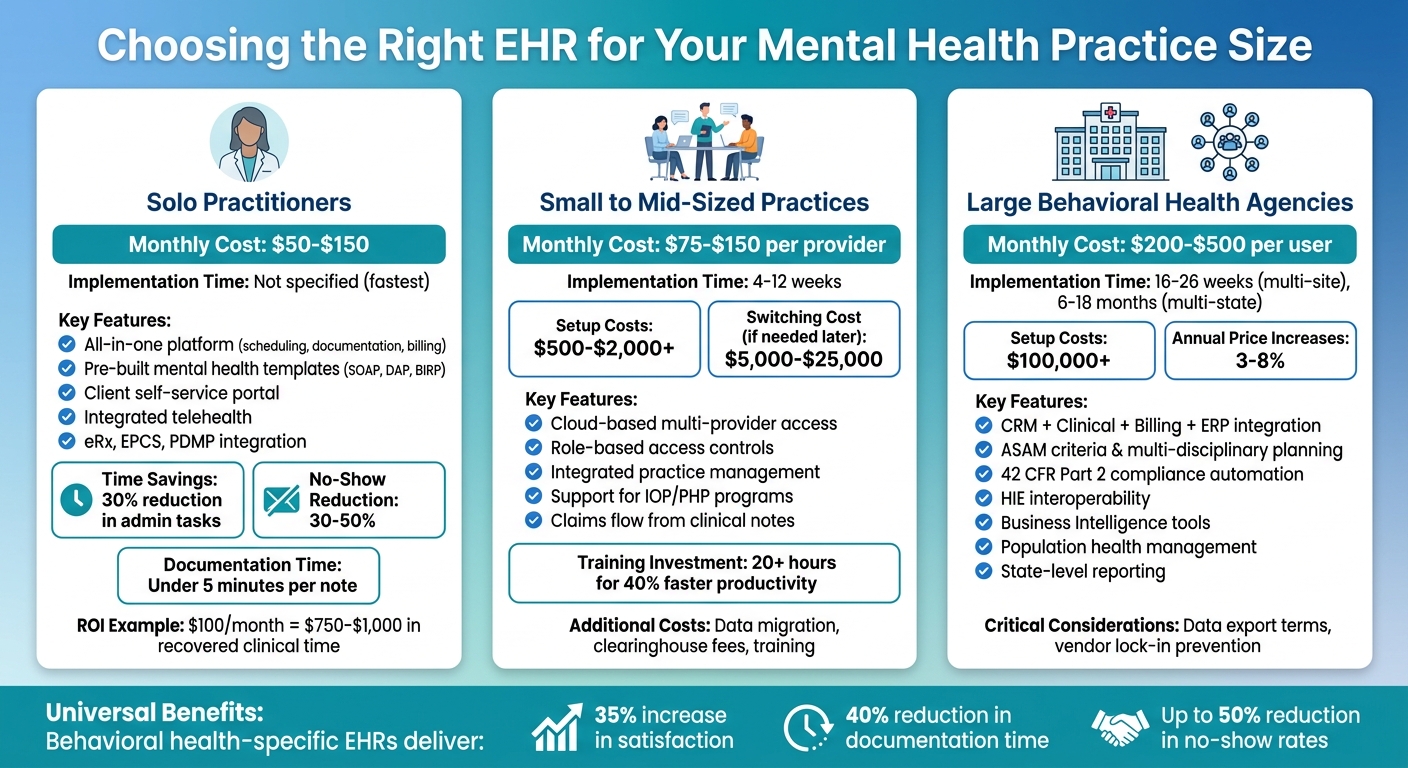
EHR Selection Guide by Mental Health Practice Size
Choosing the right EHR isn’t just about features - it’s about finding a system that fits the size and needs of your practice.
Solo Practitioners
If you’re running a solo practice, your EHR should simplify life by combining scheduling, documentation, billing, and IT tasks into one platform [14].
Efficiency is key. During a trial, see if you can complete a progress note in under five minutes [14]. Look for pre-built templates tailored to mental health documentation (like SOAP, DAP, or BIRP) and common psychiatric assessments such as PHQ-9 and GAD-7 [13].
Psychiatrists should ensure that e-Prescribing (eRx), Electronic Prescribing of Controlled Substances (EPCS), and PDMP integration are included - these shouldn’t be costly add-ons [5].
A client self-service portal is a must-have. It should handle digital intake forms, consent signatures, online scheduling, and secure messaging without constant oversight [13]. Integrated telehealth that launches directly from your calendar can save time, while automated appointment reminders can cut no-show rates by 30% to 50% [2].
"As a solo practitioner, you are the clinician, the office manager, the biller, and the IT department - your EHR needs to handle administrative work efficiently so you can focus on clients." - Ease Health [14]
Make sure the monthly fee ($50–$150) covers essential features like telehealth, e-claims, and patient portals.
For example, an EHR costing $100 per month that saves five hours of admin work weekly could translate to a $750–$1,000 return in recovered clinical time [14]. Many solo practitioners report cutting administrative tasks by 30% with a well-integrated system [13].
Small to Mid-Sized Practices
As your practice grows, your EHR needs to scale with you. A system designed for multiple providers should streamline workflows across locations and teams with a cloud-based infrastructure that’s accessible anytime, anywhere [2].
Integrated practice management is crucial. When clinical notes flow directly into claims, it reduces denials and speeds up revenue collection [3].
Role-based access controls are also essential to protect sensitive therapy notes - billing staff, for instance, should only see financial data, not clinical content [3]. The system should also support transitions to higher levels of care, such as Intensive Outpatient Programs (IOP) or Partial Hospitalization Programs (PHP).
"Revisit your choice in an EHR. Your decision has a ripple effect on the providers, administrators, and patients in your practice." - Kristin Trick, MA, LPC-S, RPT, Private Practice Therapist [3]
Budget for the full cost. Monthly fees typically range from $75 to $150 per provider [2]. Don’t forget to account for setup costs like implementation fees ($500–$2,000+), data migration, clearinghouse fees, and training.
Switching EHRs later can cost between $5,000 and $25,000, factoring in downtime and retraining [2]. Practices that invest at least 20 hours in staff training during implementation often reach full productivity 40% faster [2]. Implementation for small to mid-sized practices usually takes 4–12 weeks [2].
For practices with larger networks, the next section covers enterprise-level requirements.
Large Behavioral Health Agencies
Larger agencies need systems that go beyond basic integration to handle complex interoperability and reporting. These organizations require platforms that combine CRM (for admissions), clinical documentation, billing (RCM), and operations (ERP) to avoid data silos and reduce reconciliation errors [15][4].
Generic hospital systems often lack the specialized workflows behavioral health agencies need, such as ASAM criteria, multi-disciplinary treatment planning, and compliance with 42 CFR Part 2 for substance use disorder records [15].
Interoperability and advanced reporting are non-negotiable. Large networks must exchange data seamlessly with external providers, labs, pharmacies, and Health Information Exchanges (HIE) [15][16].
Business Intelligence tools should enable population health management, state-level reporting, and tracking clinical outcomes across programs [15]. The system should also segregate SUD records and enforce consent-based release workflows without relying on add-ons [15].
Long-term scalability is critical. Your EHR should accommodate new providers, programs, and locations without major disruptions or a complete overhaul [3][2].
Implementation for large, multi-site agencies typically takes 16–26 weeks, while multi-state networks may require 6–18 months [15]. Monthly subscription costs range from $200 to $500 per user, with setup and training fees often exceeding $100,000. Contracts may also include annual price increases of 3%–8% [15].
"The broad functionality allowed us to adopt the platform to our needs. It saves quite a bit of money and confusion in switching between systems." - Jay J., Executive Director, Behave Health [4]
Before signing a contract, confirm that data export terms are clear and that fees for exporting data won’t hold you hostage if you need to switch vendors later [15]. Involve billing staff early in demos to ensure the system supports complex Medicaid carve-outs and state-specific claim formats [15].
Compliance and Security for Behavioral Health EHRs
Mental health records come with distinct legal protections that demand extra care compared to standard medical documentation. Protecting this sensitive clinical data requires EHR systems that meet strict federal regulations while defending against cyber threats - especially as attacks on health systems tripled between 2016 and 2021 [18].
HIPAA Compliance and Data Security
To keep patient data secure, AES 256-bit encryption should be used for stored data, while TLS with forward secrecy protects information during transmission [17]. These tools ensure data is shielded both at rest and in transit.
Adding multi-factor authentication (MFA) is another essential step. Even if a password is stolen, MFA requires a secondary verification method, like a mobile code, before granting access. Security can be further tightened with audit trails and automatic account lockouts after repeated failed login attempts [18].
Role-based access control (RBAC) is critical for limiting user permissions. For instance, billing staff should not have access to clinical notes, and front-desk staff don’t need to view psychotherapy documentation [9]. Audit trails track every action - whether it’s viewing, editing, or exporting data - ensuring accountability in case of a breach.
Modern cloud-based EHR systems configured to Center for Internet Security (CIS) benchmarks can achieve up to 99.999999999% durability and 99.99% availability [17]. Additionally, ensure that all vendors sign a BAA (Business Associate Agreement), affirming their commitment to protecting PHI.
These technical safeguards create a solid framework for handling sensitive behavioral health data securely.
Managing Sensitive Behavioral Health Information
Beyond technical measures, managing mental health data involves additional specialized controls.
Psychotherapy notes require extra care. Under HIPAA, these notes are treated differently from standard progress notes. They must be stored separately from the general medical record and can only be disclosed with the patient’s explicit written consent - except in rare cases, such as a court order or to prevent serious harm [9].
"Psychotherapy notes can be disclosed only with the patient's explicit written authorization, except in limited situations such as a court order or to prevent a serious threat to health or safety." - Patagonia Health [9]
For practices treating substance use disorders, compliance with 42 CFR Part 2 is mandatory. These regulations are stricter than HIPAA and require consent-driven workflows for data release [4].
Your EHR should automatically enforce these workflows and segregate substance use disorder records to maintain compliance.
When it comes to communication, HIPAA-compliant channels are a must. For example, sending a message like "Reminder: therapy appointment tomorrow at 2:00 PM" could inadvertently expose PHI [9]. To avoid this, use integrated messaging, telehealth, and patient portals built into the EHR system, rather than relying on third-party tools like Zoom or Skype [4].
The Cures Act adds another layer of responsibility. While it promotes data sharing to prevent information blocking, behavioral health EHRs must balance this with protecting sensitive information [9]. Systems designed specifically for mental health can handle this balance by allowing clinicians to separate psychotherapy notes while still sharing standard clinical data when appropriate.
How Opus Behavioral Health EHR Supports Mental Health Practices
Opus Behavioral Health EHR addresses the challenges of compliance and workflow management by offering solutions specifically designed for mental health practices.
Tailored Workflows for Behavioral Health
Built specifically for mental health and addiction treatment, Opus Behavioral Health EHR includes over 100 assessment tools like ASAM criteria, PHQ-9, GAD-7, AUDIT, DAST, and the Columbia Suicide Severity Rating Scale.
These tools integrate with visual progress graphs, allowing clinicians to measure treatment outcomes and share progress with patients.
For residential programs, the platform’s Recovery Coaching Rounds feature replaces manual paper logs with digital tools, enabling staff to log observations, monitor patient status across shifts, and escalate concerns when necessary.
Its CRM-to-RCM architecture ensures a seamless patient experience - covering everything from initial contact to billing - while minimizing revenue loss caused by incomplete documentation [21].
"We chose Opus because it is user-friendly and configurable. We are looking forward to designing a system that meets our agency's unique needs."
Jennifer Gozy, PsyD, LP, Director of Clinical Systems and Compliance, Care Counseling Clinics [20]
AI Tools and Automation for Efficiency
The Copilot AI feature helps clinicians save time by automatically drafting progress notes for both in-person and telehealth sessions, cutting documentation time by 40% [19].
Dr. Jennifer Williams noted that providers spent 35% less time on documentation while capturing more detailed clinical information [19].
The platform’s AI sentiment analysis evaluates text and speech to predict outcomes and detect risks early. Automated billing features, such as claim generation from clinical encounters and algorithms for reviewing group session data, further reduce errors that could lead to claim rejections [20].
These tools, combined with Opus’ scalable design, ensure smooth operations for practices of all sizes.
Integration and Scalability
As a cloud-based solution, Opus eliminates the need for on-premise hardware and supports practices ranging from solo providers to large organizations.
Trusted by over 160,000 practitioners and processing data for more than 44 million clients, the platform integrates telehealth for individual and group sessions, DEA-compliant e-prescribing for controlled substances, and lab results directly into patient files [20].
For those exploring the system, Opus offers a free tier that includes basic scheduling, billing tools, and access to over 140 practice management reports, helping practices monitor treatment trends and operational performance [21].
"As our organization continues to grow, we need a partner that can grow with us. OPUS is that perfect partner."
Trevor Mulvey, VP of Finance, Care Counseling Clinics [22]
Conclusion
Choosing the right EHR is about finding a partner that truly understands the specific needs of your behavioral health practice. This decision impacts everything - from how efficiently clinicians handle documentation to how effectively your billing team secures reimbursements.
Research indicates that behavioral health-focused EHRs can increase satisfaction by 35%, reduce documentation time by 40%, and lower both no-show rates and claim denials [2][20]. These benefits translate into more time for patient care and improved financial outcomes.
These results emphasize the value of a solution designed for your needs. Opus Behavioral Health EHR integrates clinical and administrative workflows to enhance patient care and streamline operations.
Features like AI-driven documentation and seamless CRM-to-RCM integration ensure scalability, whether you're a solo practitioner or managing a large, multi-site agency.
To make the best choice, involve your clinical and billing teams in product demos, test workflows thoroughly, and account for all implementation and training costs [2][23]. The ideal EHR should feel like a natural extension of your practice, supporting your clinical expertise while managing the complexities of behavioral health care.
FAQs
How do I test an EHR to see if it fits my note-writing style?
To figure out if an EHR matches your note-writing preferences, see if it supports structured formats like SOAP notes and offers options for customization, such as adjustable templates or reorganizing sections. Make sure it aligns with key documentation principles, like being clear and thorough. Many EHR systems provide trial periods or demos, so take advantage of those to test sample notes and confirm that the interface and features fit seamlessly into your workflow.
What should I ask to confirm HIPAA and 42 CFR Part 2 compliance?
To ensure compliance with HIPAA and 42 CFR Part 2, check if the EHR system includes essential safeguards like encryption, multi-factor authentication, role-based access controls, and audit logs. It's also important to confirm that the provider performs regular risk assessments, conducts staff training, and has clear incident response procedures in place. Make sure the system is designed to meet the specific confidentiality requirements for substance use disorder records, as outlined in both HIPAA and 42 CFR Part 2.
Which integrations will reduce no-shows and speed up billing?
Integrating appointment reminder software with your EHR can make a big difference in reducing no-shows. By sending out automated and timely reminders, patients are less likely to forget their appointments, keeping your schedule on track.
On the financial side, connecting billing software to your EHR simplifies the revenue cycle. This integration speeds up claim submissions and ensures greater accuracy, so payments are processed more efficiently. Together, these tools can significantly improve your practice's workflow and keep operations running smoothly.



- Behavioral Health
- EHR Systems
- Addiction Treatment EHR
- mental health
- Telehealth
- addiction treatment
- Behavioral health facility
- Substance Abuse Disorder
- behavioral Health center
- HIPPA Compliant
- ehrsoftware
- PTSD
- behavioral health ehr
- Depression
- hipaa
- Anxiety
- MentalHealthMatters
- RCM
- claim denials
- clinical documentation
- mental health awareness
- screening tools

September 15, 2026

September 15, 2026

September 14, 2026

September 11, 2026

September 10, 2026

September 09, 2026
Recommended Posts

Monday, June 15, 2026
Essential Features in Mental Health EHR Systems
Mental health EHRs are specialized tools designed for behavioral health professionals, addressing unique challenges ...

Monday, June 22, 2026
Signs Your Mental Health EHR Has Aged Out
Outdated EHR systems can hurt your practice more than you think. If your system slows down workflows, struggles with ...

Saturday, June 06, 2026
The Mental Health EHR Features Your Clinic Can't Afford to Skip
Mental health clinics need EHR systems tailored to their unique demands-generic platforms simply won't cut it. From ...