
Data encryption is now a must-have for protecting sensitive patient data in healthcare Revenue Cycle Management (RCM). With cyberattacks on the rise, encryption ensures that even if systems are breached, the data remains unreadable.
Here’s why it’s crucial:
Cyber Threats Are Escalating: Breaches cost an average of $11 million, with 91% starting from phishing. Automated RCM systems, where bots outnumber humans 82 to 1, create more vulnerabilities.
Encryption Protects Data: It secures patient and payment information both at rest (stored) and in transit (transmitted). Standards like AES-256 and TLS 1.3 are essential.
Compliance Is Non-Negotiable: Updated HIPAA rules (May 2026) mandate end-to-end encryption for all electronic health data. Non-compliance risks fines exceeding $50,000 per violation.Minimizes Breach Impact: Properly encrypted data qualifies for "safe harbor", avoiding breach notifications and penalties.
Encryption safeguards financial and clinical data, ensures compliance, and reduces risks in an era of rising cybercrime. Whether it’s securing claims, payments, or patient records, encryption is a key defense for healthcare organizations.
What Data Encryption Protects in Healthcare RCM
Payment and Billing Data Most at Risk
Revenue Cycle Management (RCM) workflows handle a wide range of sensitive information, including credit card numbers, banking details from ACH transactions, co-pay amounts, outstanding balances, and patient or guarantor identifiers like names, addresses, and phone numbers.
These details are highly attractive to cybercriminals. In behavioral health settings, this risk extends to family members' personal information as well.
Additionally, claims identifiers, eligibility verification results, and remittance records frequently pass between EHR systems, clearinghouses, and payer portals, creating multiple points where data could be exposed during the billing process.
The situation becomes even more complex with the integration of clinical data into billing systems. This overlap between financial and clinical information heightens the need for robust encryption measures.
As Gil Vidals, CEO of HIPAA Vault, explains:
"A payment becomes HIPAA-regulated when it includes or connects to: Patient names linked to balances, procedure or service descriptions, appointment references, or invoice notes." [5]
Because billing statements often carry Protected Health Information (PHI), encryption isn't just about meeting compliance standards - it's a critical safeguard for patient privacy.
Encryption for Data at Rest vs. Data in Transit
Understanding the difference between data at rest and data in transit is essential because each state requires tailored encryption strategies.
Data at rest refers to information stored in databases, local servers, or cloud storage. Examples include billing histories, archived claims, and patient financial records. To protect this type of data, the industry relies on AES-256 encryption, which scrambles stored information, making it unreadable without the correct decryption key [4].
Data in transit involves information actively moving between systems - such as claims sent from an EHR to a clearinghouse or payments submitted via an online portal. TLS 1.3 is the current encryption standard for securing these transmissions, ensuring data remains protected from interception during transfer [4].
|
Data State |
RCM Workflow Example |
Recommended Encryption Standard |
|---|---|---|
|
At Rest |
Stored billing history, archived claims, patient financial records |
AES-256 [4] |
|
In Transit |
Claims submissions to clearinghouses, patient portal transactions |
TLS 1.3 [4] |
|
Point-of-Interaction |
Credit card swipe at front desk, mobile payment apps |
P2PE / E2EE [4] |
Point-to-point encryption (P2PE) is particularly important at the moment of payment, such as when a credit card is swiped or a chip is inserted. This method encrypts payment data immediately, ensuring healthcare facilities never handle unencrypted card information [4].
As highlighted by the HIPAA Partners team:
"All patient data must remain encrypted during transmission and storage, using current industry-standard encryption algorithms." [4]
Failing to secure either data at rest or data in transit can leave a critical vulnerability.
For example, encrypting stored records but transmitting claims over an unsecured connection - or vice versa - can expose patient payment systems to breaches.
By understanding these distinctions, healthcare organizations can better align encryption practices with compliance requirements and reduce financial risks throughout the revenue cycle.
Platforms like Opus Behavioral Health EHR adopt these encryption standards to protect patient payment and billing data at every stage of the revenue cycle.
How Encryption Supports Compliance and Reduces Risk
Meeting HIPAA and PCI DSS Requirements
Encryption is no longer optional under HIPAA regulations. Starting in May 2026, updated HIPAA and 42 CFR Part 2 rules will require end-to-end encryption for all electronic protected health information (ePHI) and substance use disorder records within Revenue Cycle Management (RCM) systems [3].
This applies to every covered entity and business associate handling patient billing data, regardless of their size.
"No more 'addressable' vs. 'required'; encryption, MFA, and access controls are now non-negotiable for all ePHI." - RevGen Billing [3]
On the payment side, PCI DSS standards already mandate encryption for cardholder data during both transmission and storage.
These requirements align closely with HIPAA's technical safeguards. Together, these frameworks establish a compliance baseline that RCM platforms must adhere to in order to legally process patient payments and submit claims.
By implementing these measures, organizations not only protect sensitive data but also reduce the financial risks associated with security breaches.
Reducing Breach Risks and Financial Penalties
One of the biggest advantages of encryption is its ability to minimize the impact of breaches. Under the HIPAA Breach Notification Rule, properly encrypted PHI qualifies for "safe harbor" [7]. This means if a device containing encrypted data is lost or stolen, it’s not considered a reportable breach.
As Garvita Amin, a healthcare technology expert, explains:
"Encryption is the single control that turns a HIPAA breach into a non-event." [7]
Failing to comply with encryption requirements can lead to severe financial penalties, with fines exceeding $50,000 per violation.
The average cost of a breach often falls between $7 million and $10 million [3][6]. Real-world examples highlight the consequences: in April 2026, the HHS Office for Civil Rights (OCR) settled with four organizations following ransomware attacks that compromised data for over 427,000 individuals. These settlements totaled $1,165,000 in penalties [6].
One of the affected entities, Consociate Health, paid $225,000 after a phishing attack exposed sensitive information - including credit card numbers, bank account details, Social Security numbers, and medical diagnoses for 136,539 individuals. The breach stemmed from weak risk analysis and inadequate encryption [6].
OCR Director Paula M. Stannard emphasized the importance of proactive compliance:
"Proactively implementing the HIPAA Security Rule before a breach or an OCR investigation not only is the law but also is a regulated entity's best opportunity to prevent or mitigate the harmful effects of a successful cyberattack." [6]
For RCM teams, the message is clear: encryption is a critical tool for minimizing legal, financial, and reputational fallout from security incidents. In many cases, it’s the deciding factor in whether an incident escalates into a public breach.
Encryption Methods Used in RCM Systems
Choosing the right encryption methods is critical for safeguarding patient payment data. Each method addresses specific vulnerabilities, and using a combination of these tools ensures that patient billing data remains secure throughout its lifecycle.
Database and File Encryption for Stored RCM Data
When billing records, payment histories, and patient financial data are stored in databases or servers, they are classified as data at rest. Database and file encryption convert this stored data into an unreadable format, ensuring it can't be accessed without the correct decryption key.
A common oversight among organizations is assuming that cloud storage is automatically encrypted. In fact, nearly 99% of cloud security failures through 2025 are expected to stem from customer misconfigurations, not provider-side issues [2].
Under the shared responsibility model, it's crucial to actively configure encryption settings rather than relying on the cloud vendor to handle it.
The Institute at MagMutual highlights this clearly: "The use of password protection without encryption is not HIPAA-compliant." [10] To meet compliance, encryption must be applied to databases and files, with encryption keys securely stored in separate locations.
"Encryption is non-negotiable when securing RCM data in an automated environment. Every piece of patient and billing data must be protected whether it's sitting in a database or moving between systems." - ProMantra [2]
Next, let’s explore how encryption ensures secure data transfer between systems.
TLS/SSL and VPNs for Data in Transit
In RCM workflows, data is constantly exchanged between EHRs, clearinghouses, payer portals, and billing platforms.
To protect this data in transit, protocols like TLS (Transport Layer Security) and SSL (Secure Sockets Layer), along with VPNs (Virtual Private Networks), create encrypted channels that prevent unauthorized interception during transmission.
The importance of transit encryption cannot be overstated. Past breaches have highlighted the dangers of leaving data unencrypted during transmission [2][9].
As part of the 2026 HIPAA updates, encryption for data in transit is no longer optional - it’s now a required technical safeguard [9]. Organizations must also obtain annual written assurances from their business associates confirming that their transmission encryption complies with these updated standards.
Let’s also consider the role of encryption in securing electronic communications.
Email Encryption for Billing Communications
Email remains a weak link in RCM security. Billing teams often send EOBs, claim updates, and payment details via email without encryption, leaving them vulnerable to breaches. In 2023, unauthorized access accounted for 25% of email-related security incidents [8].
Encrypting emails that contain billing information ensures that even if intercepted, the data is unreadable to anyone without proper credentials. This applies to both internal communications and exchanges with patients, payers, or clearinghouses.
"Applying encryption at each step of data handling during transfers and storage can reduce unauthorized disclosures and comply with HIPAA regulations." - IS Partners [8]
Best Practices for Encryption Key Management
Strong encryption is only as good as the management of its keys. Without proper handling, even the best encryption can fail to protect sensitive data. As healthcare technology expert Garvita Amin aptly states:
"Encryption without a proper key management strategy is ineffective." [7]
Secure Key Storage and Access Control
One critical rule in managing encryption keys is this: never store the keys in the same place as the data they protect.
VertiComply emphasizes this point:
"If the keys live in the same database as the ciphertext, an attacker who reads the database reads the keys." [7]
To mitigate this risk, keys should be stored in specialized tools like Key Management Systems (KMS) or Hardware Security Modules (HSMs).
These tools not only isolate the keys but also enforce access controls and keep audit logs. For healthcare settings that deal with sensitive patient or financial data, using a two-layer encryption approach is highly recommended. This involves:
A Data Encryption Key (DEK) to encrypt the actual records.
A Key Encryption Key (KEK) stored securely in the KMS to protect the DEK.
Access to these keys should follow the principle of least privilege. Here’s how to ensure secure access:
Assign at least two key custodians.
Implement Role-Based Access Control (RBAC).
Require multi-factor authentication (MFA) for all privileged operations.Additionally, compliance regulations like HIPAA mandate that access logs and key management records be kept for six years [7].
While secure storage is essential, regular key rotation is equally important to minimize risks.
Key Rotation and Hardware Security Modules
Encryption keys can become vulnerable over time, especially if they are exposed or compromised. Regular key rotation helps reduce this risk. For highly sensitive healthcare data, the recommended rotation interval is every 90 days [7].
However, audits often uncover lapses in this practice.
As Amin points out:
"You say you rotate every 90 days, but the KMS console shows the master key has not changed in 2 years." [7]
Automating key rotation through a managed KMS can help organizations stay on track and avoid such pitfalls.
Hardware Security Modules (HSMs) offer another layer of protection. These devices create a secure, tamper-resistant environment for generating and using encryption keys.
Crucially, HSMs ensure that keys are never exposed to application memory. HIPAA expert Kevin Henry explains their value:
"A Hardware Security Module (HSM) provides a tamper‑resistant root of trust that generates, stores, and uses cryptographic keys without exposing them to application memory." [11]
Advanced HSMs that meet FIPS 140-3 Level 3 standards go even further. They can detect physical tampering and destroy the stored keys if necessary, making them an ideal choice for organizations managing large volumes of sensitive payment or patient data.
|
Key Management Component |
2026 Best Practice Standard |
|---|---|
|
Storage Location |
Managed KMS or FIPS 140-3 Level 3 HSM |
|
Rotation Cadence |
90 days (high sensitivity) to 1 year (standard) |
|
Access Policy |
Minimum of 2 designated custodians; IAM-restricted |
|
Log Retention |
6 years |
|
Architecture |
Envelope encryption (KEK/DEK) |
Where Encryption Is Applied Across the Revenue Cycle
Encryption plays a critical role in safeguarding data throughout the revenue cycle, ensuring sensitive information is protected at every stage. From patient payment portals to claims workflows, each step relies on specific encryption methods tailored to the type of data and its flow.
Encryption in Patient Payment Portals and Claims Workflows
When patients log into payment portals to pay their bills, TLS 1.3 with forward secrecy secures the connection. To prevent session hijacking, session tokens are protected using JWT combined with HMAC-SHA256 encryption [12].
Claims workflows handle even more sensitive data, such as Social Security Numbers (SSNs) and Medical Record Numbers (MRNs).
Basic disk encryption alone isn’t enough. By incorporating field-level encryption, critical details like SSNs and MRNs remain secure, even if login credentials are compromised [7].
For claims transmitted electronically, 2048-bit TLS encryption ensures that Protected Health Information (PHI) remains secure while in transit [12].
"As of 2025 and through 2026, encryption is required - no equivalent alternatives, no addressable opt-out." - VertiComply [7]
Encryption doesn’t stop when data reaches its destination. As information moves from being in transit to being stored, robust encryption continues to shield it from unauthorized access.
Securing Remittance Processing and Stored Financial Records
Once data is stored, it requires equally strong encryption to maintain its safety. For remittance files, financial records, and database backups, AES-256-GCM encryption at rest is the standard [7]. This ensures that even if a storage server is physically breached, the data inside remains inaccessible.
Modern Revenue Cycle Management (RCM) platforms are adopting FHIR-based APIs for real-time remittance processing, replacing outdated EDI file transfers.
These APIs come with built-in encryption and automated reconciliation processes, reducing manual errors and limiting exposure to potential attacks compared to older systems [13].
The table below highlights how encryption is applied across key RCM components:
|
RCM Component |
Encryption State |
Recommended Standard |
|---|---|---|
|
Patient Payment Portals |
In Transit |
TLS 1.3 with forward secrecy [7] |
|
Claims Submission |
In Transit |
2048-bit TLS Encryption [12] |
|
Session Management |
In Use |
JWT with HMAC-SHA256 [12] |
|
Stored Financial Records & Remittance |
At Rest |
AES-256-GCM [7] |
|
Key Management Infrastructure |
Infrastructure |
Managed KMS or FIPS 140-3 Level 3 HSM [7] |
Encryption standards like these ensure that sensitive data remains protected, no matter where it resides or how it is transmitted.
Current Security Priorities in Healthcare RCM
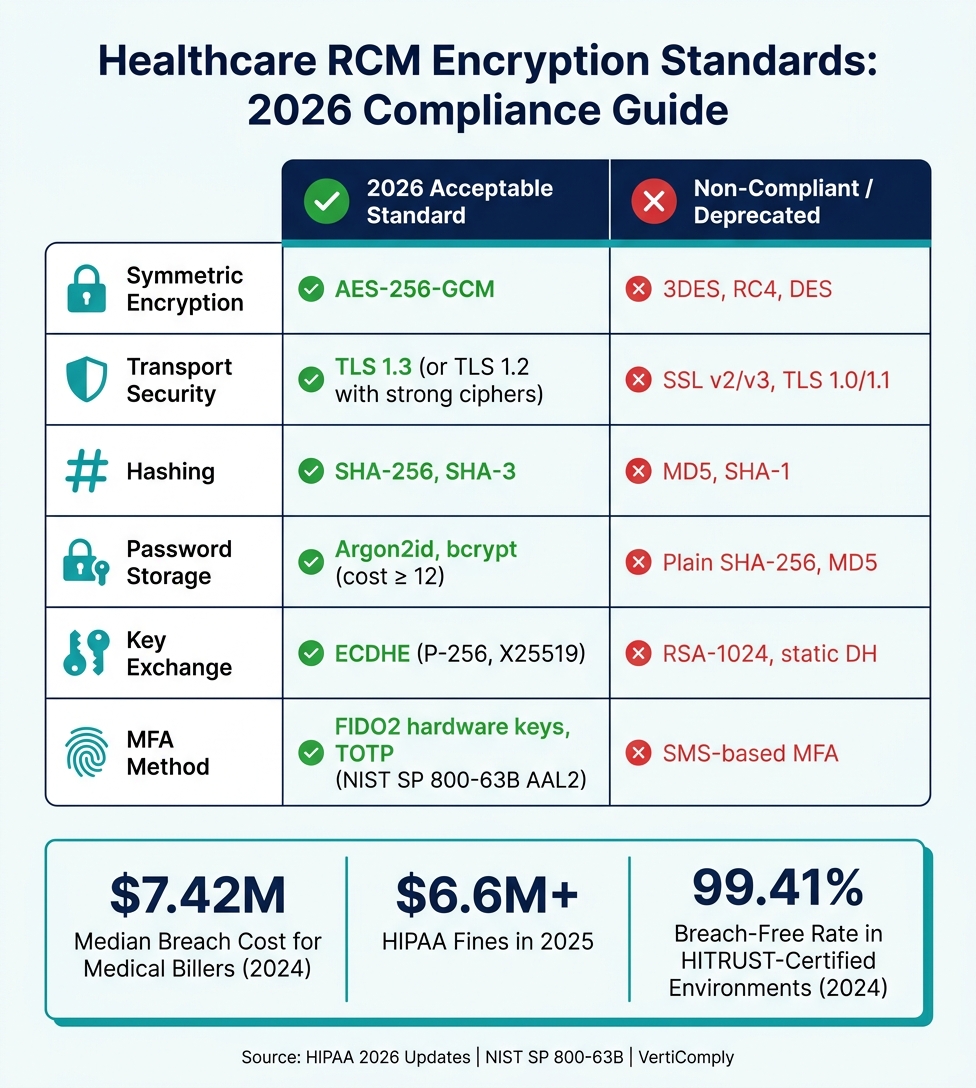
Healthcare RCM Encryption Standards: 2026 Compliance Guide
Stronger Encryption Algorithms and Multi-Factor Authentication
Cybersecurity in healthcare revenue cycle management (RCM) has reached a critical juncture. By 2026, organizations must adhere to stringent encryption and authentication standards to combat evolving threats. For data at rest, AES-256-GCM is now the baseline, while TLS 1.3 secures data in transit. Older protocols like TLS 1.0 and 1.1 no longer pass compliance checks [7].
Here’s a quick breakdown of acceptable versus non-compliant standards:
|
Purpose |
2026 Acceptable Standard |
Non-Compliant |
|---|---|---|
|
Symmetric Encryption |
AES-256-GCM |
3DES, RC4, DES |
|
Transport Security |
TLS 1.3 (or TLS 1.2 with strong ciphers) |
SSL v2/v3, TLS 1.0/1.1 |
|
Hashing |
SHA-256, SHA-3 |
MD5, SHA-1 |
|
Password Storage |
Argon2id, bcrypt (cost ≥ 12) |
Plain SHA-256, MD5 |
|
Key Exchange |
ECDHE (P-256, X25519) |
RSA-1024, static DH |
These updates aim to protect sensitive data from modern attacks, ensuring both stored and transmitted information remains secure.
Multi-factor authentication (MFA) has also evolved. It’s no longer just for remote logins - every access point now requires MFA.
The 2026 HIPAA updates specifically ban SMS-based MFA, pushing organizations toward FIDO2 hardware keys and TOTP authenticators that meet NIST SP 800-63B Authenticator Assurance Level 2 [15][16].
Furthermore, many organizations are beginning to adopt post-quantum cryptography (PQC) - such as FIPS 203, 204, and 205 - to shield long-term patient data from future threats like "harvest now, decrypt later" attacks [14].
While these technical upgrades are critical, the human element remains just as important in securing RCM systems.
Staff Training and Third-Party Risk Management
Even the most advanced systems can’t compensate for human vulnerabilities. Social engineering attacks, particularly phishing, remain a major risk. In fact, phishing accounted for 16% of reported breaches through September 2025 [9].
To address this, organizations are implementing quarterly phishing simulations and ongoing security training to keep staff vigilant.
Third-party risk is another pressing issue. A ransomware attack in February 2024 disrupted billing operations for thousands of practices, compromising nearly 193 million health records and causing massive financial losses due to delayed claims [9][2].
This incident led to a major regulatory shift: as of 2026, a signed Business Associate Agreement (BAA) is no longer enough to ensure vendor security.
Organizations must now secure annual written verification, such as SOC 2 Type II or HITRUST r2 certifications, from all RCM vendors [9].
"Being self-proclaimed compliant is worth zero dollars. Being validated by a third party is worth millions." - Human Medical Billing [9]
The importance of third-party validation is underscored by data: HITRUST-certified environments reported a breach-free rate of 99.41% in 2024 [9].
Organizations are now expected to demand full audit reports from vendors and refuse partnerships with those unwilling to share them under NDA. These measures are becoming the gold standard for safeguarding patient payment data throughout the revenue cycle.
Conclusion: Building a Secure RCM Framework with Encryption
Key Takeaways
Encryption isn’t just a best practice anymore - it’s a legal requirement. Consider this: medical billers faced a staggering $7.42 million median breach cost in 2024, while HIPAA fines topped $6.6 million in 2025, with penalties reaching up to $3,000,000 [9].
To protect sensitive patient payment data, a secure RCM framework should include:
AES-256-GCM encryption for data at rest
TLS 1.3 protocols for data in transit
NIST-compliant key management
Layered multi-factor authentication (MFA)
Ongoing monitoring and threat detectionAdditionally, third-party certifications like SOC 2 Type II or HITRUST r2 are no longer optional - they’re essential [9]. These measures are the foundation of safeguarding patient data in today’s regulatory environment.
"Encryption is no longer optional. The proposed rule makes encryption a required safeguard." - Human Medical Billing [9]
Steps Toward a Secure RCM Framework
To strengthen your RCM framework, start by mapping all ePHI flows across your system, from databases and APIs to payment portals and billing integrations.
Once you’ve identified these pathways, confirm that your vendors comply with current encryption standards. Don’t just take their word for it - demand full audit reports instead of relying on self-reported claims [9][12].
Some platforms are already designed with these security needs in mind. For example, Opus Behavioral Health EHR employs robust security measures like organization-wide MFA, HMAC-SHA256 token authentication, and 2048-bit TLS encryption for all client-server communications.
This ensures patient data remains protected at every level [12]. Similarly, payment solutions like Curogram integrate PCI-DSS Level 1 secure, encrypted text-to-pay links, eliminating the risk of storing sensitive card data locally [1].
To maintain a secure ecosystem, conduct annual vendor audits and insist on third-party certifications. This proactive approach not only ensures compliance with regulations but also provides peace of mind by safeguarding patient payment data throughout the revenue cycle.
FAQs
What RCM data should be encrypted first?
The first type of revenue cycle management (RCM) data you should encrypt includes patient-linked payment information - things like billing documents, invoices, and statements.
Encrypting this data not only helps maintain HIPAA compliance but also protects protected health information (PHI) at every stage: creation, storage, and transmission.
How do we know our encryption qualifies for HIPAA safe harbor?
Your encryption can meet HIPAA safe harbor requirements if it aligns with NIST standards, like AES-256 for data stored on devices and TLS 1.2 or higher for data being transmitted. Be sure to maintain thorough documentation to prove compliance, as these standards are accepted by the OCR for safe harbor qualification.
What’s the biggest encryption mistake in cloud-based RCM?
The most critical misstep in cloud-based RCM encryption is neglecting to implement and regularly update robust standards such as AES-256 for securing data at rest and TLS 1.3 for protecting data in transit.
Without these protections, sensitive protected health information (PHI) could be exposed to breaches, jeopardizing both patient privacy and regulatory compliance.



- Behavioral Health
- EHR Systems
- Addiction Treatment EHR
- mental health
- Telehealth
- addiction treatment
- Behavioral health facility
- Substance Abuse Disorder
- behavioral Health center
- HIPPA Compliant
- ehrsoftware
- PTSD
- behavioral health ehr
- Depression
- hipaa
- Anxiety
- MentalHealthMatters
- RCM
- claim denials
- clinical documentation
- mental health awareness
- screening tools

September 15, 2026

September 15, 2026

September 14, 2026

September 11, 2026

September 10, 2026

September 09, 2026
Recommended Posts
Friday, June 19, 2026
Evaluating Software Vendors for HIPAA
When selecting software vendors for behavioral health, ensuring compliance with HIPAA and 42 CFR Part 2 is ...
Friday, May 15, 2026
HIPAA vs 42 CFR Part 2: Data Encryption Rules
HIPAA and 42 CFR Part 2 both require encryption to protect patient data, but they differ in scope and strictness.

Tuesday, June 23, 2026
Conducting a HIPAA Risk Assessment: Key Steps
A HIPAA risk assessment is mandatory for any organization handling electronic protected health information (ePHI).