

Tired of PTSD tools that overpromise and underdeliver?
Start with these three free, clinician-trusted options for 2026:: use PC-PTSD-5 for a fast screen, PCL-5 for symptom tracking, and CAPS-5 when a clinician needs to confirm PTSD.
That matters because PTSD and substance use disorder appear together in about 50% of cases, so picking the right tool fast can shape intake, follow-up, and diagnosis.
Key Points:
PCL-5: best for screening + tracking symptoms
CAPS-5: best for formal DSM-5 diagnosis
PCL-5 with Criterion A / PC-PTSD-5 / LEC-5: best for screening with trauma context
SPRINT: best for a brief clinician-rated symptom check
IES-R: best for event-specific distress tracking, but it uses DSM-IV, not DSM-5A few numbers stand out:
PC-PTSD-5: about 1–2 minutes
PCL-5: about 5–10 minutes
CAPS-5: about 45–60 minutes
PCL-5 cutoff: 31–33 often points to probable PTSD
PCL-5 change score: a 10-point drop often shows treatment responseQuick Comparison
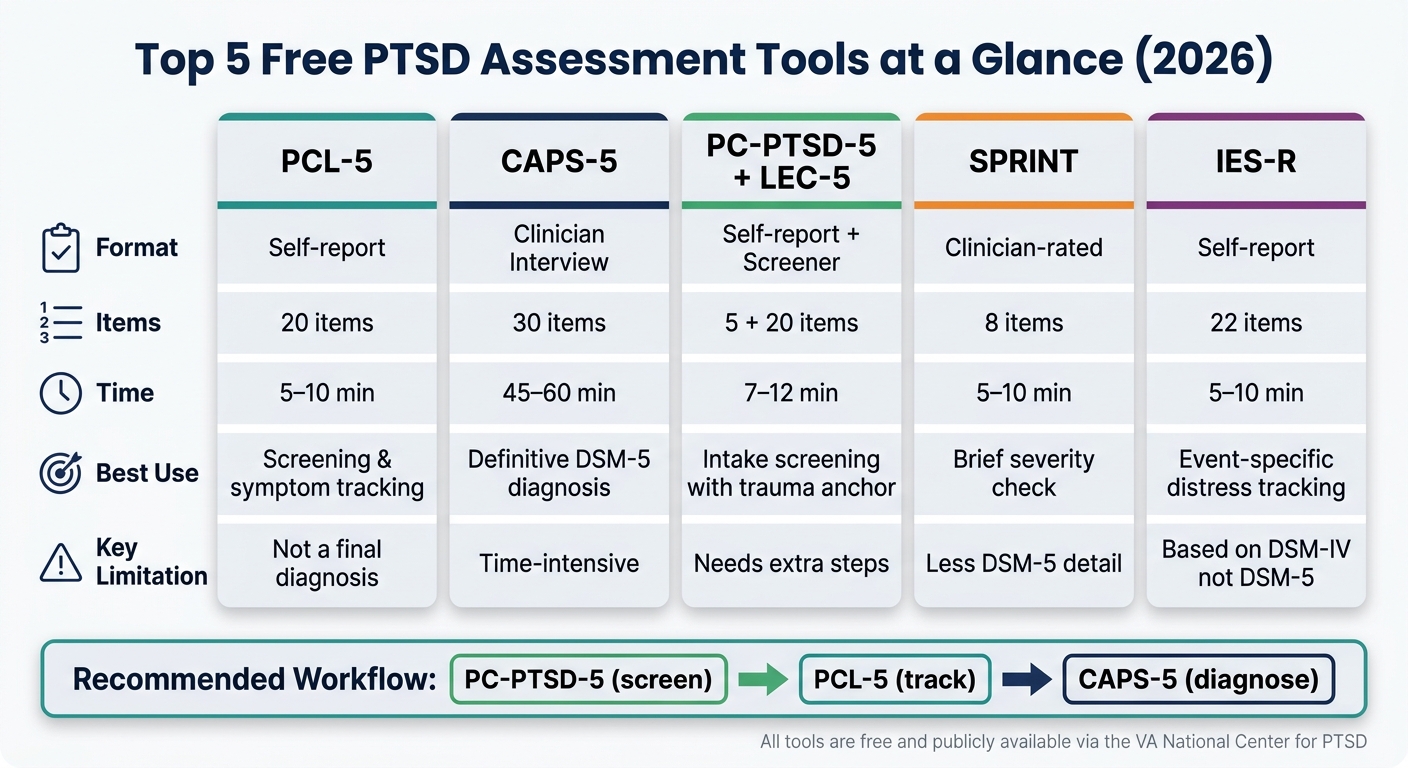
Top 5 Free PTSD Assessment Tools Compared (2026)
|
Tool |
Best Use |
Format |
Time |
Main Catch |
|---|---|---|---|---|
|
PCL-5 |
Screening and symptom tracking |
Self-report |
5–10 min |
Not a final diagnosis |
|
CAPS-5 |
Diagnostic confirmation |
Clinician interview |
45–60 min |
Takes more staff time |
|
PCL-5 + Criterion A forms |
Intake screening with trauma anchor |
Screener + self-report |
7–12 min |
Needs extra steps |
|
SPRINT |
Brief severity check |
Clinician-rated |
5–10 min |
Less detail than full PTSD tools |
|
IES-R |
Event-specific symptom tracking |
Self-report |
5–10 min |
Not aligned with DSM-5 |
If you're choosing by workflow, use the least burdensome tool that still answers the question: screen first, track with the same measure over time, and confirm with a structured interview when diagnosis matters.
Quick Comparison: Top 5 Free PTSD Assessment Tools
Here’s a quick side-by-side look at the top options by format, use case, and workflow fit.
|
Tool |
Format |
Items |
Time Burden |
Primary Use |
Key Limitation |
|---|---|---|---|---|---|
|
PCL-5 |
Self-report |
5–10 min [5] |
Screening, symptom monitoring, provisional diagnosis |
Does not provide a definitive diagnosis |
|
|
CAPS-5 |
Structured clinician interview |
Interview-based |
Longer than self-report tools |
Definitive PTSD diagnosis |
More time-intensive than a self-report tool |
|
PCL-5 With Criterion A and Related Screening Forms |
Self-report + screener |
20 + screener items |
5–10 min |
Screening with trauma exposure context |
Requires additional screener steps |
|
SPRINT |
Clinician-rated interview |
8 |
5–10 min |
Brief symptom severity rating |
Less comprehensive than full diagnostic tools |
|
IES-R |
Self-report |
22 |
5–10 min |
Symptom monitoring post-event |
Not aligned to DSM-5 criteria |
Use this table to match each tool to screening, diagnosis support, or symptom tracking. If you want a fast self-report option, start with PCL-5 or IES-R.
If you need a clinician-led diagnosis, CAPS-5 is the better fit. And if trauma exposure context matters up front, the PCL-5 With Criterion A and Related Screening Forms gives you that extra layer before you go deeper into the tool details below.
1. PTSD Checklist for DSM-5 (PCL-5)
The PCL-5 is often the best free place to start when you want to track PTSD symptoms. It’s a 20-item, public-domain self-report measure from the VA National Center for PTSD. You can use it on its own, or pair it with Criterion A screening and the LEC-5. [2]
Assessment Format
The 20 items line up with the four DSM-5 symptom clusters:
Intrusion (B)Avoidance (C)
Negative Cognitions/Mood (D)
Arousal/Reactivity (E)
Most patients complete it in 5–10 minutes. Scores run from 0 to 80, and a score of 31–33 often points to probable PTSD. [2]
Primary Clinical Use
In practice, the PCL-5 helps with screening, tracking symptoms over time, and supporting a provisional diagnosis.
Clinicians often use it at intake, then again every 2–4 weeks during treatment, and once more at discharge. A 10-point score change is commonly used as a marker of response. [2]
Key Limitation
The PCL-5 cannot confirm PTSD by itself. If the screen is positive, it should be followed by CAPS-5. Cutoff scores can shift based on the patient group and the reason for testing, so clinician judgment still matters. If the goal is diagnosis rather than screening, move to CAPS-5. [2]
2. Clinician-Administered PTSD Scale for DSM-5 (CAPS-5)
If the PCL-5 points to a concern, CAPS-5 is usually the next move. This is the step used to confirm a diagnosis after a positive screen.
Assessment Format and Scoring
The CAPS-5 is a structured clinical interview for clinicians trained in PTSD assessment. In some cases, specifically trained paraprofessionals can administer it too[6].
Before the interview, clinicians usually use the Life Events Checklist for DSM-5 (LEC-5) to identify the index traumatic event[6].
The interview has 30 items and usually takes 45–60 minutes[6]. It rates each DSM-5 symptom on a 0 to 4 scale and also covers onset, duration, distress, functional impact, and the dissociative subtype[6].
For treatment tracking, a 10-point drop is the benchmark for response, and a score below 8 often signals meaningful improvement[6].
Primary Clinical Use
CAPS-5 is used for formal current or lifetime PTSD diagnosis and severity rating, not screening[6]. Put simply, it works best when you need diagnostic confirmation after a positive screen.
Key Limitation
The biggest drawback is time and staffing. A full clinical interview often doesn't fit fast-paced workflows[1]. That’s why CAPS-5 is best reserved for confirmatory assessment instead of routine intake.
When speed and lower staff burden matter more, the next tool is a brief clinician-rated option.
3. PCL-5 With Criterion A and Related Screening Forms
For clinics that need faster triage than CAPS-5, but want better trauma anchoring than the PCL-5 on its own, PCL-5 with Criterion A is a smart middle ground. It ties symptoms to a specific traumatic event - an index trauma - before the person rates what they’ve been experiencing. That matters because, without that anchor, people may rate distress linked to stressful life events that do not meet Criterion A.
Assessment Format
When used with Criterion A, the PCL-5 is paired with the Life Events Checklist for DSM-5 (LEC-5) to confirm trauma exposure before symptom scoring [3][7]. The PC-PTSD-5 is a 5-item yes/no screener that first checks for trauma exposure and then asks about symptoms, which helps cut down on false positives [1].
"PC-PTSD asked individuals to respond to questions about DSM-IV PTSD symptoms in reference to an experience that was 'frightening, horrible, or upsetting,' which could lead respondents to refer to events that, while stressful, were not considered Criterion A traumas (e.g., divorce).
To avoid this, the PC-PTSD-5 asks respondents whether they have experienced prior trauma(s), and provides examples of events that qualify." - VA National Center for PTSD [1]
Used together, these tools create a fast two-step intake screen.
Item Count and Time Burden
The PC-PTSD-5 takes about 1–2 minutes, and the PCL-5 adds 5–10 minutes. That puts the full intake flow at about 7–12 minutes [1][4].
Primary Clinical Use
This setup works well as a two-step triage workflow:
Use PC-PTSD-5 for fast intake screening
Follow with PCL-5 to rate symptom severity across the DSM-5 clusters
Use PCL-5 again over time to track symptom changeKey Limitation
A positive screen is not enough for a formal diagnosis. It should be followed by a structured clinical interview, specifically CAPS-5, before making that call [3][4]. During administration, display 988 [3].
For a brief clinician-rated next step, move to SPRINT.
4. Short PTSD Rating Interview (SPRINT)
SPRINT is a free, 8-item PTSD severity measure. It works well when you need a quick symptom check after screening but before a full diagnostic assessment.
Assessment Format
SPRINT looks at symptom severity over the past week and covers core PTSD symptoms along with functional impairment [8]. Each item uses a 5-point Likert scale, scored from 0 ("not at all") to 4 ("very much") [8].
Item Count and Time Burden
Because it’s short, SPRINT fits routine follow-ups and repeat symptom tracking without adding much burden.
Primary Clinical Use
SPRINT is especially helpful for tracking symptom change over time [8]. A cutoff score of 14 is often used to flag people who may need a more detailed structured clinical interview [8].
Key Limitation
SPRINT can help you monitor severity, but it does not offer DSM-5 diagnostic specificity.
If you want another self-report tool for symptom tracking, move to the IES-R.
5. Impact of Event Scale–Revised (IES-R)
If you need a brief self-report tool for post-event distress, the IES-R is a practical, low-burden option.
The IES-R is a free self-report measure used to track PTSD-related distress after a specific traumatic event [9]. People rate how much each problem bothered them during the past seven days.
Assessment Format
Each item uses a 5-point Likert scale from 0 ("not at all") to 4 ("extremely") [9]. The tool includes Intrusion, Avoidance, and Hyperarousal subscales, and total scores range from 0 to 88 [9].
Item Count and Time Burden
The IES-R has 22 items, which makes it a good fit for routine follow-up without adding much extra work to the clinical workflow.
Primary Clinical Use
The IES-R is meant for symptom measurement, not PTSD diagnosis. It works best when you want to measure distress tied to a specific event, rather than make a formal diagnosis [9].
Key Limitation
There’s one big catch: the IES-R is based on DSM-IV criteria, not DSM-5. That means it does not fully cover current diagnostic requirements, especially negative alterations in cognition and mood [9].
"The IES-R has not been updated to match the DSM-5, so it does not include items to full assess negative alterations in cognition and mood, for instance." - VA National Center for PTSD [9]
When you need full DSM-5 diagnostic coverage, use a DSM-5–aligned tool instead [9].
Choose the IES-R for quick symptom tracking, especially when speed and ease matter, then match the tool to your workflow below.
How to Pick the Right Tool for Your Workflow
The right tool depends on what you need at that point in care. The simplest rule is this: use the least burdensome tool that still answers the clinical question. That keeps screening light, saves clinician time, and makes repeat follow-up easier.
It also helps to sort each choice into one of three roles: screening, diagnosis support, or symptom monitoring.
Use the table below to match each tool to the stage of care.
For intake screening, PC-PTSD-5 is often the easiest fit. It takes under 2 minutes and works well in either paper or digital check-in. A score of 4 is the usual cut-point for follow-up screening [1].
If you need repeat measurement, pick the tool that makes symptom tracking simple. In most cases, that means PCL-5. It takes 5–10 minutes and gives DSM-5 symptom severity across criteria B, C, D, and E [2].
For a more structured diagnosis, step up from screening to CAPS-5. If you need a firm diagnosis for treatment planning or a disability claim, this is the tool to use. It requires a trained clinician or paraprofessional and takes 45–60 minutes [6].
For fast triage, SPRINT gives a short severity snapshot. A suggested cutoff of 14 can flag who should move on to a structured diagnostic interview [8]. If the goal is to review the impact of one specific traumatic event, IES-R is a good fit for event-specific monitoring.
For treatment follow-up, PCL-5 is usually the most practical option. You can give it every 2–4 weeks during treatment for repeat tracking [2]. If your EHR supports outcomes measurement, embedding the PCL-5 can automate tracking and cut down on manual follow-up work.
The matrix below narrows the choice to five common clinical goals.
|
Clinical Goal |
Best Tool |
Time Required |
|---|---|---|
|
Early screening / intake |
PC-PTSD-5 |
Under 2 minutes |
|
Screening and symptom tracking |
PCL-5 |
5–10 minutes |
|
Rapid triage |
SPRINT |
Brief |
|
Event-specific symptom tracking |
IES-R |
Brief |
|
Definitive DSM-5 diagnosis |
CAPS-5 |
45–60 minutes |
Workflow and Outcomes Tracking Considerations
The tool you pick matters. But using it the same way every time matters more.
Start with one measure at baseline, then use that same measure at follow-up. Recheck symptoms at set intervals so the scores can help shape treatment changes instead of just sitting in the chart. For repeat symptom tracking, PCL-5 is the practical default. If a screen comes back positive and you need to confirm the diagnosis, move up to CAPS-5.
Don’t just look at total scores. Track change scores too. A 10-point drop on the PCL-5 signals response, and a score below 28 often points to meaningful improvement. Put both thresholds in the chart so the next step is clear.
Routine outcome monitoring is just part of good care.
Make sure the record includes the index trauma, symptom clusters B–E, functional impact, onset, duration, and interference. Even with a solid workflow, free tools still have limits.
Opus Behavioral Health EHR can automate assessment delivery, scoring, threshold alerts, and outcome trends.
Limitations to Keep in Mind
Once you pick a tool, the next step is knowing what it can and can’t tell you. That part matters a lot. These tools are built for different jobs, and using the wrong one can create clinical risk.
One of the biggest differences is self-report vs. clinician-administered. Self-report tools rely fully on what the patient says. Clinician-administered interviews, on the other hand, can pick up nuance that a checklist may miss.
That’s why CAPS-5 is the gold standard for PTSD diagnosis. It’s a structured clinical interview, not just a symptom checklist. And that difference becomes most important when you move from screening to diagnosis.
DSM alignment matters too. DSM-5 tools follow the current four-cluster model. Older DSM-IV tools can miss cognitive, mood, and risk-related symptoms. So if a practice is still using an older PCL or PDS version, it may miss part of the DSM-5 symptom picture.
There’s another catch with PCL-5: cutoff scores vary by population. In plain English, the same score may not mean the same thing in every setting. So use cutoffs as screening guides, not fixed diagnostic rules.
And one point should stay front and center: no tool here diagnoses PTSD on its own. A positive screen is a signal to look closer, not a clinical conclusion. Scores should always be interpreted by a qualified clinician before any treatment decisions are made.
Conclusion
Across the five free tools above, the best pick comes down to workflow and clinical purpose.
Use the tool that gets the job done with the least friction:
PC-PTSD-5 for fast triage
PCL-5 for symptom tracking
CAPS-5 for diagnostic confirmationWhen diagnostic certainty matters most, CAPS-5 is the right call. That includes cases tied to legal claims, disability reviews, or treatment-planning decisions.
There’s no one-size-fits-all tool here. The measure should match the task in front of you. Use brief screeners for triage, self-report tools for monitoring, and structured interviews for diagnosis.
That simple split - screening, monitoring, diagnosis - covers most PTSD workflows. And when you use free PTSD tools in the right sequence, they can support intake, follow-up, and diagnosis without adding extra strain.
FAQs
When should I use CAPS-5 instead of PCL-5?
Use CAPS-5 when you need to confirm a formal PTSD diagnosis. The PCL-5 works well for screening and for tracking symptoms over time, but it should not be used on its own to make a diagnosis.
CAPS-5 is a structured clinical interview and the gold standard for finalizing a clinical PTSD assessment.
What PCL-5 score suggests probable PTSD?
The PCL-5 does not give a formal diagnosis. But a total score of 31 to 33 is often used as a sign of probable PTSD.
That said, the cutoff isn't fixed in stone. It can change based on the group being assessed and the clinician's goal, so some practitioners use slightly different thresholds.
The PCL-5 is best used for screening and tracking symptoms over time, not for making a final diagnosis. A licensed mental health professional still needs to confirm whether someone has PTSD.
Can these tools diagnose PTSD on their own?
No. Tools like the PCL-5, ITQ, and PDS-5 can help spot symptoms and support a provisional diagnosis, but they’re used mainly for screening and tracking changes over time.
A structured clinical interview, such as the CAPS-5, is still the gold standard for confirming PTSD and should be done by a trained mental health professional.



- Behavioral Health
- EHR Systems
- Addiction Treatment EHR
- mental health
- Telehealth
- addiction treatment
- Behavioral health facility
- Substance Abuse Disorder
- behavioral Health center
- HIPPA Compliant
- ehrsoftware
- PTSD
- behavioral health ehr
- Depression
- hipaa
- Anxiety
- MentalHealthMatters
- RCM
- claim denials
- clinical documentation
- mental health awareness
- screening tools

September 15, 2026

September 15, 2026

September 14, 2026

September 11, 2026

September 10, 2026

September 09, 2026
Recommended Posts

Wednesday, June 24, 2026
AI in PTSD Screening for Veterans
AI is transforming how PTSD is identified in veterans, addressing long-standing challenges like underreporting, stigma, ...

Thursday, July 02, 2026
Best Practices for Child PTSD Screening
Child PTSD screening is essential for identifying trauma responses early, ensuring children receive appropriate ...
Tuesday, March 10, 2026
How PTSD Screening Tools Improve Patient Outcomes
PTSD often goes undiagnosed, leading to severe health issues and higher costs. Screening tools like PC-PTSD-5 and PCL-5 ...