

In SUD care, staff should not answer family questions by default.
The decision usually turns on five checks: consent, scope, emergency status, restricted notes, and 42 CFR Part 2.
For behavioral health leaders, the issue is simple: a family disclosure that seems routine can create compliance risk, workflow confusion, and trust problems if staff apply HIPAA without checking Part 2 first. The article’s main point is that family involvement may support care, but it does not give relatives automatic access to patient information.
At a glance, the article says treatment centers should:
- Confirm the patient’s permission before sharing identifiable information
- Limit the disclosure to only what the family member needs for care or payment
- Use emergency exceptions narrowly
- Keep psychotherapy notes and SUD counseling notes separate
- Check 42 CFR Part 2 before any family disclosure tied to SUD treatment records
A few facts frame the issue:
- HIPAA may allow some family disclosures when the patient agrees, does not object, or lacks capacity and the provider decides sharing is in the patient’s best interest
- 42 CFR Part 2 is often stricter and usually requires written consent
- The updated Part 2 rule took effect on February 16, 2026
- When both rules apply, the stricter standard controls
For executive teams, the practical message is clear. Front-line staff need a repeatable process, clear documentation, and EHR controls that can help track consent, restricted note types, disclosure scope, and emergency use.
|
Rule |
Core decision |
|---|---|
|
Get patient consent |
Is there a valid permission basis to speak with family? |
|
Share only what is directly relevant |
How much information is actually needed? |
|
Use the emergency exception only when conditions are met |
Is this a true emergency or just an urgent call? |
|
Keep psychotherapy notes separate and restricted |
Is the request reaching restricted note types? |
|
Check 42 CFR Part 2 before any family disclosure |
Does Part 2 block a disclosure HIPAA might otherwise allow? |
The article then ties these five rules to documentation steps and workflow controls that treatment centers may use to reduce disclosure mistakes across teams and shifts.
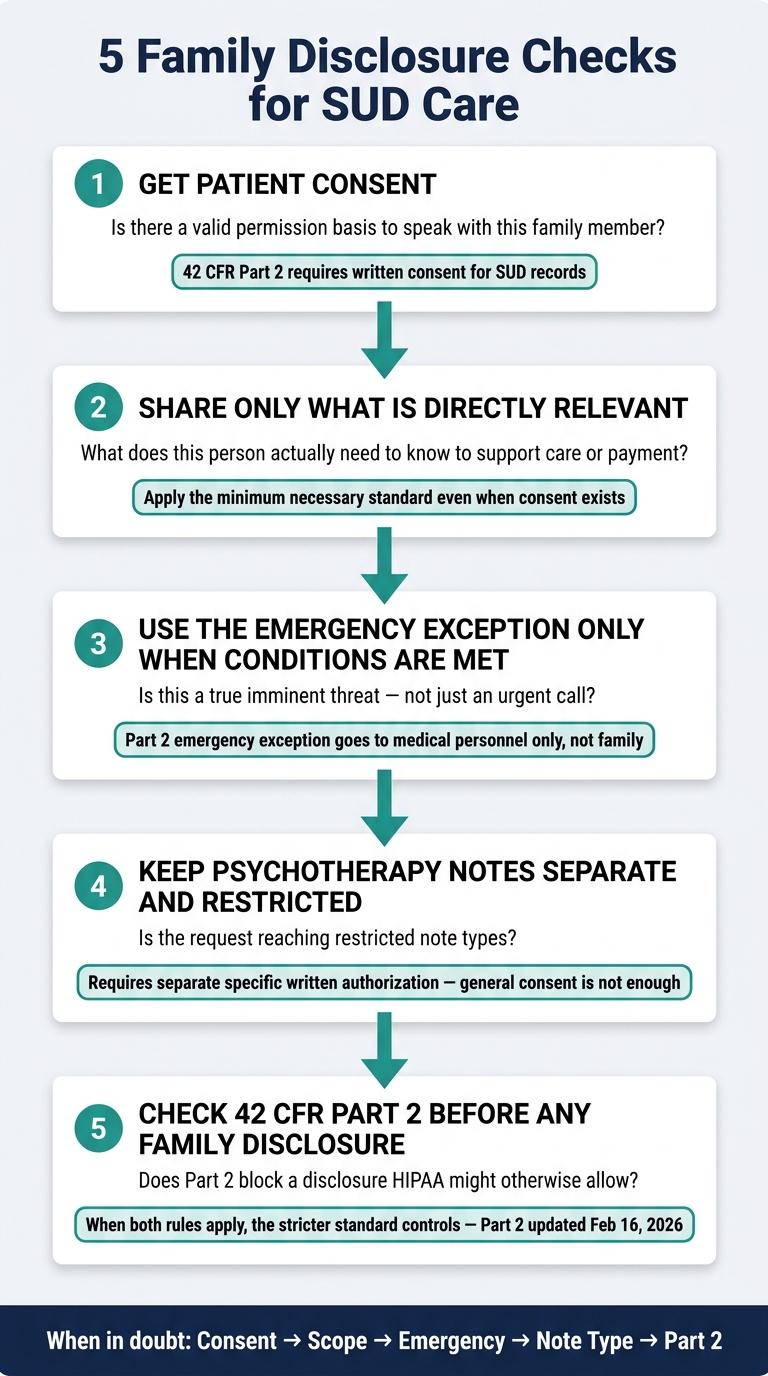
5 HIPAA & 42 CFR Part 2 Family Disclosure Checks for SUD Care
Quick Reference: Family Disclosure Rules in SUD Care
Use this table to match the disclosure rule before responding to a family inquiry.
|
Rule |
When It Applies |
Written Consent Required? |
Permitted Disclosure |
Limits & Exceptions |
|---|---|---|---|---|
|
1. Get Patient Consent |
Any non-emergency family inquiry about identifiable patient information |
Conditional - written consent is required for Part 2-protected SUD records; for general PHI, patient agreement, no objection, or best-interest judgment for an incapacitated patient may allow disclosure |
Only information the patient authorized or the rule allows, such as treatment participation, diagnosis, medications, discharge plans, and aftercare |
Do not assume family has a right to know; if the patient revokes permission, stop sharing and reassess the record |
|
2. Share Only What Is Directly Relevant |
Whenever staff are already allowed to disclose information and must decide how much to share |
No separate requirement - follows the underlying consent or exception |
Only the information directly relevant to the family member's role in care or payment decisions, such as pickup time, medication side effects to watch for, or safety warning signs |
Do not share full clinical history when a summary will do |
|
3. Use the Emergency Exception Only When Conditions Are Met |
When the patient is incapacitated or disclosure is needed to prevent or lessen a serious and imminent threat |
Not required in a qualifying emergency |
Only the information needed to reduce harm or respond to the emergency, such as current medications, overdose history, known triggers, or critical safety plan elements |
Use this only for real emergencies, not convenience; once the patient is stable, revert to normal consent rules. For Part 2 programs, emergency disclosures go to medical personnel first, not directly to family |
|
4. Keep Psychotherapy Notes Separate and Restricted |
Any request for psychotherapy notes |
Yes - specific written authorization is required |
Generally, these notes may not be shared with family; if consent permits, provide a clinical summary from the general record instead |
Keep psychotherapy notes separate from the main EHR record and limit access to clinicians who need them |
|
5. Check 42 CFR Part 2 Before Any Family Disclosure |
When Part 2 applies and the information would identify a patient as having or having had SUD treatment |
Yes - Part 2-compliant written consent naming the family member, information scope, and purpose is usually required |
Only the SUD-related information specifically authorized in the consent, such as admission date, program type, medications for addiction treatment, or progress summaries |
Apply Part 2 first when it covers the record; every consent-based disclosure must include a redisclosure prohibition notice, and exceptions are narrow |
Before staff respond, document the rule used, what was shared, and who received it.
1. Get Patient Consent Before Speaking With Family
When patient permission is required
Before staff speak with family, they should confirm that a valid permission basis exists. Family involvement is common in SUD care and can support treatment, but it does not give family members a right to patient information.
If the patient is present and has decision-making capacity, staff should share information only when the patient gives explicit agreement, does not object after a direct chance to object, or clearly states that staff may proceed. If the patient says no, the conversation should stop unless an emergency exception applies.
If Part 2 applies, the standard is stricter. Under 42 CFR Part 2, verbal agreement is not enough. Providers should use a written consent that names the family member, describes the information to be shared, states the purpose, and includes an expiration date before disclosing SUD information that identifies the patient.[6][9][2]
What information may be shared
Even when consent is in place, staff should share only the information the patient approved. That may include discharge pickup time, follow-up appointments, safety plan details, and medication instructions.[13][1]
Document the disclosure
After consent is confirmed, the disclosure should be documented with care. The record should show who requested the information, who received it, what was shared, the consent or exception used, any limits on the disclosure, and any revocation.[11][12][2]
2. Share Only What Is Directly Relevant
Even when disclosure is allowed, staff still need to keep the scope tight. Patient permission does not remove the minimum necessary standard. Under HIPAA, teams should share only the information needed for the specific purpose, even when a patient has agreed to family involvement.
What information may be shared
The safest starting point is simple: what does this person need to know to support care or payment? That question sets the boundary.
In practice, a family member or caregiver may need the medication schedule, warning signs, and crisis steps. That does not automatically mean they need access to therapy notes, unrelated diagnoses, or other sensitive parts of the record.
Listening is different from disclosing. Without a release, staff may listen to family concerns, document them, and use that input in care planning without sharing the patient’s information back to the family member.
What staff should document
Documentation should show more than the fact that a disclosure happened. Staff should record the scope of what was shared and why it was appropriate. That means noting the specific categories of information disclosed, the family member’s role, any topics the patient said were off-limits, the regulatory basis, and the clinical reason the disclosure was directly relevant. Clear documentation helps show that the disclosure stayed within the minimum necessary limit.
|
Field |
What to Capture |
|---|---|
|
Information shared |
Specific categories only (e.g., medication regimen and side effects) |
|
Family member's role |
Why they needed this information (e.g., caregiver managing medications) |
|
Excluded topics |
Any areas the patient said were off-limits |
|
Regulatory basis |
HIPAA 164.510(b), Part 2 consent, or applicable exception |
|
Clinical rationale |
How the disclosure supports care, safety, or payment |
If the patient is in immediate danger, the emergency exception may allow more limited sharing.
3. Use the Emergency Exception Only When Conditions Are Met
Crisis calls create pressure, but the emergency exception is narrow.
Staff should use it only when the facts meet the legal threshold. It does not apply to routine family updates, general care coordination, or calls from relatives who simply want more information.
After applying the minimum-necessary rule, the next issue is whether the situation is serious enough to override normal consent rules.
Under HIPAA, a provider may make a limited disclosure when the patient is incapacitated or absent and the disclosure is in the patient’s best interest. HIPAA also permits disclosure when it is needed to prevent a serious and imminent threat to the health or safety of the patient or others, including to people who may help reduce that threat.
Under 42 CFR Part 2, the emergency exception is narrower. It allows disclosure only to medical personnel, only when consent cannot be obtained, and only for treatment during a true medical emergency. Part 2’s emergency exception does not permit disclosure to family members who are not medical personnel.
If those emergency standards are not met, staff need consent. For example, if a parent calls with concerns about relapse but there is no current threat, staff should not confirm or deny treatment. In that situation, the safer response is to offer general crisis guidance without sharing protected information.
Disclosures should stay tightly focused on the immediate safety issue. That may include current medications, overdose risk, immediate safety steps, or instructions about naloxone and calling 911. It should not include therapy details, unrelated diagnoses, or past legal matters.
Once an emergency disclosure is made, the chart should clearly show why the exception applied. EHR workflows can help by supporting structured emergency-disclosure notes, threat-assessment fields, and audit logs.
|
Documentation Field |
What to Capture |
|---|---|
|
Facts of the emergency |
Observed facts showing imminent risk |
|
Legal basis |
HIPAA emergency disclosure or 42 CFR Part 2 medical emergency |
|
Information disclosed |
Specific categories only, such as current medications or overdose risk |
|
Recipient |
Who received the information |
|
Date, time, and method |
When and how the disclosure was made |
|
Follow-up actions |
Safety steps taken |
4. Keep Psychotherapy Notes Separate and Restricted
Even when staff are allowed to speak with family, that does not mean every part of the chart can be used in that conversation.
Psychotherapy notes sit outside the standard clinical record and carry tight limits. Family requests almost never justify access. 42 CFR Part 2 sets a similar protected category for SUD counseling notes, which must also remain separate from the rest of the SUD and medical record and require specific consent before disclosure.[1][7][15]
What information may be shared
Family members may receive relevant information from the standard clinical record when the patient agrees or does not object. That can include facts tied to care, treatment status, or other allowed clinical details.
What cannot be shared from these restricted note types is different. That includes the clinician’s private impressions, analysis, or verbatim dialogue kept in separate psychotherapy notes or SUD counseling notes.
When patient permission is required
Sharing psychotherapy notes or SUD counseling notes with family requires a separate, specific written authorization. A general intake consent is not enough.[16][17]
That distinction matters in daily operations. A broad family consent may allow some communication, but it does not extend to psychotherapy notes or SUD counseling notes. Under Part 2, programs also may not make treatment contingent on the patient signing an authorization for SUD counseling notes.[15]
Which narrow exception applies
The exceptions are narrow. They do not create a general right to disclose psychotherapy notes or SUD counseling notes to family.
For behavioral health leaders, this is where policy language, staff training, and EHR permissions need to line up. If access rules are loose, staff may rely on the wrong part of the chart during a family call or release review.
What staff should document
Staff should document family contact in the standard progress note and keep private clinical impressions in the restricted note. Opus Behavioral Health EHR can support separate note types, role-based access, and audit trails.
Before any note-based information is used for a family disclosure, teams should confirm whether Part 2 applies, since it may set the stricter rule.
5. Check 42 CFR Part 2 Before Any Family Disclosure
Before any information is shared with family, staff should confirm whether the record is covered by 42 CFR Part 2. In SUD care, Part 2 serves as the last review point for family disclosures. When it applies, it overrides HIPAA and calls for a tighter disclosure review.[8][4][23]
When patient permission is required
Under Part 2, staff need written patient consent before sharing any SUD information that could identify the patient, including with family members.[20][21][3] That can include diagnoses, dates of treatment, SUD medications, and test results.[5][21]
The consent must include the required elements:
- Patient name
- Program name
- Family member or other recipient
- Information to be shared
- Purpose of the disclosure
- Expiration date or event
- Required redisclosure warning
These details are not optional. If any part is missing, the disclosure may not meet Part 2 requirements.[18][20][3][9][10]
Which exception applies
Part 2 exceptions are narrow. The medical emergency exception allows disclosure to medical personnel, not straight to family members.[19][20][14] If the situation does not meet the standard of a true medical emergency, written consent is required.[18][20][3][22]
For behavioral health leaders, this is where risk often enters the workflow. Staff may assume that urgency, family pressure, or a general HIPAA exception is enough. Under Part 2, that assumption can lead to the wrong disclosure decision.
What staff should document
Documentation should show the legal basis for the disclosure, what information was shared, who received it, and the redisclosure warning.[9][10]
When the disclosure is made under the emergency exception, staff should also record:
- Name and affiliation of the medical personnel who received the information
- Name of the person making the disclosure
- Date and time
- Nature of the emergency
This level of documentation matters for compliance review, internal audit work, and staff accountability.[19]
Opus Behavioral Health EHR can centralize Part 2 consents, track expiration dates, and prompt staff to record the legal basis before release. In practice, that kind of workflow control can help treatment centers reduce avoidable disclosure errors and create a clearer process for front-line teams.
Documentation and Workflow Safeguards for Staff
Knowing the five rules is only part of the job. Each family disclosure also needs a clear record in the chart. For staff, that usually means following the same review sequence every time: consent, scope, emergency status, note type, then Part 2.
Once disclosure is allowed, the chart must show why it was allowed. Documentation should include the patient’s decision, the named family member, the approved scope, any limits, and the date, time, and form of consent.
When a patient is present during a family conversation and does not object, the record should show who was present, what was shared, and that the patient had a chance to object. It should also note the basis for treating silence as non-objection and confirm that the disclosure stayed limited to what was needed.
Emergency disclosures need their own documentation layer. Staff should record the nature of the emergency, the clinician’s identity, the reason emergency access was used, the family member’s role in the response, and what information was shared. If communication continues after the crisis, the record should also show that consent was reviewed again.
Psychotherapy notes should be labeled "Psychotherapy Note - restricted access" and kept separate from the general clinical record. Role-based permissions should limit access to authorized mental health clinicians, and that restriction should appear in both system settings and written policy.
These safeguards work best when the EHR supports them in the workflow. Opus Behavioral Health EHR supports configurable note types, tiered role-based permissions, automated consent alerts when authorizations are close to expiration, and structured disclosure logs that record the legal basis, recipient, and purpose for each family communication. For behavioral health organizations, those controls can help staff follow a consistent process and spot gaps before information is released.
Conclusion
In SUD care, family disclosures should follow five checks in sequence: consent, minimum necessary, emergency, note, and Part 2. That order matters. Disclosure mistakes can do lasting damage.
The stakes in SUD treatment are high. 42 CFR Part 2 places tighter limits on disclosure than HIPAA because sharing treatment information without proper authorization can affect a patient’s employment, custody arrangements, housing, or legal status. Those protections help patients seek care and remain in treatment. Strict compliance helps preserve that trust.
For clinical and administrative leaders, the next step is operational. Review recent family interactions against these five rules. Update consent forms and disclosure policies to reflect the 2024 Part 2 final rule. Train staff with common SUD scenarios so teams know how to respond during tense or time-sensitive calls.
Documentation makes these rules repeatable across shifts and teams. An EHR can help track authorizations, log disclosures, and standardize staff review so compliant disclosure becomes the default.
FAQs
How do we know if 42 CFR Part 2 applies to a record?
42 CFR Part 2 applies to records maintained by federally assisted programs that provide diagnosis, treatment, or referral for substance use disorders.
These records contain sensitive SUD-related information and are subject to stricter confidentiality rules than standard HIPAA-covered data, including the need for explicit patient consent before disclosure.
What should staff say if a family member asks for updates without consent?
If a family member asks for updates and the patient has not given consent, staff must decline. Under HIPAA and 42 CFR Part 2, providers cannot confirm or deny that a patient is receiving care, and they cannot share clinical details without clear, documented authorization.
Opus Behavioral Health EHR supports this process with automated consent tracking and role-based access controls, which can help treatment centers protect sensitive patient information.
How often should patient consents for family disclosures be reviewed?
Patient consents for disclosures in substance use disorder care need regular review so they remain current and valid.
Digital consent management tools can support this process by tracking signatures, monitoring expiration dates, and alerting staff when renewals are due. Opus Behavioral Health EHR is designed to support these workflows and may help treatment centers maintain compliance with 42 CFR Part 2 and HIPAA.



- Behavioral Health
- EHR Systems
- Addiction Treatment EHR
- mental health
- Telehealth
- addiction treatment
- Behavioral health facility
- Substance Abuse Disorder
- behavioral Health center
- HIPPA Compliant
- ehrsoftware
- PTSD
- behavioral health ehr
- Depression
- hipaa
- Anxiety
- MentalHealthMatters
- RCM
- claim denials
- clinical documentation
- mental health awareness
- screening tools
September 15, 2026

September 15, 2026

September 14, 2026

September 11, 2026

September 10, 2026

September 09, 2026
Recommended Posts

Tuesday, May 05, 2026
HIPAA Training for Substance Abuse Centers
Substance abuse treatment centers must comply with HIPAA and 42 CFR Part 2 regulations to protect sensitive patient ...

Monday, July 20, 2026
Personalized EHR Intake Forms: Guide for SUD Clinics
One intake form for every SUD patient is a fast way to create delays, denials, and compliance gaps.

Friday, May 15, 2026
HIPAA vs 42 CFR Part 2: Data Encryption Rules
HIPAA and 42 CFR Part 2 both require encryption to protect patient data, but they differ in scope and strictness.