
VR gamification in adolescent care works best when it targets one clear treatment goal, uses short supervised sessions, and fits existing documentation, consent, and billing workflows.
VR can help with teen engagement, but leaders should judge it by symptom change, attendance, safety, staff workload, and reimbursement fit.
VR gamification in adolescent care should prioritize the following points:
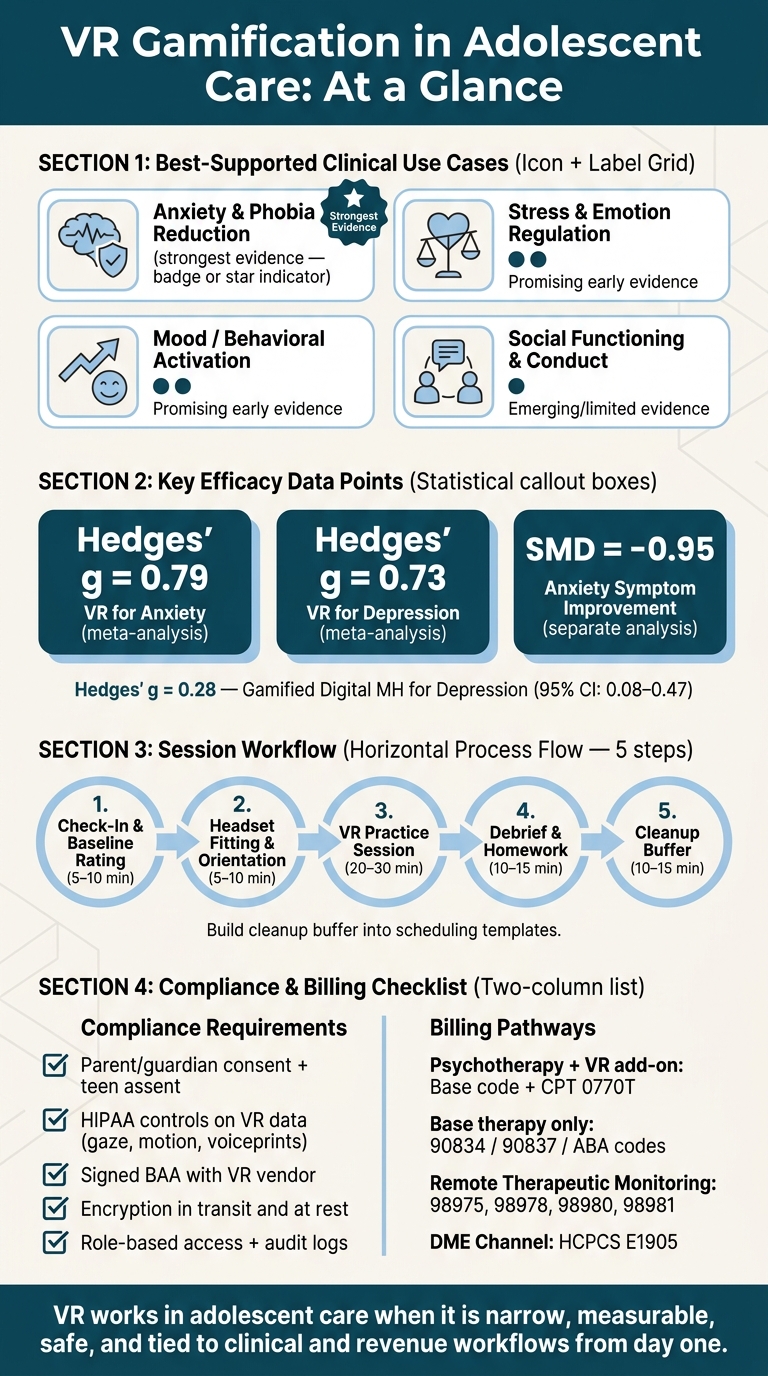
- Best-supported use cases: anxiety exposure, stress regulation, and some social skills practice
- What to measure: tools like GAD-7, PHQ-A, fear ratings, attendance, dropout, and school or social functioning
- Main risks: cybersickness, distress, dissociation risk, room safety issues, and weak clinician framing
- Workflow needs: screening, pre-brief, supervised VR time, debrief, cleaning, and staff training
- Compliance needs: minor consent, teen assent, HIPAA controls, vendor BAAs, and clear data rules
- Billing choices: base therapy codes, possible CPT 0770T use in some cases, and close review of payer rules
A few data points shape the business case. Reported meta-analysis findings in the article include Hedges’ g = 0.79 for anxiety and 0.73 for depression in VR-based interventions, while another analysis found anxiety symptom improvement with a standardized mean difference of -0.95.
It's important to note: strong teen interest alone is not enough. Programs need a defined clinical target, stop rules, and a record that shows why VR was used in treatment.
For executive teams, the short version is this: VR gamification in adolescent care may support engagement and skills practice, but only if the program is narrow, measurable, safe, and tied to clinical and revenue workflows from day one.
VR Gamification in Adolescent Care: Clinical Goals, Evidence & Billing Pathways
Clinical goals and adolescent use cases
Behavioral health teams should start with the clinical target, not the headset. A VR program without a measurable symptom goal may create interest without producing clinical change. The practical next step is straightforward: match the VR format to the symptom domain and care setting.
Matching VR formats to anxiety, mood, stress, and social functioning goals
Anxiety and phobia reduction remains the most established adolescent VR use case. Adolescent VR exposure has the strongest support in anxiety and phobia treatment, including social anxiety and fear of public speaking, with gains sustained at 3-month follow-up in small randomized trials. [5][6][2]
Stress and emotion regulation programs often rely on short breathing or mindfulness scenes that fit brief outpatient or school-based sessions. A school-based VR deep-breathing game delivered in six 15-minute sessions over four weeks reduced daily anxiety levels at both the individual and group levels. [4]
Mood and behavioral activation is an expanding use case. Gamified VR experiences built around mastery tasks, movement, and positive activity scheduling may support behavioral activation for adolescents with depressive symptoms. A meta-analysis of gamified digital mental health interventions found modest but significant effects for depression (Hedges' g = 0.28; 95% CI 0.08–0.47). [3] For anxiety treatment, gamification on its own is usually not enough. Clinical teams should pair it with exposure or another evidence-based intervention. The simplest format that still targets the intended symptom is often the best fit.
Social functioning and disruptive behavior programs use VR for perspective-taking, emotion recognition, and peer interaction practice. A VR socioemotional intervention called Impact VR, designed for youth with conduct disorder, reduced callous–unemotional traits, conduct problems, and reactive aggression compared with a control condition. [7] These applications are still early-stage, but they point to a meaningful use case in residential and justice-involved settings, where social skills practice is often a core treatment goal.
How population, setting, and outcome measures shape program fit
Age matters. Younger adolescents usually need shorter, more structured sessions. Older teens tend to handle more autonomy and more realistic scenarios. Younger teens often need more scaffolding, while older teens may disengage if content feels childish.
Comorbidities also shape fit. Adolescents with ADHD, autism spectrum disorder, trauma history, psychosis risk, or a tendency toward dissociation may need modified content. High-immersion VR is not the right choice for every teen. That screening step should happen before the first session, not after.
Setting also affects how often and how intensely VR can be used. In outpatient care, VR tends to work best as a brief adjunct tied to a narrow clinical target. In IOP and PHP, repeated exposure or skills practice across multiple sessions is more realistic. In residential care, daily social skills rehearsal may be feasible, but it requires tighter staffing and safety protocols. In school-linked care, the main constraints are portability, consent coordination, and keeping disruption to the school day low.
For outcome tracking, programs should use a mix of symptom measures, engagement measures, and functional indicators.
Common symptom tools include the GAD-7, PHQ-A, and youth-specific anxiety scales such as the SPAI-18 or LSAS-CA. Engagement measures such as session attendance, completion rate, dropout rate, and willingness to repeat sessions show whether the intervention is holding attention over time. Functional measures such as school attendance, social participation, and goal attainment scaling help teams see whether clinical gains are carrying over outside the headset.
Comparison table: clinical goals, VR modality, session pattern, and evidence strength
|
Clinical Goal |
VR Modality |
Primary Setting |
Typical Session Length |
Key Outcome Measures |
Evidence Strength |
|---|---|---|---|---|---|
|
Anxiety / phobia reduction |
Graded exposure (interactive scenarios) |
Outpatient, IOP, PHP |
10–30 min active + debrief |
GAD-7, SPAI-18, LSAS-CA, fear ratings, avoidance behavior |
Stronger evidence |
|
Stress / emotion regulation |
Guided relaxation, breathing games, mindfulness scenes |
Outpatient, school-linked |
10–15 min standalone or pre-session |
Self-rated stress, state anxiety, classroom behavior ratings |
Promising early evidence |
|
Mood / behavioral activation |
Mastery tasks, movement-based, gamified CBT |
Outpatient, IOP, residential |
20–40 min |
PHQ-A, behavioral activation logs, goal attainment scaling |
Promising early evidence |
|
Social functioning / prosocial behavior |
Perspective-taking, conversation practice, peer simulations |
Residential, school-linked, justice-involved |
15–30 min |
Peer interaction quality, teacher/parent ratings, callous–unemotional trait scales |
Limited evidence |
|
Disruptive behavior / conduct |
Emotion-recognition, conflict de-escalation simulations |
Residential, justice-involved |
20–30 min |
Conduct problem scales, reactive aggression ratings |
Emerging use |
Once the clinical goal is clear, the next decisions involve design, safety screening, and hardware.
Program design, safety, and hardware decisions
Building treatment-aligned game mechanics and session structure
Once the clinical target is defined, each game mechanic should support a treatment behavior rather than exist for entertainment alone. In CBT-based programs, graded levels, coping prompts, and feedback loops can support exposure practice or cognitive reframing.
In ACT-based work, narrative choices and values-based missions may support psychological flexibility and willingness. For skills training, progress bars and repetition can reward practice without turning the session into a contest. A simple test helps: What behavior does this reinforce? If a feature does not support treatment, it should be removed.
Leaderboards and high-stakes scoring are often a poor fit for adolescents with anxiety, depression, trauma histories, or low self-esteem. Competitive mechanics can increase shame and avoidance, which cuts against the goals of treatment.
Session structure matters just as much as content. A pre-brief, the VR task itself, and a debrief should form the basic flow. Session length should increase only as tolerance improves. For first-time users or higher-acuity patients, shorter VR blocks with more frequent check-ins often work better than long, uninterrupted sessions.
Safety screening, adverse effects, and stop criteria
Safety screening should take place before the first session, not after a problem appears. Screening is especially important for trauma, panic, dissociation, vestibular symptoms, or concussion history.
Clinicians should also check for seizure risk, motion sensitivity, psychosis risk, active migraines with aura, major cognitive impairment, and any physical limitation that could affect safe movement. The room should be reviewed for hazards such as furniture, cords, or glass nearby. Screening should be repeated when symptoms shift, medications change, or the teen reports discomfort.
Cybersickness is the main adverse effect, so staff need to watch for nausea, dizziness, headache, and disorientation during the session. [9] Teens may handle short sessions well, but they also may underreport early symptoms, which makes active monitoring important from start to finish. [10][1]
Staff should also monitor for psychological distress, including panic, dissociation, shutdown, or refusal to continue. Stop criteria should be plain and easy to use. The headset should be removed at once if the patient reports severe discomfort, loses orientation, becomes unsafe in the room, shows rising distress that does not settle with coaching, or asks to stop.
Mild symptoms may call for a pause, lower intensity, or a shorter session. If symptoms continue or get worse, the session should end and the clinician should review the case before the next visit. Documentation should note both the symptom and the action taken. That record can help the program improve later screening and choose better-fit content.
Comparison table: deployment model, room setup, and approximate costs
|
Deployment Model |
Cost / Budget Considerations |
Space Needed |
Portability |
Cleaning Burden |
Best Fit for Adolescent BH |
|---|---|---|---|---|---|
|
Standalone headsets |
Moderate upfront cost; no external PC required |
About 6.5 ft × 6.5 ft for active use; seated use may need less |
High - no cables or external computer |
Moderate - shared devices need sanitizing between patients |
Best default for most supervised clinic programs |
|
PC-tethered systems |
Higher upfront cost because a headset and PC are needed |
About 6.5 ft × 6.5 ft minimum; more for room-scale use |
Low - more setup and support |
Higher - cables, controllers, and computer add maintenance |
Specialty exposure programs needing higher-fidelity simulation |
|
Smartphone-based viewers |
Very low hardware cost in some setups [8] |
Minimal - primarily seated |
Very high - lightweight and portable |
Low - simple to wipe or replace |
Lower-resource pilots or limited-use programs |
Budget planning should go beyond the headset itself. Software, disposables, staff training, maintenance, and room modifications all add cost, and total program spend usually exceeds the device price.
The programs that tend to last are usually the ones that start small. A narrow initial use case, a limited number of devices, and a clear process for reviewing safety events and utilization can give behavioral health leaders a better handle on workflow, staff training, and documentation before a broader rollout.
Workflow integration, telehealth, consent, and privacy
Staff training and session workflow in U.S. behavioral health settings
Once the clinical target, hardware, and safety rules are in place, workflow often becomes the next point of friction. In many U.S. behavioral health settings, steady adoption depends less on the headset itself and more on leadership support, protected staff time, local program champions, and dependable technical help.[20][11]
A fixed session structure can help teams keep care consistent and reduce scheduling strain. A common flow includes 5–10 minutes for check-in and a baseline distress rating, 5–10 minutes for fitting and orientation, 20–30 minutes of VR practice, and 10–15 minutes for debrief and homework, with an added 10–15 minute cleanup buffer.[18][19] Scheduling templates should include that buffer so one delayed session does not disrupt the rest of the day.
Clear role design also matters.
Many programs assign:
- a VR champion to manage protocols and updates
- therapists to lead clinical coaching and debrief
- support staff or a safety monitor to handle fitting, hygiene, and troubleshooting
For group sessions, a co-facilitator is not optional in practice. The primary therapist needs room to focus on the clinical work while another staff member manages devices and room flow.[20][21][22]
Training should cover headset operation, infection control, how to tell the difference between distress and cybersickness, live coaching, and documentation requirements.[18][19][22]
Shared-device programs also need written disinfection procedures for all contact surfaces, including lenses, straps, and controllers. As programs expand, ongoing case consultation and protected practice time can help staff maintain skill and comfort.
Connecting in-clinic VR to telehealth follow-up without losing clinical control
Telehealth follow-up works best when it extends the same exposure hierarchy and skills practice used in clinic. After an in-clinic VR exposure or skills session, therapists can assign home practice that reflects what took place in the headset.
During the follow-up visit, the clinician reviews that homework, looks at the gap between the virtual experience and day-to-day life, and adjusts the exposure plan as needed.
Parent or guardian telehealth check-ins can support care in a direct way. These visits may focus on skill reinforcement at home, monitoring for unexpected distress, and setting limits around screen use. When clinicians share concrete examples from VR sessions, caregivers are better positioned to support practice between visits.
If a program allows home VR use, the guardrails need to be clear. Programs should set technical minimums, including stable internet with at least 5 Mbps download speed per user.[25] They should also provide simple written troubleshooting steps and explain to caregivers what reactions are expected, what may signal a problem, and when to contact the clinician.
Clinical control depends on keeping VR use prescribed and time-limited, not open-ended. Teams should document the scenarios used in clinic and the difficulty levels assigned, then make that record visible to the clinician managing telehealth follow-up.
Opus Behavioral Health EHR can keep VR sessions, homework notes, and outcome data in one workflow, which may help support steadier treatment planning and oversight across in-person and remote visits. For home use, emergency planning should be written, signed, and specific. That plan should state what the adolescent does if distress rises, what the caregiver does next, and which crisis line or emergency service to contact if needed.[24][23]
Minor consent, assent, HIPAA, and VR data handling
When VR use extends beyond the clinic, consent and data handling move from back-office tasks to core workflow requirements. In U.S. behavioral health, minors usually cannot provide full legal consent for treatment. A parent or guardian gives consent, while the adolescent provides assent, meaning an age-appropriate agreement to take part. Because state minor-consent rules differ, organizations should confirm local law before finalizing forms.[16][14][17][12][13]
VR also introduces disclosures that many standard behavioral health consent forms do not address. Parent or guardian consent should explain the purpose of VR gamification, the evidence behind it, and the risks tied to use.
Those risks include emotional distress during exposure scenarios, cybersickness such as nausea, dizziness, or eye strain, and possible symptom aggravation. The consent should also explain what data the VR system collects, how it is stored, and what non-VR care options are still available.[21][15]
Adolescent assent forms should use plain language. They should explain the game-like challenge, its treatment purpose, and the right to stop at any time without penalty.[21][15]
When VR data is tied to a patient in treatment, HIPAA applies. Voiceprints, facial geometry, gaze telemetry, motion data, and 3D scene scans should be handled as PHI.
That means:
- encryption in transit and at rest
- role-based access
- audit logs
- a signed BAA with any VR vendor whose system touches PHI
Consent and assent should not be treated as one-time paperwork. They should be reviewed at intervals as the adolescent’s maturity, preferences, and risk profile change, and each update should be recorded in the care record.
Documentation, reimbursement, and conclusion
Documenting VR-enhanced sessions and outcomes in the care record
Documentation for VR-enhanced care should be specific enough to show both clinical purpose and billing support. The record should capture the VR module used, the therapeutic objective, total session time, time spent in VR, patient response, and any adverse effects. That level of detail can help support medical necessity and payer review.
When VR is used within a psychotherapy or ABA session, the note should state that connection plainly. The base service should be billed, while VR should be documented as the in-session method used to support that service. That distinction matters for code pairing and for audit defense.
Opus Behavioral Health EHR can help standardize this process by structuring VR notes, linking sessions to treatment goals, embedding outcome scales, and reporting trends by program, clinician, diagnosis, or age band.
Once documentation is standardized, the next issue is reimbursement. Leaders need to decide which billing pathway fits the service model and payer mix.
Comparison table: billing pathways, compliance notes, and financial risks
|
Billing Pathway |
Relevant Codes |
Required documentation |
Main denial risks |
Initial cost drivers |
|---|---|---|---|---|
|
Psychotherapy or ABA + VR add-on |
Base code (e.g., 90834, 90837, ABA codes 97153–97158) + CPT 0770T [26][27][28][30] |
VR must assist the base therapy; document the scenario, duration, therapeutic rationale, patient response, and eligible code pairing |
Unsupported code pairing; VR not clearly integral to the session; missing medical necessity documentation |
Hardware, software licensing, staff training, room setup |
|
Base therapy only (VR as a clinical tool) |
Standard psychotherapy or ABA codes |
Document VR as a modality within the session; clinical rationale required; no separate VR code billed |
Lower audit risk, but technology costs are absorbed within existing rates |
Hardware, software, training, and cleaning/safety supplies |
|
Remote Therapeutic Monitoring (digital CBT) |
98975, 98978, 98980, 98981; and 0702T for standardized digital CBT programs [31][32][33][34] |
Must meet code-specific criteria, including device data capture over at least 16 days in 30 and at least one interactive communication per month for management codes |
High denial risk if VR use is more like home practice than defined remote monitoring; payer education burden |
Device management infrastructure and compliance overhead |
|
Therapeutic VR device (DME channel) |
Device must meet the HCPCS definition; requires DME supplier infrastructure |
Narrow applicability; most programs will not qualify |
DME compliance setup and device acquisition |
After the billing path is defined, the clinical question still remains: does the VR use target a clear treatment need, or is it just extra activity in the session?
Conclusion: When VR gamification fits adolescent care
VR gamification fits adolescent behavioral health when it is tied to a clear clinical target such as anxiety exposure, social skills practice, or emotion regulation. It also needs a VR format backed by evidence, along with safety screening, structured documentation, and a verified billing pathway.
Programs that scale this work well tend to treat each part of the model as a discipline rather than something added on later.
When the approach is structured, measurable, and tied to treatment goals, VR is more likely to support clinical outcomes. When it is driven by novelty alone, devices often end up sitting unused within months.
FAQs
How do we know if VR is clinically worth it?
Set clear, measurable goals and track outcomes to determine whether VR gamification is clinically effective. Behavioral health leaders should review symptom change, treatment adherence, and goal completion, then compare those results with in-person care when appropriate.
Validated measurement-based care tools can help teams track progress with more consistency. Patient satisfaction surveys and quality metrics, such as session completion rates and clinical outcomes, can also give executive teams a clearer view of what is working and where the program may need adjustment. This kind of monitoring can support better program refinement across clinical, operational, and patient experience goals.
Which teens are not good candidates for VR?
VR gamification may be a poor fit for teens who cannot reliably access the hardware, internet connection, or platform support these tools require. That concern is especially relevant for organizations serving populations affected by the digital divide, where limited broadband, shared devices, inconsistent device availability, or low digital literacy can make virtual care harder to use and harder to sustain.
It may also be a weaker fit when providers cannot offer accessible, inclusive support across the full care experience. In practice, that can include onboarding, troubleshooting, language access, accommodation needs, and caregiver coordination. The model can also fall short when privacy and security requirements cannot be met consistently within day-to-day workflows.
Can VR sessions be reimbursed by insurance?
Coverage depends on the payer. Medicare, Medicaid, and commercial insurers do not handle VR services the same way, so behavioral health organizations need to verify plan rules before billing.
Because VR is often delivered alongside established behavioral health services, billing usually needs to map to recognized psychotherapy or psychiatric evaluation CPT codes rather than a separate VR-specific code. When the payer allows it, telehealth modifiers such as 95 or GT may also apply.
For finance leaders and billing teams, this creates a documentation issue as much as a coding one. Claims need to show that the billed service matches the clinical service provided, with clear support in the note. Opus Behavioral Health EHR can help support accurate, compliant claims documentation.



- Behavioral Health
- EHR Systems
- Addiction Treatment EHR
- mental health
- Telehealth
- addiction treatment
- Behavioral health facility
- Substance Abuse Disorder
- behavioral Health center
- HIPPA Compliant
- ehrsoftware
- PTSD
- behavioral health ehr
- Depression
- hipaa
- Anxiety
- MentalHealthMatters
- RCM
- claim denials
- clinical documentation
- mental health awareness
- screening tools

September 15, 2026

September 15, 2026

September 14, 2026

September 11, 2026

September 10, 2026
September 09, 2026
Recommended Posts

Friday, February 11, 2022
Top Considerations for Behavioral Health Treatment Centers When Switching EHR Systems
The world is cautiously beginning to open again after the Covid-19 shelter-in-place orders are lifted. While it’s ...
Thursday, July 16, 2026
Real-Time Feedback Tools for Behavioral Health
Timing is extremely essential in healthcare. If feedback comes in too late, it can’t change care.
Monday, September 14, 2026
HIPAA Security Rule Training for Behavioral Health Staff
Behavioral health providers need HIPAA Security Rule training that is role-based, documented, and tied to daily work.