

EHR suicide risk detection improves when providers look at patterns, not single data points.
The clearest chart signals often include prior self-harm, missed follow-up, diagnosis shifts, medication changes, crisis use, social stressors, and worsening PHQ-9 or C-SSRS trends.
For behavioral health leaders, the article’s core message is simple: coded data alone misses too much. One study cited in the source material found that ICD codes alone identified only 25% of suicide-related visits, while combining codes with free-text chief complaints and discharge diagnoses increased sensitivity to 85%.
That matters because suicide risk can stay hidden when it sits across disconnected parts of the chart.
Executive teams should focus on:
Prior self-harm history that may sit in notes instead of coded fieldsNo-shows and post-discharge care gaps, especially in the first 7 days
High-risk diagnosis and substance use patterns
Psychotropic medication starts, dose changes, or abrupt stops
Recent ED, inpatient, or crisis encounters
Trauma, housing issues, legal stress, and social isolation
Worsening screening trends over time, not just one score
What this means for behavioral health organizations
Suicide risk review is not only a clinical task. It is also a documentation, reporting, workflow, and leadership visibility issue. When risk details stay buried in free text or follow-up is not logged in structured fields, treatment centers may miss chances for outreach, safety planning, and care-team review.
Why these EHR signals matter
Behavioral health organizations often need a more consistent way to connect chart data to action. A missed appointment after discharge, a new crisis visit, and a medication change may each look minor alone. Together, they may point to a patient who needs same-day review or outreach.
Key risk if this is handled poorly
When systems rely too heavily on billing codes, teams may miss:
- Prior attempts- Self-harm intent
- Psychosocial stress
- Trend changes in screenings
- Whether follow-up actually happened
That can weaken chart visibility, staff response, and leadership reporting across programs or locations.
Practical takeaway for decision-makers
Behavioral health leaders should tie each risk signal to a set response in the EHR, such as:
Chart reviewOutreach
Repeat screening
Safety plan updates
Telehealth follow-up
Task tracking until completion
A useful suicide risk workflow does not stop at detection.
It should show who reviews the signal, what happens next, and whether the response was completed.
Why EHR Signals Matter in Suicide Prevention
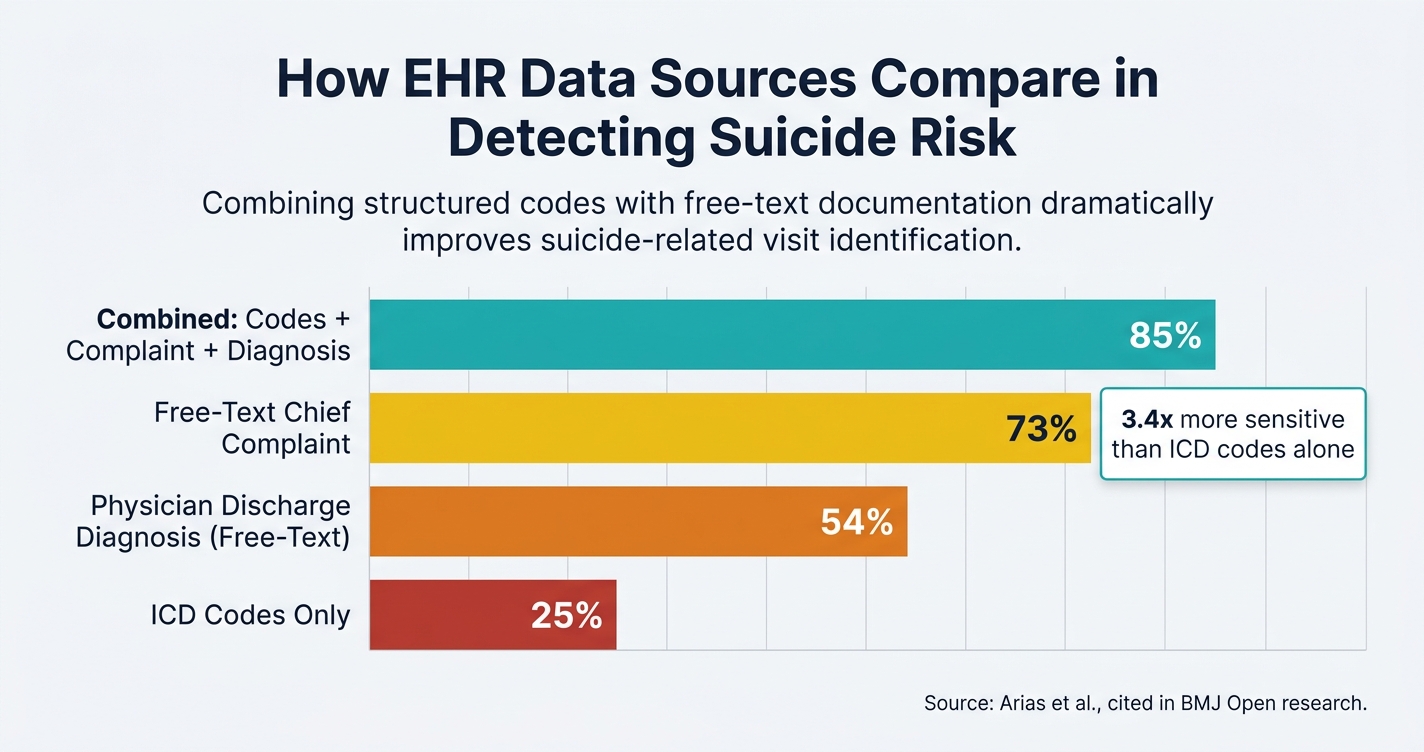
EHR Data Sources vs. Suicide Risk Detection Sensitivity
Suicide risk rarely shows up in one field or one visit. In behavioral health settings, it often appears as a pattern across diagnoses, service use, medications, screening results, and clinical notes.
As Joydeep Sarkar et al. wrote in BMJ Open:
"Suicidal acts represent the common endpoint of a vast number of causal pathways containing a nearly infinite number of combinations of static and dynamic risk factors." [2]
That matters for treatment centers, mental health providers, and clinical leaders because the clearest warning signs are not always found in structured data alone. Diagnosis codes are easy to search, sort, and report on.
But notes, chief complaints, and discharge narratives often hold the context that explains why risk may be changing.
Research makes that gap hard to ignore. ICD codes alone identify only about 25% of suicide-related visits. When those codes are combined with free-text chief complaints and physician discharge diagnoses, sensitivity rises to 85% [1].
|
Data Source |
Sensitivity for Identifying Suicide-Related Visits |
|---|---|
|
ICD Codes Only |
25% [1] |
|
Free-Text Chief Complaint |
73% [1] |
|
Physician Discharge Diagnosis (Free-Text) |
54% [1] |
|
Combined (Codes + Complaint + Diagnosis) |
85% [1] |
For behavioral health organizations, the point is straightforward: risk detection improves when teams review signals across the full patient record, not just coded fields.
A single note may not mean much on its own. A note paired with a medication change, missed follow-up, prior crisis visit, or shift in screening results can tell a very different story.
That is why these signals need longitudinal review across visits, medications, and outcomes. Opus Behavioral Health EHR supports this monitoring with reporting, outcomes measurement, automated workflows, telehealth follow-up, and e-prescribing.
The next section breaks these patterns into seven EHR signals teams can track.
1. Prior Self-Harm and Suicide Attempts
Prior self-harm or a past suicide attempt remains one of the strongest warning signs for later suicidal behavior.
Research published in Social Psychiatry and Psychiatric Epidemiology found that patients with a prior inpatient or ED event for self-harm or suicidal ideation had 5.45 times higher odds of a later suicidal crisis within 180 days [7].
For behavioral health providers, the operational problem is not only clinical. It is also a documentation and visibility issue. This history is often buried in free-text notes, which means many systems fail to surface it in a reliable way. One study found that only 19% of patients with a documented suicide attempt in their clinical notes had a matching ICD-9-CM code [1].
As Sarah A. Arias, PhD, said:
"Research that relies on ICD codes from the EHR to study suicide-related outcomes significantly underestimates both SI [suicidal ideation] and SA [suicide attempt] cases." [1]
That gap matters. If teams rely only on diagnosis codes, they may miss a prior attempt that appears in presenting complaints, progress notes, discharge narratives, or the problem list.
Free-text presenting complaints and discharge documentation often contain far more usable detail than billing codes alone.
Clinical and operations leaders should make sure this history is tracked across notes, discharge diagnoses, and the problem list. Because prior self-harm and suicide attempts carry long-term risk value, this information should remain visible in the patient summary at every encounter, not disappear after a single visit or episode of care.
2. Missed Appointments and Care Gaps
After prior self-harm, the next key signal is disengagement from care. Missed visits are not just a scheduling problem. In behavioral health, they can point to unresolved or worsening suicide risk. Research published in Social Psychiatry and Psychiatric Epidemiology found that erratic or declining attendance and missed visits often indicate that a patient's underlying crisis remains unresolved or is escalating [7].
The first 7 days after discharge are the highest-risk follow-up period. About 7.2% of mental health-related ED visits are followed by a nonfatal suicidal event within 180 days of discharge [7]. A missed follow-up visit during that first week should be treated as a serious signal for clinical review, not just a front-desk task.
Behavioral health teams can monitor this through four EHR fields: appointment status, discharge date, last-visit date, and follow-up date. EHR workflows should flag missed appointments for any patient with a history of self-harm or a recent acute care discharge.
|
Risk Signal |
Why It Matters |
EHR Data Type |
|---|---|---|
|
Erratic attendance |
May indicate an escalating or unresolved mental health crisis [7] |
Structured (appointment status) |
|
Long care gaps |
May signal loss of treatment connection |
Structured (days since last visit) |
|
Post-discharge no-show |
High-risk window within the first 7 days after discharge [2] |
Structured (discharge date vs. appointment date) |
|
Disengagement notes |
Clinical observations of a patient pulling away from treatment |
Unstructured (free-text notes) |
Missed visits should be reviewed alongside diagnosis changes and medication patterns. That broader view helps teams tell the difference between an administrative gap and a clinical warning sign. When no-shows start to cluster with diagnosis shifts, the risk picture often becomes more serious.
3. High-Risk Mental Health and Substance Use Diagnosis Patterns
When attendance starts to slip, diagnosis history can help show whether clinical risk is also getting worse. For behavioral health teams, this is not just a documentation issue. It can be an early warning sign that a patient’s risk profile is changing.
Diagnosis history is a strong suicide-risk signal when teams watch the right patterns. Patients with "Other Psychoses" have a 4.00 odds ratio for suicide death, while those with "Personality Disorders and Other Nonpsychotic Mental Disorders" have a 3.58 odds ratio [3]. Risk also rises when substance use appears alongside frequent behavioral health visits and multiple antidepressant medications. Research identifies that mix as a strong predictor of near-term intentional self-harm [2].
Teams should monitor these patterns across the problem list, encounter diagnoses, and recent chart history. The goal is not to treat the intake diagnosis as fixed. Diagnosis patterns often shift over time, and those shifts may matter as much as the original presentation.
A practical review should look at:
Changes in diagnosis patterns over timeRecent medication adjustments, especially across antidepressants
Crisis visits or other signs of rising acuity
Co-occurring substance use tied to frequent behavioral health utilization
Tracking these signals together can give clinical and operations leaders a clearer view of whether risk is building across multiple parts of the record.
4. Psychotropic Medication Starts, Dose Changes, and Discontinuation
Medication activity can signal near-term risk before the next scheduled visit. In behavioral health settings, structured medication data shows what changed, while clinical notes often explain why it changed. That combination makes medication starts, dose adjustments, and discontinuation an important area for risk monitoring.
One EHR study found that notes referencing prescribed medication, overdose, or poisoning were linked to suicide attempts within 30 days [6].
"Documents containing words related to prescribed medications/drugs/overdose/poisoning/addiction had the highest odds of being a risk indicator used proximal to a suicide attempt (OR 1.88; precision 0.91 and recall 0.93)." - Rina Dutta, Senior Clinician and Researcher, King's College London [6]
Medication volume may matter as well. A 2024 model found that a higher number of antidepressant medications was one of the top predictors of 30-day intentional self-harm [8].
For clinical and operational leaders, that points to a clear need for a fast, standardized, and well-documented response when psychotropic medication regimens change.
A practical approach is to treat a new start, dose change, or abrupt stop as a 14-day follow-up trigger. That follow-up may help clinical teams confirm patient contact, review symptom changes, assess side effects, and document any new safety concerns.
Opus Behavioral Health EHR can support this process through automated workflows, e-prescribing, and reporting. When medication changes appear at the same time as ED use or crisis care, the risk picture becomes more serious and may call for closer review across clinical and operations teams.
5. Recent ED Visits, Psychiatric Admissions, and Crisis Encounters
A recent ED visit, psychiatric hospitalization, or crisis encounter is one of the clearest warning signs in the EHR. These events often point to distress that has not resolved and may be getting worse. In many cases, they are the last documented point of contact before a later suicide attempt or death [7]. Timing matters most here: the more recent the encounter, the more urgent the review.
Near-term risk is often highest in the weeks and months after an ED mental health visit, especially when the visit involved self-harm or suicidal ideation. A prior ED visit tied to self-harm or SI is a strong predictor of later events. Even an ED visit coded more broadly as a mental health encounter can signal higher short-term risk [7].
Documentation gaps can make these cases harder to spot. ICD codes alone miss many crisis-related encounters. A better approach combines diagnosis codes with presenting complaints and discharge diagnoses, which identifies far more SI and suicide attempt cases [1].
For behavioral health teams, the most useful fields to track include:
Encounter dateCare setting
Discharge reason
Whether follow-up occurred within 7 days
When crisis care appears alongside trauma history, social isolation, or other stressors, the record often points to a more urgent pattern that calls for closer review.
6. Documented Psychosocial Stressors, Trauma, and Social Isolation
Psychosocial stressors such as homelessness, legal problems, trauma, family conflict, and social isolation often show up in narrative documentation rather than diagnosis codes. For behavioral health leaders, that creates a visibility problem.
Risk may be present in the chart, but not in the fields most teams use for reporting, triage, or case review.
Social isolation and a sense of burdensomeness are known suicide risk signals, especially when older male patients become disconnected from routine care [3]. The issue is not only whether risk exists. It is also where that risk is documented.
The documentation gap is large. About 50% of people who die by suicide have no mental health diagnosis in structured records, and more than 90% of patients identified through notes have no matching ICD code [3][4].
In practice, that means warning signs may appear in a free-text progress note, presenting complaint, or discharge summary long before they appear in a coded field.
Behavioral health organizations should track these factors in both structured fields and note text. Z-codes can capture some social determinants, but many of the details that matter most, such as homelessness, legal problems, incarceration, or family history of suicide, are often buried in clinical notes.
Natural language processing tools can help teams surface those terms in reporting workflows [5]. Prior trauma is also a major risk factor for suicide and intentional self-harm [5].
This matters at the workflow level. If trauma history, isolation, or life stressors are only visible to the individual clinician reading the note, leadership teams may miss shifts in risk across patients, programs, or locations.
That can limit outreach planning, delay safety plan updates, and reduce visibility into patients whose risk profile is changing between visits.
A more reliable process often includes:
Documenting psychosocial stressors in structured fields when possible.
Reviewing note text for repeated references to trauma, isolation, and worsening life stressors.
Comparing those patterns with screening scores and care engagement data.
Triggering outreach, safety plan refreshes, or added review when stressors intensify.
When these stressors worsen, teams should compare them with screening scores to determine whether risk may be rising. That step can help connect narrative clinical detail with action, rather than leaving meaningful warning signs buried in the chart.
7. Worsening Screening Scores and Patient-Reported Outcome Trends
When psychosocial stress builds, screening scores often shift soon after. For behavioral health teams, PHQ-9 and C-SSRS trends usually matter more than any one score on its own. The main signal is movement over time, especially a steady decline or a sharp change between visits.
Research shows that suicide risk is predicted more accurately by changes tracked across visits than by a single score viewed in isolation [9].
A score that worsens over time, or changes sharply from one appointment to the next, can point to rising risk more clearly than a threshold crossed once. Rolling-window monitoring and longitudinal trajectory views give clinical teams a clearer way to see whether risk is moving up or down over time [9].
This is also where workflow becomes a leadership issue, not just a clinical one. If a PHQ-9 score crosses a set threshold, or shows a meaningful decline between visits, that event should lead to a documented response rather than a note sitting in the chart.
Opus Behavioral Health EHR supports outcomes measurement and automated workflows that can help teams assign trigger-based responses and track follow-up activity. Those score patterns should connect directly to trigger rules, outreach steps, and safety planning workflows.
In practice, treatment centers should tie score changes to clear next steps, such as:
- clinician review- patient outreach
- safety planning
- follow-up documentation
Every threshold crossing or sharp score decline should connect to a defined action so teams are not left making case-by-case decisions without a clear process.
How to Turn Risk Signals Into Action
Once a signal is identified, the workflow needs to show exactly what happens next. A signal only has value when it starts a documented response.
Set Clear Trigger Rules for Each Signal
Each signal in this article should have a defined threshold that starts a response automatically. That may include a missed post-discharge appointment, a new self-harm code, a medication change, or worsening screening scores. Those thresholds should be documented, aligned across the clinical team, and built into the EHR instead of relying on individual judgment.
Triggers should pull from multiple EHR fields, including diagnoses, notes, medications, and screening trends, rather than billing codes alone.
The next step is to connect each trigger to a standard response.
Match Each Trigger to a Standard Response
When a trigger fires, the team should not have to improvise. Each trigger should connect to one pre-assigned response.
|
Risk Signal |
Standard Response |
|---|---|
|
Missed post-discharge appointment |
Same-week outreach, documented in chart |
|
New self-harm or crisis encounter code |
Same-day chart review; safety plan update |
|
Recent medication change |
Prompt clinician review; telehealth check-in |
|
Worsening screening score or patient-reported outcome trend |
Repeat screening; care-team review |
|
High-risk psychosocial stressor documented |
Increased visit frequency; care-team notification |
High-risk triggers should use interruptive alerts, not passive chart flags.
That structure matters because a response only counts when the EHR can show that staff completed it.
Use Reporting and Workflow Tools to Close the Loop
Flagging a patient is not the same as following up. Clinical and operations teams need a way to see whether the assigned action actually happened.
Dashboards, task queues, and follow-up trackers can show which flagged patients received outreach, which safety plans were updated, and which telehealth check-ins were completed. They also show what is still open, which matters when staff are balancing heavy caseloads and time-sensitive follow-up.
Opus Behavioral Health EHR supports closed-loop follow-up with automated workflows, reporting, and outcomes tracking, so unresolved tasks stay visible until completed.
Even strong trigger rules can break down when key risk details never make it into the chart.
Common Documentation Gaps That Can Hide Suicide Risk
Even well-built trigger rules can miss suicide risk when chart data is incomplete, inconsistent, or buried in narrative notes. In behavioral health settings, the biggest blind spots often show up in coding, free-text documentation, and follow-up tracking. Those gaps can obscure the same warning signs already discussed, including self-harm history, crisis encounters, medication changes, and worsening screening patterns.
Inconsistent Coding for Self-Harm and Crisis Events
ICD codes are often used to flag suicide-related visits, but they do not replace complete clinical documentation. Research shows that ICD codes alone identify only 25% of suicidal ideation and suicide attempt cases in emergency department records.
Among patients with a documented suicide attempt, only 19% had a matching ICD code in the chart [1].
"Research that relies on ICD codes from the EHR to study suicide-related outcomes significantly underestimates both SI and SA cases." - Sarah A. Arias, PhD, Assistant Professor (Research), Brown University [1]
For behavioral health leaders, this creates a reporting problem and a care risk at the same time. If staff rely too heavily on encounter codes, the record may miss intent, severity, or context.
An overdose visit, a laceration, or another injury-related encounter may involve self-harm, but that risk can remain invisible if intent is not documented directly.
A better approach is to require structured intent documentation for overdose, laceration, and other injury visits. That gives clinical teams a clear way to record whether self-harm was suspected, disclosed, or confirmed rather than leaving it to be inferred from the visit type alone.
Key Details Buried in Free-Text Notes
When coding misses risk, the chart often still contains the signal, just not in a place where reports or alerts can use it.
Narrative notes may include homelessness, family conflict, family history of self-harm, or legal and incarceration history. Those details matter. They can shape risk level, discharge planning, and follow-up needs, yet they often sit outside searchable fields.
This is a common breakdown in behavioral health documentation. A clinician may record prior self-harm, psychosocial stressors, or crisis history in a note, but if that data stays in free text, reporting tools may not surface it. The result is familiar: care teams document risk, but the organization cannot reliably track it across patients, programs, or locations.
The practical fix is straightforward. Critical risk data should move out of narrative text and into discrete EHR fields.
Standardized note templates can prompt clinicians to document self-harm history, homelessness status, and family conflict or family history of self-harm in structured fields. Once captured that way, the information becomes available to both care teams and reporting workflows.
Missing Follow-Up and Screening Data
The same issue appears when screening and follow-up activity is not documented the same way every time. If a patient’s PHQ-9 scores are collected irregularly, there is no consistent trend line to review. If a post-discharge outreach attempt is not entered into the chart, the system cannot confirm that it happened.
For treatment centers and mental health providers, this weakens both care visibility and operational follow-through. Leadership may assume that screening and outreach workflows are in place, while the underlying data tells a different story. Without consistent capture, trend reporting, task tracking, and gap monitoring become much less useful.
Teams should collect PHQ-9 scores and post-discharge outreach on a fixed schedule and store both in structured fields so reports and task queues can work as intended. Opus Behavioral Health EHR supports outcomes measurement and advanced reporting to help teams identify missing screening and follow-up data before those gaps turn into missed signals.
Conclusion
These seven EHR signals are most useful when clinical teams treat them as one risk pattern rather than a set of separate alerts.
Prior self-harm, missed appointments, high-risk diagnosis clusters, psychotropic medication changes, crisis utilization, psychosocial stressors, and worsening screening trends each matter on their own. Their strongest value, though, comes from being reviewed together. Suicide risk often shows up as a pattern across the record, not as one isolated event.
EHR-based models can strengthen clinical judgment, but they should support human review rather than replace it. Behavioral health leaders should focus on closing documentation gaps, standardizing screening, and defining clear trigger rules.
When providers capture risk in a consistent way and respond without delay, the EHR can serve as an early warning system. The goal is not more data. The goal is faster recognition and follow-up.
FAQs
Why aren’t ICD codes enough?
ICD codes alone are not enough because they often miss or undercount suicidal ideation and suicide attempts. Many clinical encounters tied to suicide risk never receive the matching diagnostic code, which means structured administrative data and claims data may fail to show the full level of risk.
To get a clearer view, behavioral health teams also need unstructured information, including free-text clinical notes and psychosocial factors. That added context can reflect a patient’s behavioral health trajectory more accurately than coded data alone.
Which EHR signal matters most?
Research suggests chronic stress is the strongest single psychosocial signal tied to suicide risk, especially when it appears in clinical notes.
Diagnostic codes on their own can miss that risk. In many behavioral health settings, suicidal thoughts and behaviors are undercoded, which leaves leadership teams and clinical staff with an incomplete picture. That gap matters. When risk is not clearly visible in the record, providers may have less context for care decisions, and organizations may have weaker reporting across clinical and operational workflows.
Bringing together structured data and unstructured note data can improve prediction. For behavioral health organizations, that means looking beyond coded diagnoses and pulling insight from the language clinicians document during care.
Opus Behavioral Health EHR supports this process with advanced reporting and AI-powered tools designed to help clinicians connect those data points more effectively.
How should teams respond to a new risk signal?
Use a new risk signal as one more data point alongside clinical judgment, patient self-reports, and interview findings.
It can help teams decide when to prioritize follow-up after missed appointments or when to prompt a safety assessment. It should not replace final clinical decision-making. These insights work best when paired with evidence-based education.



- Behavioral Health
- EHR Systems
- Addiction Treatment EHR
- mental health
- Telehealth
- addiction treatment
- Behavioral health facility
- Substance Abuse Disorder
- behavioral Health center
- HIPPA Compliant
- ehrsoftware
- PTSD
- behavioral health ehr
- Depression
- hipaa
- Anxiety
- MentalHealthMatters
- RCM
- claim denials
- clinical documentation
- mental health awareness
- screening tools

September 15, 2026

September 15, 2026

September 14, 2026

September 11, 2026

September 10, 2026

September 09, 2026
Recommended Posts

Tuesday, September 01, 2026
How EHR Integration Supports Coordinated Care
Disconnected records often weaken behavioral health coordination.
Friday, February 11, 2022
Top Considerations for Behavioral Health Treatment Centers When Switching EHR Systems
The world is cautiously beginning to open again after the Covid-19 shelter-in-place orders are lifted. While it’s ...

Friday, December 05, 2025
Real-Time vs. Manual Payment Reconciliation
Payment reconciliation ensures financial accuracy by matching incoming payments to claims or invoices. In healthcare, ...