
Addiction Treatment Software & EHR: A Buyer’s Guide
 By: Adi Tawari
Saturday, April 04, 2026

Addiction treatment software should follow each patient from Detox to outpatient care, bill correctly at every level, and keep substance use records private under 42 CFR Part 2. Most EHRs can't do all three, because they're built for general healthcare: short office visits, one kind of claim, and standard HIPAA privacy. Treatment centers run long stays, group sessions, per-day billing, and stricter consent rules. Opus was built by operators who ran 14 treatment facilities and kept running into those gaps. This guide is for owners and leaders of centers with several levels of care. It covers what your EHR should handle at each level, how billing and consent should work, and what to ask vendors before you switch.
In this guide
-
What is addiction treatment software?
-
Why general EHRs fall short in addiction treatment
-
What your EHR should handle at each level of care
-
How per day and per visit billing works
-
How your EHR should handle 42 CFR Part 2 consent
-
How drug-screen orders and results work
-
Addiction treatment EHR checklist
-
EHR software for addiction treatment, built by operators
-
Key takeaways
-
Before you switch
-
FAQs
What you'll learn
-
What an addiction treatment EHR does at Detox, Residential, PHP, IOP, and OP
-
How per-day and per-visit billing work, and what changes when a patient moves to OP
-
How 42 CFR Part 2 consent should work in your EHR
-
How drug-screen orders and results move through the chart
-
Seven features to ask vendors about
Trusted by treatment centers like these
Rated 4.8 on Capterra, Software Advice and GetApp
What is Addiction Treatment Software?
Addiction treatment software is the set of tools a substance use disorder (SUD) treatment center uses to run admissions, clinical care, and billing. The strongest systems combine all three in one platform, so a patient's information follows them from the first call to discharge and every service gets captured for billing.
Admissions (CRM) tracks inquiries, referrals, insurance verification, and pre-admission screening, so no lead falls through the cracks.
Clinical records (EHR) holds assessments, treatment plans, progress and group notes, medications, and lab results for every level of care.
Billing (RCM software) turns documented services into claims and tracks authorizations, payments, and denials.
You'll see EHR (electronic health record) and EMR (electronic medical record) used interchangeably. For addiction treatment, they mean the same thing.
Why General EHRs Fall Short in Addiction Treatment
Most EHRs are made for general healthcare, where a patient comes in for a short office visit and leaves. Treatment centers work differently in four ways.
Long stays. A residential patient may be in your care around the clock for weeks. That means daily notes, nursing shifts, medication passes, and group sessions. A general EHR treats each of these as a separate appointment, which buries staff in clicks.
Patients moving between programs. Patients step down from Detox to Residential, then PHP, IOP, and OP. In many systems, each move starts a new episode, so staff re-enter demographics and the treatment plan doesn't carry over.
Stricter privacy rules. SUD records are protected by 42 CFR Part 2, which goes further than HIPAA. Your EHR has to keep SUD information separate and track patient consent for every disclosure.
Per-day billing. Detox, Residential, PHP, and IOP are usually billed at a daily rate. Most EHRs are set up for per-visit claims, so centers end up tracking billable days in spreadsheets.
Here's how that plays out. An insurer approves 15 days of IOP for a patient. The patient keeps attending after day 15, but nothing in the system flags that the approved days have run out. No one asks the payer for more days, and the center doesn't get paid for care it already provided.
Moving fully off paper also makes a measurable difference. According to a 2024 federal data brief, 99% of substance use and mental health treatment facilities that use only an EHR record treatment plans electronically, compared with 94% of facilities that still use paper charts alongside their EHR.
What Your EHR Should Handle at Each Level of Care
Each level of care has its own documentation and billing needs, and your EHR should handle all five in one chart.
|
Level of care |
What it is |
What the EHR handles |
Billing |
|---|---|---|---|
|
Detox |
Medically monitored withdrawal, usually a few days |
Withdrawal scales, vitals, nursing notes, medications |
Per day |
|
Residential |
24-hour inpatient stay |
Daily and group notes, beds and census, treatment plans |
Per day |
|
PHP |
Full-day program, patient goes home at night |
Group attendance, program hours |
Per day |
|
IOP |
Outpatient care a few hours a day, several days a week |
Group notes, attendance, planning the move to OP |
Per day |
|
OP |
Sessions by appointment |
Scheduling, session notes, reminders |
Per visit |
What Detox Software Needs to Track
Detox is medically monitored withdrawal, usually lasting a few days. Nurses score withdrawal on standard scales, such as CIWA-Ar for alcohol and COWS for opioids, and track vitals and scheduled medications around the clock. In Opus, withdrawal scores, vitals, and medication records sit in the same chart, so the nursing team sees symptoms and doses side by side.
Daily Care in a Residential Program
Residential patients live at the facility, so their records grow quickly, with daily progress notes, group notes, nursing notes, and treatment plan updates. In Opus, a counselor can write one group note and add it to each attendee's chart. Bed and census views show admissions which beds are open in each program.
Keeping Track of PHP Attendance
In a partial hospitalization program (PHP), patients spend most of the day in treatment and go home at night. Payers expect proof of attendance and program hours for every billed day. Opus logs which groups each patient attended and for how long, and ties that to the day's billing.
Why IOP Is Outpatient Care
In an intensive outpatient program (IOP), patients attend a few hours a day, several days a week, and live at home. Even though it's outpatient care, IOP is usually billed per day, not per visit, which trips up EHRs built for outpatient practices. Opus tracks IOP attendance and approved days, so staff can plan the move to OP before the authorization ends.
Scheduling and Billing in Outpatient Programs
Outpatient (OP) care runs on appointments, usually individual or small-group sessions once or twice a week. Here the EHR works like a practice system, with scheduling, session notes, appointment reminders, and per-visit claims. In Opus, the same chart follows the patient into OP, so the counselor can see their full history from admission onward.
When a patient steps down to a new program, their record should go with them. That's where care coordination makes the biggest difference.
How Per Day and Per Visit Billing Works
Higher levels of care, meaning Detox, Residential, PHP, and IOP, are usually billed at a daily rate. Outpatient care is billed per visit. When a patient steps down from IOP to OP, billing switches from one model to the other, and your EHR needs to handle both.
-
One rate covers the whole day. The daily rate covers all of that day's care, so every note for the day needs to be finished before the claim goes out.
-
Every patient in a group gets a billable entry. A group session with eight patients should create eight billable entries, one in each patient's chart.
-
Facility and professional claims are handled in one system. Opus handles facility claims (UB-04) and professional claims (CMS-1500) in one place, so you don't need a second tool when patients move to OP.
-
Payer and state rules are checked before claims go out. Opus's Genie checks each claim against payer and state rules before it's submitted.
-
The billing software comes with the EHR. Documented services flow into claims without being re-entered.
"With the ease of use for our clinical staff and clients, robust functionality for our back-office support, payer rate compliance features, and accrual accounting reporting, along with many more, it was an easy choice." - Trevor Mulvey, VP of Finance, Care Counseling Clinics
See how Opus bills per day and per visit in one system. Book a demo
How Your EHR Should Handle 42 CFR Part 2 Consent
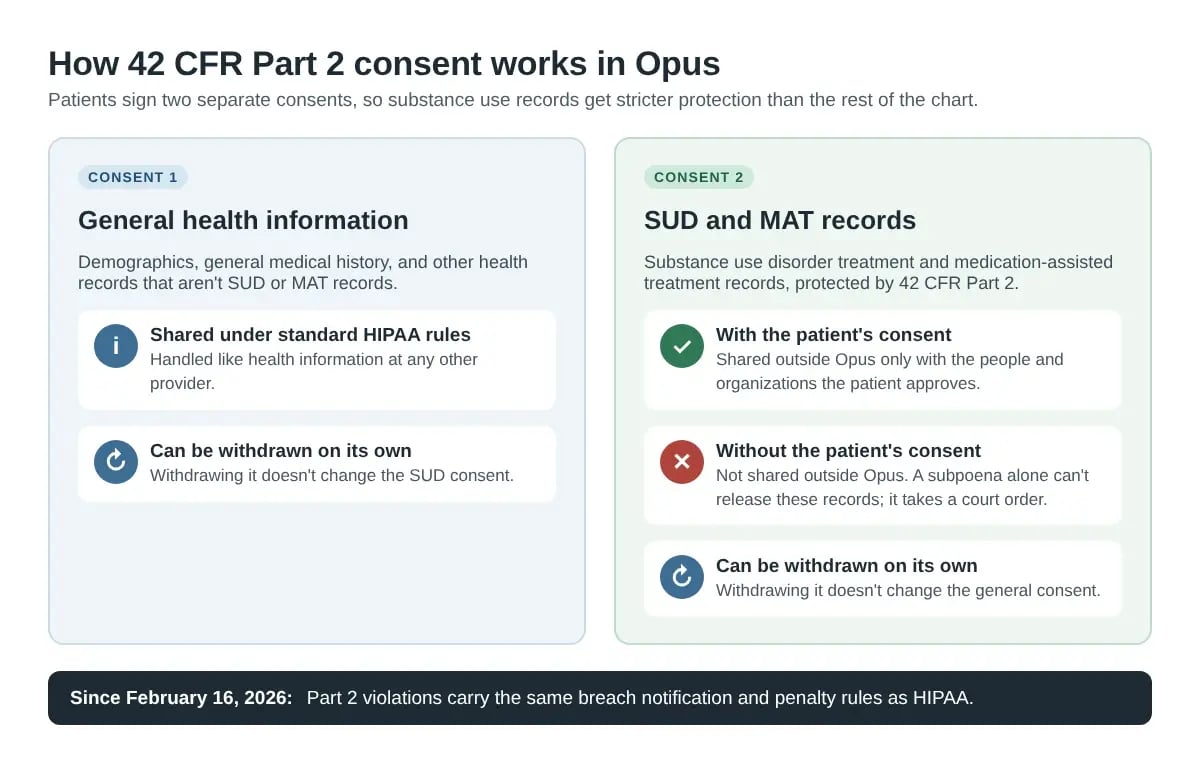
42 CFR Part 2 is the federal rule that protects records from substance use disorder treatment programs. It's stricter than HIPAA. In most cases, SUD records can't be shared without the patient's written consent, even with other providers, and there are extra limits on how they can be used in legal proceedings.
-
Violations now carry HIPAA penalties. Since February 16, 2026, the compliance date for the 2024 HHS Part 2 final rule, Part 2 violations are subject to the same breach notification and penalty rules as HIPAA.
-
A subpoena isn't enough. A subpoena on its own can't release Part 2 records. It takes a court order.
-
Two separate consents. In Opus, consent is split in two: one for general health information and one for SUD and MAT records. Patients can withdraw either one on its own, and SUD records are only shared outside Opus with the patient's consent.
-
Consents signed before arrival. Patients can sign consent forms on their phone before they arrive, so they're on file at admission.
Consent is only one part of Part 2. For audit trails and access controls, see these compliance features for SUD EHRs.
How Drug-Screen Orders and Results Work
Drug-screen results shape treatment decisions, so they need to reach the clinician fast. If lab results have to be typed into the chart by hand, a positive result can sit unnoticed, and the clinician finds out later than they should.
-
The clinician orders the screen from the patient's chart and picks the test panel.
-
The order goes to the lab electronically, linked to the patient.
-
Staff collect the specimen and record the collection in the chart.
-
The lab sends results straight back into the patient's chart.
-
Positive or unexpected results are flagged for the clinician.
-
The clinician reviews the result, documents next steps, and updates the treatment plan if needed.
Addiction Treatment EHR Checklist: 7 Features to Ask For
Bring these seven questions to every vendor demo.
-
One chart across levels of care: Will a patient's chart move with them from Detox all the way to OP?
-
Group notes: Can I write one group note and have it go into everyone's chart?
-
Billing models: Can it bill per day and per visit?
-
Part 2 consent: Does it keep SUD consent separate, and let me know before a consent expires?
-
Lab results: Do drug-screen results come back into the chart on their own?
-
E-prescribing: Can we e-prescribe controlled substances and check the PDMP without leaving the chart?
-
Reporting: Can I pull census and admissions reports for each program?
The right system also needs intake forms that fit your programs. Here's how to set up intake forms for SUD clinics.
EHR Software for Addiction Treatment, Built by Operators
Opus started inside treatment centers. Its founders ran 14 facilities across several levels of care, and the EHRs they used kept failing them on group notes, per-day billing, and SUD consent. So they built the system they needed.
Opus is built for centers with several programs and 10 or more providers. It includes 40 built-in reports, including Daily Census, Admits by Month, and Utilization Review by level of care, plus a report builder for anything custom.
Opus is rated 4.8 out of 5 on Capterra.
Opus brings admissions, records, and billing together in one behavioral health EHR.
Key Takeaways
-
General EHRs are built for short office visits. Treatment centers need one chart that follows a patient through every program.
-
IOP is outpatient care but is usually billed per day, so your system has to handle both billing models.
-
An authorization that runs out unnoticed can mean days of care you don't get paid for. Your EHR should flag it.
-
Since February 2026, Part 2 violations carry HIPAA-level penalties, which makes separate SUD consent essential.
-
Lab results that flow into the chart automatically mean positive screens get seen sooner.
Before You Switch Addiction Treatment Software
A new EHR means retraining your whole staff, from admissions to nursing to billing, so it has to fit how your center already works. Before you commit, ask each vendor to show your actual programs and workflows, not a generic demo. Once you're live, check 10 to 20 random charts a month for missing consents, missing drug-screen results, and copied notes. You'll catch problems before an auditor does.
"Easy to teach to new staff. This is the best EMR I have ever used, and every department at my company agrees. Very easy to learn, use, and navigate." - Cory N., Executive VP of Operations
Want to see how Opus fits your levels of care? Book a demo, and we'll walk through your programs.
FAQs
Is an addiction treatment EHR the same as an EMR?
Yes. EHR (electronic health record) and EMR (electronic medical record) are used interchangeably for addiction treatment software. Both refer to the digital chart that holds assessments, treatment plans, notes, medications, and lab results. What matters more is whether the system is built for SUD care, including Part 2 consent and per-day billing.
What software do addiction treatment centers use?
Most centers use three kinds of software: a CRM for admissions, an EHR for clinical records, and RCM software for billing. Some buy these separately and connect them. Others use one platform, like Opus, that combines admissions, records, and billing, so patient information never has to be re-entered between systems.
Can one EHR handle Detox through OP?
Yes, if it's built for addiction treatment. It needs withdrawal scales and nursing notes for Detox, group notes and census for Residential, attendance tracking for PHP and IOP, and scheduling for OP. It also has to bill per day and per visit, and keep one chart as the patient steps down.
How long does it take to switch EHRs?
It depends on your center's size, how many programs you run, and how much data you're moving. Plan time for setup, data migration, configuring forms and billing rules, and training every department. Ask any vendor for a realistic timeline based on centers like yours.
Related Resources


- Behavioral Health
- EHR Systems
- Addiction Treatment EHR
- mental health
- Telehealth
- addiction treatment
- Behavioral health facility
- Substance Abuse Disorder
- behavioral Health center
- HIPPA Compliant
- ehrsoftware
- PTSD
- behavioral health ehr
- Depression
- hipaa
- Anxiety
- MentalHealthMatters
- RCM
- claim denials
- clinical documentation
- mental health awareness
- screening tools

September 15, 2026

September 15, 2026

September 14, 2026

September 11, 2026

September 10, 2026

September 09, 2026
Recommended Posts

Friday, December 12, 2025
HIPAA Compliance: Access Control in SUD Systems
SUD data is highly sensitive: It includes substance use history, mental health details, and treatment records. Exposure ...

Thursday, December 11, 2025
Top Compliance Features in SUD EHRs
SUD treatment centers face strict privacy rules under HIPAA and 42 CFR Part 2. Falling short of these regulations risks ...

Monday, December 01, 2025
How AI Improves Patient Engagement in Addiction Treatment
AI is transforming addiction treatment by making care more personalized, efficient, and accessible. It helps address ...