
Electronic health record (EHR) systems are transforming pediatric behavioral health care by integrating screening tools like the Pediatric Symptom Checklist (PSC), Strengths and Difficulties Questionnaire (SDQ), and Vanderbilt ADHD Diagnostic Rating Scale (VADRS).
These tools streamline workflows, improve diagnosis rates, and enhance patient care by embedding behavioral health data directly into clinical workflows.
Key takeaways:
Higher Completion Rates: Electronic systems achieve up to 90.5% screening completion compared to paper methods.
Improved Diagnoses and Referrals: Clinicians are 64% more likely to diagnose behavioral disorders and 3–6 times more likely to refer patients to specialists.
Data Integration: EHRs combine behavioral screening data with medical records, lab results, and medication lists for better insights.Major EHR systems like Epic Systems, Cerner, Allscripts, athenahealth, and Opus Behavioral Health EHR offer unique features such as workflow automation, decision support, and outcome tracking. Each system caters to specific needs, from large hospitals to smaller practices, making it essential to choose based on clinical requirements and budget.
1. Epic Systems
Integration Methods
Epic Systems leverages HL7 FHIR (covering DSTU2, STU3, and R4) as its main standard for integration, ensuring smooth data exchange between third-party pediatric screening tools and the EHR.
It also supports SMART on FHIR, which allows clinicians to access behavioral health apps directly within a patient’s chart - no need to switch between systems.
For real-time clinical decision support, Epic uses CDS Hooks to automatically trigger reminders for screenings based on factors like a patient’s age or the type of visit. Additionally, FHIRcast ensures that both the EHR and external behavioral health apps stay synchronized on the same patient throughout the workflow.
Epic's Care Everywhere framework facilitates the exchange of over 20 million patient records daily, ensuring that behavioral screening results are accessible no matter where a child receives care [5].
With over 60,000 active interfaces using standards like HL7 and ASC X12, Epic connects seamlessly across systems. The platform also handles an impressive 54.3 billion web service transactions annually through its publicly available APIs [5].
This level of integration helps create a streamlined process for pediatric behavioral screenings.
Workflow Efficiency
Epic simplifies the pediatric behavioral screening process by using MyChart, its patient portal, which serves over 195 million users - including caregivers for more than 2 million children aged 2 or younger [4]. Through MyChart, parents can complete screening tools like the PSC-17 before their child’s appointment. Once submitted, the results - along with calculated scores - are automatically added to the EHR. This setup saves valuable time during appointments, allowing clinicians to focus more on treatment planning instead of administrative tasks.
Outcome Tracking
Epic offers robust tools to track outcomes over time. The Clarity and Kit databases provide SQL-based access for detailed clinical and operational reports, while FHIR Bulk Data exports support population-level analysis. These capabilities enable pediatric practices to monitor screening trends, measure the success of interventions, and identify areas needing improvement.
For example, from November 2018 to June 2023, Children's Hospital of Philadelphia used an Epic-integrated pediatric sleep screener across 31 primary care practices. This resulted in clinicians being 64% more likely to diagnose sleep disorders and a 6.48-fold increase in referrals to sleep clinics. The screener maintained a 92.5% usage rate among providers throughout the study period [2].
|
Integration Technology |
Primary Function in Pediatric Screening |
|---|---|
|
FHIR (R4/STU3) |
Facilitates standardized data exchange for screening scores and demographics |
|
CDS Hooks |
Provides real-time alerts or decision support based on screening outcomes |
|
SMART on FHIR |
Launches third-party screening apps within the Epic interface with patient context |
|
MyChart API |
Lets parents submit screening questionnaires from home or the waiting room |
|
Clarity/Kit |
Supports outcome tracking and insights into population health trends |
2. Cerner Systems
Integration Methods
Cerner uses standards-based APIs and reliable network connections to facilitate data sharing between its EHR and external health applications [7].
As a founding member of the CommonWell Health Alliance, Cerner prioritizes interoperability, enabling access to a patient’s full medical history - such as immunizations and past diagnoses - from other organizations [7].
The platform incorporates the American Academy of Pediatrics (AAP) Bright Futures guidelines directly into its EHR PowerForms. This approach replaces custom systems with a standardized framework that is regularly updated [9].
By retaining screening responses as discrete data instead of narrative notes, Cerner ensures that this information is reusable for future visits. This also creates a searchable database that supports population health tracking [9]. Additionally, evidence-based tools, such as the ICU Liberation Bundle, are embedded within clinician workflows, making assessment tools easily accessible during care [6].
For smaller healthcare facilities, Cerner offers Oracle Health CommunityWorks, a cloud-based solution that provides an integrated system capable of scaling with the organization's growth [8]. These integration methods are designed to simplify workflows and improve efficiency, as discussed below.
Workflow Efficiency
In July 2022, Children's Minnesota adopted Cerner's "Pediatric Ambulatory Care" blueprint, led by Dr. Chase Shutak, a clinical informaticist.
This initiative introduced Workflow mPages tailored for medical assistants and clinicians, integrated the AAP Bright Futures guidelines, and implemented the LaunchPoint Tracking Board for walk-in care.
The results were notable: an 18% reduction in after-hours work, a 12% increase in same-day encounter closures, and a 59% improvement in mental health screening compliance. Clinicians collectively saved over 43 hours of EHR time per month [9].
"For care management within applicable visits, 59% of our clinicians demonstrated increased mental health screening compliance and 40% of our clinicians had increased asthma action plan completion." - Dr. Chase Shutak, Clinical Informaticist and Primary Care Pediatrician, Children's Minnesota [9]
The HealtheLife Patient Portal enables parents and caregivers to complete behavioral screenings remotely, which then sync directly into the clinician's system [8].
This streamlined "one patient, one record" approach eliminates redundant data entry and replaces outdated systems that often caused disruptions during upgrades [8].
Implementation Costs
In December 2024, Nashville General Hospital transitioned to Cerner EHR powered by Oracle Health, unifying operations across its 150-bed hospital and more than 20 outpatient clinics.
CIO Melanie Thomas spearheaded the project, aiming to replace multiple disconnected systems with a centralized record that automates manual processes and enhances care coordination [8].
"We chose Oracle Health because it offered a more complete and integrated solution versus the other options we considered.
We are replacing several disparate systems that required redundant data entry, disrupted our operations during upgrades, and lacked integration." - Melanie Thomas, Chief Information Officer, Nashville General Hospital [8]
For smaller practices, initial EHR implementation costs typically range from $5,000 to $25,000, which includes data migration expenses [10]. This affordability aligns with Cerner’s mission to improve clinical workflows while positively impacting patient care.
Outcome Tracking
Cerner’s Dynamic Worklists empower clinicians to manage patient panels based on specific behavioral health needs. For example, providers can monitor follow-ups for patients prescribed SSRIs for mood disorders or stimulants for ADHD [9].
By storing screening data as discrete entries, medical assistants can quickly auto-populate clinician notes for immediate review [9].
"Our internally designed system did not retain information – it allowed for efficient documentation but not the creation of a database for panel management or population health purposes." - Dr. Chase Shutak, Clinical Informaticist and Pediatrician, Children's Minnesota [9]
Oracle Health Data Intelligence transforms collected screening data into actionable insights, aiding treatment decisions [8].
For instance, studies on electronic psychosocial screening using the PSC-17 tool found that 90.5% of cases completed the screen electronically, and clinicians referenced the electronic scores in 90.0% of treatment progress notes [1].
3. Allscripts
Integration Methods
Allscripts offers a range of integration options, including FHIR API, proprietary Allscripts APIs, HL7, and RESTful APIs, making it possible to connect pediatric behavioral health screening tools effectively [11].
Through the Veradigm App Expo, a certified marketplace, pediatric practices can access third-party tools like CHADIS and TimeDoc Health [12].
CHADIS, for instance, provides over 600 web-based questionnaires for mental and behavioral health assessments, complete with instant scoring and actionable recommendations [3][[14]](https://expo.veradigm.com/apps/Details/Healthwise® Solution for Allscripts).
Families can complete these age-appropriate screenings online via the patient portal, and the system automatically processes results based on the visit type and patient’s age [3].
These tools and integrations contribute to smoother clinical workflows and better patient care.
Workflow Efficiency
Allscripts Professional EHR includes clinical decision support tools designed to enhance care delivery. These tools flag gaps in preventive care and alert providers to potential drug interactions during charting [16]. The platform also supports voice recognition, handwriting input, and auto-generated templates that draw on a patient’s historical data [15][16].
However, the charting module is known to be click-intensive, requiring multiple actions to navigate between sections such as vitals, medications, and encounter notes [16].
"The charting tools also include prompts that flag potential drug interactions or gaps in preventive care, helping improve patient outcomes while reducing errors."
Stephen Beer, Content Writer, Clarity Ventures [16]
Despite the click-heavy navigation, these features collectively aim to streamline workflows and support consistent outcome tracking.
Implementation Costs
The cost of Allscripts Professional EHR ranges from $299 to $600 per provider each month. Implementation fees vary widely, from $5,000 to $50,000, depending on the size of the practice. For smaller practices, there’s also an option to subscribe to a standalone Veradigm ePrescribe plan, starting at $59 per month [16].
Outcome Tracking
The platform integrates with tools like TimeDoc Health, which use validated rating scales to monitor treatment responses and track patient progress over time [13].
Veradigm Connect further enhances this by allowing third-party behavioral health applications to integrate seamlessly within the EHR. This creates a unified system for monitoring outcomes effectively [13][16].
4. athenahealth
Integration Methods
athenahealth's athenaOne SaaS platform simplifies patient data management with ChartSync, a feature that automatically imports and deduplicates records from hospitals, pharmacies, and health systems.
This ensures that clinicians have access to complete and accurate information during screenings, eliminating the need for manual data entry and integrating seamlessly into the clinical workflow [19].
The platform is ONC HIT-certified, meaning it meets federal standards for interoperability and security [17][18]. With a network that includes over 150,000 providers - among them, more than 12,000 behavioral health specialists - athenaOne promotes coordinated care between pediatric primary care providers and behavioral health teams.
Families can also complete behavioral health screeners ahead of appointments through the athenaPatient app or patient portal, with results automatically appearing in the clinician's view [18].
Workflow Efficiency
athenaOne enhances clinical workflows by replacing generic medical templates with specialty-specific layouts tailored for behavioral health. These layouts use formats like Data/Assessment/Plan (DAP) or SOAP, making session notes more relevant to the specialty [18][19].
Additionally, treatment plans are integrated directly into these notes, which helped athenaOne achieve the #1 ranking from KLAS Research in Ambulatory Behavioral Health during its first year of eligibility [17][18].
The platform's impact is evident in real-world settings. For instance, after implementing athenaOne in June 2025, PrimeCare Community Health reported several improvements: a 10% increase in same-day documentation, a 10% decrease in encounters left open after 2-3 days, and 93% provider utilization of behavioral health encounter plans [19].
AI-powered tools, including ambient listening, further reduce the workload associated with narrative-style charting, allowing clinicians to focus more on patient care [19]. This operational efficiency also makes the platform cost-effective.
Implementation Costs
As a cloud-based solution, athenaOne eliminates the need for expensive local servers and IT infrastructure [18]. For small practices, implementation fees typically range from $500 to $5,000, while data migration costs vary between $500 and $10,000+ depending on whether selective or full automated migration is chosen [10].
Staff training requires 8-20 hours per person, and practices should allocate 2-5 hours per 100 active patients for data cleanup prior to migration [10].
Outcome Tracking
athenaOne also excels in outcome tracking, offering a library of standardized behavioral health screeners such as CFARS, HAM-A, and HAM-D [17][18].
These validated tools support evidence-based care and consistent monitoring of patient progress. Practices using athenahealth's online payment tools have also reported a 47% higher Patient Pay Yield and receive payments 10% faster compared to those without digital self-serve options [18].
5. Opus Behavioral Health EHR
Integration Methods
Opus Behavioral Health EHR is designed to modernize pediatric behavioral health screening by moving away from outdated paper-based methods. Instead, it uses mobile-friendly digital intake forms that caregivers can complete remotely before appointments.
These forms integrate seamlessly with platforms like Curogram, enabling data to flow directly into specific fields within the EHR, rather than being uploaded as static PDFs. This approach reduces transcription errors and ensures accuracy in patient records [21].
The platform supports over 100 assessment tools, including widely used screeners like the PHQ-9 and GAD-7, all of which are embedded into the digital intake process [20][21].
For pediatric care, Opus offers a "family-inclusive histories" feature, allowing parents or caregivers to securely contribute medical histories and medication details. This information is then automatically merged into the patient’s record [21].
Additionally, real-time alerts flag high-risk responses - such as potential suicide risks or seizure histories - even before the forms are fully submitted [21].
These integration features create a smoother, more reliable workflow for clinical teams.
Workflow Efficiency
With Copilot AI, Opus simplifies documentation by drafting progress notes for both in-person and telehealth sessions, reducing documentation time by 40% [22].
Dr. Jennifer Williams, a mental health practice owner, shared:
Since implementing Opus EHR, our providers spend 35% less time on documentation while capturing more comprehensive clinical data [20].
Automated digital screeners collect baseline data before sessions, allowing providers to focus on addressing key concerns during appointments [21].
The system also uses mandatory field logic to ensure all necessary information, including consents required under 42 CFR Part 2, is collected [21].
Its integrated telehealth platform combines video conferencing, scheduling, and documentation into one interface, eliminating the inefficiencies of switching between multiple apps [22].
This streamlined approach not only saves time but also enhances the overall workflow.
Outcome Tracking
Opus takes efficiency a step further with its robust outcome tracking tools. It offers over 140 detailed reports and dynamic dashboards that help visualize clinical patterns and treatment outcomes [22].
Clinical Director Mark Thompson highlighted how the customizable assessment tools have transformed the way practitioners track patient progress. Additionally, the platform’s AI sentiment analysis monitors mental health risks and treatment trends in real time [20][22].
The system continuously analyzes EHR data, including vital signs, lab results, and clinical notes, to send real-time alerts about critical changes. With over 160,000 practitioners using the platform daily, Opus also integrates lab testing seamlessly, letting providers order tests and view results directly within the system [22].
These features ensure a more data-driven approach to monitoring and improving patient care.
Strengths and Weaknesses
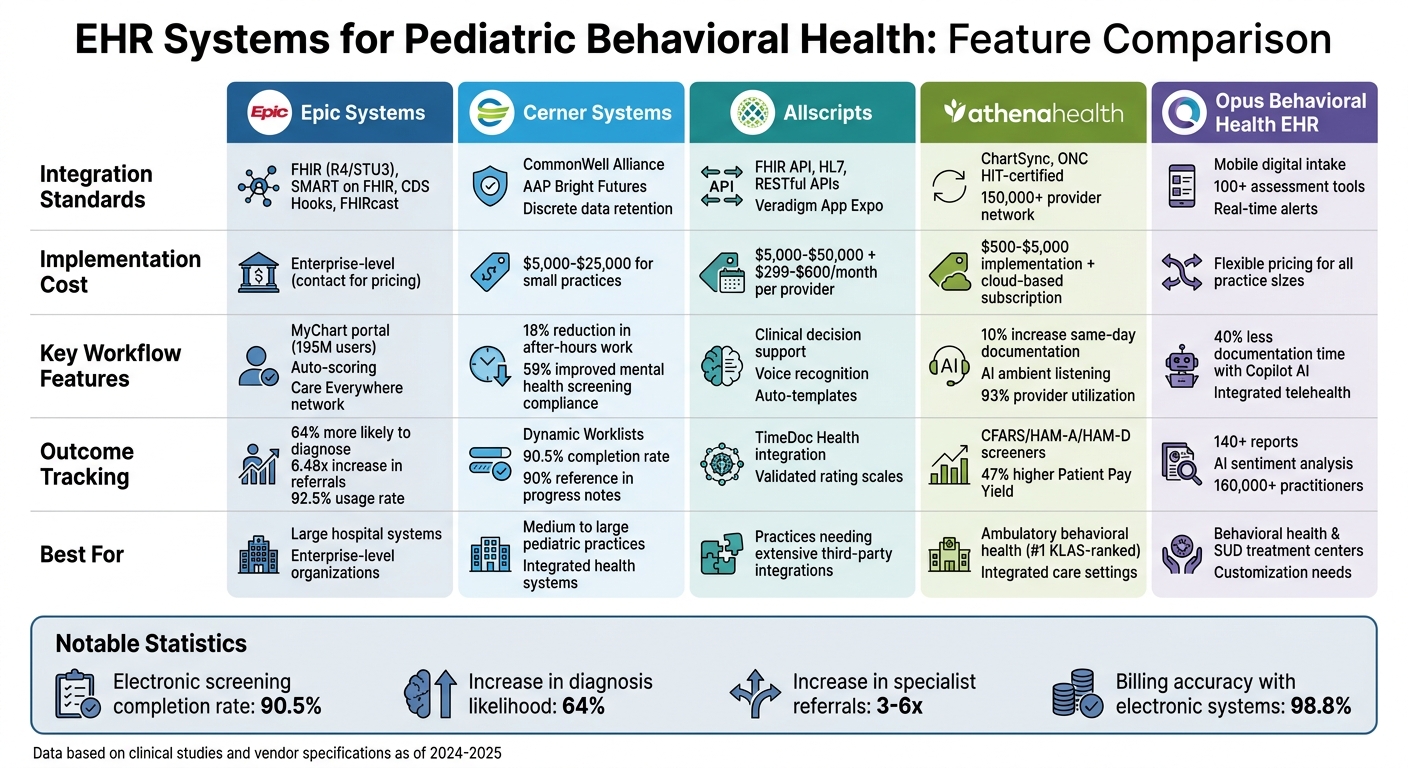
EHR Systems Comparison for Pediatric Behavioral Health Screening
EHR systems bring a mix of advantages and challenges to pediatric behavioral health screening.
For instance, athenahealth's athenaOne has been recognized as the top-ranked solution for Ambulatory Behavioral Health by KLAS. Its ChartSync feature integrates patient data from external hospitals and pharmacies directly into the clinical workflow, while its AI-powered ambient listening reduces documentation burdens.
This has allowed organizations like PrimeCare Community Health to boost same-day documentation by 10% [19]. These features underscore how differences in workflow integration can significantly impact daily operations and outcomes.
However, standard EHR systems often fall short in certain areas. They typically lack integrated narrative documentation and tend to silo primary care and behavioral health data [19].
While traditional EHRs have seen widespread adoption - over 92% when screening tools are incorporated into well-child visits [2] - many still require extra steps or workarounds for behavioral health documentation. Addressing these gaps, Opus Behavioral Health EHR offers features like AI-powered documentation, integrated telehealth, and customizable workflows, simplifying the process for pediatric behavioral health screenings.
Cost structures also vary significantly between systems. For example, CHADIS charges a flat rate per provider and has an 8-week implementation timeline [3].
In contrast, solutions like athenaOne operate on a subscription-based model. Despite these differences, electronic screening systems have proven their longevity. One study reported a 92.5% usage rate a full year after implementation [2].
Another critical area where these systems stand out is outcome tracking. Electronic screening has been shown to increase sleep disorder diagnoses by 64% and boost referral rates by 6.48 times [2].
In a study involving 1,773 Medicaid-insured outpatients, electronic systems achieved a 90.5% completion rate for the Pediatric Symptom Checklist (PSC-17), along with a billing accuracy rate of 98.8% [1]. As athenahealth emphasizes:
A truly interoperable EHR that integrates behavioral health and primary care workflows ensures all providers on the team can see the full picture of a patient's health [19].
Conclusion
Choosing the right EHR for pediatric behavioral health screening means finding a system that aligns with your clinical needs, workflow, and budget.
For pediatric practices, PCC's native CHADIS integration simplifies the process by automating questionnaire delivery and embedding tools like M-CHAT and ASQ directly into well-child visits [3]. This setup eliminates tedious manual tasks and integrates decision support effortlessly.
In broader integrated care settings, athenaOne stands out by connecting primary care and behavioral health teams seamlessly. Known as the KLAS-ranked #1 Ambulatory Behavioral Health solution, athenaOne includes features like ChartSync, which consolidates data from external pharmacies and hospitals to help avoid medication conflicts [19].
For behavioral health and SUD treatment centers, Opus Behavioral Health EHR offers the customization often missing in standard systems. Trusted by over 160,000 practitioners and supporting 44 million clients, Opus includes behavioral-specific SOAP notes, AI-powered documentation with Copilot AI (cutting documentation time by 40%), and flexible pricing for practices of all sizes [22].
This is especially important as 40% of behavioral health practices switch EHR systems within three years due to workflow challenges [10].
Each of these options caters to specific needs, ensuring better support for both providers and patients.
FAQs
Which pediatric behavioral screeners should we digitize first?
Digitize clinically validated, standardized screening tools that work effortlessly with EHR systems. Emphasize tools for conditions like depression, anxiety, ADHD, and autism spectrum disorders - key areas for early intervention and frequently addressed during well-child visits.
These digital tools boost data accuracy, simplify workflows, and enable timely clinical decisions, playing a crucial role in improving pediatric care.
What’s the easiest way to collect caregiver questionnaires before visits?
The simplest way to gather caregiver questionnaires before appointments is by using digital patient intake systems.
These systems let caregivers fill out forms on their phones or other devices ahead of time. This mobile-first method streamlines the process, cuts down on paperwork, and gives the clinical team access to completed questionnaires beforehand, making data collection faster and more reliable.
How do we turn screening scores into alerts, referrals, and follow-ups?
To make screening scores actionable, configure your EHR to automate critical workflows. By setting score thresholds, you can trigger alerts that prompt clinicians to take timely steps, such as making referrals or scheduling follow-ups.
Adding decision support tools within the EHR can further enhance care by offering personalized recommendations. Platforms like Opus, which allow for customizable automation, make it easier to ensure interventions happen efficiently and on time.



- Behavioral Health
- EHR Systems
- Addiction Treatment EHR
- mental health
- Telehealth
- addiction treatment
- Behavioral health facility
- Substance Abuse Disorder
- behavioral Health center
- HIPPA Compliant
- ehrsoftware
- PTSD
- behavioral health ehr
- Depression
- hipaa
- Anxiety
- MentalHealthMatters
- RCM
- claim denials
- clinical documentation
- mental health awareness
- screening tools

September 15, 2026

September 15, 2026

September 14, 2026

September 11, 2026

September 10, 2026

September 09, 2026
Recommended Posts
Friday, February 11, 2022
Top Considerations for Behavioral Health Treatment Centers When Switching EHR Systems
The world is cautiously beginning to open again after the Covid-19 shelter-in-place orders are lifted. While it’s ...
.png)
Tuesday, November 04, 2025
Fix Low Collection Rates: 4 Simple Solutions...
Low collection rates can hurt your behavioral health practice by reducing cash flow, increasing administrative work, ...

Friday, December 05, 2025
Real-Time vs. Manual Payment Reconciliation
Payment reconciliation ensures financial accuracy by matching incoming payments to claims or invoices. In healthcare, ...