
If a behavioral health platform cannot show who accessed ePHI, what changed, when it happened, and whether the action was allowed, audit risk goes up fast.
For treatment centers, mental health providers, and SUD programs, audit logging is not just an IT setting. It affects privacy review, claims support, incident response, and leadership visibility across EHR, CRM, RCM, telehealth, labs, and integrations.
Set of controls leaders should confirm right away:
Log the core fields: user ID, role, action, record ID, UTC timestamp, source IP, device, outcome, and purpose of use
Cover every system that touches ePHI: not just the EHR, but billing, portals, messaging, APIs, identity tools, and data interfaces
Record both allowed and denied activity: failed logins, blocked access, export attempts, and break-glass events matter
Protect logs from edits or deletion: central storage, append-only controls, and tamper flags help keep the record usable
Keep logs for at least 6 years: many providers keep them longer, often up to 10 years, to line up with state or pediatric record rules
Review logs on a set schedule: daily for high-risk alerts, weekly or monthly for privacy checks, quarterly for access review, and yearly for full testing
Keep proof of review: reviewer name, date, scope, findings, tickets, and sign-off should all be retained
Add extra review for 42 CFR Part 2 records: SUD access should show consent status at the time of access and blocked disclosure attempts
For behavioral health leaders, the main question is simple: can the organization reconstruct a clear timeline across systems during an OCR review, privacy event, payer dispute, or internal investigation? If the answer is unclear, the audit log process likely needs work.
Core HIPAA Audit Log Requirements for Behavioral Health Software
Behavioral health platforms must log and retain activity tied to ePHI.
Under the HIPAA Security Rule, systems that contain ePHI need audit controls. Related policies and documentation must be kept for at least six years [2][3][6][5].
Retention alone is not enough. Each log entry has to include enough detail to support review, investigation, and follow-up.
Checklist: Minimum Audit Control Standards
Every log entry should answer five basic questions: who, what, when, where, and why. OCR reviews tend to focus on these core data points.
When key identifiers are missing, the audit trail becomes harder to trust and harder to use during an investigation [6].
|
Field |
What to Capture |
|---|---|
|
User ID + Role |
Unique user identifier, the role at the time of access, and any acting service account |
|
Action |
READ, CREATE, UPDATE, DELETE, EXPORT, or PRINT |
|
Resource ID |
Internal identifier for the specific record or data object, not raw PHI such as names or Social Security numbers |
|
UTC Timestamp |
Precise date and time with millisecond precision, using synchronized clocks |
|
Source IP + Device |
Source IP address and device/workstation identifier |
|
Status / Outcome |
Whether the attempt succeeded or failed |
|
Purpose of Use |
Treatment, payment, operations, or break-glass justification |
UTC timestamps matter in multi-system behavioral health settings. Without a single time standard, it becomes much harder to match events across the EHR, billing platform, identity tools, telehealth systems, and integration layers.
Even small time mismatches can slow down incident review.
Failed attempts should be logged alongside successful ones. Denied access requests may point to credential attacks, misuse, or unauthorized record lookups, especially in multi-location organizations with shared infrastructure [6][5].
For behavioral health teams, these fields provide the minimum record needed to reconstruct access, disclosure, and misuse events.
Those fields need to be captured across every system that stores or moves ePHI.
Systems and Workflows That Must Be Covered
Audit controls should extend across the full behavioral health tech stack, not just the core EHR. Gaps often appear when access shifts between clinical, financial, and infrastructure systems.
|
System Category |
What's in Scope |
|---|---|
|
Clinical |
EHR/EMR, patient portals, lab systems, imaging (PACS/VNA) |
|
Communication |
Telehealth platforms, e-prescribing, eFax, secure messaging |
|
Administrative |
Billing systems, CRM, analytics tools, reporting engines |
|
Infrastructure |
Identity providers (SSO/MFA), VPNs, APIs, databases, cloud storage |
|
Interoperability |
HIE interfaces, FHIR/HL7 integration engines, data pipelines |
This matters in behavioral health because patient data often moves through several connected systems before a claim is filed, a note is signed, or a referral is processed.
If one layer is missing audit coverage, leadership may lose visibility into how ePHI was accessed, changed, transmitted, or disclosed.
For behavioral health programs, SUD workflows need one more level of detail. For SUD records under 42 CFR Part 2, logs must also show consent status at the time of access and record blocked disclosure attempts [2][8].
Next, list the specific user actions, disclosures, and system events these controls must capture.
Audit Events Your Behavioral Health Platform Should Log
Behavioral health organizations need audit logging that goes well beyond basic sign-in history. Leaders need a clear record of who accessed data, what changed, what left the system, and how information moved across telehealth, messaging, and external interfaces.
The priority should be broad coverage across every covered system, starting with access events and extending through record changes, disclosures, telehealth activity, secure communications, and interface traffic.
User Access, Authentication, and Sensitive Record Activity
Every login attempt should be logged, whether it succeeds or fails. Audit records should also capture logouts, session timeouts, MFA events, password resets, account lockouts, role assignments, and permission grants or revocations.
Chart access needs close attention. Systems should log every chart view, including search queries, not only records that were opened. For 42 CFR Part 2 records, the access event should also include the consent state at the time of access itself. [2]
Break-glass access should be logged in full. That means recording the clinician’s identity along with the stated reason for the access.
Changes, Exports, Disclosures, and System Configuration
Behavioral health platforms should log every create, edit, or delete action tied to progress notes, diagnoses, medication orders, treatment plans, and lab orders.
The log should include the specific resource ID, not just the endpoint. That level of detail matters when compliance teams, clinical leaders, or security staff need to trace exactly what changed.
Exports and disclosures need the same level of detail.
Audit logs should record the destination and each specific record involved in:
Print jobsDownloads
Bulk exports
API extractions
Account creations should also be logged, along with any changes to security settings or audit settings. These administrative changes can affect system risk in ways that are easy to miss if logging is too thin.
Telehealth, Messaging, and Interface Activity
Telehealth logging should include session start and end times, as well as join, leave, and file-share events. For treatment centers and mental health providers, that record can help clarify both user activity and workflow issues tied to virtual care.
Secure communications should also be part of the audit trail. That includes patient portal messages and clinician-to-clinician secure messages.
Interface traffic is just as important. Every HL7 and FHIR transmission should be logged, including failures and timeouts. Each outbound transmission to an external lab, pharmacy, or HIE needs its own log entry, whether the transmission succeeded or not.
Once these events are logged, the next step is to assess retention, protection, and access controls.
Audit Log Retention, Protection, and Access Controls
After event capture, the next priority is retention, protection, and review. For behavioral health organizations, this is where audit logging shifts from a technical task to a compliance and risk management function. Once retention and protection controls are in place, the next requirement is documented review.
Retention Periods and Required Log Data
HIPAA requires audit logs and related documentation to be retained for at least six years from the date of creation or the date the record was last in effect [7].
Many organizations keep logs longer, often up to 10 years, to help cover state record rules and pediatric retention requirements.
Each log entry should support event reconstruction without storing clinical content. The goal is to preserve enough detail to explain who did what, when, where, and under what role without adding avoidable PHI exposure.
|
Control |
Required Practice |
|---|---|
|
Retention period |
Retain logs for at least 6 years; extend to 10 years to cover state and pediatric record rules |
|
Scope |
Log across EHR, CRM, RCM, telehealth, e-prescribing, lab, patient portal, and reporting |
|
Metadata |
Store only the metadata needed to reconstruct access without exposing PHI; include effective role at the time of the event in each log row |
|
PHI minimization |
Store opaque patient/record IDs; hash or tokenize sensitive identifiers; redact free-text payloads |
|
Tamper protection |
Centralize logs and apply hash chaining or WORM/object-lock protections |
|
Timestamps |
Use UTC timestamps to preserve cross-system traceability |
In practice, this means audit data should be broad enough to cover the full care and revenue workflow.
A treatment center may have user activity spread across clinical documentation, admissions, billing, telehealth, and patient communications. If logs sit in silos, investigators may struggle to piece together a clean timeline during an internal review or security event.
Integrity Controls and Access Restrictions
Logs need to show tampering if it occurs. Append-only or WORM storage, paired with hash chaining, can help make changes visible rather than hidden.
Many organizations also centralize logs in a dedicated SIEM or audit repository that sits apart from the application database. That separation matters. When logs remain in the same system they monitor, control gaps tend to grow.
Access should be limited to authorized compliance and security personnel through RBAC and MFA.
Audit data should be encrypted in transit and at rest, with decryption rights kept to a small approved group. This helps reduce the risk of internal misuse while keeping review access available to the teams that need it.
A key control often gets missed: system admins should not be able to delete or overwrite logs that record their own actions. If that line is blurry, the audit trail loses credibility fast.
Every read, query, export, and admin action taken against audit data should also be logged. That second layer of monitoring gives leadership a way to verify that the log system itself is being handled properly.
Next, the review process needs to be defined clearly, including who reviews the logs, how often reviews occur, and what evidence shows the review took place.
Time Synchronization and Log Availability
Accurate timestamps are the backbone of incident reconstruction across systems. All system clocks should be synchronized through NTP, and timestamps should be recorded in UTC with millisecond precision.
Without that alignment, even a short investigation can turn messy, especially when events span EHR, CRM, RCM, lab, and telehealth platforms.
Log availability also needs a storage plan that matches operational use. Many healthcare organizations use hot, warm, and cold tiers so logs stay accessible without driving up storage costs.
Hot storage supports active review and near-term investigations.
Warm storage supports compliance queries and less frequent lookups.
Cold archives support long-term retention needs.Archived log restoration should be tested quarterly.
That test is easy to postpone, but when a regulator, payer, or internal investigator needs historical records, a failed restore can become a serious operational problem.
Who Reviews Audit Logs, How Often, and How to Document Reviews
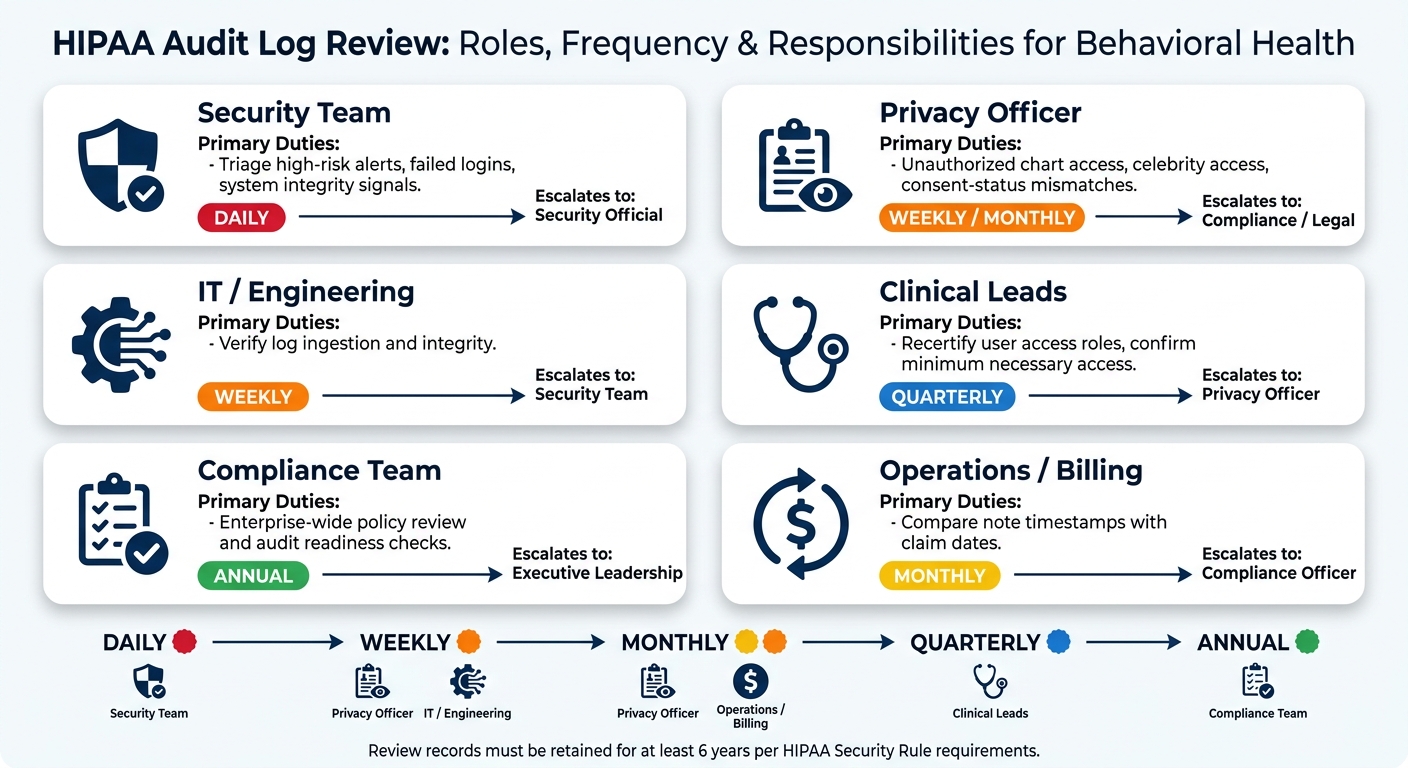
HIPAA Audit Log Review Cadence & Roles for Behavioral Health
Once audit logs are retained and protected, behavioral health organizations need a clear review model.
That means naming the teams that review logs, setting a review cadence, and keeping proof that reviews took place. Without that structure, audit logging can turn into passive data storage instead of an active compliance and risk control process.
Review Roles, Frequency, and Escalation Rules
Review duties should be assigned by function so each team focuses on the risks it is best equipped to spot.
|
Role |
Primary Audit Log Duties |
Review Frequency |
Escalation Responsibility |
|---|---|---|---|
|
Security Team |
Triage high-risk alerts, failed logins, and system integrity signals |
Daily |
Security Official |
|
Privacy Officer |
Review unauthorized chart access, celebrity access, unexpected consent status, and consent-status mismatches |
Weekly / Monthly |
Compliance / Legal |
|
IT / Engineering |
Verify log ingestion and integrity |
Weekly |
Security Team |
|
Clinical Leads |
Recertify user access roles and confirm access remains minimum necessary |
Quarterly |
Privacy Officer |
|
Compliance Team |
Enterprise-wide policy review and audit readiness checks |
Annual |
Executive Leadership |
|
Operations / Billing |
Compare note timestamps with claim dates |
Monthly / As needed |
Compliance Officer |
Operations and billing teams should compare note timestamps with claim dates to catch records created after claim submission.
This review can help confirm that documentation supports the claim, rather than being added after the fact.
A setup like this also helps separate day-to-day monitoring from formal oversight. Security teams may focus on immediate system risk. Privacy and compliance teams may look for misuse, disclosure issues, or policy drift. Clinical and operations leaders add another layer by checking whether access and documentation still match current workflows.
Review Documentation and Evidence for HIPAA Audits
Behavioral health providers should keep a monthly review packet that shows what was reviewed, what was found, and what happened next.
That packet should include the scope of the review, specific findings, links to investigation tickets, and formal sign-offs [10]. Review logs should capture the date, reviewer name, systems reviewed, filters used, findings, and follow-up actions [10][9].
Review records should be retained for at least 6 years.
|
Evidence Type |
Owner |
Storage Location |
Retention Period |
|---|---|---|---|
|
Audit Logging Policy |
Compliance Officer |
Policy Management Portal |
6 years from last effective date |
|
Review Logs / Dashboards |
Security Official |
Centralized Compliance Repository |
6 years |
|
Access Attestations |
IT / Clinical Leadership |
Identity & Access Management (IAM) System |
6 years |
|
Incident / Remediation Tickets |
Security |
IT Service Management (ITSM) Tool |
6 years |
|
Integrity Check Results |
IT / Security |
Immutable Log Store |
6 years |
|
Export Chain-of-Custody Records |
Compliance / IT |
Centralized Compliance Repository |
6 years |
For HIPAA audit readiness, the record should do more than show that someone looked at a dashboard. It should show what was reviewed, how the review was performed, and whether any issue moved into investigation or remediation.
That paper trail matters when leadership needs to show consistent oversight across clinical, billing, privacy, and system activity.
For behavioral health organizations treating substance use disorders, documentation must also capture consent-based disclosures under 42 CFR Part 2, including the recipient, purpose, and the re-disclosure prohibition notice delivered [2][11].
This logging layer is separate from standard HIPAA ePHI records and needs its own review trail.
What Triggers Immediate Investigation
The same review process should support immediate escalation when high-risk activity appears. Some events should not wait for the next weekly or monthly check.
Repeated failed logins or impossible travel should trigger immediate lockout and credential review.
Access by a terminated user requires immediate account disablement and HR investigation.
Large-volume exports or bulk downloads should result in immediate suspension of export rights and a privacy review.
Disabled or suppressed logging requires logging to be restored at once, followed by review of the gap.
Celebrity or VIP record access without a documented treatment relationship should generate an automatic alert to the privacy officer for review.
Privilege escalation or unauthorized break-glass overrides should be reviewed immediately after use.
In behavioral health settings, these triggers matter for more than IT hygiene.
They can point to privacy violations, documentation risk, billing exposure, or breakdowns in access control. A prompt response can help limit harm and create a clearer record for compliance follow-up.
Common Audit Log Gaps in Behavioral Health Software
Behavioral health organizations can have formal audit logging policies on paper and still miss key areas in practice.
The problem usually is not the policy itself. It is incomplete coverage, uneven logging across systems, or no clear proof that logs are being checked. A solid checklist loses value when logging stops at system boundaries or review steps fail.
Missing Coverage Across Modules and Integrations
One of the most common gaps is partial logging inside the EHR, with little or no coverage across CRM, billing, telehealth, or messaging.
In behavioral health operations, risk often shows up where data moves from one module to another. That is where records can be exported, edited, shared, or synced without a full audit trail.
Export logging is a frequent weak point. Logs may show that an export occurred, but leave out the patient IDs involved, the number of records included, or where the data was sent.
That creates a problem for compliance teams, privacy officers, and operations leaders who need clear evidence during an internal review or OCR inquiry.
Third-party platforms and AI tools can create another blind spot when they sit outside the main audit trail.
For Opus Behavioral Health EHR, logging needs to cover the full operating stack:
EHRCRM
RCM
telehealth
e-prescribing
AI documentation
integrations
The highest risk points are often the handoffs between these systems, where data passes from one workflow to another without consistent logging.
Weak Review Processes and Incomplete Evidence
Missing fields are only part of the issue. Weak review processes turn those gaps into larger blind spots.
Common failures include unclear ownership, no set review schedule, and no record showing that a review actually took place. If no one is named to review the logs, they often go unchecked. If alerts do not move into tickets and escalation steps, issues can sit unresolved.
The 2026 HIPAA Security Rule update favors automated checks that confirm logging and required fields at each deployment [6][2][9].
That matters for behavioral health providers with many workflows, several sites, or a mix of internal systems and vendor tools. Manual review alone may not give executive teams enough visibility.
Review records should document:
reviewer namereview date
scope
findings
remediation steps
Without those records, it becomes much harder to show consistent oversight during an OCR review.
For compliance leaders, IT teams, and operations executives, these are often the last items worth checking before sign-off.
Conclusion: Final HIPAA Audit Log Checklist for Behavioral Health Leaders
Behavioral health leaders need more than a written policy to face an audit with confidence.
The 2026 HIPAA Security Rule update puts the focus on testable controls, documented reviews, and proof that logging works as expected in daily operations, not just on paper [6][7].
Final Checklist Summary
Use the checklist below to confirm the system is ready for audit.
|
Area |
What to Confirm |
|---|---|
|
Event Coverage |
Logging spans EHR/EMR, administrative privilege changes, billing claims access, telehealth session start/stop, and integrations such as FHIR/HL7, e-prescribing, and eFax [3][5][2] |
|
Required Log Fields |
Every entry captures User ID + Role, Action (Read/Write/Delete/Export/Print), Resource ID, UTC Timestamp, Source IP + Device, Status Code/Success flag, and Purpose of Use (Treatment, Payment, Operations, or Break-glass) [6][7] |
|
Sensitive Record Handling |
Access to psychotherapy notes is logged separately, and 42 CFR Part 2 SUD records track consent state at the time of access [1][2][4] |
|
Retention |
Logs are retained for at least 6 years, with 10 years recommended for pediatric exposure or stricter state-law requirements [6][7] |
|
Log Integrity |
Storage is append-only and tamper-evident, using WORM or hash-chaining, so administrators cannot modify or delete entries [2][6][7] |
|
Time Synchronization |
All systems are synchronized to UTC with millisecond precision [2][6][3] |
|
Reviewer Assignment |
Security, Privacy, and Compliance personnel have defined responsibilities for pipeline monitoring, patient-access anomaly review, and program oversight [5][1] |
|
Review Cadence |
Daily high-risk alerts, weekly privileged activity, monthly trend analysis, quarterly access recertification, and annual end-to-end testing [2][7] |
|
Review Documentation |
Each review is recorded with the reviewer's name, date, scope, findings, and remediation steps [2][9] |
|
Audit-Ready Evidence |
Automated reports, immutable snapshots, annual risk analyses, and automated test results proving the logging pipeline is active are available for OCR on request [2][6][7] |
For Opus Behavioral Health EHR, this checklist should be applied across EHR, CRM, RCM, telehealth, e-prescribing, labs, and connected integrations. That matters because audit gaps often show up at the handoffs between systems, not only inside the core clinical record.
FAQs
What counts as an audit-ready log?
An audit-ready log records system activity in a way that supports HIPAA and 42 CFR Part 2 requirements.
For behavioral health organizations, that matters because access to patient data must be traceable, reviewable, and hard to dispute during an internal review, payer inquiry, or compliance audit.
To serve that purpose, the log should be immutable, tamper-evident, and retained for at least six years.
At a minimum, it should capture:
Unique user ID and roleAction performed
Resource type and specific ID
Precise UTC timestamp
Which systems should log ePHI activity?
Audit controls should extend across every system that creates, receives, maintains, or transmits ePHI.
For behavioral health organizations, that reach goes well beyond the core EHR. It includes patient portals, lab systems, telehealth platforms, databases, APIs, servers, and file shares.
Security logging should cover the systems around those clinical tools as well. Identity providers, MFA, VPNs, and firewalls all play a role in showing who accessed what, when, and from where. Without that broader view, teams may see part of an event but miss the full path of user activity.
Centralized logging helps close that gap. When logs are brought together in one place, compliance, IT, and operations teams can better correlate user, patient, and device activity across the full care and access workflow.
What should trigger an immediate log review?
Immediate log reviews should be triggered by high-risk security events and unusual activity patterns so issues can be found and contained quickly.
Behavioral health organizations should give top priority to break-glass emergency access, mass record exports, repeated failed sign-in attempts, and access to highly sensitive records, including those tied to celebrities.
Teams should also watch for signs of possible snooping, such as repeated access denials that may point to attempted unauthorized viewing.



- Behavioral Health
- EHR Systems
- Addiction Treatment EHR
- Telehealth
- mental health
- addiction treatment
- Substance Abuse Disorder
- behavioral Health center
- Behavioral health facility
- HIPPA Compliant
- ehrsoftware
- PTSD
- behavioral health ehr
- Depression
- hipaa
- Anxiety
- MentalHealthMatters
- RCM
- claim denials
- clinical documentation
- mental health awareness
- screening tools

August 28, 2026

August 27, 2026

August 26, 2026

August 25, 2026

August 24, 2026

August 21, 2026
Recommended Posts

Tuesday, August 11, 2026
Telehealth Vendor HIPAA Review: Do it Right in 5 Steps
If a telehealth vendor touches ePHI, I treat the review like a HIPAA risk check before any patient data moves.
Friday, August 28, 2026
10 HIPAA-Compliant CRM Features to Review
A healthcare CRM that touches PHI should be reviewed like a risk system, not just a sales tool.
Wednesday, August 26, 2026
Symptom Forecasting For Behavioral Health EHRs
Symptom Forecasting For Behavioral Health EHRs Symptom forecasting only helps when it changes care before the next ...