

Predictive analytics helps SUD providers act before relapse, dropout, overdose, or readmission.
For treatment centers, the issue is not the score alone. The score has to be tied to clean data, staff review, documented care changes, and tracking after the intervention.
Key points:
- Relapse rates are often estimated at 40% to 60%, which puts pressure on teams to spot risk earlier.
- Models work best when they use structured data, notes, and patient history over time.
- Risk scores should appear inside the EHR workflow, not in a separate tool staff may ignore.
- Scores should be validated on the provider’s own patient population before they affect care.
- A clinician should review, approve, or override any score that may change the treatment plan.
- Each risk level should connect to a clear action, such as more visits, safety planning, telehealth follow-up, or remote monitoring.
- Teams should document why the plan changed, who owns the follow-up, and when the case will be reviewed again.
- Outcomes data should feed back into the process so leaders can see what is working and where gaps remain.
This matters beyond clinical care. It can affect staff workload, documentation quality, retention, readmission patterns, and leadership visibility across programs and sites.
In short, predictive analytics can support SUD care planning when organizations treat it as a workflow and governance process, not just a model.
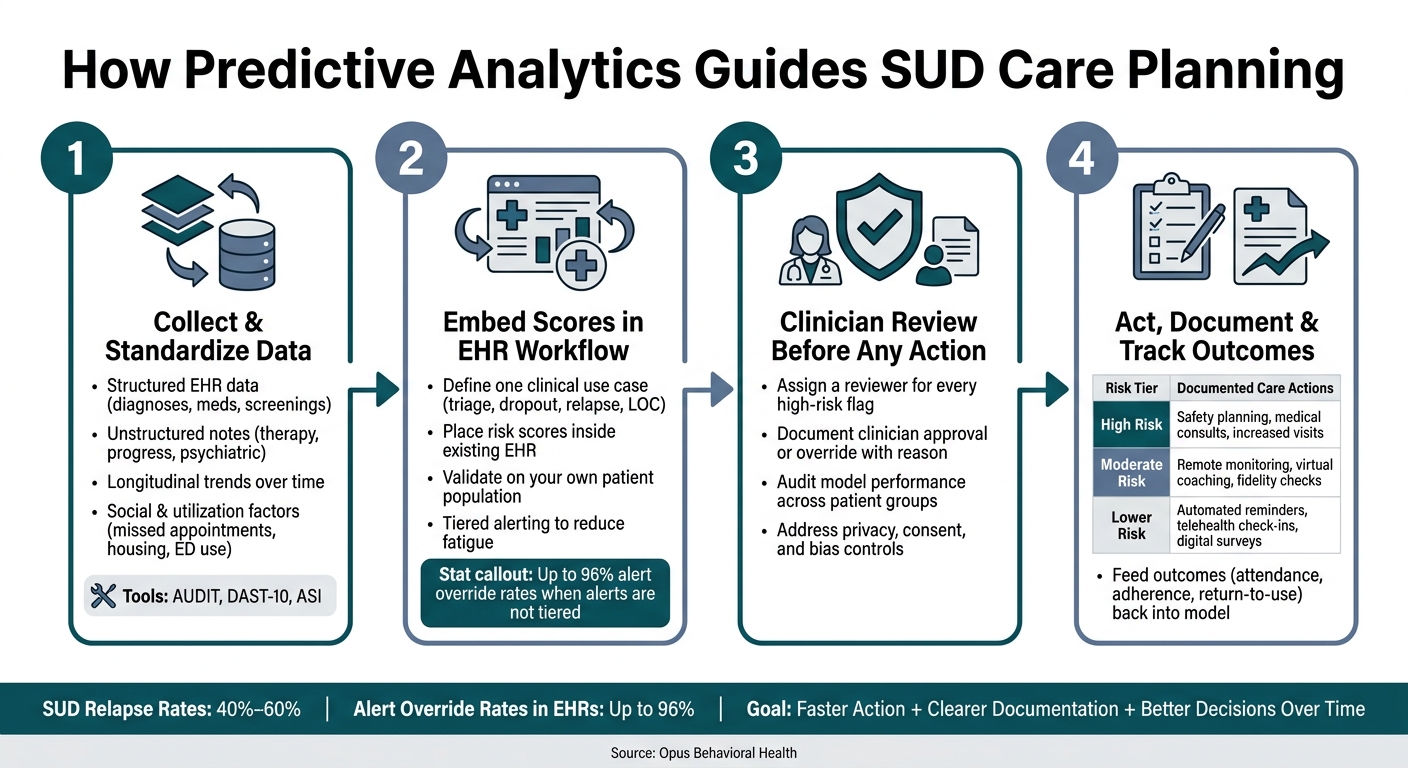
Predictive Analytics Workflow for SUD Care Planning
1. Identify the data inputs the model needs
A predictive model is only as useful as the data behind it. Before behavioral health leaders rely on any risk score or recommendation, the organization needs a clear view of what data the model reads and how that data is documented.
Structured, unstructured, and longitudinal clinical data
Behavioral health organizations should use structured, unstructured, and longitudinal clinical data together.
Structured data includes coded fields in the EHR, such as diagnoses, medications, screening results, and discharge status. This data is easier for a model to read at scale.
Unstructured data includes therapy notes, psychiatric notes, and progress notes. These records often contain context that coded fields miss, especially in SUD treatment, where changes in motivation, relapse risk, housing status, family dynamics, or treatment engagement may show up first in narrative documentation.
Longitudinal data tracks change over time. That matters because SUD care is rarely static. A single data point may miss the bigger pattern, while trend data can help clinical teams see whether a patient is stabilizing, disengaging, or showing signs of increased risk.
Behavioral, social, and utilization indicators
Clinical data on its own is not enough. Behavioral, social, and utilization indicators add context that can support care planning and risk review.
For many treatment centers, that may include factors such as:
- prior admissions or readmissions
- missed appointments
- changes in employment or housing
- family or caregiver support
- transportation barriers
- ED use or other high-cost utilization patterns
These factors should be captured at intake and updated as circumstances change.
When documentation is uneven or outdated, model performance often suffers. In practice, the issue is not just missing data. It is also whether teams record the same information the same way across programs, levels of care, and locations.
Documentation standards that improve model reliability
Documentation standards help make predictive scores reliable enough to support SUD care decisions. Without clear documentation rules, even a well-designed model can produce scores that are hard to trust, explain, or use in the care plan.
Several practices can strengthen data quality:
- standardized coding practices
- consistent use of validated screening tools
- complete and timely progress notes
- aligned intake, treatment, and discharge documentation
Tools such as the AUDIT, DAST-10, and ASI give organizations structured assessments that support this work. Consistent intake, treatment, and discharge notes also give the model a fuller patient history, which can help clinical and operations teams review how a score was formed and whether it fits the patient’s current situation.
For executive teams, this is not just a documentation issue. It is a data governance issue tied to care quality, reporting visibility, and trust in the model output.
Once the inputs are defined, the next step is placing the score into the care workflow.
2. Build predictive analytics into the care workflow
Predictive analytics only helps when it fits daily SUD operations.
For behavioral health leaders, that means more than adding a score to a dashboard. Clinical teams need a clear question, staff need to see the score inside the workflow they already use, and leadership needs proof that the model works as intended before it influences care decisions.
Start with a clear clinical use case
The starting point is a single, well-defined use case. That may be intake triage, dropout prevention, relapse monitoring, or level-of-care planning.
What matters is not just the flag itself, but the response tied to it. Each use case should have a set action path once a flag appears, so clinicians know what happens next and operations leaders can track whether the process is being followed.
In April 2025, the University of Wisconsin–Madison deployed an AI-powered OUD screener that flagged at-risk patients in real time, triggered addiction medicine consults, and was linked to fewer 30-day readmissions [1] [3].
That kind of workflow matters because a prediction without a response plan adds noise, not value.
Once the use case is defined, the next step is simple: put the score where staff already spend time.
Place scores where staff already work
Scores should sit inside the EHR workflow clinicians already use for caseload review, treatment planning, and follow-up. If staff have to leave their main workflow, open another tool, or hunt for a separate report, adoption usually drops and response times often suffer.
In Opus Behavioral Health EHR, centralized documentation and outcomes data keep risk signals visible where staff can act on them. For executive teams, that matters because visibility inside the clinical workflow can support more consistent follow-through and reduce the chance that a high-risk patient signal gets missed.
Validate before using predictions
No predictive model should move into care decisions without validation on the provider’s own patient population. A model may perform well in one setting and still miss the mark in another, especially across different levels of care, payer mixes, or patient groups.
Before wider use, organizations should review whether the model performs differently across patient populations and audit for bias. Staff also need clear guidance on how to read the score, when to question it, and when an override is appropriate. If a score leads to a care change, that action should be documented.
A practical approach often includes:
- Validation on internal patient data before live use
- Review of performance differences across patient groups
- Staff training on interpretation and overrides
- Required documentation for AI-driven care changes
- Tiered alerting to limit alert fatigue
Tiered alerting is especially important. Critical alerts, interruptive guidance, and passive reminders should not carry the same weight. That matters because nearly 25% of all medication orders in EHRs generate an alert, and override rates can be as high as 96% [4].
Only after that review should teams define how a score turns into a documented care action.
3. Require staff review and governance before action
After validation, every score that could change care needs a clear owner. A risk score only matters when a clinician reviews it before anything happens. Behavioral health organizations should define who approves the output, how that decision is documented, and when an override is allowed.
Define who reviews, approves, and documents model output
Any predictive output that may affect a care decision needs an assigned reviewer. For high-severity alerts, organizations should require documented clinician review before action. For lower-priority alerts, the review process may be lighter, but it should still happen before any care plan update is signed.
That review step is where clinical judgment stays in control. It gives clinicians a formal point to confirm the score, change the recommendation, or override it. It also creates a record of what happened next, which matters for care quality, compliance, and leadership visibility.
"Models can make mistakes. Therapists are encouraged to go over the suggestions and validate them." - Lidor Bahar, Data Scientist, Eleos Health
When a clinician overrides a model recommendation, the reason should be documented. Structured override fields can help teams track false positives, tune alert logic, and show why the model output was not used.
Address privacy, consent, and bias risks
Governance should also cover privacy, consent, and legal and compliance requirements as part of decision control. That means setting rules for who can see model output, who can act on it, and what must be documented in the record.
Key controls often include:
- Limiting access to model inputs and outputs
- Confirming that patient consent and disclosure requirements are met
- Reviewing model performance across patient groups on a set schedule
- Investigating at once if one group is flagged more often without a clinical reason
Once review and governance are in place, each risk tier should be tied to a documented care action.
4. Turn risk scores into documented SUD care actions
A reviewed score only matters if it changes care. If a risk score stays on a dashboard and never affects the treatment plan, it does little for clinical teams or patients.
Match risk tiers to care plan changes
Each risk tier should connect to a set care response so teams know what to do next without guesswork. That helps treatment centers reduce variation across staff, programs, and sites.
|
Risk Tier |
Primary Interventions |
|---|---|
|
High |
Safety planning, medical consults, increased visit frequency |
|
Moderate |
Remote symptom monitoring, virtual coaching, checks that CBT and motivational interviewing are delivered as intended |
|
Lower |
Automated reminders, telehealth check-ins, digital surveys |
Using the same response framework across programs helps staff apply the same predefined response. That matters in SUD care, where uneven follow-up can affect safety, engagement, and continuity of care.
Document why the plan changed and what happens next
Documentation should show more than the score itself. Clinical teams should record the flag, the clinician's judgment, the intervention, the owner, and the next review date. That creates a clear record of why the plan changed and what should happen next.
Patient-reported outcome tools add another layer of accountability. When patients report their status between sessions, that input can help justify plan changes in a documented way. Andrea Horwitz, Clinical Director at Opus Behavioral Health, describes how that can work in day-to-day care:
"Reviewing weekly treatment results shows me what is really happening with my clients, even if they are not able to express it in session. I was able to review the results of my client's assessments to see that his anxiety was out of range... We were able to work together to prevent a relapse." [2]
Use outcomes data to refine future decisions
After the intervention is documented, the next step is outcome tracking. Teams should feed documented outcomes back into model review and future care planning so the scoring process improves over time.
That means symptom scales, craving scores, session attendance, medication adherence, and return-to-use rates should flow back into the model. With that feedback loop in place, providers can see which interventions appear to help and where care plans may need adjustment. This connects measurement to action instead of treating risk scoring as a one-time event.
Opus Behavioral Health EHR supports this loop with outcomes measurement and reporting tools.
Conclusion: Make predictive analytics usable, reviewable, and actionable
Predictive analytics supports SUD care planning only when treatment teams turn risk scores into actions that are reviewed, documented, and followed through.
A platform that brings those steps into one place can help teams use the process the same way across programs, staff, and sites. Opus Behavioral Health EHR is designed to support that workflow by bringing together data, outcomes measurement, telehealth, e-prescribing, lab integration, automated workflows, and reporting.
The goal is not a better score. The goal is faster action, clearer documentation, and better decision-making over time.
FAQs
How accurate are predictive analytics models for SUD care?
Predictive analytics models for substance use disorder (SUD) care can deliver high accuracy, with some machine learning models reaching 98.5% accuracy when tracking outcomes and flagging risk.
Reliability is also measured through AUC scores. Reported results include 0.83 for suicide risk and 0.81 for treatment dropout. When these models use inputs such as physiological markers, therapy adherence, and behavioral patterns, they often match or outperform provider-only assessment methods.
What data does a predictive model need to flag relapse risk?
Predictive models draw on EHR data from several sources, including:
-
clinical history and treatment adherence
-
therapy attendance and medication compliance
-
sleep quality, heart rate variability, and vital signs
Some models also review behavioral patterns, mood shifts, and sentiment in clinical notes or patient narratives. That can help teams spot early signs that relapse risk may be rising, even when those signals are easy to miss in day-to-day care.
How should clinicians use a risk score without overrelying on it?
Clinicians should treat risk scores as a support tool, not a substitute for clinical judgment.
A human-in-the-loop approach gives care teams room to interpret, question, or override AI-generated insights based on direct knowledge of the patient and the clinical context.
To reduce overreliance, clinical teams should check outputs against other inputs, including clinical interviews, patient self-reports, lab results, and peer review when needed. Regular case review and open communication with patients can help keep treatment plans individualized and grounded in current needs.



- Behavioral Health
- EHR Systems
- Addiction Treatment EHR
- mental health
- Telehealth
- addiction treatment
- Behavioral health facility
- Substance Abuse Disorder
- behavioral Health center
- HIPPA Compliant
- ehrsoftware
- PTSD
- behavioral health ehr
- Depression
- hipaa
- Anxiety
- MentalHealthMatters
- RCM
- claim denials
- clinical documentation
- mental health awareness
- screening tools

September 15, 2026
September 15, 2026

September 14, 2026

September 11, 2026

September 10, 2026

September 09, 2026
Recommended Posts

Sunday, December 07, 2025
Measuring Patient Engagement in SUD Treatment
Patient engagement is critical for successful substance use disorder (SUD) recovery. But how do you measure it? ...

Monday, December 01, 2025
How AI Improves Patient Engagement in Addiction Treatment
AI is transforming addiction treatment by making care more personalized, efficient, and accessible. It helps address ...

Saturday, November 29, 2025
AI in SUD Outcomes Measurement
AI is transforming how Substance Use Disorder (SUD) treatments are monitored and improved. By analyzing clinical data, ...