
AI tools are transforming how therapists handle progress notes, saving time and reducing burnout.
Writing notes manually can take 20–30 minutes per session, adding up to 10 hours weekly. AI reduces this process to under 5 minutes by generating structured notes like SOAP, DAP, or BIRP formats.
These tools integrate into workflows through methods such as real-time session transcription, post-session voice dictation, or text uploads. While AI drafts the notes, therapists maintain control by reviewing and customizing them to ensure accuracy and compliance with clinical standards.
Key takeaways:
Time savings: AI reduces note-writing time by up to 50%, saving therapists 6–8 hours weekly.
Improved accuracy: AI-generated notes are structured, detailed, and aligned with insurance requirements.
Burnout reduction: Automating documentation lowers administrative stress for 75% of therapists.
Customizable workflows: Options like voice dictation, text uploads, and ambient listening fit various practice needs.
Compliance: AI tools are HIPAA-compliant with strong security measures, ensuring data safety.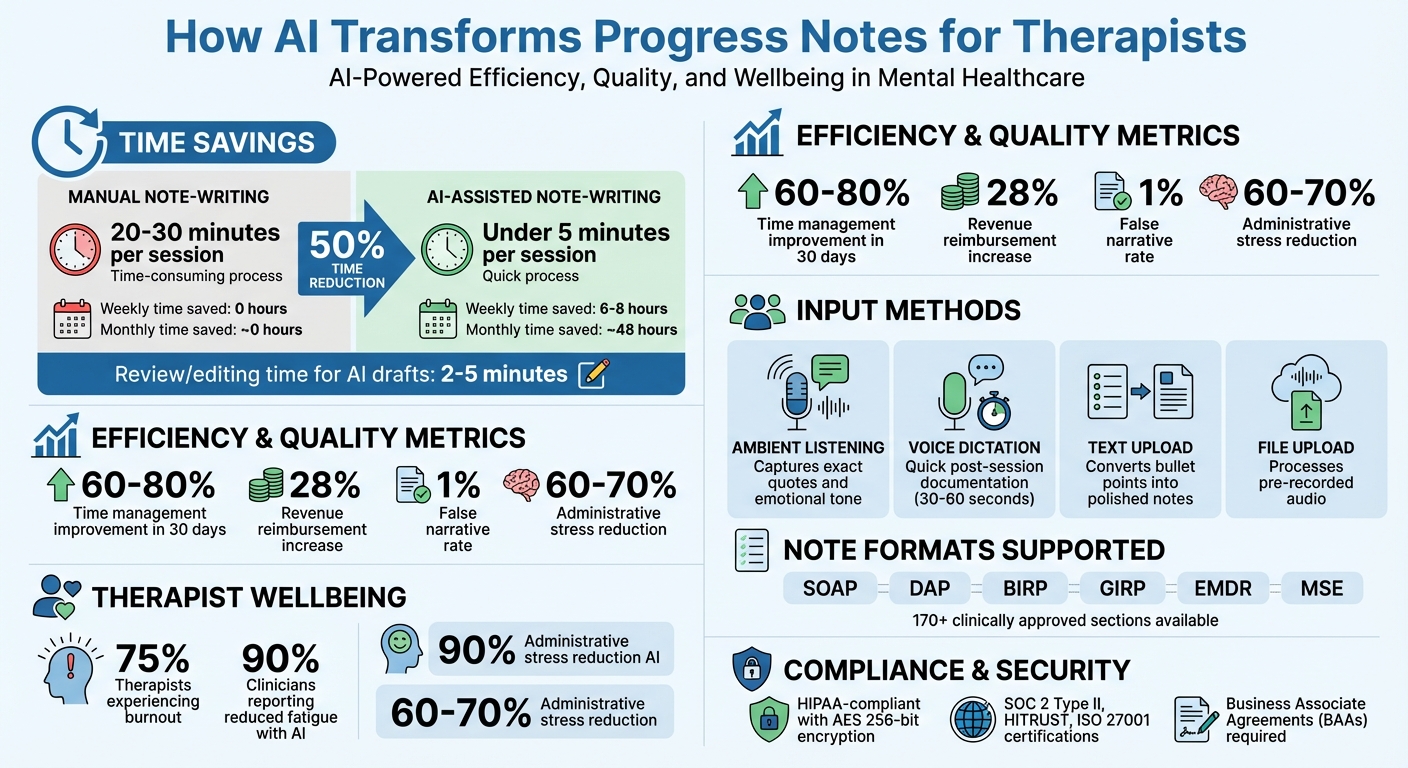
AI Progress Notes Time Savings and Benefits for Therapists
AI for Therapists: How to Create Audit-Proof Mental Health Progress Notes Fast
How AI Captures and Processes Session Information
AI documentation tools offer therapists various ways to record and process session data, making the process more adaptable to different practices. One option is ambient listening, where AI records therapy sessions - whether in-person or virtual - without interrupting the flow of conversation [9].
This approach captures everything: exact quotes, emotional tones, and clinical details as they naturally unfold.
These recordings then serve as the foundation for generating structured clinical notes. For telehealth sessions, many AI tools function as browser extensions that integrate with platforms like Zoom, Google Meet, or Microsoft Teams, capturing audio effortlessly.
Therapists also have the option to use post-session voice dictation, allowing them to record their reflections while the session details are still fresh [9]. Alternatively, some prefer uploading pre-recorded audio files or typing out text-based summaries, which the AI processes into formal clinical notes. This flexibility ensures therapists can choose the method that aligns best with their workflow and their clients’ comfort.
Input Methods for Session Data
The choice of input method often depends on the therapist's practice environment and privacy considerations.
Real-time ambient listening provides the most detailed capture, including client tone, affect, and specific interventions used during the session [9]. However, this method requires informed client consent, typically facilitated by built-in consent forms integrated into electronic health record (EHR) systems.
For those seeking more privacy, post-session dictation allows therapists to summarize the session verbally, with the AI processing the input in just 30–60 seconds [11]. Others may prefer typing bullet points or rough notes, which the AI then refines into professional clinical language. For practices that use external recording devices, file uploads enable therapists to submit audio recordings for AI processing at a later time [6].
|
Input Method |
Best Use Case |
Key Benefit |
|---|---|---|
|
Ambient Listening |
In-person or telehealth sessions |
Captures exact quotes and emotional tone |
|
Voice Dictation |
Immediately post-session |
Quick and reflective documentation |
|
Text Upload |
After-the-fact documentation |
Converts bullet points into polished notes |
|
File Upload |
External recordings |
Processes pre-recorded session audio |
Once the data is captured, the AI transforms these inputs into structured clinical documentation.
Processing Raw Data into Clinical Details
After gathering session data, AI systems convert it into meaningful clinical information. Using automatic speech recognition (ASR), audio is transcribed into text. From there, large language models (LLMs) analyze the text to identify key clinical elements such as client symptoms, therapeutic interventions, progress toward goals, medication updates, and homework assignments [9].
Advanced systems go a step further by performing contextual analysis, uncovering patterns, themes, and even specific details like scores from standardized rating scales or next steps for treatment plans [5]. For sessions involving multiple participants, such as couples or family therapy, the AI can differentiate between speakers - a critical capability [11]. The AI organizes these extracted details into standardized note formats like SOAP, DAP, or BIRP, making them ready for therapist review in as little as 10 to 25 seconds after the session concludes [5].
How AI Generates Structured Clinical Notes
AI takes session data and organizes it into structured clinical notes by breaking it down into specific sections.
For example, it separates what the client shares (Subjective), what the therapist observes (Objective), and the clinical interpretation (Assessment) [11]. This precise categorization ensures that each part of the note fulfills its role and aligns with documentation standards.
The data is then mapped to widely used formats like SOAP (Subjective, Objective, Assessment, Plan), DAP (Data, Assessment, Plan), and BIRP (Behavior, Intervention, Response, Plan).
These formats are essential for meeting both insurance and legal requirements [11][1][13]. What's impressive is how much time this process saves - AI can cut the time spent on a single note from 10–15 minutes to under 2 minutes [11]. While the structure is standardized, these notes can still be customized to match each therapist's preferred style.
Standardized Note Formats and Customization
AI platforms are equipped to handle several clinical formats, including SOAP, DAP, BIRP, and Mental Status Exams (MSE). Many modern tools even allow therapists to create custom templates using pre-approved clinical sections or "Smart Sections", which guide the AI to write in a particular clinical tone [14].
Some platforms offer as many as 170 clinically approved sections for building these templates [14], giving therapists the freedom to tailor notes to their specific practice needs.
AI systems also adapt to individual therapists over time. By analyzing edits made to drafts, the tools learn a therapist's writing style, preferred formats, and therapeutic approaches [14][1]. Features like "Smart Edit" let clinicians adjust the structure, tone, or content of a note with just a few prompts, eliminating the need to start over. This level of customization not only speeds up the documentation process but also ensures compliance and clarity.
Maintaining Context and Continuity
AI doesn't just focus on formatting - it also ensures that each note ties seamlessly into the broader treatment narrative. This is achieved by maintaining the "Golden Thread" of documentation, which links session notes to treatment plans and tracks progress over time [12][14].
For instance, if a client has a SMART goal to reduce anxiety, the AI will reference this goal in future notes, showing whether progress is being made.
"Notes connect across sessions into one story... Progress and patterns become visible over time - session by session." - Mentalyc [15]
To enhance continuity, some systems preload relevant data from previous sessions, highlighting key points from the last interaction [15][16].
This feature allows therapists to build on earlier notes without having to manually review them, saving time and improving both therapeutic and administrative workflows.
Additionally, tools like "Compliance Checkers" flag any missing elements in a note, ensuring it meets payer standards and is ready for audits [14]. This helps therapists avoid documentation errors and ensures their notes are complete before finalization.
Improving Documentation Quality and Compliance with AI
AI doesn't just speed up documentation - it also improves accuracy and ensures compliance with clinical standards.
By organizing session data in line with established guidelines, AI reduces the chances of missing details or inconsistent formatting. Early trials of clinical AI tools revealed a low false narrative rate of about 1% [3], along with a 28% boost in revenue reimbursement [7]. This structured approach minimizes errors and simplifies audits.
AI tools transcribe speech into text and pre-fill forms using existing client data - like demographics, diagnoses, and medication histories - pulled from EHR records.
This reduces transcription errors but isn't foolproof. For instance, in couples or family therapy sessions, AI can sometimes misattribute dialogue or fabricate details, making therapist review a must [3].
"AI is reliable for capturing structure and flow, but it still misses nuance, context, and reasoning. That's why a therapist review is always non-negotiable."
– Supanote [3]
Reducing Errors and Improving Clarity
Switching from manual to AI-assisted documentation significantly improves quality. Manual notes often lack consistent detail and structure, and they're more prone to spelling errors and omissions.
AI-generated notes, on the other hand, follow standardized templates and use language tailored for insurance requirements, enhancing both clarity and compliance. The time savings are substantial too - manual notes take 15–20 minutes each, while AI-generated ones typically need just 2–5 minutes for review and editing [3].
To get the best results, therapists should prioritize clear audio and a quiet session environment. Poor audio quality leads to more documentation errors, as the principle of "garbage in, garbage out" applies here.
Using AI platforms trained on de-identified mental health data also boosts accuracy by capturing clinical nuances more effectively. For example, DeepScribe Behavioral Health has shown greater reliability in documenting client mood, affect, and therapeutic interventions because it uses data derived specifically from therapy sessions rather than general conversations [3].
Beyond improving clarity, AI tools are equipped with strong security measures to protect sensitive information.
Supporting HIPAA Compliance
AI tools built for clinical documentation come with advanced security features to help meet HIPAA requirements. They use AES 256-bit encryption to safeguard data in transit and at rest, and vendors sign Business Associate Agreements (BAAs) to protect Protected Health Information (PHI) [17][19].
"The platform is fully HIPAA-compliant... All data is encrypted in transit and at rest to keep it safe."
– AutoNotes [6]
These systems also include role-based access controls, audit logs to monitor all access and edits to PHI, and automatic data deletion options, allowing therapists to remove session recordings and transcripts once notes are finalized [6][18][7][19].
When choosing an AI vendor, therapists should look for certifications like SOC 2 Type II, HITRUST, or ISO 27001 to ensure top-tier security [19][7]. It's equally critical to confirm that the BAA or service terms prohibit using your practice's PHI to train AI models for other clients [19].
Additionally, therapists should update their Notice of Privacy Practices to include the use of AI tools and recording-based systems [19].
These advancements in quality and compliance seamlessly integrate with the time-saving benefits of AI, further enhancing therapists' workflows.
Integrating AI into Therapists' Workflows
For AI documentation tools to be effective, they need to fit naturally into therapists' workflows. Platforms like Opus Behavioral Health EHR achieve this by embedding AI directly into the clinical environment, eliminating unnecessary steps.
This integration works in two main ways: linking AI-generated notes directly to the EHR for smoother record-keeping and billing, and boosting efficiency before and after therapy sessions. When done right, AI becomes an invisible assistant, handling administrative tasks so therapists can focus on their clients.
Connecting AI Notes to EHR Systems
The best AI tools are designed to work within the EHR itself, removing the hassle of copying and pasting notes between systems. Take Opus Copilot, for instance - it listens during sessions and instantly drafts notes that are ready for review as soon as the session ends [7]. These drafts align seamlessly with the EHR's pre-set forms and templates.
Additionally, integration with telehealth platforms like Zoom, Google Meet, and Microsoft Teams allows session audio to flow directly into the EHR without extra equipment [7][4]. This audio is processed within the same platform to generate a structured clinical note, keeping everything in one place - from client records and treatment plans to billing.
"Having our EHR seamlessly connected with billing has eliminated the documentation gaps that used to cause claim denials."
– Lisa Chen, Practice Administrator, Behavioral Health Center [20]
This built-in connection simplifies billing workflows, ensuring notes meet reimbursement requirements and reducing the risk of claim denials. Beyond just note-taking, AI also enhances productivity before and after sessions.
Improving Pre-Session and Post-Session Efficiency
AI's benefits aren't limited to post-session documentation - it also saves time during preparation and follow-up. For instance, AI systems carry forward treatment plan goals and client progress from previous sessions [6], eliminating the need for therapists to re-enter recurring objectives or sift through past records.
Before a session, AI-powered EHRs provide dashboards that highlight key clinical patterns and client details, cutting prep time down to just seconds [20].
Afterward, real-time note drafting ensures that notes are ready for review immediately, capturing all the session details while they're still fresh [7][11]. This eliminates the need to piece together notes after several back-to-back sessions.
Clinicians using Opus Copilot report saving an average of 40% of their time per therapy session [7][20], with some practices seeing a 35% reduction in overall documentation time after adopting AI-powered EHRs [20].
For a clinician billing $150 per session, saving just 10 minutes per note translates to approximately $25 of recaptured time value per session [11]. By simplifying both preparation and follow-up, AI reduces administrative burdens and allows therapists to dedicate more energy to their clients.
How Therapists Maintain Control Over AI-Generated Notes
AI may draft the notes, but therapists remain in charge, acting as the clinician of record who reviews, edits, and signs off on every final document [11][21].
While AI efficiently structures the notes, therapists bring in the essential clinical insights. This includes verifying details, adding emotional depth, and tailoring the notes to reflect their practice style. The result? Faster documentation without compromising on quality or control.
Reviewing and Editing AI-Generated Drafts
Every AI-generated note requires a careful review. Therapists must double-check client names, pronouns, medication dosages, and psychiatric history to ensure accuracy [3][21].
AI isn’t perfect - it can sometimes include details that weren’t discussed in the session or misattribute dialogue, especially in family or couples therapy where multiple voices are involved [3].
Therapists also need to enrich the notes with critical clinical details, like emotional nuances or non-verbal cues, to create a complete and meaningful record [3][11]. These observations are vital for demonstrating medical necessity and providing a full picture of the session.
Editing an AI draft typically takes 2–5 minutes, a significant time saver compared to the 15–20 minutes it usually takes to write a note from scratch [3].
A practical guideline is the "30% rule": AI takes care of about 30% of the work by providing structure and flow, while therapists handle the remaining 70% through their expertise and edits [3]. This balance ensures documentation efficiency without sacrificing quality.
"AI generates a draft, not a final note. You are still the clinician of record. You review everything before it enters the chart."
– Reframe Practice [11]
For those new to AI-assisted documentation, running the tool alongside manual note-taking for 5–10 sessions can help build confidence and provide an opportunity to compare accuracy [11]. Many therapists also prefer to use AI for routine check-ins while continuing manual documentation for more complex cases, crisis sessions, or mandated reporting situations [11].
Once the draft is reviewed, therapists can further tailor the notes to align with their unique practice needs.
Customizing AI Outputs for Practice Needs
Most AI platforms offer a variety of note formats, including SOAP, DAP, BIRP, GIRP, and EMDR, or allow therapists to create custom templates suited to specific therapeutic approaches like CBT, DBT, or trauma-focused therapy [6][11][14].
This flexibility ensures that the notes reflect the therapist’s clinical style and meet payer requirements.
Over time, AI can adapt to a therapist’s preferences, learning their preferred terminology, tone, and level of detail [6][14]. Features like Smart Edit allow therapists to refine notes quickly - whether by requesting more detail on a specific intervention or simplifying language in a section [14].
Therapists can also develop custom sections or "Smart Sections" to address specific clinical needs, such as relational dynamics in couples therapy or behavioral interventions in DBT [14][22]. Providing the AI with background details like treatment goals, standardized measures, or client history can help it generate drafts that are more accurate and contextually relevant [22].
|
Feature |
AI Strength |
Therapist's Role (Control) |
|---|---|---|
|
Structure |
Automatically organizes into SOAP/DAP/BIRP formats [3]. |
Selects and customizes templates to fit practice needs [6]. |
|
Factual Flow |
Captures sequence of events and interventions [3]. |
Verifies names, dates, and medication dosages [21]. |
|
Nuance |
Summarizes spoken content [11]. |
Adds observations on affect, tone, and non-verbal cues [3]. |
|
Clinical Judgment |
Identifies themes and patterns [5]. |
Finalizes diagnoses and risk assessments [21]. |
This level of customization makes AI a flexible tool that adapts to the therapist’s workflow, rather than forcing therapists to conform to the tool. By combining AI’s efficiency with their expertise, therapists maintain full control over the documentation process.
Time Savings and Efficiency Gains for Therapists
AI has drastically cut down the time therapists spend on documentation. Tasks that used to take 20–30 minutes per note now take less than 5 minutes[2].
This translates to saving 6–8 hours of paperwork every week - or nearly 48 hours each month[2][7]. That’s time therapists can reinvest in client care, professional growth, or even their personal lives.
The results speak for themselves. Pilot studies show that AI tools can reduce note-writing time by as much as 50%[8][10].
Measurable Time Savings
Within just 30 days of implementing AI tools, therapists often see a 60% to 80% improvement in time management metrics[2].
This efficiency comes from automating the most tedious parts of documentation: transcribing session details, structuring information in clinical formats, and entering data into EHR systems. By handling these tasks, AI allows therapists to focus on what matters most - clinical judgment and tailoring care to their clients.
There’s also a financial upside. Better documentation has been linked to a 28% increase in revenue reimbursement[7], while more accurate records reduce the risk of audits and simplify responses to payer inquiries. One therapist, an EMDR specialist and LCSW at Quill Therapy Solutions, shared:
"Note writing took less than 1/4 of my normal time. I use SOAP notes and the notes generated were spot on!"[24]
These time savings don’t just make the workday smoother - they also reduce the administrative burden, giving therapists more bandwidth to enhance client care and refine their clinical skills.
Reducing Cognitive Load and Burnout
The benefits of AI go beyond just saving time. It also helps reduce the mental strain therapists face. Around 75% of mental health professionals report experiencing burnout, with documentation overload being one of the main culprits[2]. Constantly switching between "Therapist Brain" and "Administrative Brain" can be exhausting[23].
AI tools ease this burden significantly. Ninety percent of clinicians using such tools report a noticeable drop in fatigue[7], and administrative stress is reduced by 60% to 70%[2]. Dr. Alexis Mercado, LMFT at Alma, described the transformative impact AI had on her practice:
"The ability to automate progress notes has changed my entire practice, taking away the stress and pressure I felt to get my notes done within 24 hours and giving me time back to focus on my own wellbeing"[8]
Conclusion
AI has transformed how therapists handle progress notes, cutting down documentation time and increasing revenue reimbursement rates[7][8]. It’s also making a noticeable difference in reducing clinician fatigue, with 90% of therapists reporting less exhaustion in their workday[7].
By minimizing distractions, AI allows therapists to stay present during sessions, maintaining eye contact and engaging more deeply with clients. This enhanced focus has a tangible impact - over 80% of clients in AI-supported EHR environments have reported improvements in symptoms of depression or anxiety[8].
Clinical platforms integrating AI reflect these benefits. Tools like Opus Behavioral Health EHR and its Copilot AI feature show how AI can function as a supportive assistant rather than a replacement. These tools draft notes, capture session details, and ensure continuity of care, all while leaving therapists in control. As Dr. Alexis Mercado, LMFT at Alma, puts it:
"I view Note Assist as a useful first draft, giving me a jumping off point and allowing me to remain in control of my practice"[8].
AI isn’t here to replace the human touch or clinical expertise - it’s here to eliminate the administrative hurdles that often interfere with delivering quality care. By doing so, it empowers therapists to dedicate more time and energy to their clients, enhancing both care and clinical outcomes.
FAQs
Do clients have to consent to AI recording sessions?
Clients must give informed consent before therapy sessions are recorded and transcribed using AI. This step is essential to uphold ethical standards and address privacy concerns. By obtaining consent, therapists ensure transparency, maintain trust, and adhere to professional guidelines.
Can AI notes be wrong or hallucinate details?
AI-generated notes sometimes contain errors or even made-up details, which can result in inaccurate information. That’s why it’s crucial for clinicians to carefully review and edit these notes to ensure they are correct and uphold high documentation standards.
How do AI notes get into my EHR?
AI tools are now transforming how progress notes are created and saved in Electronic Health Records (EHR). Tools like Opus Copilot AI can take spoken or written details from therapy sessions and automatically generate structured, accurate notes. These notes meet compliance standards and are directly stored within the EHR system. This automation not only ensures precision but also removes the need for manual data entry, making therapists' workflows more efficient.



- Behavioral Health
- EHR Systems
- Addiction Treatment EHR
- Telehealth
- mental health
- addiction treatment
- Substance Abuse Disorder
- behavioral Health center
- Behavioral health facility
- HIPPA Compliant
- ehrsoftware
- PTSD
- behavioral health ehr
- Depression
- hipaa
- Anxiety
- MentalHealthMatters
- RCM
- claim denials
- clinical documentation
- mental health awareness
- screening tools

August 28, 2026

August 27, 2026
August 26, 2026

August 25, 2026

August 24, 2026

August 21, 2026
Recommended Posts

Tuesday, June 09, 2026
EHR Mental Health Platforms That Reduce Admin Burden
Behavioral health providers spend 37% of their time on administrative tasks like documentation, cutting into patient ...

Thursday, June 11, 2026
Best Mental Health EHR for Small Practices
Finding the right EHR for your small mental health practice is critical to saving time, reducing administrative ...

Saturday, June 06, 2026
The Mental Health EHR Features Your Clinic Can't Afford to Skip
Mental health clinics need EHR systems tailored to their unique demands-generic platforms simply won't cut it. From ...