
Multi User Billing Software for Behavioral Health Clinics
Behavioral health clinics face unique challenges in billing - managing specialized claim formats, navigating complex reimbursement models, and ensuring compliance with strict documentation standards.
Multi-user billing software simplifies these processes by offering a collaborative platform for clinicians, administrators, and billing teams.
Key benefits include:
Real-time insurance verification: Reduces claim denials by confirming coverage upfront.
Automated claims processing: Generates accurate claims directly from clinical documentation.
Role-based access controls: Ensures secure, task-specific access while maintaining compliance.
Customizable workflows: Tailored tools for different clinic sizes and operational needs.
Faster reimbursements: Advanced tools streamline the entire revenue cycle, improving cash flow.Opus Behavioral Health EHR stands out with features like over 140 practice management reports, SMS-based payment links, integrated RCM tools, and compliance with HIPAA and other regulatory standards.
Clinics of all sizes - from small practices to large organizations - can benefit from its flexibility and efficiency, leading to reduced errors, better collaboration, and improved financial performance.
Opus Behavioral Health EHR Multi-User Billing Features
Opus tackles the intricate billing needs of behavioral health clinics by centralizing clinical and operational data - from patient intake to billing - into a single, secure system. This streamlined approach simplifies workflows and ensures everything is in one place [7].
The platform is designed with role-specific tools, allowing clinicians to focus on documentation while back-office teams manage payor rate compliance and accrual accounting.
Trevor Mulvey, VP of Finance at Care Counseling Clinics, highlights the system's efficiency:
"We chose OPUS for... robust functionality for our back-office support, payor rate compliance features, and accrual accounting reporting." [1]
This division of tasks enables therapists to prioritize patient care, while billing specialists use advanced financial tools tailored to their needs.
Role-Based Access for Team Collaboration
Opus assigns specific access roles to different team members, such as administrators, billing specialists, and clinicians. This ensures that each team member has the tools they need without compromising sensitive data.
The platform also maintains detailed session logs, providing a transparent record of activities. These logs are crucial for insurance claims and compliance reviews, meeting HIPAA and 42 CFR Part 2 standards [6].
Front desk staff can instantly verify insurance coverage, billing teams gain automatic access to completed clinical documentation, and managers can analyze financial performance using over 140 detailed practice management reports [1].
Customizable Billing Workflows
Opus builds on its secure, role-based structure by offering flexible billing workflows that clinics can tailor to their needs. With customizable templates and over 100 assessment tools, practices can adapt the system to their unique requirements [5].
It supports UB-04 and CMS 1500 claims, complies with HIPAA 5010 standards, and facilitates 837 electronic claim submissions [1]. For practices with multiple locations, batch processing features like "batch start and stop" simplify operations [9].
Jennifer Gozy, PsyD, LP, Director of Clinical Systems and Compliance at Care Counseling Clinics, shares her experience:
"We are looking forward to designing a system that meets our agency's unique needs... and being more hands-on on back-end billing processes so that we can bill more effectively and efficiently." [1]
The system also modernizes payment collection, offering SMS-based payment links. Patients can pay through mobile wallets like Apple Pay and Google Pay, receiving instant digital receipts [8].
Real-Time Insurance Verification and Claims Management
Opus further enhances efficiency with real-time insurance verification integrated into its workflow. Clinics can confirm patient coverage during the admissions process, reducing delays.
Claims are automatically generated from clinical encounters, minimizing revenue loss [10]. The Revenue Cycle Management (RCM) module handles every stage of the claims process - from submission to ERA/EOB processing and denial management [10].
Lisa Chen, Practice Administrator at a Behavioral Health Center, notes:
"Having our EHR seamlessly connected with billing has eliminated the documentation gaps that used to cause claim denials. Our clinicians document naturally, and the system automatically captures everything needed for proper reimbursement." [5]
Amanda Wilson, Director of Clinical Services at a Mental Health and Substance Use Treatment Center, adds:
"This process will simplify our operations to save so much time. We will no longer have to manually pull so many charts per quarter and have a timelier billing process for quicker reimbursements." [1]
Opus also handles complex billing scenarios, including per-diem residential billing and multiple levels of care. Its real-time insights reduce errors and speed up reimbursements, making it an invaluable tool for behavioral health practices [10].
Benefits of Multi-User Billing for Behavioral Health Clinics
Multi-user billing software brings measurable improvements to behavioral health clinics by speeding up billing processes, boosting team collaboration, and reducing errors.
Faster Billing Processes
With multi-user billing software, clinics can streamline revenue collection by cutting out manual steps.
For example, when clinicians finish session notes, the system automatically generates accurate billing claims, avoiding the need for manual data entry[2]. This automation can save days - or even weeks - of administrative time.
Real-time insurance verification is another game-changer. Front desk staff can confirm a patient’s coverage instantly during check-in, catching issues like inactive plans or missing authorizations before they lead to claim denials[2][11].
Claims are also scrubbed for errors before submission, which helps clinics achieve up to a 99% clean bill rate[12]. By switching from manual to electronic claim submissions, clinics can speed up insurance processing and improve cash flow. Administrators can also use the software to identify and resolve workflow bottlenecks quickly[1].
These faster processes don’t just improve efficiency - they also create a more collaborative and accountable work environment.
Better Team Collaboration and Accountability
Multi-user access lets team members work simultaneously without stepping on each other’s toes.
Data flows seamlessly from scheduling to clinical notes to billing, cutting down on repetitive tasks. Real-time dashboards give clinical directors and billing managers instant insights into claim statuses, denial trends, and team productivity.
Administrative tasks often take a toll on mental health professionals. According to the National Council for Mental Wellbeing, one-third of providers say these tasks dominate their workday, and 68% feel it takes away from time with clients[4].
By automating task assignments, the software ensures that critical activities don’t fall through the cracks. This directly addresses clinicians' frustrations with administrative overload. As one clinical director explains:
"The OPUS EMR system is easy accessibility and user friendly, the ability to cross reference clinical, case management, medical and demographic information within the client file is a true benefit for clinical collaboration." [1]
Better Compliance and Fewer Errors
The system also helps clinics stay compliant and reduce errors. Automated claim scrubbing catches mistakes before submission, which is especially helpful for clinics navigating intricate Medicaid requirements.
Generic billing tools often miss state-specific rules, such as session limits or supervision mandates, but multi-user billing software ensures these details are handled correctly[2][12][4].
Real-time authorization tracking is another vital feature. It monitors approved hours and blocks scheduling once a patient’s authorization limit is reached, preventing billing issues down the line[2][12].
This not only protects revenue but also reduces frustration for staff. Additionally, role-based access control ensures HIPAA compliance by limiting sensitive data access to authorized users. Every action is logged, creating a clear audit trail for regulatory reviews[2][3].
Judd Carey, Director of Operations at VirtualServices, Mindful Health, highlights the value of these features:
"By automating the quality of internal data, and applying an algorithm, it will cut back on errors to not miss a thing, especially from group sessions." [1]
Considering that the average claim denial rate for in-network healthcare claims is around 18% - and often higher for behavioral health practices - integrated billing software can make a big difference. Clinics using these tools have reported revenue collection improvements of up to 70% and net revenue increases of up to 12%[12].
Opus RCM Plans for Different Clinic Sizes
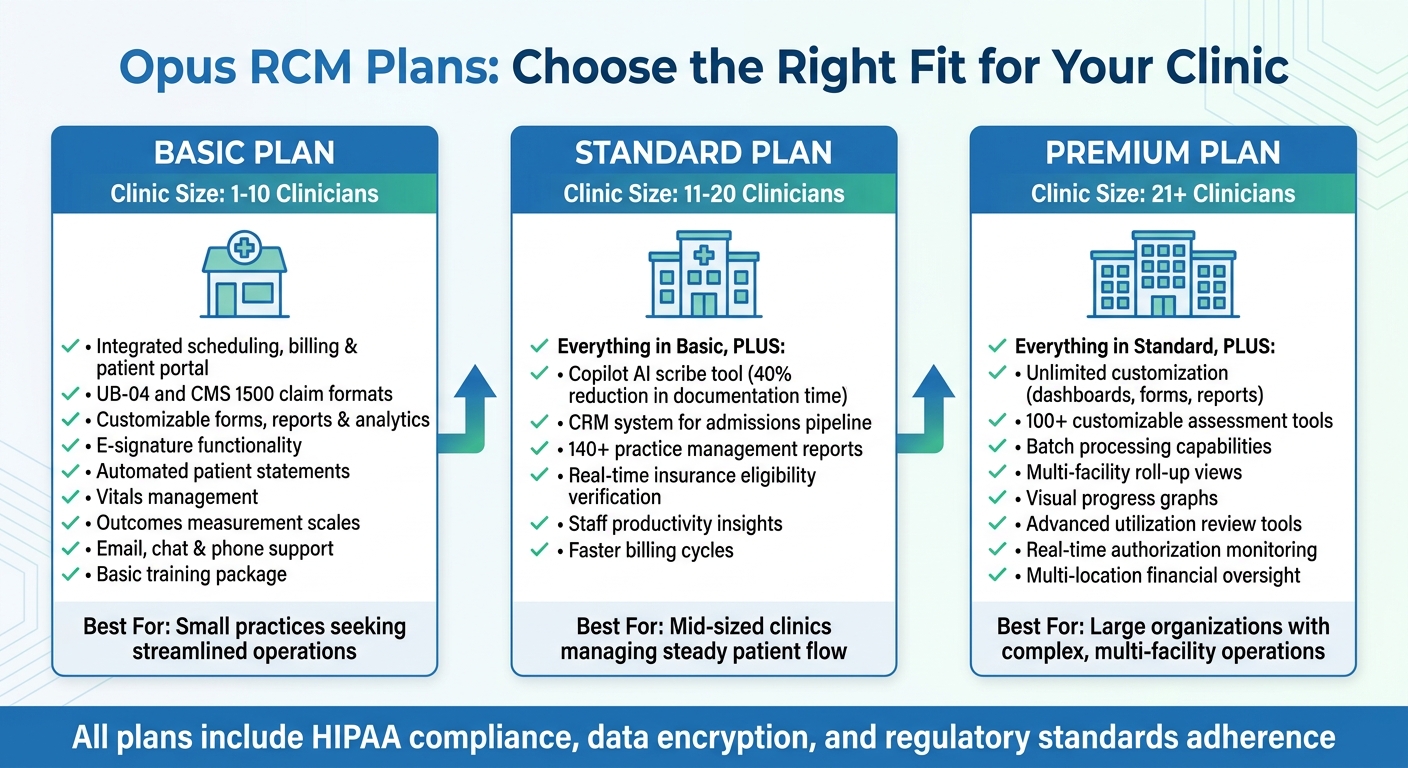
Opus RCM Plans Comparison for Behavioral Health Clinics
Opus offers three Revenue Cycle Management (RCM) plans specifically designed to fit the needs of behavioral health clinics, regardless of their size. These plans address challenges clinics face, providing tools for efficient multi-user billing and operational management. Each tier is tailored to the scale of the clinic, adding features that match the complexity of larger operations.
Basic Plan for Small Clinics (1-10 Clinicians)
The Basic Plan is built for smaller practices and focuses on simplifying day-to-day operations. It includes integrated scheduling, billing, and patient portal access, which work together to streamline everything from patient intake to payments.
Clinics can also customize forms, reports, and analytics widgets to suit their specific needs. The plan supports UB-04 and CMS 1500 claim formats and automates patient statements to save time.
Key clinical tools include e-signature functionality for paperless workflows, vitals management, and access to widely used outcomes measurement scales. Support is available through email, chat, and phone, with a basic training package to help teams get started.
Emily B., Lead Dietitian, shared her experience:
"I would recommend OPUS to any healthcare provider, small or large. It has incredible capability and functionality. I have worked at numerous treatment centers, none of which carry the sophistication and ease I see in OPUS." [1]
Standard Plan for Mid-Sized Clinics (11-20 Clinicians)
The Standard Plan introduces Copilot AI, an embedded scribe tool that reduces documentation time by up to 40% by auto-populating progress notes [10].
It also includes a CRM system that manages the entire admissions pipeline, from lead capture to insurance verification, ensuring clinics maintain a steady flow of new patients.
Mid-sized clinics benefit from over 140 practice management reports, offering insights into staff productivity and financial health.
Additionally, real-time insurance eligibility verification is integrated into the admissions process, allowing clinics to confirm benefits before a patient’s visit. These features cut down manual chart reviews and speed up billing cycles, resulting in faster reimbursements.
Premium Plan for Large Clinics (21+ Clinicians)
The Premium Plan is built for large organizations managing complex, multi-facility operations. It offers unlimited customization for dashboards, forms, reports, and assessment tools, allowing clinics to tailor the platform to their specific workflows.
Features like batch processing and multi-facility roll-up views make managing high-volume operations more efficient.
This plan supports over 100 customizable assessment tools and provides visual progress graphs to track patient outcomes.
Advanced utilization review tools monitor authorizations and claims in real time, identifying unpaid claims or over-billing issues across multiple locations. These capabilities are essential for clinics with 21 or more clinicians, ensuring smooth operations and better financial oversight.
All three plans are designed with compliance and data security in mind, helping clinics protect patient information while meeting regulatory requirements.
HIPAA Compliance and Regulatory Standards
Handling compliance in multi-user billing environments can be tricky. When multiple team members access sensitive patient records and financial data, clinics need systems that strike a balance between protecting information and maintaining smooth workflows.
Opus tackles this challenge head-on with built-in security features and automated tools
designed to meet regulatory standards. By combining advanced security protocols with efficient billing processes, Opus ensures clinics stay compliant while reducing errors and improving overall efficiency.
Role-Based Access Control for Data Security
Opus takes data security seriously by implementing multi-factor authentication (MFA) and single sign-on (SSO) across the organization to verify user identities before granting access to billing data [13].
Administrators also have the flexibility to set access controls based on geographic location, IP address, and specific business hours, ensuring only authorized users can view sensitive health information [13].
Data security is further reinforced with strong encryption protocols that protect information both in transit and at rest [13]. For clinics managing payment data, Opus complies with PCI DSS Level 1, the highest certification for secure credit card processing [13].
The platform also holds additional certifications, including ISO 27001, SOC 1, and FISMA Moderate, and employs 24/7 intrusion monitoring along with automated session timeouts to safeguard data [13].
Audit Trails for Transparency
Opus goes beyond access control by providing detailed audit trails that track every user action. Every interaction is logged with an unalterable timestamp, creating a permanent record of who accessed or modified billing and clinical data [14].
This feature is invaluable during regulatory audits, as it offers surveyors a complete and consistent documentation trail.
Compliance specialist Mira Gwehn Revilla highlights this benefit:
"Every action is logged with a timestamp that cannot be altered. When surveyors review your charts, they find clean records from day one." [14]
To further ensure accuracy, mandatory field logic prevents incomplete submissions by requiring all necessary signatures and data entries [14].
Automated version control tracks exactly which consent forms were signed and when, helping clinics stay compliant as regulations evolve [14]. Additionally, digital intake features streamline audit preparation by cutting out manual chart reviews and transcription errors, reducing prep time by 50% or more [14].
Amanda Wilson, Director of Clinical Services at a mental health and substance use treatment center, shared her experience:
"This process will simplify our operations to save so much time. We will no longer have to manually pull so many charts per quarter and have a timelier billing process for quicker reimbursements." [1]
Conclusion
Behavioral health clinics face unique billing hurdles that general medical software simply can't resolve. These clinics need tools tailored to their specific needs, such as managing guarantor-focused collections- where payments are handled by family members - and processing specialized claim formats for various levels of care.
Opus Behavioral Health EHR bridges these gaps by integrating CRM and RCM, eliminating data silos and manual workflows to streamline everything from patient contact to reimbursement [10].
The platform's multi-user functionality revolutionizes teamwork. With role-based access and detailed audit trails, clinical, administrative, and billing teams can collaborate simultaneously while staying compliant [1].
On top of that, AI-driven documentation cuts clinical paperwork by 40%, giving providers more time to focus on patients and ensuring faster billing [1].
These efficiencies also lead to better financial outcomes. Opus offers over 140 practice management reports, allowing clinics to track revenue trends, spot areas of revenue loss, and monitor team productivity [1]. Plus, SMS-based payment links speed up collections, often reducing receivables from 45–90 days to same-day payments [15].
Whether you're running a small practice with just a handful of clinicians or managing a large organization with 36+ providers, Opus adapts to your needs.
Its tiered solutions let you pay only for the features you need, with room to scale as your practice grows.
With over 160,000 practitioners relying on the system daily, Opus Behavioral Health EHR has shown it can meet the complex demands of behavioral health billing [1]. This unified system underscores the importance of streamlining operations with solutions designed specifically for behavioral health care.
FAQs
How many staff members can bill at the same time?
The number of staff members who can bill at the same time depends on the features of the software being used. Many behavioral health billing platforms, such as Opus Behavioral Health EHR, are built to handle multiple users billing simultaneously. This functionality can simplify workflows and improve efficiency for clinics.
What access should clinicians vs billing teams have?
Clinicians should only have access to patient care documentation and clinical notes, ensuring their focus remains on providing medical care.
Meanwhile, billing teams should handle billing, claims processing, and financial data, enabling them to manage insurance submissions and payments efficiently. This separation of access helps maintain clear role boundaries while safeguarding data and ensuring compliance with security standards.
How can I switch from my current billing process without downtime?
To ensure a smooth transition, take it step by step to maintain consistency. Start by evaluating your workflows and setting up the new system alongside the existing one.
Plan to migrate data during off-peak hours to minimize interference, and double-check everything to ensure accuracy.
Make sure to train your team thoroughly before rolling out the new system completely. Transition in phases, monitoring progress closely, and be prepared with support and backups to address any unexpected challenges.
This method helps reduce disruptions and keeps the process as seamless as possible.



- Behavioral Health
- EHR Systems
- Addiction Treatment EHR
- mental health
- Telehealth
- addiction treatment
- Behavioral health facility
- Substance Abuse Disorder
- behavioral Health center
- HIPPA Compliant
- ehrsoftware
- PTSD
- behavioral health ehr
- Depression
- hipaa
- Anxiety
- MentalHealthMatters
- RCM
- claim denials
- clinical documentation
- mental health awareness
- screening tools

September 15, 2026

September 15, 2026

September 14, 2026

September 11, 2026

September 10, 2026

September 09, 2026
Recommended Posts

Monday, June 22, 2026
Want Fewer Billing Delays? Modernize Your EHR Mental Health Records
Billing delays in mental health practices can disrupt cash flow, increase administrative costs, and harm patient trust. ...
Friday, February 11, 2022
Top Considerations for Behavioral Health Treatment Centers When Switching EHR Systems
The world is cautiously beginning to open again after the Covid-19 shelter-in-place orders are lifted. While it’s ...
Thursday, July 16, 2026
Real-Time Feedback Tools for Behavioral Health
Timing is extremely essential in healthcare. If feedback comes in too late, it can’t change care.