

Behavioral health data exchange fails less from standards alone and more from vendor setup, consent controls, and post-launch ownership.
For mental health and SUD providers, that means vendor choices can affect referrals, billing, care transitions, and privacy risk long after go-live.
In behavioral health, the core issue is simple: data must move and stay within tighter privacy rules.
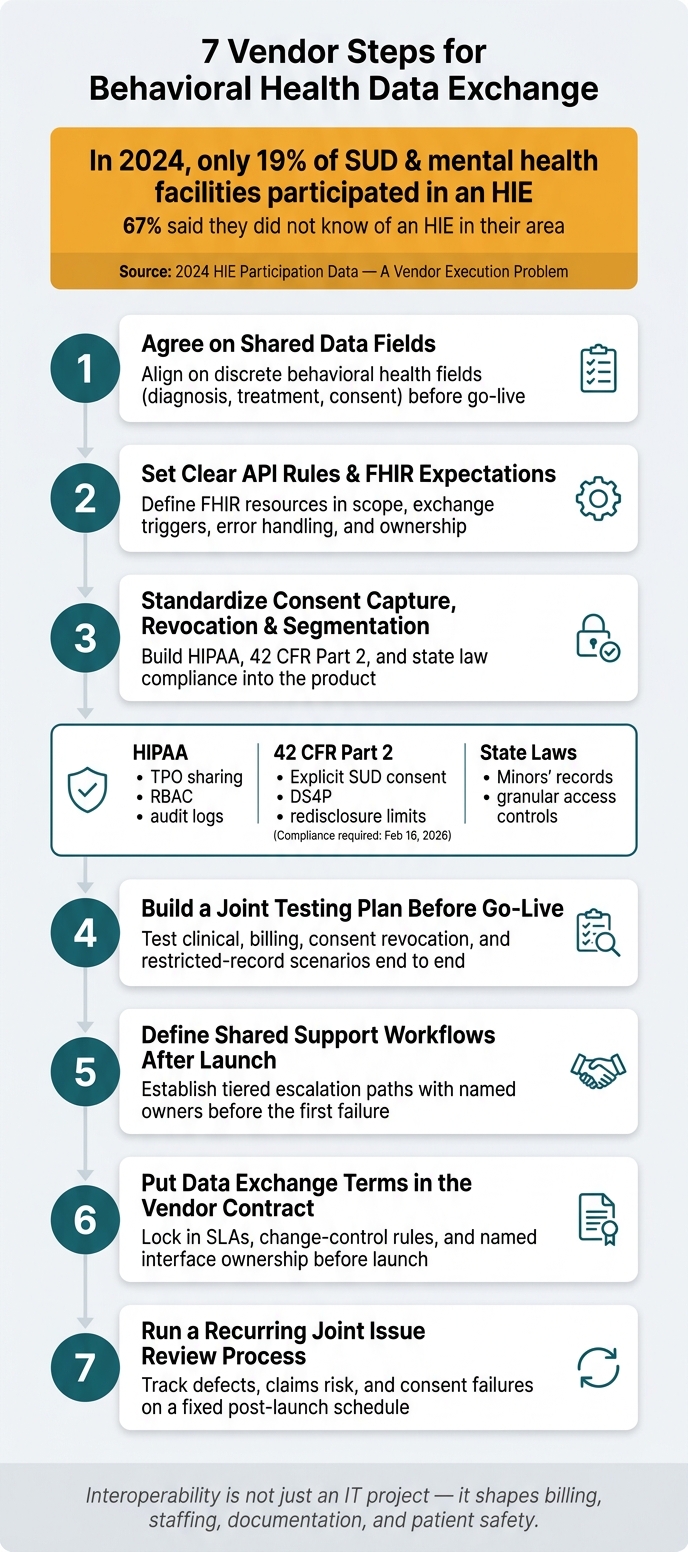
The article points to one clear gap: in 2024, only 19% of substance use and mental health treatment facilities reported taking part in an HIE, while 67% said they did not know of an HIE in their area.
That points to a vendor execution problem, not just a standards problem.
This article narrows the work to seven vendor steps teams should check before and after launch:
- Shared data fields so diagnosis, treatment, and consent data move as structured fields
- Clear API and FHIR rules for exchange triggers, error handling, and ownership
- Consent, revocation, and segmentation rules that support HIPAA, 42 CFR Part 2, and state law
- Joint testing before go-live across clinical, billing, and restricted-record scenarios
- Shared support workflows so providers are not stuck between vendors after launch
- Contract terms that set SLAs, change control, and named interface ownership
- Recurring issue reviews to track defects, claims risk, and consent-related failures after launch
A few dates matter. The 2024 HHS Part 2 final rule took effect on April 16, 2024, and compliance was required by February 16, 2026. That rule moved Part 2 closer to HIPAA for treatment, payment, and health care operations, but vendors still need to support consent handling, segmentation, and redisclosure limits inside the product.
For behavioral health leaders, the message is direct: interoperability is not just an IT project.
It can shape staff workload, claims flow, documentation quality, access controls, and post-discharge coordination. The article’s value is that it turns a broad interoperability problem into seven vendor checks that executive, clinical, finance, and IT teams can use in contract review, implementation planning, and post-launch governance.
7 Vendor Steps for Behavioral Health Data Exchange
Why Behavioral Health Data Exchange Needs a Vendor-First Approach
Behavioral health providers can train staff, tighten workflows, and set internal policies.
But vendors control the underlying system logic: data models, APIs, consent rules, and release timing. Those design choices shape what data moves, how cleanly it moves, and whether it can be shared safely. In practice, behavioral health interoperability starts with vendor design, because vendor decisions determine whether the steps below work as intended.
This gap points to system-level barriers, not provider resistance. Many of the platforms treatment centers and mental health organizations depend on still have not made data exchange reliable or safe enough to support scale.
In most cases, the breakdown comes back to four vendor-side issues.
Poor field mapping can turn structured substance use data into an unstructured note [2][6], which removes last-use dates, route of administration, and other details that matter in care delivery. Unclear APIs leave partners guessing about system behavior under load, what happens when consent is revoked, and which FHIR resources the platform actually supports [4][5][7].
Weak consent logic often forces an all-or-nothing sharing model. Because many systems cannot segment records at the data-element level, providers may end up sharing everything or blocking everything, which keeps sensitive behavioral health data isolated [1][2]. Poor post-launch coordination, including schema changes, unclear support ownership, and no incident review process, can wear down integrations over time [4][2][7].
Opus Behavioral Health EHR addresses this by connecting consent, telehealth, e-prescribing, lab integration, and documentation in one platform, applying the same rules across the full care continuum. The seven steps below focus directly on those vendor-controlled areas.
1. Agree on Shared Behavioral Health Data Fields
Before an API connection goes live, both vendors need to align on which behavioral health data fields will move between systems and what each field means.
In behavioral health, that usually includes diagnosis, treatment episode, consent status, and other discrete clinical fields. If field definitions do not match, staff often end up doing manual reconciliation. If code sets differ, the same data can be interpreted in different ways across platforms. The sending system defines the source structure, while the receiving system determines how that data is read. That means the sender must format the data correctly, and the receiver must interpret it the same way.
Data should be mapped to discrete fields, not notes or PDFs [8]. That matters for reporting, workflow routing, billing support, and downstream clinical use. A diagnosis buried in a document is much harder to act on than a diagnosis stored in a structured field.
Before go-live, vendors should test the mapping with real records to confirm that the agreed fields land in the right place in the receiving system. Once the field map is set, vendors can then define how those fields move through the API.
2. Set Clear API Rules and FHIR Expectations
Once field mapping is complete, vendors need one shared rulebook for how data moves between systems. In behavioral health, that rulebook cannot stop at transport mechanics. It also needs to define how consent status, restricted records, and SUD data are handled from the start.
That means setting clear rules for which FHIR resources are in scope, how each resource is profiled, and what events trigger an exchange. Consent-aware exchange, restricted access, and SUD-related controls should be built into the API specification at the beginning, not added later as patchwork.
Workflow Impact
Unclear API behavior can disrupt workflows and make failures difficult to trace. When systems do not share the same expectations, teams often end up dealing with missing records, duplicate transactions, or data that arrives at the wrong point in the workflow.
Vendors should align on the FHIR resources in scope, including Patient, Encounter, Consent, MedicationRequest, and DocumentReference. They also need to define how each resource is profiled and what triggers a data exchange event. Without that level of detail, even a technically working interface can create operational problems for admissions, clinical documentation, and follow-up care.
Compliance Risk
Authentication standards and data segmentation rules should be documented and tested so access is handled the same way across systems. That matters in behavioral health, where the line between permitted access and restricted access may depend on consent state, record type, or service line.
CMS ePA requirements add more pressure for consistent API behavior [9]. If vendors interpret access rules differently, organizations may face gaps in exchange controls, uneven audit trails, and more manual review work.
Define API Ownership
Ownership should be assigned before launch, not during the first failed transaction.
Vendors need clear accountability for:
- Error responses
- Retry logic
- Rate limits
- Log sharing
If those items are left open, support teams can lose time debating responsibility instead of fixing the issue.
Go-Live Readiness
Before go-live, vendors should confirm a shared test environment, fixed error codes, versioning rules, and one end-to-end test using real record types. That same shared rulebook should also extend into consent handling and testing, so organizations are not validating transport alone while leaving access behavior unclear.
3. Standardize Consent Capture, Revocation, and Segmentation
Consent is a live control, not a one-time checkbox. Vendors need a standard way to capture, revoke, and segment consent across systems. In practice, that makes consent design an integration issue, not just a policy issue.
Workflow Impact
The same consent fields should appear across every system: who consented, what may be shared, with whom, for what purpose, and the effective and expiration dates. If those field definitions differ from one platform to another, segmentation can break during exchange.
Revocation is often where risk shows up first. If a patient withdraws consent and one system updates while another does not, disclosures may continue after the revocation date. That gap can create workflow confusion for staff and exposure for the organization.
Compliance Risk
Vendors need one shared rule set across all three layers below.
|
Requirement Layer |
Data Exchange Implications |
Required Technical Controls |
|---|---|---|
|
HIPAA |
Allows treatment, payment, and operations (TPO) sharing without specific authorization |
Role-based access control (RBAC), audit logs |
|
42 CFR Part 2 |
Requires explicit consent for SUD records; strict redisclosure limits |
Data Segmentation for Privacy (DS4P), metadata tagging, emergency override workflows |
|
State Privacy Laws |
May impose stricter rules on minors' records |
State-specific compliance rules, granular access controls |
Under the current Part 2 rule, vendors must block redisclosure unless a new consent allows it [10][11]. That distinction needs to be built into the way data is tagged, segmented, and exchanged.
Cross-Vendor Accountability and Pre-Launch Validation
Each vendor should have a defined role in the consent chain. One system may capture consent at intake. Another may enforce segmentation during exchange. A third may trigger revocation updates across downstream systems.
Before go-live, executive and operations teams should assign clear ownership for:
- Consent state updates
- Revocation propagation timelines
- Audit log ownership
Every handoff should then be tested end to end, including revocation scenarios, to confirm that a withdrawal in one system stops data flow in every downstream system within an agreed timeframe.
Those consent scenarios should be part of the joint testing plan before go-live.
4. Build a Joint Testing Plan Before Go-Live
Once consent rules are set, behavioral health organizations need to prove they work in live exchange testing before go-live. That means testing the full data path, not only the interface itself. Executive teams should expect end-to-end testing across intake, documentation, e-prescribing, referrals, billing, and care transitions.
The test plan should also cover payer-specific X12 275 exchanges for discharge summaries and treatment plans. Just as important, it should include consent revocation and restricted-record scenarios. Those cases often expose workflow gaps that do not appear in standard happy-path testing.
Compliance Risk
Workflow testing alone is not enough. After operational testing is complete, organizations should run a separate compliance test pass focused on access controls, segmentation, and state-level rules. The goal is simple: confirm that the system behaves correctly under the privacy and disclosure conditions that matter most before launch.
The table below outlines the controls that should be verified before cutover.
|
Requirement Layer |
Test Controls |
|---|---|
|
HIPAA |
Role-based access control (RBAC), AES-256 encryption, audit logs |
|
42 CFR Part 2 |
Data Segmentation (DS4P), metadata tagging, break-glass workflows, current TPO consent form, prohibition on redisclosure |
|
State Laws |
Jurisdiction-aware compliance logic, state-specific rules, granular access controls |
Audit logs should be tested, not simply turned on. Each log entry should capture user ID, role, action, resource ID, UTC timestamp, and purpose of use. If those fields are missing or inconsistent, compliance reviews and post-issue tracing become much harder.
Cross-Vendor Accountability
Clear ownership matters before testing starts. Organizations should assign separate clinical and billing sign-off owners before testing begins [12]. That step helps avoid a common problem: one team assumes another team has approved a workflow that still has payer, documentation, or disclosure issues.
Cutover Readiness
Before cutover, teams should export the data dictionary and reconcile active clients, open claims, and payer authorizations [12]. This check helps surface mismatches between source data and the live environment before they affect care delivery or reimbursement.
Every failed case should also be logged with a named post-launch support owner. That creates a clean handoff into stabilization and gives leaders a direct line of sight into unresolved issues that may affect operations in the first days after launch.
5. Define Shared Support Workflows After Launch
Go-live marks the start of vendor support, not the end of coordination. The same alignment used during testing needs to continue after launch, especially around escalation paths and issue ownership. If that handoff is weak, providers often end up stuck in the middle, trying to sort out vendor disputes while care delivery slows down.
Workflow Impact
Post-launch support works best when it follows a tiered model with clear ownership at each level. Tier 1 should handle intake, basic triage, and early issue review. Tier 2 should take on mapping problems, interface failures, and performance issues. Tier 3 should involve engineering teams when cross-vendor issues become more complex or harder to isolate.
That structure only works if each tier is tied to clinical impact. Problems that block treatment plan documentation, medication reconciliation, or live telehealth sessions should move to urgent status right away. Less urgent issues, such as minor reporting gaps, can move through a slower queue. Each integration should be tied to the workflow it supports so teams can judge urgency based on care impact, not just technical symptoms.
Compliance Risk
Support workflows also need to protect the consent and data segmentation rules already put in place. Support tickets can expose PHI if teams are not careful. Staff should rely on de-identified IDs, timestamps, and error codes rather than full clinical notes or SUD records. Troubleshooting should use de-identified logs and test data whenever possible, and breach-response ownership and deadlines should be assigned before an incident occurs. HIPAA requires notification without unreasonable delay and no later than 60 days after discovery. [13][14]
Cross-Vendor Accountability
When multiple vendors are involved, ownership cannot stay vague. One primary contact should coordinate the issue from start to finish, even when the root cause sits elsewhere. In many cases, that role falls to the EHR vendor or the integration platform vendor. The goal is simple: providers should not have to referee between systems, teams, and contracts.
A shared ticket queue helps keep everyone working from the same record. A RACI chart also helps by assigning responsibility across each layer of the stack, including the FHIR API, message broker, and EHR mapping.
One owner, one queue, and one escalation path keep providers out of the middle.
|
Role |
Post-Launch Support Responsibility |
Review Frequency |
|---|---|---|
|
Security Team |
Triage high-risk alerts, failed logins, and system integrity signals |
Daily |
|
Privacy Officer |
Review unauthorized access, consent mismatches, and break-glass events |
Weekly / Monthly |
|
Clinical Leads |
Recertify user access roles and confirm minimum necessary access |
Quarterly |
|
IT/Engineering |
Verify data exchange latency, API success rates, and log integrity |
Weekly |
Production-Readiness
Support workflows should be tested before go-live rather than built in response to the first production issue. Production-readiness criteria should include documented escalation paths, along with configured monitoring and alerting for key interfaces. For organizations that operate 24/7 crisis services or residential programs, vendors should confirm after-hours on-call coverage before cutover.
A day 1–30 support plan can help manage the higher ticket volume that often follows launch. That plan should include daily or weekly check-ins between vendors and the provider’s IT and clinical leadership. Many organizations also benefit from a 90-day audit period focused on data integrity, interface stability, and issue trends.
6. Put Data Exchange Terms in the Vendor Contract
Vendor contracts are where data exchange rules become enforceable obligations. Support expectations, testing standards, and change controls are far less useful if they sit outside the agreement. For behavioral health organizations, those terms should be in place before go-live so interface issues do not turn into avoidable disputes once clinical and billing workflows depend on them.
Workflow Impact
The contract should require interface SLAs that cover uptime, response time, and escalation procedures. It should also separate escalation paths for clinical interruptions and reporting issues, since those incidents carry different operational risks and may need different response teams.
The agreement should also require written notice and approval before a vendor makes API version updates, schema changes, or deprecations that affect mapped fields. Without that control, a vendor-side change can disrupt documentation, reporting, or downstream billing workflows with little warning.
Compliance Risk
Each vendor should be required to apply the agreed segmentation tags and maintain logs for access to restricted data. This matters in behavioral health settings, where consent rules and data-sharing limits often carry added sensitivity.
The contract should also assign named ownership for consent capture and consent revocation. If that responsibility is left vague, consent failures and segmentation gaps can become cross-vendor arguments after go-live, leaving provider teams to sort out the operational and compliance fallout.
Cross-Vendor Accountability
When an integration involves more than one vendor, the contract should identify one primary interface owner for end-to-end issue resolution. That party should be accountable for coordinating fixes across systems, including any integration failure that follows a vendor update.
Without a named owner, multi-vendor issues often stall. One vendor blames the API, another points to field mapping, and the provider is left dealing with delays that affect admissions, care delivery, reporting, or claims workflows.
Production-Readiness
Production readiness should be tied to signed acceptance based on test results, open defects, and target resolution dates. That creates a documented standard for go-live rather than relying on informal sign-off.
The agreement should also require a post-launch stabilization window with named owners, open-defect tracking, and remediation timelines. Those contract terms should connect directly to the recurring issue review process in the next step.
7. Run a Recurring Joint Issue Review Process
After go-live, contract language only matters if both vendors review issues on a fixed schedule. Signing the agreement and finishing launch testing does not end vendor responsibility. Data exchange problems can still surface after launch, so both parties should commit to a recurring review process from day one. That schedule turns support, compliance, and ownership terms into one shared operating process.
Workflow Impact
A joint review cadence can help admissions, billing, finance, and clinical teams avoid carrying interface failure costs on their own. Reviews should rely on one shared post-launch issue log for root-cause analysis and status updates. When a critical failure appears, such as a broken EHR-to-billing connection, the agreement should define a clear Time to Cure. For critical failures, define a clear time to cure and review it at every meeting. Set a 7-day cure window for critical failures.
A shared review process works best when every team is looking at the same facts. That includes what failed, when it failed, who owns the fix, and whether the issue is blocking claims, admissions activity, or clinical documentation.
Compliance Risk
Each review cycle should flag PHI handling issues, access-control drift, and disclosure risks tied to restricted behavioral health data, consent status, and redisclosure limits. If a repeat issue affects any of these areas, it should be surfaced in the review and assigned to a named owner on each side before the next meeting.
This matters because interface issues are not always limited to workflow delays. In behavioral health settings, a missed consent update or an access error can create risk that reaches well beyond an IT queue.
Cross-Vendor Accountability
Reviews should include an ongoing post-launch reconciliation of active authorizations and open claims to confirm that no data is lost during transitions between systems. Participation should extend beyond technical teams to include contract, utilization review, admissions, billing, and finance teams so everyone is working from the same issue log.
That cross-functional model can prevent a common breakdown: one vendor treating the matter as a ticketing problem while provider teams are dealing with held claims, missing authorizations, or intake delays.
Production-Readiness
Joint reviews should track support ticket trends, open defects, and repeat incidents to decide whether the integration needs escalation. The cadence should be fixed, and escalation triggers should be defined in advance so issues are reviewed as soon as they appear, not just at the next scheduled meeting.
Useful review signals often include:
- repeat failures tied to the same workflow
- rising ticket volume from admissions, billing, or clinical staff
- unresolved defects that affect authorizations, claims, or documentation
- issues that have passed the agreed 7-day cure window
When those patterns show up, executive and operational leaders need a path to escalate early rather than waiting for a monthly check-in while revenue, staff time, and compliance risk continue to build.
Vendor Responsibility Snapshot
This snapshot helps behavioral health organizations assign ownership before recurring issue reviews start. That matters because many interface, consent, and access problems do not begin with a single system failure. They begin with unclear accountability.
|
Responsibility Area |
Vendor |
Provider |
|---|---|---|
|
Data Mapping |
Field mapping, FHIR alignment, value set validation |
Clinical content, sensitivity flags, workflow validation |
|
API Management |
API availability, auth, rate limits, versioning, uptime |
Enabled endpoints |
|
Consent Policy |
Consent capture, segmentation logic, consent status tracking, outbound filtering |
Consent rules, patient signatures, state-specific policy updates |
|
Testing |
Sandbox, validation scripts, consent tests, defect fixes |
Clinical UAT, workflow sign-off, staff readiness |
|
Support Escalation |
Technical support, incident management, bug fixes, escalation |
First-line triage, user communication, issue routing |
|
Security & Compliance |
Encryption, access controls, audit logging, HIPAA Security Rule obligations |
Role-based access decisions, workforce training, audit log reviews |
|
Change-Control Approval |
System updates, API deprecation notices, feature documentation |
Workflow approval, stakeholder sign-off before deployment |
Consent and security sit in shared territory. Vendors enforce system controls, while providers set policy, determine access, and manage workforce use.
In joint issue reviews, this snapshot can help teams name the lead owner before the next failure review begins. In many behavioral health settings, these gaps tend to surface first in the failure points that follow.
Common Failure Points to Watch During Implementation
Behavioral health data exchange issues often do not show up as one big failure. They tend to appear quietly: duplicate patient charts, missed consent updates, or interface rejects that no team fully owns. In most cases, the root cause comes back to weak ownership, poor field mapping, or thin testing during setup.
Mismatched patient identity fields are often one of the first problems to surface. When front-end teams enter the same patient into an EHR, CRM, and billing system, even small data-entry mistakes can create long-term record issues.
A transposed date of birth or a misspelled last name can produce duplicate records that are hard to clean up later. The same pattern shows up with medication entry. If dosage or drug-name fields are keyed in incorrectly, the risk moves beyond workflow friction and into patient safety, especially in detox and SUD settings.
API version changes can be harder to catch, but the disruption can be just as serious. When a vendor updates an API and connected systems are not updated at the same time, data exchange may fail in ways that are not obvious at first.
Consent revocation is one area where this can become a problem fast. If version changes interrupt propagation, protected data may continue moving after a patient has withdrawn consent. That makes version control and consent propagation part of the same implementation plan, not separate technical tasks.
Unclear support SLAs often become the biggest problem after go-live. If ownership and escalation paths are vague, a login issue or telehealth connection failure can sit unresolved while each party assumes someone else is handling it. Many vendor statements of work also leave out day-to-day interface maintenance, which means EDI reject fixes or third-party integration work may trigger separate fees [3].
The table below links common failure points to likely business impact and the control that may help reduce the risk.
|
Failure Point |
Likely Impact |
Recommended Control |
|---|---|---|
|
Mismatched patient identity fields |
Duplicate or mixed patient records |
API-driven CRM-to-EHR integration; required field logic at intake |
|
Medication transcription errors |
Dosing errors in detox/SUD settings |
Digital intake with patient-entered data; mandatory field validation |
|
API version changes |
Disrupted data exchange |
Versioning clauses in the contract |
|
Consent revocation not propagating |
Protected data flowing after withdrawal |
Pre-go-live testing of consent segmentation and revocation workflows |
|
Untested denial and error paths |
Unhandled errors surfacing post-launch |
Joint testing plan that includes negative and edge-case scenarios |
|
Unclear support SLAs |
Stalled resolution, no clear owner |
Defined escalation protocols with assigned roles for specific failure types |
|
Unbudgeted interface changes |
Unexpected charges post-launch |
Audit clauses excluded from the SOW before signing; negotiate maintenance into the base contract |
One gap that often gets missed is dual-write access. When two systems can update the same field, overwrite conflicts become almost inevitable unless one source of truth is clearly defined. This is where implementation discipline matters. If leaders do not decide which system owns each field, teams may spend months dealing with preventable cleanup work.
Conclusion
Behavioral health data exchange improves when vendors handle interoperability as a shared implementation process, not a one-time setup task. That process starts with early agreement on shared fields and continues through recurring issue review meetings after go-live.
The seven steps work together. Shared fields affect consent segmentation. API rules shape testing. Support workflows depend on contract terms. Recurring reviews help keep the integration stable as teams, payers, and partner systems change.
That is why the implementation gap still matters. Many facilities still rely on manual entry, and nearly one-third still cannot query external records. For behavioral health organizations, that can increase care coordination problems, add staff burden, and create compliance risk.
A single platform may help keep those controls aligned. Opus Behavioral Health EHR can support this model by keeping data fields, consent records, workflows, and reporting in one system.
The goal is straightforward: data exchange that is safer for patients, cleaner for billing teams, and more useful for clinicians, backed by vendor commitments that hold up in production.
FAQs
How do we know if our vendor is ready for Part 2 compliance?
Check that the system supports granular data segmentation so restricted SUD data stays separate. It should also automatically tag records by program type, which can help block disclosure unless the patient has given explicit consent.
Leaders should also confirm that the platform includes detailed, immutable, searchable audit logs. Those logs should show the consent status in effect at the time of access or disclosure, not just who opened a record.
In addition, the vendor should provide:
- A signed Business Associate Agreement
- Documentation for role-based access controls
- Documentation showing how automated redisclosure prohibitions are applied
These items matter because consent rules, access controls, and disclosure records often sit at the center of compliance reviews, internal audits, and partner due diligence.
Which data fields should we prioritize first for exchange?
Start with the clinical data that matters most for safe care coordination:
- patient demographics
- medications
- allergies
- active diagnoses
- recent labs and test results
From there, expand into structured care summaries that support provider-to-provider exchange. Aligning these fields with USCDI+ Behavioral Health and the latest USCDI versions can help standardize key data elements, including mental status and substance use history.
What should we include in the contract before go-live?
Before go-live, the contract should clearly define support workflows, joint issue review, API usage terms, adapter costs, and connector buildout timelines.
The agreement should also require testing in a sandbox and clinical user acceptance testing. It should spell out data exchange and security requirements in plain terms, including consent-driven data segmentation, audit logs, and 42 CFR Part 2 compliance.



- Behavioral Health
- EHR Systems
- Addiction Treatment EHR
- mental health
- Telehealth
- addiction treatment
- Behavioral health facility
- Substance Abuse Disorder
- behavioral Health center
- HIPPA Compliant
- ehrsoftware
- PTSD
- behavioral health ehr
- Depression
- hipaa
- Anxiety
- MentalHealthMatters
- RCM
- claim denials
- clinical documentation
- mental health awareness
- screening tools

September 15, 2026

September 15, 2026

September 14, 2026

September 11, 2026

September 10, 2026

September 09, 2026
Recommended Posts

Friday, February 11, 2022
Top Considerations for Behavioral Health Treatment Centers When Switching EHR Systems
The world is cautiously beginning to open again after the Covid-19 shelter-in-place orders are lifted. While it’s ...

Tuesday, August 11, 2026
Telehealth Vendor HIPAA Review: Do it Right in 5 Steps
If a telehealth vendor touches ePHI, I treat the review like a HIPAA risk check before any patient data moves.

Friday, August 28, 2026
10 HIPAA-Compliant CRM Features to Review
A healthcare CRM that touches PHI should be reviewed like a risk system, not just a sales tool.