

AI is changing how healthcare providers use Patient-Reported Outcome Measures (PROMs), making data collection faster, cheaper, and more effective.
Here's what you need to know:
Response Rates: Paper surveys see a 25% response rate, while AI-powered tools (e.g., WhatsApp) boost this to 83%.
Cost Efficiency: Traditional methods cost $42–$45 per response; AI reduces this to $3 per patient.
Real-Time Insights: AI analyzes patient feedback instantly, helping clinicians identify issues like pain spikes or mental health risks faster.
Advanced Tools: Techniques like machine learning and natural language processing (NLP) extract deeper insights from data, including free-text patient narratives.
Integration: Platforms like Opus Behavioral Health EHR streamline PROMs with features like automated reports and alerts, saving clinicians time and improving care quality.
Challenges: Managing incomplete data and ensuring ethical AI use are critical for reliable results.
AI-powered PROMs improve care by cutting administrative burdens, enabling personalized treatments, and providing actionable insights. This shift supports healthcare providers in delivering better outcomes for patients.
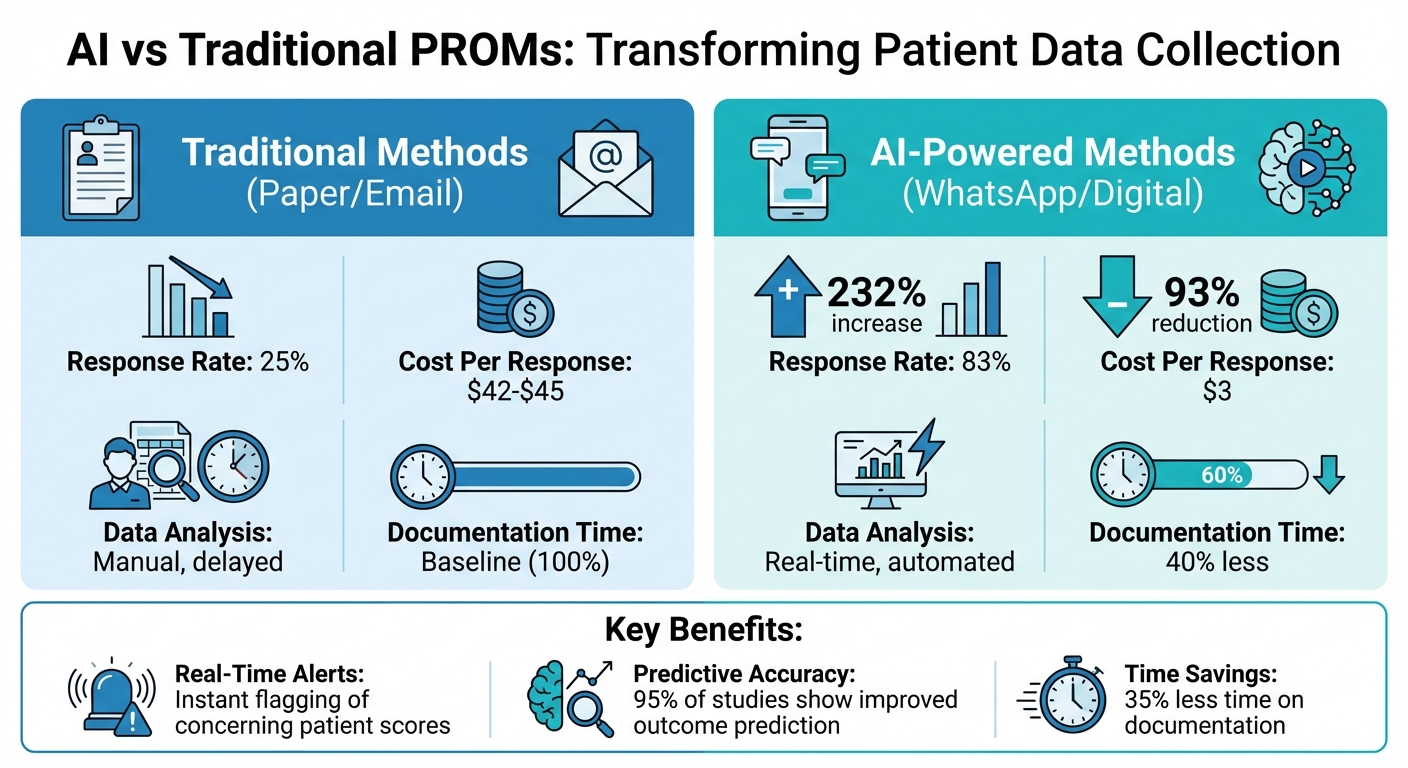
AI vs Traditional PROMs: Response Rates, Costs, and Efficiency Comparison
AI Methods for Analyzing PROMs Data
AI has transformed the way Patient-Reported Outcome Measures (PROMs) data is analyzed. It employs three primary methods: machine learning to predict outcomes by identifying patterns in structured data, natural language processing (NLP) to interpret patient narratives, and advanced analytics to monitor symptom trends over time. These techniques provide insights that go far beyond isolated data points.
Machine Learning for Predicting Outcomes
Machine learning is particularly effective for predicting how patients will respond to specific treatments. These models integrate PROMs data with clinical and demographic information, a combination used in about 67% of predictive studies [3].
Common algorithms include:
Regression models: Used in 65% of studies, delivering the best performance in 30% of cases.
Boosting methods (e.g., XGBoost): Applied in 56% of studies, with strong performance in 25% of cases.
Random forests: Utilized in 53% of studies [3].These models predict clinical milestones like reaching a Minimally Clinically Important Difference (MCID) or achieving a patient-acceptable symptom state. Impressively, 95% of studies found that including PROMs data improved outcome prediction accuracy [3].
By combining PROMs with clinical data, these models help healthcare providers make precise treatment decisions [4]. While machine learning excels at predictions, NLP dives deeper into qualitative insights.
Natural Language Processing for Text Responses
NLP has revolutionized the analysis of open-ended patient feedback, turning what was once a manual, labor-intensive process into an efficient, automated workflow. It identifies themes, measures sentiment, and even predicts standardized PROM scores.
For instance, in July 2022, researchers at Leiden University Medical Center introduced the AI-PREM tool.
Tested on 534 patients with vestibular schwannoma, it analyzed responses to five open-ended questions, achieving a 90% alignment with manual topic extraction [6].
The tool also offered hierarchical visualizations, enabling doctors to explore general sentiments and drill down into specific patient quotes.
"The AI-PREM tool is a comprehensive method that combines a validated, open-ended questionnaire with a well-performing NLP pipeline and visualization." - BMC Medical Informatics and Decision Making [6]
Additionally, transformer models like BERT and BioBERT are now capable of predicting quantitative scores from patient narratives.
These models perform best with concise narratives of around 100 words and require input from at least 250 patients for reliable results [5]. NLP ensures that subjective patient feedback is not only heard but also actionable.
Advanced Analytics for Identifying Trends
Advanced analytics go a step further by capturing the dynamic progression of symptoms over time. Techniques like time-series analysis allow for tracking changes across multiple check-ins, making them especially useful in areas like behavioral health, where recovery often takes a non-linear path.
Deep learning models such as Long Short-Term Memory (LSTM) and Gated Recurrent Units (GRU) excel at processing temporal data [3].
These models can flag concerning trends in real time. For example, in December 2025, an orthopedic and spine center used a chatbot via WhatsApp to collect PROMs. When a post-surgical patient reported a pain score of "8", the system flagged the response, enabling the care team to adjust medication within 30 minutes [1].
Early intervention like this can be critical in avoiding complications.
These analytics also improve data quality by addressing gaps, using techniques like KNN-based imputation to fill in missing responses [3]. Together, these methods ensure that PROMs data is not only accurate but also actionable for healthcare providers.
Benefits of AI-Powered PROMs Analysis
AI is reshaping how Patient-Reported Outcome Measures (PROMs) are used in healthcare, turning them into tools for actionable insights. It offers three standout advantages: real-time analysis to catch emerging issues early, tailored treatment adjustments based on individual needs, and automated reporting that fills in documentation gaps.
These features address the daily challenges of time constraints and administrative tasks faced by behavioral health providers, paving the way for faster data review and more proactive patient care.
Real-Time Data Analysis
AI systems process patient responses instantly, flagging any concerning trends or scores for immediate review by clinical teams. Dynamic dashboards make this data accessible right away, which is crucial in behavioral health, where timely intervention can prevent crises or hospital readmissions.
By automating tasks like data processing and pattern recognition, AI frees up clinicians to spend more time directly engaging with patients.
"Since implementing Opus EHR, our providers spend 35% less time on documentation while capturing more comprehensive clinical data. The AI documentation assistant feels like having an extra team member in every patient encounter" [2].-Dr. Jennifer Williams, mental health practice owner
Customized Treatment Plans
AI can detect subtle patterns across patient assessments that might be overlooked otherwise. These insights allow clinicians to adjust medications, therapies, or support services as symptoms change.
With access to over 100 customizable assessment tools, practices can track progress metrics tailored to their patients - whether monitoring anxiety levels in teens or identifying substance use triggers for adults in recovery [2].
According to Mark Thompson, Clinical Director at a family medicine group:
"The customizable assessment tools have revolutionized how we track patient progress. We can now visualize treatment outcomes in ways that were impossible with our previous system, and patients appreciate the more focused interactions" [2].
This approach not only improves care but also enhances the overall patient experience.
Better Reporting and Compliance
AI-powered tools streamline documentation, cutting time spent on it by 40% while ensuring records are complete [2].
PROMs data is automatically captured and organized to meet regulatory requirements, whether for insurance claims, quality assurance, or accreditation purposes. This automation minimizes gaps in documentation that could lead to claim denials or compliance issues.
Lisa Chen, Practice Administrator at a behavioral health center, says:
"Having our EHR seamlessly connected with billing has eliminated the documentation gaps that used to cause claim denials. Our clinicians document naturally, and the system automatically captures everything needed" [2].
Connecting AI with Behavioral Health EHRs
Integrating AI-driven PROMs analysis directly into behavioral health EHR systems creates a seamless experience for clinicians. With this setup, there's no need to switch between multiple platforms - everything stays centralized. This approach simplifies how treatment centers handle patient-reported outcomes, from collection to analysis, while amplifying the impact of AI-powered insights.
Automating Data Collection and Analysis
Behavioral health EHRs leverage AI to manage every step of the PROMs process. Patients can complete digital assessments on any device, and their responses are automatically captured and added to their records. From there, AI tools analyze the data instantly, turning raw scores into actionable insights that guide personalized care.
But it doesn’t stop at data entry. These systems can even send alerts to care teams if a patient shows signs of a potential crisis. Additionally, they conduct quality checks by reviewing clinical documents for accuracy and flagging errors - a feature especially helpful in complex scenarios like group therapy.
Opus Behavioral Health EHR: AI Tools for PROMs
Opus Behavioral Health EHR takes automation a step further by embedding AI throughout its platform.
Trusted by over 160,000 practitioners and used to support more than 44 million clients [7], Opus offers tools like Copilot AI Scribe. This feature automatically converts structured data into clinical narratives, reducing documentation time by up to 40% [8]. It processes data from widely-used assessment tools like PHQ-9, GAD-7, ASAM criteria, and AUDIT, creating detailed clinical notes without requiring clinicians to spend hours typing.
The platform also tracks patient progress through over 100 customizable assessments. Its dynamic dashboards aggregate outcomes data across facilities, while visual progress graphs turn PROM scores into trend lines, helping patients see their progress over time.
On top of that, Opus uses AI sentiment analysis to interpret emotional cues in clinical notes and patient communications, which helps identify mental health risks and tailor care plans.
"By automating the quality of internal data, and applying an algorithm, it will cut back on errors to not miss a thing, especially from group sessions" [7]. - Judd Carey, Director of Operations, VirtualServices, Mindful Health
Opus ensures AI integration across the entire patient journey, from intake to billing. Lab results are delivered directly within the EHR, removing the need for external portals or manual data entry. This seamless flow means PROMs data is incorporated naturally at every stage of care, enhancing clinical decision-making and patient outcomes.
Addressing Challenges in AI-Powered PROMs
Tackling data gaps and ethical concerns is essential to make the most of AI in analyzing digital PROMs (Patient-Reported Outcome Measures). Challenges like incomplete datasets and responsible AI use can significantly impact the reliability of insights if left unaddressed.
Managing Incomplete Data
Missing data is a major obstacle in AI-PROM studies. In fact, a review of 94 studies revealed that 68% dealt with incomplete datasets [3]. When patients fail to complete their assessments, AI models lose critical information, which can lead to skewed or inaccurate results.
To address this, researchers often discard incomplete records or use simple methods like mean imputation. However, these approaches risk introducing bias [3]. A better solution is K-Nearest Neighbors (KNN)-based imputation, which uses patterns from similar patient records to fill in gaps while maintaining accuracy [3]. On top of that, conversational AI tools - like using WhatsApp for data collection - have shown promise in boosting response rates to 83%, cutting down on missing data right from the start [1].
Another issue is class imbalance. Many datasets disproportionately represent favorable outcomes over unfavorable ones. For example, 68% of AI-PROM studies showed this imbalance, and 45% didn’t even acknowledge it [3]. When datasets are skewed, standard accuracy metrics can give misleading results. To address this, researchers should rely on metrics like the F1 score or balanced accuracy and validate their models using independent datasets [3].
But solving data issues is only part of the equation - ethical AI use is just as critical.
Maintaining Ethical AI Practices
Ethical AI starts with transparency and patient consent. Dynamic consent models allow patients to control how long their data is used and revalidate their consent over time, ensuring they remain informed and their autonomy is respected [10].
"The protection of human rights and dignity is the cornerstone of the Recommendation, based on the advancement of fundamental principles such as transparency and fairness, always remembering the importance of human oversight of AI systems." – UNESCO [9]
Human oversight is key. AI should support clinical decisions, not replace them. Bringing together multidisciplinary teams - including patients, clinicians, and data scientists - during the design phase can help identify and address biases early [10].
Alarmingly, only 26% of studies report participant ethnicity, which raises concerns about algorithmic bias potentially disadvantaging diverse populations [3]. Regular audits of training datasets can help ensure they reflect the diversity of patients and avoid perpetuating stereotypes [11].
Data security and minimization are also vital. Collect only the bare minimum data required for treatment and avoid including personally identifiable information in AI prompts [10].
This is particularly important in behavioral health, where strict regulations like 42 CFR Part 2 protect substance use records [12]. Lastly, using transparent AI systems allows clinicians to verify insights before applying them, ensuring accountability and trust [9].
Conclusion
AI is reshaping how Patient-Reported Outcome Measures (PROMs) are collected and used, making patient care more efficient and effective.
Traditional manual methods, which often struggled with low response rates and high costs, have been replaced by automated, real-time systems that deliver actionable insights. For example, AI-powered platforms have boosted response rates to an impressive 78%–83% [1], nearly quadrupling the rates of traditional email surveys.
At the same time, these systems have significantly cut costs, reducing the expense of data collection from $42–$45 per patient to just $3 [1].
Beyond just collecting data, AI transforms it into meaningful, personalized treatment strategies. Real-time alerts can flag issues like declining mental health scores or elevated risk indicators, allowing clinicians to intervene promptly instead of waiting weeks for scheduled follow-ups.
This shift from reactive to proactive care has a direct and measurable impact on patient outcomes. Additionally, AI can uncover clinical patterns that would otherwise remain hidden, enabling care that is tailored to each patient’s unique needs.
For behavioral health providers, integrating AI with systems like Opus Behavioral Health EHR makes these advancements part of everyday workflows.
AI documentation tools, for instance, can reduce charting time by 40% [2], giving clinicians more time to focus on their patients. By streamlining workflows and providing real-time data analysis, AI helps create a more seamless care process and supports better decision-making at every stage.
The future of AI in behavioral health lies in finding the right balance - leveraging its potential to enhance care while ensuring it is used responsibly to improve outcomes for patients everywhere.
FAQs
How does AI flag high-risk PROMs responses in real time?
AI processes patient-reported outcome measures (PROMs) in real time, scanning for patterns or irregularities that could indicate potential risks. By identifying these concerns quickly, it allows clinicians to receive immediate alerts and take prompt action, ultimately helping to improve patient care and outcomes.
What data is needed to reliably use AI on digital PROMs?
To effectively apply AI to digital Patient-Reported Outcome Measures (PROMs), having high-quality, structured data is essential. This data should accurately represent the patient’s health status, including detailed PROM responses about symptoms, functional abilities, and overall quality of life. Contextual information, such as demographics and clinical history, is equally important to provide a complete picture.
Incorporating real-time inputs from sources like electronic health records (EHRs) or wearable devices can take AI analysis to the next level. These inputs allow for more personalized and precise treatment planning, tailored to the unique needs of each patient.
How can AI-PROMs stay HIPAA-compliant and ethical?
AI-driven Patient-Reported Outcome Measures (PROMs) ensure compliance with HIPAA regulations and maintain ethical standards by prioritizing data privacy and security.
To achieve this, key measures include performing AI-specific risk assessments, encrypting Protected Health Information (PHI), and implementing robust access controls such as multi-factor authentication.
Additionally, maintaining transparency, securing informed consent, and incorporating human oversight of AI-generated outputs are critical steps. These practices are especially important for behavioral health platforms like Opus Behavioral Health EHR, where protecting sensitive patient data is paramount.



- Behavioral Health
- EHR Systems
- Addiction Treatment EHR
- mental health
- Telehealth
- addiction treatment
- Behavioral health facility
- Substance Abuse Disorder
- behavioral Health center
- HIPPA Compliant
- ehrsoftware
- PTSD
- behavioral health ehr
- Depression
- hipaa
- Anxiety
- MentalHealthMatters
- RCM
- claim denials
- clinical documentation
- mental health awareness
- screening tools

September 15, 2026
September 15, 2026

September 14, 2026

September 11, 2026

September 10, 2026

September 09, 2026
Recommended Posts

Monday, August 24, 2026
Patient-Reported Outcome Collection in EHR
If patient-reported outcomes stay in PDFs, paper forms, or free-text notes, they are hard to trend, hard to report, and ...

Friday, February 06, 2026
AI in Outcomes Tracking for Addiction Treatment
AI is transforming addiction treatment by fixing outdated tracking systems. It automates data collection, reduces ...

Tuesday, February 24, 2026
How to Measure Outcomes with EHR Data Visualization
EHR data visualization is transforming how behavioral health providers track treatment outcomes. By turning complex ...