
AI mental health assessments can cut intake work, speed note review, and improve follow-up visibility, but they still need clinician review, crisis routing, and tight privacy controls.
For behavioral health leaders, the issue is not whether AI can assist with screening or documentation. The issue is whether the workflow is safe, billable, auditable, and usable across programs.
Behavioral health organizations reviewing AI assessment tools should focus on a few core points:
Where AI fits: intake screening, triage, symptom tracking, note drafting, and risk alerts
What it cannot do: diagnose, make final clinical decisions, or replace safety assessment
What must be in place: clinician sign-off, crisis escalation for self-harm responses, HIPAA controls, and Part 2 data segmentation for SUD programs
What leaders should measure: PHQ-9 completion, Q9 response time, no-show rates, note time, CPT 96127 use, and denial rates
What often affects rollout: staff workload, patient digital access, EHR integration, and site-level compliance readinessThe article makes one point clear: AI mental health assessments may help reduce admin burden and support measurement-based care, but only when clinical oversight, documentation rules, and payment workflows are built into the process from day one.
2. Types of AI Tools Used in Behavioral Health Assessments
Behavioral health AI tools usually fall into a few workflow-based groups. Each group serves a different part of the assessment process, and each needs a different level of review. For leadership teams, the main issue is not just what the tool does. The bigger issue is where it sits in the assessment workflow and how staff oversee it.
Intake, triage, and symptom-monitoring tools
These tools support intake and triage. Unlike static portal forms, conversational AI can gather clinical history through adaptive voice or text interviews.
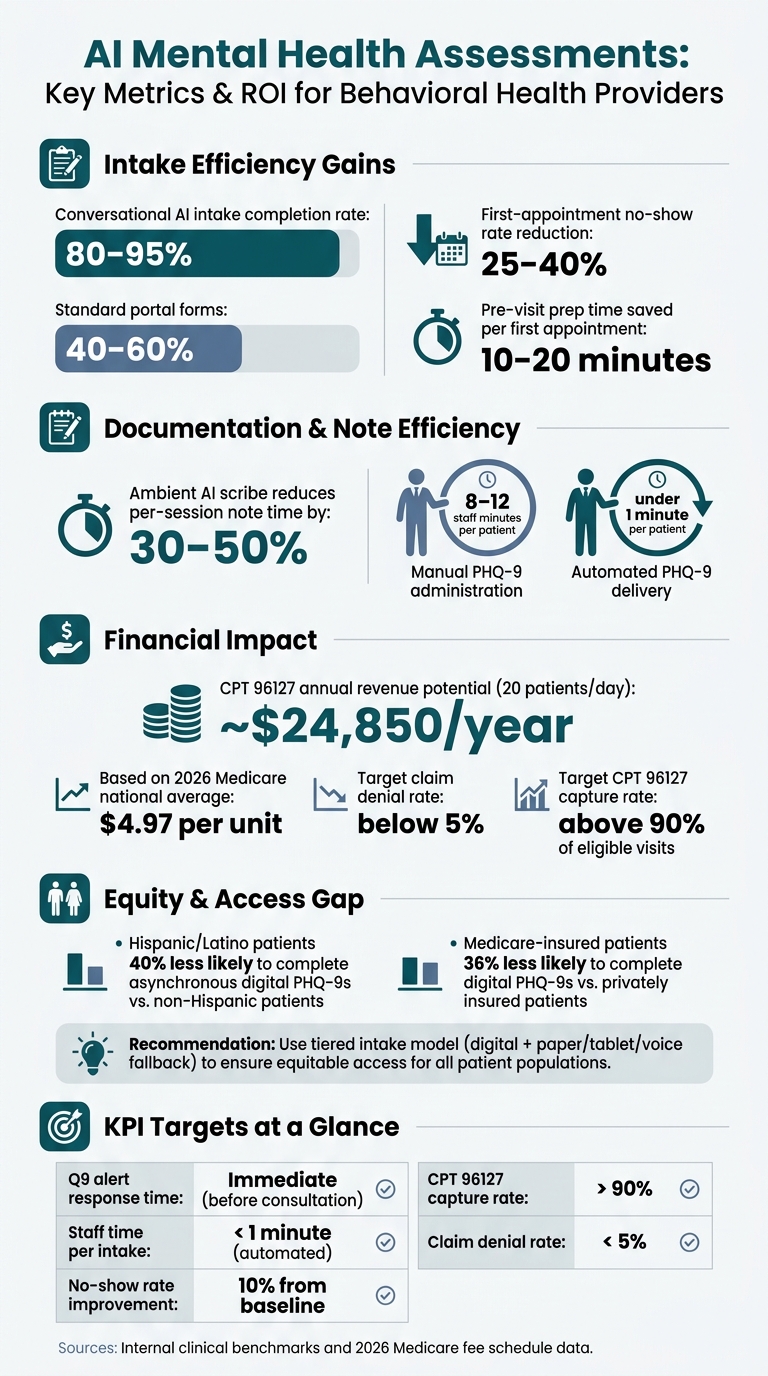
If a patient reports vague symptoms, the system can ask follow-up questions to clarify what is happening. Practices using conversational AI intake report completion rates of 80–95% compared with 40–60% for standard portal forms, while first-appointment no-show rates drop by 25–40% [9].
These tools can also run validated screeners such as the PHQ-9 and GAD-7 automatically.
They score responses and surface results before the clinician begins the visit, which can save about 10–20 minutes of prep time for each first appointment [9]. Between visits, symptom-monitoring tools can send follow-up questionnaires automatically to track changes over time and return that longitudinal data to the clinical record.
A key safety requirement applies here: any intake or monitoring tool must include real-time crisis escalation. If a patient reports self-harm or suicidal ideation in PHQ-9 Item 9, the system should alert on-call clinical staff at once and provide emergency resources such as the 988 Suicide & Crisis Lifeline [9][1].
Once intake is done, the next issue is how that information moves into the record and into follow-up workflows.
Documentation, analytics, and reporting tools
Ambient AI scribes generate structured notes and coding suggestions, reducing per-session note time by 30–50% [10].
Analytics and reporting tools operate at the population level. They review longitudinal EHR data, repeated screener scores, and treatment response patterns to flag patients who may be at risk of dropout or poor response to care.
This can support measurement-based care by making outcomes tracking part of the normal workflow instead of something teams revisit later.
One firm rule applies across documentation and analytics tools: clinicians must review and approve every AI draft before it enters the record [3][5].
The table below maps each tool to its main workflow role.
|
Tool Type |
Primary Purpose |
Common Inputs |
Clinical Use |
Main Limitations |
|---|---|---|---|---|
|
Conversational Intake |
Triage, screening, and history collection |
Patient narrative (voice/text), PHQ-9, GAD-7, insurance info |
Pre-visit onboarding and provider matching |
Cannot replace clinical judgment in active crises [9] |
|
AI Clinical Scribe |
Automated note generation and coding |
Ambient session audio, transcripts |
Progress notes, treatment plans, CPT/ICD-10 coding |
|
|
Predictive ML Models |
Risk monitoring and outcome forecasting |
Longitudinal EHR data, repeated screener scores |
Between-visit risk flagging and population health |
Potential for algorithmic bias; limited real-world validation [8][7] |
|
Analytics & Reporting |
Outcomes measurement and trend detection |
Assessment scores, session data |
Tracking treatment progress across programs |
Depends on clean, structured upstream data |
How an integrated platform supports assessment workflows
These tools only help when their outputs move cleanly into documentation, outcomes tracking, and billing. If intake data sits in one system, notes in another, and follow-up reporting somewhere else, staff often end up doing duplicate work and leadership loses visibility across the patient journey.
An integrated platform keeps intake, documentation, outcomes, telehealth, e-prescribing, labs, and billing in one workflow. Opus Behavioral Health EHR (https://opusehr.com) supports this with Copilot AI, outcomes measurement, and reporting.
Those workflow decisions shape the oversight, escalation, and review rules discussed next.
3. Workflow Design and Clinical Oversight
Once tools are in place, the next step is to define handoffs, review points, and escalation paths. In behavioral health, that matters because AI output should support care delivery, not move through the workflow without clinician oversight.
Where AI fits in the visit cycle
AI can support several parts of the visit cycle. Before the visit, it can send intake links by secure SMS or email, gather clinical history through conversational screening, and score validated tools such as the PHQ-9 and GAD-7. That gives the clinician a structured summary before the session begins.
During the visit, the clinician keeps final decision authority over any score, classification, or note content. AI may assist with decision support, but it does not replace live clinical judgment.
After the visit, the system can automate follow-up outreach and recurring screenings at set intervals. That may help teams track treatment progress over time and spot changes that need attention.
The workflow below shows where AI fits and who reviews each output.
|
Workflow Phase |
AI Role |
Who Reviews It |
|---|---|---|
|
Pre-Visit |
Conversational intake, PHQ-9/GAD-7 screening, real-time insurance eligibility verification, structured summary, longitudinal trend report |
Front desk reviews demographics and scheduling; clinician reviews clinical flags and summary before session starts |
|
During Visit |
Real-time decision support |
Clinician applies final decision authority based on live interaction |
|
Post-Visit |
SOAP/DAP note draft, CPT/ICD-10 code suggestions, follow-up scheduling |
Clinician signs note |
|
Between Visits |
Recurring screeners, relapse-risk alerts |
Care coordinator reviews flags for outreach |
Human review, escalation rules, and crisis handling
Every AI output needs a human review step. Clinicians should verify, edit, or reject drafts before anything enters the chart. That review point is not just a workflow detail. It helps protect documentation quality, supports compliance, and keeps accountability with licensed staff.
When a clinician accepts, modifies, or rejects an AI recommendation, that action should be documented in the record with an immutable timestamp. That separation helps preserve auditability and keeps AI in a support role rather than a decision-maker.
Crisis escalation is the most time-sensitive checkpoint in the workflow. If PHQ-9 Item 9 is positive, on-call staff should be alerted at once, the patient should be routed to 988, and the escalation should be logged with a timestamp [9][1].
4. Compliance, Documentation, and Payment Readiness
Before an AI assessment tool goes live, clinical and administrative leaders need to confirm that governance, documentation, and billing workflows are ready. This is a go-live requirement, not a later clean-up item. Compliance gaps can lead to enforcement action, privacy exposure, and billing delays. Once AI touches intake, notes, or claims, governance determines whether the workflow can operate safely inside day-to-day clinical and billing work.
HIPAA, consent, transparency, and audit controls
A signed BAA is required before any ePHI reaches an AI vendor. The BAA should clearly cover all AI features and subprocessors, and it should include language that bars the vendor from using patient data to train or fine-tune shared AI models [4][15]. Leaders should also require TLS 1.2+ for data in transit, AES-256 for data at rest, and multi-factor authentication. In practice, these controls are required under the May 2026 HIPAA Security Rule update [4].
SUD programs also need data segmentation so that Part 2 records cannot be accessed or re-disclosed without authorization [2][11]. For treatment centers that handle both mental health and substance use data, that makes a pre-launch architecture review a must.
Role-based access controls, or RBAC, help enforce the HIPAA minimum necessary standard. Billing specialists should see coding data, but they should not see session recordings. Clinicians need full notes. Front desk staff need scheduling and demographic fields [4][2].
Audit logs under HIPAA Security Rule §164.312(b) must show who accessed a record, when access happened, what action was taken, and which device or IP address was involved [2].
Some states also require clear AI disclosure and patient opt-out rights [12][14]. A plain-language AI consent addendum can help here. It should name the tool, explain how data is used, and state that opting out will not reduce access to care [12][6].
Another risk sits closer to home: shadow IT. Staff may use consumer AI tools that do not have BAAs or HIPAA controls in place [2].
After access and consent rules are in place, leaders need to control how AI output moves into the chart and the claim.
Documenting AI outputs and supporting reimbursement workflows
AI outputs are drafts, not final clinical records. The clinician of record remains responsible for accuracy, medical necessity, diagnosis, and the final signature [15][13]. Any section that requires clinical judgment should use placeholders until a licensed clinician completes review [13]. That line matters if the record is later reviewed during a payer audit or legal matter.
AI-generated summaries can support billing-ready documentation only when they remain tied to the encounter note and the final code. CPT codes such as 90837 for individual psychotherapy, 53+ minutes, carry session-length rules. If the note does not support the billed code, denials can follow [2]. This link between documentation and coding can reduce handoff errors between clinical teams and billing staff.
Before go-live, leadership teams should assign clear ownership for compliance, documentation, and billing controls.
|
Category |
Key Requirement |
Primary Risk |
Owner |
|---|---|---|---|
|
Compliance |
Signed BAA covering AI features and subprocessors; MFA; 42 CFR Part 2 segmentation for SUD programs |
Shadow IT; unauthorized data use for model training |
Compliance Officer / IT Director |
|
Documentation |
Clinician review and signature on all AI drafts; placeholders for clinical gaps |
AI-generated content entering the permanent record unchecked |
Clinical Director / Lead Provider |
|
Billing |
AI-generated codes linked to session-length requirements; medical necessity reviewed before submission |
Claim denials from CPT mismatches or weak necessity documentation |
RCM Manager / Billing Specialist |
5. Measuring Outcomes, Site Fit, and Scaling Across Programs
AI Mental Health Assessments: Key Metrics & ROI for Behavioral Health Providers
Metrics that show clinical and operational value
Once workflow and compliance are stable, outcome data should guide the next decision: whether the model is ready to scale.
The most useful view combines clinical, operational, and financial measures. Behavioral health leaders should track PHQ-9 completion, symptom trends, Q9 response time, staff time saved, no-show rate, CPT 96127 capture, and denial rate.
Symptom trends should be monitored as improving, flat, or worsening. Q9 alert response time should be measured from the moment the flag appears to the moment a staff member takes action.
The clearest operating gain is often staff time. Manual PHQ-9 administration usually takes 8 to 12 staff minutes per patient for retrieval, scoring, and EHR entry [16]. Automated delivery can bring that down to under one minute.
Finance teams should also watch CPT 96127 capture and denial performance closely. A clinic seeing 20 patients per day can capture about $24,850 per year in CPT 96127 revenue based on the 2026 Medicare national average of $4.97 per unit [16]. Denials tied to documentation gaps should stay below 5%.
When the pattern is moving in the right direction, such as faster Q9 response, fewer denials, and lower intake burden, that usually signals that leadership can begin checking whether other sites can support the same process.
|
Metric Category |
KPI |
Target |
|---|---|---|
|
Clinical |
Q9 alert response time |
Immediate (before consultation) |
|
Clinical |
PHQ-9 remission rate (score < 5) |
Tracked per cohort |
|
Operational |
Staff time per intake |
< 1 minute (automated) |
|
Operational |
No-show rate |
10% improvement from baseline |
|
Financial |
CPT 96127 capture rate |
> 90% of eligible visits |
|
Financial |
Claim denial rate |
< 5% for documentation errors |
How to compare readiness across sites
Strong results at one location do not automatically mean every site is ready. Before expanding, executive teams should compare readiness across programs in a structured way.
Sites differ in staffing, patient mix, compliance controls, and technical setup. The strongest pilot candidates tend to be the ones that already support structured data flow, audit trails, and human review. In plain terms, the next site should look a lot like the first successful one.
Patient demographics also shape which intake method works best. Research shows that Hispanic and Latino patients are 40% less likely to complete asynchronous pre-visit digital PHQ-9s than non-Hispanic patients, and Medicare-insured patients are 36% less likely than privately insured patients [17].
That gap matters. A tiered model, such as digital pre-visit with a paper or tablet fallback, or voice-based intake with paper fallback, can help sites serve older patients or populations with lower digital comfort [17].
For SUD programs, 42 CFR Part 2 segmentation should be completed before AI assessment tools are added. Without that control in place, scaling can create chart access and disclosure risks that are harder to manage later.
Platforms like Opus Behavioral Health EHR can ease multi-program rollout because the EHR, outcomes tracking, and reporting functions are connected. That setup helps structured AI data flow into the patient chart without manual re-entry, which reduces extra staff work and lowers the chance of missing data.
|
Site Fit Criteria |
High Readiness (Pilot First) |
Low Readiness (Delay Rollout) |
|---|---|---|
|
Patient Volume |
20+ patients/day |
Fewer than 5 patients/day |
|
Staffing Model |
High documentation burden; high turnover |
Stable staff; low administrative load |
|
Patient Population |
High telehealth use; comfortable with digital intake |
High Medicare share; low digital literacy |
|
Compliance Capacity |
Automated audit logs; 42 CFR Part 2 ready |
Basic HIPAA only; manual audit processes |
|
Technical Integration |
FHIR/API-capable EHR |
Paper-based or legacy system |
A 60- to 90-day pilot window gives leadership enough time to judge whether a site is ready for broader rollout. The clearest approach is to start with one tool, one site, and one defined completion-rate target. That evidence can then support expansion to other programs.
FAQs
How do we choose the right AI assessment workflow?
Use a structured approach centered on integration, safety, and clinical utility. Behavioral health organizations should map when assessments are administered, who completes them, how they are scored, and what actions follow based on the results.
An EHR-integrated platform can help automate scoring and display trends directly in the patient chart, giving clinical teams clearer visibility at the point of care.
Clear clinical decision rules also matter. That may include automatic risk alerts tied to specific assessment thresholds. Executive and clinical leaders should give weight to systems that support human oversight, provide transparent outputs, and include documented HIPAA safeguards.
A practical rollout often starts with one high-impact tool, used consistently across the organization, before adding more assessments over time.
What safeguards are required before using AI with patients?
Before using AI with patients, behavioral health organizations should have administrative, physical, and technical safeguards in place to protect ePHI.
That includes a Business Associate Agreement (BAA) before any patient data is shared.
Leaders should also complete a security risk analysis and put core controls in place, such as:
Role-based accessEncryption
Audit logs
Human review of AI-generated content
Clear policies for data training, retention, and deletion
For treatment centers, mental health providers, and multi-site organizations, these controls are not just IT tasks. They shape how patient data moves through clinical, admissions, billing, and operations workflows, and they can reduce the risk of privacy gaps, weak oversight, and misuse of AI-generated output.
How can we tell if an AI pilot is worth scaling?
Look for a clear fit. The tool should address a specific, high-impact bottleneck without adding more complexity to daily work.
For behavioral health leaders, that usually means focusing on a narrow use case with measurable return, such as a 30% to 50% reduction in documentation time or meaningful billing savings that show up in operational and financial reports.
Leaders should also confirm that the tool supports HIPAA and 42 CFR Part 2 requirements, includes clinician review of outputs, allows for safe testing before full rollout, and integrates cleanly with the current EHR and underlying data foundation.



- Behavioral Health
- EHR Systems
- Addiction Treatment EHR
- mental health
- Telehealth
- addiction treatment
- Behavioral health facility
- Substance Abuse Disorder
- behavioral Health center
- HIPPA Compliant
- ehrsoftware
- PTSD
- behavioral health ehr
- Depression
- hipaa
- Anxiety
- MentalHealthMatters
- RCM
- claim denials
- clinical documentation
- mental health awareness
- screening tools

September 15, 2026

September 15, 2026

September 14, 2026

September 11, 2026

September 10, 2026

September 09, 2026
Recommended Posts
Friday, July 17, 2026
Bipolar Screening Tools: Outcome Tracking Guide
Bipolar disorder is often missed for years, and that delay can affect safety, treatment choices, and long-term care.
Wednesday, August 26, 2026
Symptom Forecasting For Behavioral Health EHRs
Symptom Forecasting For Behavioral Health EHRs Symptom forecasting only helps when it changes care before the next ...

Monday, August 31, 2026
How AI Alerts Clinicians to Suicide Risk
AI suicide risk alerts only matter when they lead to the right action at the right time.