

Behavioral health billing is more complex than general medical billing, with challenges such as high denial rates, coding errors, and compliance with regulations like 42 CFR Part 2.
Specialized EHR billing software can address these issues by integrating clinical documentation with billing processes, reducing errors, and improving revenue cycle management.
This article ranks five companies offering tailored solutions for behavioral health practices, evaluating their clean claims rates, collection rates, pricing models, and specialization.
Here's a quick overview:
Opus Behavioral Health EHR: Combines CRM, EHR, and billing tools with AI features for automation.
Dastify Solutions: Offers a 98% clean claims rate and specializes in telehealth billing.
MedCareMSO: Focuses on AI-powered billing with a 98.5% clean claims rate.
Psychiatric Billing Associates: Tailored for psychiatric providers, with strong expertise in mental health parity laws.
NCDS Medical Billing: Provides high claim accuracy and customizable pricing for practices of all sizes.
For practices, the right choice depends on factors like practice size, denial rates, and billing needs. Each platform offers unique strengths to streamline operations and improve financial outcomes.
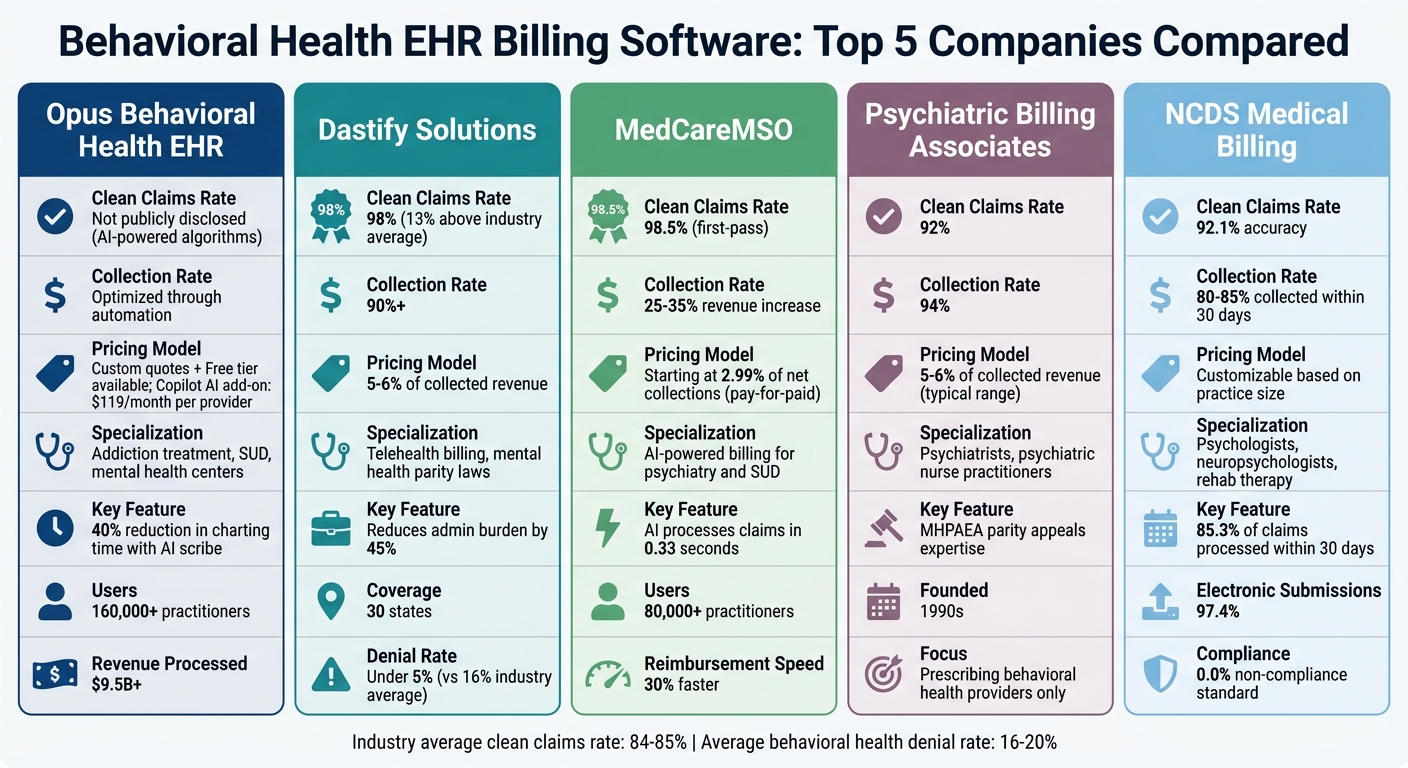
Behavioral Health EHR Billing Software Comparison: Clean Claims Rates, Collection Rates, and Pricing Models
1. Opus Behavioral Health EHR
Opus Behavioral Health EHR is tailored for addiction treatment, substance use disorder (SUD), and mental health centers. It combines CRM, EHR, and revenue cycle management into a single workflow.
With over 160,000 practitioners using it daily and more than $9.5 billion in revenue processed for its partners, Opus is built to handle the unique needs of behavioral health facilities. It supports both UB-04 and CMS 1500 claims, ensuring compatibility with diverse billing requirements[2].
Clean Claims Rate
While Opus doesn't publicly disclose its clean claims rate, its AI-powered algorithms are designed to reduce errors in documentation and billing.
These tools automate data quality checks, streamlining processes and minimizing manual effort.
Amanda Wilson, Director of Clinical Services at a mental health and substance use treatment center, shared:
This process will simplify our operations to save so much time. We will no longer have to manually pull so many charts per quarter and have a timelier billing process for quicker reimbursements.[2]
The platform also provides over 140 practice management reports. These reports deliver real-time insights into billing and operational performance, forming the backbone of a streamlined revenue cycle.
Collection Rate
Opus integrates revenue cycle management tools to reduce billing errors and optimize collections through automated claims processing and real-time tracking[2].
Judd Carey, Director of Operations at Mindful Health, highlighted the benefits:
By automating the quality of internal data, and applying an algorithm, it will cut back on errors to not miss a thing, especially from group sessions.
Another standout feature is the Copilot AI scribe tool, which drafts progress notes directly in the EHR.
This reduces charting time by 40% while ensuring clinical documentation aligns with billing requirements. By integrating clinical and billing workflows, Opus helps practices avoid reconciliation issues that often arise with separate systems.
Pricing Model
Opus offers flexible pricing tailored to the size and needs of each practice. Its custom quote model reflects the number of clinicians and specific facility requirements[2].
For smaller practices, there's a complimentary tier that includes basic scheduling, billing, and patient portal access - perfect for testing the platform's core features. For full functionality, the advanced tier includes complete EHR capabilities with detailed reporting.
The Copilot AI scribe tool is available as an optional add-on for $119 per month per provider[5].
Behavioral Health Specialization
Opus stands out with over 100 configurable assessment tools and outcomes measurement scales, such as PHQ-9 and GAD-7. These tools automatically track patient progress, helping to justify medical necessity to payers.
The platform supports multiple levels of care and multi-site billing workflows, making it ideal for behavioral health treatment centers[2].
Jennifer Gozy, PsyD, LP, Director of Clinical Systems and Compliance at Care Counseling Clinics, praised the system:
We chose Opus because it is user-friendly and highly configurable... we are looking forward to being more hands-on on back-end billing processes so that we can bill more effectively.
Additionally, Opus collaborates with Collect Rx to provide specialized billing and coding solutions for behavioral health and SUD clinics[4]. By integrating these tools and workflows, Opus simplifies the billing challenges unique to behavioral health practices.
2. Dastify Solutions
Dastify Solutions is a cloud-based revenue cycle management provider dedicated to supporting mental health practitioners, including psychiatrists, therapists, and behavioral health clinics.
Operating across 30 states, the company brings particular expertise in telehealth billing
and mental health parity laws [6]. Let’s take a closer look at Dastify’s performance metrics and how they deliver value to their clients.
Clean Claims Rate
Dastify boasts a 98% clean claims rate, which is 13% higher than the industry average. This achievement significantly reduces the time spent on denial management and improves cash flow.
For context, general billing services often face a 16% claim denial rate, while Dastify strives to keep denials under 5%. The company leverages AAPC-certified billers who are well-versed in DSM-5 coding, session-based billing, and telehealth billing modifiers [6].
Collection Rate
With a collection rate surpassing 90%, Dastify helps practices maximize their revenue potential.
Ricky Bell, Head of Operations at Dastify Solutions, highlighted the importance of their specialized approach:
"Specialized billers know DSM-5 codes, therapy sessions, and parity laws, reducing denials and boosting revenue."
Outsourcing billing to Dastify not only reduces administrative burdens by up to 45% but also allows practices to increase patient capacity by 15–20%.
The company integrates seamlessly with major EHR systems and offers real-time eligibility and benefits verification, making it easier for providers to focus on patient care [6].
Pricing Model
Dastify uses a percentage-of-collections pricing model, aligning their success with that of their clients. Their fees typically range between 5–6% of collected revenue. Ricky Bell further explained the impact of their approach:
"The right billing partner becomes an extension of your practice - improving collections, reducing stress, and driving growth." [6]
Behavioral Health Specialization
Dastify’s services are tailored for behavioral health, including claims processing with ICD-10, CPT, and HCPCS codes, as well as denial management and provider credentialing. They ensure compliance with HIPAA and mental health parity laws across all 30 states they serve.
By improving coding accuracy, their specialized billing services can drive revenue growth of up to 30% [6].
3. MedCareMSO
MedCareMSO takes behavioral health billing to the next level with its cutting-edge AI technology. Their in-house software, MAXIMUS, checks CPT, ICD-10, and NPI data against a massive database of over 3 million rules before submitting claims.
With over a decade of experience in healthcare revenue cycle management and a track record of serving more than 80,000 practitioners, MedCareMSO has established itself as a reliable partner in behavioral health billing [7].
Clean Claims Rate
MedCareMSO boasts an impressive 98.5% first-pass clean claim rate, speeding up reimbursements by 30% and cutting outstanding accounts receivable balances by 35%.
Their AI-powered denial-prediction engine processes data from 2.5 million past claims to identify potential issues in just 0.33 seconds, allowing practices to address errors quickly [7].
Dr. Godfred Mensah, Co-Founder of AW Care, shared his experience:
"MedCare MSO, as our medical billing company, has reduced our claim denials by up to 20% and resolved all of our billing challenges."
Collection Rate
By maximizing reimbursements and automating denial tracking, MedCareMSO helps practices increase revenue by 25%–35%.
The platform integrates seamlessly with existing EHR systems, ensuring smooth synchronization of patient data and billing workflows.
Features like real-time eligibility checks and automated payment posting further streamline account management, making reconciliation more accurate and efficient [7].
Pricing Model
MedCareMSO offers a simple and transparent "pay-for-paid" pricing model, starting at 2.99% of net collections. Practices are only charged fees on successfully collected revenue, aligning MedCareMSO's success with their clients' profitability.
Plus, there are no software installation costs. New clients can expect a quick 14-day onboarding process, which includes setting up payer rules and ERA/EFT systems [7].
Behavioral Health Specialization
MedCareMSO provides billing solutions tailored specifically for mental and behavioral health
services, including psychiatry and substance use treatment.
The platform stays current with upcoming 2026 billing standards by offering automated Medicare fee schedule updates and incorporating No Surprises Act dispute-resolution features into its system [7].
4. Psychiatric Billing Associates
Founded in the 1990s, Psychiatric Billing Associates focuses exclusively on serving psychiatrists, psychiatric nurse practitioners, and prescribing behavioral health providers[3].
Clean Claims Rate
The company boasts a 92% clean claims rate, which is a significant improvement over the typical 16–20% denial rate often seen in behavioral health.
For context, behavioral health denial rates are nearly double the 5–10% rate experienced in other medical specialties[6][3]. This high clean claims rate helps psychiatric practices reduce rejections and maintain a smoother revenue cycle.
Collection Rate
Psychiatric Billing Associates achieves an impressive 94% collection rate[6].
Their expertise in areas like E/M code selection for medication management and prescriber-specific documentation ensures practices receive appropriate reimbursements while staying compliant with mental health parity laws[3].
Pricing Model
The company uses a percentage-of-collections pricing model, meaning clients only pay after revenue is successfully collected[6]. While exact rates are not disclosed, specialized mental health billing services typically charge between 3% and 8% of collected revenue, with most falling in the 5%–6% range[6].
This approach aligns well with the specific needs of psychiatric practices.
Behavioral Health Specialization
Beyond standard claims processing, Psychiatric Billing Associates provides specialized support for MHPAEA parity appeals, utilizing its deep understanding of payer compliance under the Mental Health Parity and Addiction Equity Act[3].
The company also handles payer negotiations and provider credentialing, easing the administrative workload for mid-sized practices[6].
Their strong grasp of payer relationships in psychiatry further helps practices navigate the often-complex landscape of mental health reimbursements in the United States[3].
5. NCDS Medical Billing
NCDS Medical Billing supports behavioral health providers - such as psychologists, neuropsychologists, and rehabilitation therapy practices - across the United States.
Their services are tailored to fit the needs of practices ranging from solo practitioners to large groups [8].
Clean Claims Rate
NCDS boasts an impressive 92.1% claim accuracy rate, surpassing the industry benchmark of 90% [8][9].
This level of precision helps practices receive payments faster: 85.3% of claims are processed within 30 days, and 80–85% of insurance payments are collected in that same timeframe.
Additionally, 97.4% of insurance claims are submitted electronically, which helps ensure smoother cash flow [8].
Pricing Model
NCDS takes a personalized approach to pricing. Instead of offering a fixed fee schedule, they customize their pricing based on the specific needs and size of each practice.
Their goal is to create long-term, mutually beneficial relationships by providing consultations that focus on improving charge capture and reducing revenue loss [8].
This flexible pricing aligns well with their commitment to serving behavioral health providers.
Behavioral Health Specialization
NCDS has developed services specifically designed for behavioral health workflows. These include provider credentialing, telemedicine billing, MIPS compliance support, and eligibility verification.
They also offer an integrated EMR and billing platform with 24/7 secure access to financial reports [8]. Clinical Neuropsychologist and Professor of Psychology Amir Poreh shared his experience:
"NCDS improved my billing efficiency allowing me to increase my collection from insurance companies. The staff is friendly, very professional and pleasant." [8]
Additionally, NCDS enforces a 0.0% non-compliance standard, ensuring that behavioral health providers consistently meet regulatory requirements [8].
Pros and Cons
Every billing software platform has its own set of advantages and drawbacks. Understanding these can help providers choose the right option based on their specific needs and budget. Below is a table summarizing the pros and cons of each platform we’ve discussed.
|
Platform |
Pros |
Cons |
|---|---|---|
|
Opus Behavioral Health EHR |
• Combines CRM, EHR, RCM, and ERP into one system, simplifying workflows |
• Pricing is only available through custom quotes |
|
Dastify Solutions |
• Strong claims process ensures timely payments |
• Smaller practices may find the fee structure challenging |
|
MedCareMSO |
• Focuses on billing for mental health and addiction treatment |
• Costs can rise with percentage-based pricing as practice volume grows |
|
Psychiatric Billing Associates |
• Deep expertise in behavioral health billing, including credentialing services |
• Higher collection fees compared to some competitors |
|
NCDS Medical Billing |
• High claims accuracy and fast processing times |
• Custom pricing may lack upfront clarity |
When choosing a platform, it’s worth noting that percentage-based pricing links costs to revenue, which can become expensive as your practice grows.
On the other hand, custom quotes might require a higher initial investment but could reduce long-term expenses.
This comparison highlights key considerations for selecting a billing solution that aligns with your practice’s goals.
Conclusion
Choosing the right billing software hinges on factors like your practice size, specialty, and operational needs. Here’s a quick breakdown:
Small practices (fewer than 5 providers): Look for software with an easy-to-use interface and straightforward pricing.
Medium practices (5–20 providers): Prioritize systems with strong reporting tools and customizable workflows.
Large practices: Opt for platforms that handle complex billing scenarios and coordinate across multiple locations.
For behavioral health practices, specialized software is key. These platforms seamlessly integrate clinical and billing workflows, ensuring smoother operations. For example:
Addiction treatment centers: Seek software that supports ASAM-aligned documentation and complies with 42 CFR Part 2.
Psychiatry practices: Focus on platforms offering DEA-compliant e-prescribing and tools for measurement-based care.
High denial rates (over 18%): Choose software with pre-submission scrubbing and real-time authorization features to reduce errors.
The critical takeaway? Your software must align with your practice's specific needs. As industry experts emphasize:
"The most important decision is alignment: choose a platform built for the care modality you operate" [1].
General medical EHRs often require significant customization and still may not fully meet behavioral health needs. In contrast, purpose-built solutions can streamline your operations right from the start.
Before committing, test the software using a 30-day trial that covers at least five session cycles - from scheduling to claim submission.
Also, ask for references from facilities with similar program types. For example, a residential treatment center's experience won't necessarily apply to an outpatient-only clinic.
Finally, ensure the platform addresses authorization issues upfront, rather than fixing them after billing errors occur.
FAQs
What clean claims rate should a behavioral health practice aim for?
Behavioral health practices should aim for a clean claims rate of 95% or higher. Hitting this target ensures a more efficient revenue cycle by reducing billing delays and minimizing claim denials.
How do I know if percentage-based billing fees will cost me more long term?
When deciding between percentage-based billing fees and fixed fees, it's important to consider how these costs might change as your practice grows. Percentage-based fees increase alongside your revenue, which could mean higher expenses over time.
To make an informed choice, estimate your billing volume, calculate the percentage fees based on your projected revenue, and compare them to fixed fee options. For practices experiencing significant growth, percentage fees could become more costly, even if your agreement includes fee caps.
What should I test during a 30-day EHR billing trial?
During a 30-day trial of EHR billing software, prioritize testing essential features such as insurance claim processing, CPT/ICD-10 coding, electronic submissions, and automated reminders.
Pay close attention to how seamlessly the software fits into your existing workflow, including documentation, billing automation, and reporting. Confirm that it supports compliance requirements and simplifies your processes to match your practice's specific needs.
Focusing on these areas will help you assess whether the software aligns with your operational objectives



- Behavioral Health
- EHR Systems
- Addiction Treatment EHR
- mental health
- Telehealth
- addiction treatment
- Behavioral health facility
- Substance Abuse Disorder
- behavioral Health center
- HIPPA Compliant
- ehrsoftware
- PTSD
- behavioral health ehr
- Depression
- hipaa
- Anxiety
- MentalHealthMatters
- RCM
- claim denials
- clinical documentation
- mental health awareness
- screening tools

September 15, 2026

September 15, 2026

September 14, 2026

September 11, 2026

September 10, 2026

September 09, 2026
Recommended Posts

Monday, March 09, 2026
Case Study: Billing Errors Reduced with EHR Integration
Billing errors are a major headache for behavioral health centers,leading to claim denials, delayed payments, and lost ...

Friday, May 01, 2026
Behavioral Health Billing Software Providers That Make Billing Simple
Behavioral health billing is complex, with claim denial rates reaching up to 30%- higher than other healthcare sectors.

Thursday, May 14, 2026
Behavioral Health Practice Billing Software That Boosts Revenue
Behavioral health practices often struggle with billing complexities like high denial rates, coding errors, and ...