

Behavioral health providers spend 37% of their time on administrative tasks like documentation, cutting into patient care and increasing burnout.
Modern EHR platforms designed for mental health practices solve this by automating documentation, integrating billing, and simplifying scheduling. This article reviews three leading platforms - Opus Behavioral Health EHR, TheraNest, and SimplePractice - to help you find the best fit for your practice.
Key Takeaways:
Opus Behavioral Health EHR: Offers AI-powered note creation, integrated billing, and compliance tools. Ideal for mid-to-large practices handling complex cases.
TheraNest: Simplifies SOAP notes, automates billing, and supports multi-provider scheduling. Suited for small to medium practices.
SimplePractice: Focuses on ease of use with speech-to-text notes, batch billing, and robust scheduling tools. Great for solo practitioners and small teams.Quick Comparison:
|
Feature |
Opus Behavioral Health EHR |
TheraNest |
SimplePractice |
|---|---|---|---|
|
Documentation |
AI-powered scribe, templates |
AI-enhanced SOAP notes |
Speech-to-text notes |
|
Billing |
Real-time code suggestions |
Automated claims, Stripe |
Batch claims, AutoPay |
|
Scheduling |
Automated reminders, waitlists |
Centralized calendar |
Suggested times, reminders |
|
Compliance |
ONC, HIPAA, 42 CFR Part 2 |
HITRUST, HIPAA |
HITRUST, HIPAA |
|
Best For |
Mid-to-large practices |
Small to medium practices |
Solo/small teams |
These platforms save time, reduce errors, and improve outcomes, making them essential tools for mental health providers.
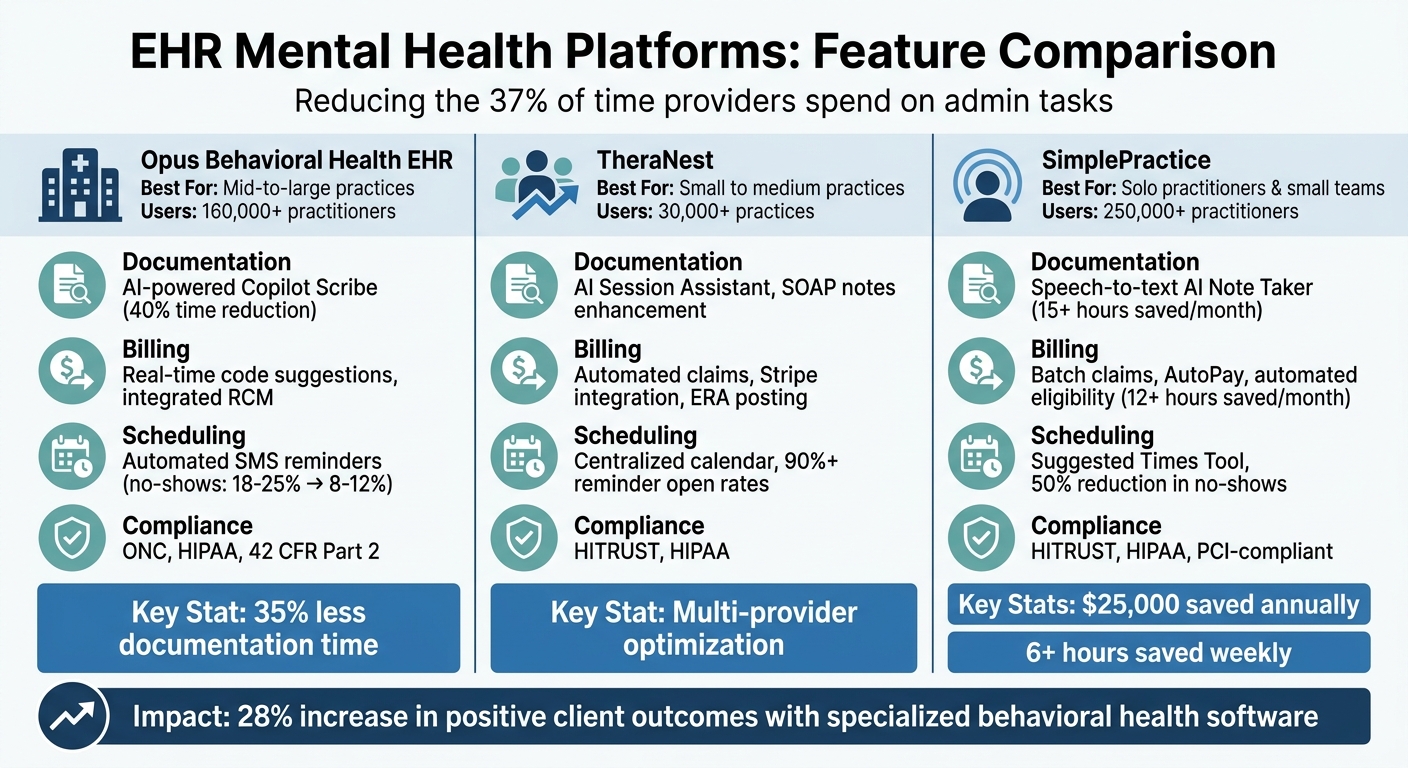
EHR Mental Health Platform Comparison: Opus vs TheraNest vs SimplePractice
1. Opus Behavioral Health EHR
Opus Behavioral Health EHR supports over 160,000 practitioners daily [5], bringing clinical documentation, billing, and scheduling together in one streamlined platform.
Documentation Automation
One standout feature is the Copilot AI Scribe, which simplifies progress note creation. This AI tool listens to session details and converts them into insurance-ready clinical notes, reducing documentation time by 40% [5].
Dr. Jennifer Williams, a mental health practice owner, shared: "Since implementing Opus EHR, our providers spend 35% less time on documentation while capturing more comprehensive clinical data" [5].
The system also auto-fills patient details, insurance data, medications, and prior treatments into new forms. With over 100 customizable templates for progress notes, assessments, and treatment plans, it caters to specialties like addiction recovery and family therapy.
For example, when a patient completes an initial assessment, the system triggers workflows to generate treatment plan templates, schedule follow-ups, and create reminders - essentially bundling multiple tasks into one smooth process.
Billing Integration
Opus connects documentation with billing through its RCM engine. As clinicians document care, the system suggests billing codes in real time, helping reduce claim denials.
Amanda Wilson, Director of Clinical Services at a mental health and substance use treatment center, noted: "This process will simplify our operations to save so much time. We will no longer have to manually pull so many charts per quarter and have a timelier billing process for quicker reimbursements" [2].
Additionally, the platform supports SMS-based payments via integrations like Curogram. Patients can receive secure text-to-pay links compatible with Apple Pay, Google Pay, and mobile wallets [6].
This approach accelerates payment collection and eases the administrative burden of following up on unpaid balances.
These billing features integrate seamlessly with the platform's scheduling tools, enhancing efficiency across operations.
Scheduling Efficiency
Missed appointments can disrupt care and reduce revenue, but Opus addresses this with automated SMS reminders. These reminders have helped facilities cut no-show rates
from 18–25% down to 8–12% [8].
Text confirmations achieve a 90% response rate, a significant improvement over the 40% response rate of traditional voicemail reminders [8].
When cancellations occur, the system sends instant alerts, allowing staff to fill gaps from a waitlist using group texts. For telehealth, patients can join video sessions with a single SMS link - no app downloads required.
Andrea Baskin, Clinical Director at Opus Behavioral Health, explained: "The ability to run groups online has enabled us to create a digital IOP program, with flexible after hours for our clients. We don't have to worry about transportation logistics, office hours, or staff availability" [9].
Compliance Features
Opus ensures compliance with ONC certification, HIPAA, and 42 CFR Part 2 regulations for substance use disorder records [7][9].
Its compliance tools pull data directly from patient records to format and schedule reports for audits. For residential SUD programs, the platform includes Recovery Coaching Rounds, enabling behavioral health technicians to log observations and monitor patient progress across shifts [7].
2. TheraNest
TheraNest supports over 30,000 mental health practices [10], offering a platform designed to simplify clinical documentation, billing, and scheduling.
Documentation Automation
TheraNest's AI Session Assistant creates structured SOAP notes from telehealth sessions, capturing key clinical details and interventions for immediate review. The AI Notes Enhancement feature provides real-time suggestions to improve clarity and tone as therapists document their sessions.
The platform also includes a dynamic form builder, allowing practices to design custom note templates and intake forms. Through the Wiley Practice Planner Integration, clinicians gain access to pre-written, evidence-based treatment goals and interventions.
For continuity, content from previous sessions can be duplicated, though diagnosis codes need manual updates. Patients can complete intake paperwork digitally through the Client Portal, with their information automatically added to their electronic records.
This efficient documentation system ensures smooth integration with billing processes.
Billing Integration
TheraNest automates tasks like invoice creation, claim submission, and ERA posting, while integrating Stripe for card payments. In April 2026, the Payer Enrollment Wizard was launched, pre-filling patient details to simplify payer enrollment. The platform also connects with clearinghouses such as Claim.MD, Apex EDI, Waystar, and Availity.
Ryan Camlin from Alta Pediatrics shared, "When they come in, we're essentially just clicking a button, checking them out and now we're taking that payment... we're really getting paid almost every single day as those services are happening."
Beyond billing, TheraNest enhances appointment management.
Scheduling Efficiency
TheraNest's centralized calendar accommodates individual, group, and recurring appointments. Features like color-coding by service type, provider filtering, and room assignments help avoid double-booking.
Patients can schedule appointments directly via the client portal, which, combined with automated reminders achieving over 90% open rates [10], reduces administrative workload. The system also enforces cancellation or no-show fees based on practice policies.
Stacey Keslar from Sanderson Psychological noted, "Managing multiple providers' schedules and documentation can be challenging. With TheraNest we've been able to optimize workflows to make life easier for our staff."
Telehealth sessions can be launched directly from the calendar, and mobile apps for iOS and Android simplify schedule management on the go.
Compliance Features
TheraNest meets HITRUST certification standards and is fully HIPAA compliant. It offers secure messaging, portal access, and supervision support, allowing notes to be sent for co-signing. This feature is especially helpful for practices employing interns or recent graduates. Together, these tools reduce administrative burdens, enabling providers to dedicate more time to patient care.
3. SimplePractice
SimplePractice simplifies essential tasks, helping mental health professionals reduce administrative burdens and focus more on patient care.
With over 250,000 practitioners relying on it and more than 230 million telehealth appointments processed, SimplePractice has become a trusted platform for streamlining documentation, billing, and scheduling tasks [14][16].
Documentation Automation
SimplePractice's AI-powered Note Taker transcribes speech to text during sessions, while the "snippets" feature allows practitioners to save commonly used phrases and notes as templates. Together, these tools save an average of 15+ hours per month on documentation [11][12][14].
Additionally, Wiley Treatment Planners® provide access to over 1,000 pre-written, evidence-based goals and objectives, while the system auto-populates ICD-10 code lists for added convenience [11][14].
James Guay, LMFT, shared, "I was doing all these emails and texts and all that administrative stuff. So with SimplePractice, I don't have to waste a lot of time - because our time is money, right?" [14]
Billing Integration
Managing billing becomes easier with features like integrated ERAs, batch claim filing, and automated eligibility checks.
AutoPay processes card payments overnight after invoices are generated, and the system creates superbills and CMS-1500 forms automatically, saving an average of 12+ hours per month [13][18][19].
The Client Portal supports payments via credit cards, debit cards, and FSA/HSA accounts [18][19]. New users also benefit from free credentialing for up to two payers upon signing up [13].
Scheduling Efficiency
The Suggested Times Tool helps identify open slots up to 10 weeks in advance, while the Client Portal enables clients to request appointments.
Automated reminders - via text, email, or voice - reduce no-shows by up to 50%, with 88% of practitioners reporting fewer missed appointments [12][16][20][21].
Integration with Google Calendar, Microsoft 365 Outlook, and Apple Calendar ensures seamless scheduling, and telehealth sessions launch directly from the calendar view using HIPAA-compliant video links [21][12].
These scheduling tools not only save time but also enhance the overall client experience.
Compliance Features
SimplePractice emphasizes security and compliance, reducing the time spent on audits and security management. The platform is HITRUST CSF certified and fully HIPAA-compliant, with bank-level encryption and 24/7 server monitoring [15].
Payment processing is PCI-compliant through its partnership with Stripe [19]. Clinicians have rated the platform 4.8 out of 5.0 [17], and it was named "#1 EHR Software of 2025" by TechRadar [16]. These features collectively help practices save more than $25,000 annually and reduce administrative work by over 6 hours per week [14][16].
With its comprehensive tools, SimplePractice helps practitioners focus on what truly matters: delivering quality care.
Advantages and Disadvantages
Opus Behavioral Health EHR brings together clinical documentation, billing, and scheduling into a single, streamlined interface. This makes it especially useful for mid-size to large treatment centers that handle both mental health and substance use disorders.
One standout feature is the Copilot AI scribe, which simplifies documentation tasks. Additionally, the integrated CRM and RCM systems eliminate the hassle of juggling multiple disconnected tools.
Compliance is another strong point, with features like ONC certification, HIPAA adherence, and 42 CFR Part 2 regulations. These tools can significantly cut down on audit preparation time, as they pull data directly from patient records.
On the flip side, pricing is only available via custom quotes, which may make budgeting a bit more complex. Also, the platform’s extensive features might be overkill for solo practitioners or smaller practices with fewer clients[1][2]. It’s important for practices to assess whether their operational needs justify the platform’s broad capabilities.
Considering that mental health providers spend about 37% of their working hours on clinical documentation[4], using a platform like this can make a real difference.
By leveraging AI automation, integrated billing, and efficient workflows, clinicians can reclaim valuable time. Moreover, organizations that adopt specialized behavioral health software have reported a 28% boost in positive client outcomes [3], showing how reducing administrative burdens can benefit both practitioners and their clients.
Conclusion
Choosing the right EHR solution means finding one that fits seamlessly with your practice's workflow and needs.
For mid-size to large behavioral health and substance use disorder treatment centers, Opus Behavioral Health EHR offers a robust set of tools, including compliance features, an integrated CRM and RCM system, and AI-powered documentation.
Its Copilot AI feature stands out by cutting documentation time by 40% and enhancing the quality of notes[2]. This makes it particularly helpful for organizations dealing with complex billing processes, such as UB-04 and CMS 1500 claims. These capabilities help reduce administrative work while improving the overall quality of care.
AI-assisted documentation tools like those in Opus can free up significant time for clinicians to focus on patients. Practices using specialized behavioral health software have also reported a 28% increase in positive client outcomes[3].
By combining documentation, billing, and scheduling into a single platform, Opus Behavioral Health EHR allows providers to dedicate more energy to what truly matters - delivering outstanding care to their patients.
FAQs
How does AI note-taking reduce documentation time?
AI-powered note-taking can dramatically reduce the time spent on documentation by generating draft clinical notes directly from patient conversations. This approach has the potential to cut charting time by as much as 70%, freeing up clinicians to dedicate more of their energy and attention to patient care.
Will integrated billing help reduce claim denials?
Integrated billing makes life easier by streamlining the process and cutting down on claim denials. It ensures that submissions are both accurate and complete. Opus EHR’s all-in-one platform takes this a step further with powerful revenue cycle management (RCM) tools. These features simplify billing workflows, reduce mistakes, and boost overall efficiency.
What compliance standards should a mental health EHR support?
A mental health EHR must align with HIPAA, 42 CFR Part 2, and other applicable regulations. These rules are designed to safeguard patient privacy, ensure secure handling of data, and properly manage sensitive information. Adhering to these standards is critical for upholding both ethical and legal responsibilities in behavioral health care



- Behavioral Health
- EHR Systems
- Addiction Treatment EHR
- Telehealth
- mental health
- addiction treatment
- Substance Abuse Disorder
- behavioral Health center
- Behavioral health facility
- HIPPA Compliant
- ehrsoftware
- PTSD
- behavioral health ehr
- Depression
- hipaa
- Anxiety
- MentalHealthMatters
- RCM
- claim denials
- clinical documentation
- mental health awareness
- screening tools

August 28, 2026

August 27, 2026

August 26, 2026

August 25, 2026

August 24, 2026

August 21, 2026
Recommended Posts

Thursday, June 11, 2026
Best Mental Health EHR for Small Practices
Finding the right EHR for your small mental health practice is critical to saving time, reducing administrative ...

Friday, December 05, 2025
Real-Time vs. Manual Payment Reconciliation
Payment reconciliation ensures financial accuracy by matching incoming payments to claims or invoices. In healthcare, ...

Friday, February 11, 2022
Top Considerations for Behavioral Health Treatment Centers When Switching EHR Systems
The world is cautiously beginning to open again after the Covid-19 shelter-in-place orders are lifted. While it’s ...