

Finding the right EHR for your small mental health practice is critical to saving time, reducing administrative burdens, and meeting compliance standards.
For practices with 1–10 clinicians, the best options are purpose-built systems that cater to behavioral health needs like SOAP/DAP templates, treatment planning, and outcome tracking.
Here's a quick overview of three top choices:
Opus Behavioral Health EHR: Offers AI-powered documentation, customizable templates, and robust compliance tools. Pricing is custom-quoted, but it's better suited for mid-sized practices.
TheraNest (now Ensora Health): Affordable tiered pricing starting at $29/month per therapist, with tools for solo and small group practices. Includes customizable forms, billing automation, and optional telehealth.
SimplePractice: Popular for its ease of use, starting at $29/month. Includes customizable notes, telehealth, and a secure client portal, with optional add-ons like AI Notes.Each system has strengths and limitations, so choosing the right one depends on your practice size, budget, and specific needs. Below is a quick comparison of features and pricing.
Quick Comparison
|
Feature/Software |
Opus Behavioral Health EHR |
TheraNest (Ensora Health) |
SimplePractice |
|---|---|---|---|
|
Best For |
Mid-sized practices (10+ providers) |
Solo therapists, small groups |
Solo practitioners, small practices |
|
Starting Price |
Custom quote |
$29/month per therapist |
$29/month |
|
AI Documentation |
Yes ($119 add-on) |
Yes |
Yes ($35 add-on) |
|
Telehealth |
Included |
$12/month add-on |
$10/month add-on |
|
Custom Templates |
Yes |
Yes |
Yes |
|
Compliance |
HIPAA, 42 CFR Part 2 |
HIPAA, HITRUST |
HIPAA, SOC2, GDPR |
|
Free Trial |
Personalized demo |
21-day free trial |
30-day free trial |
Choosing the right EHR is about balancing cost, features, and scalability. Read on for more details about each platform.
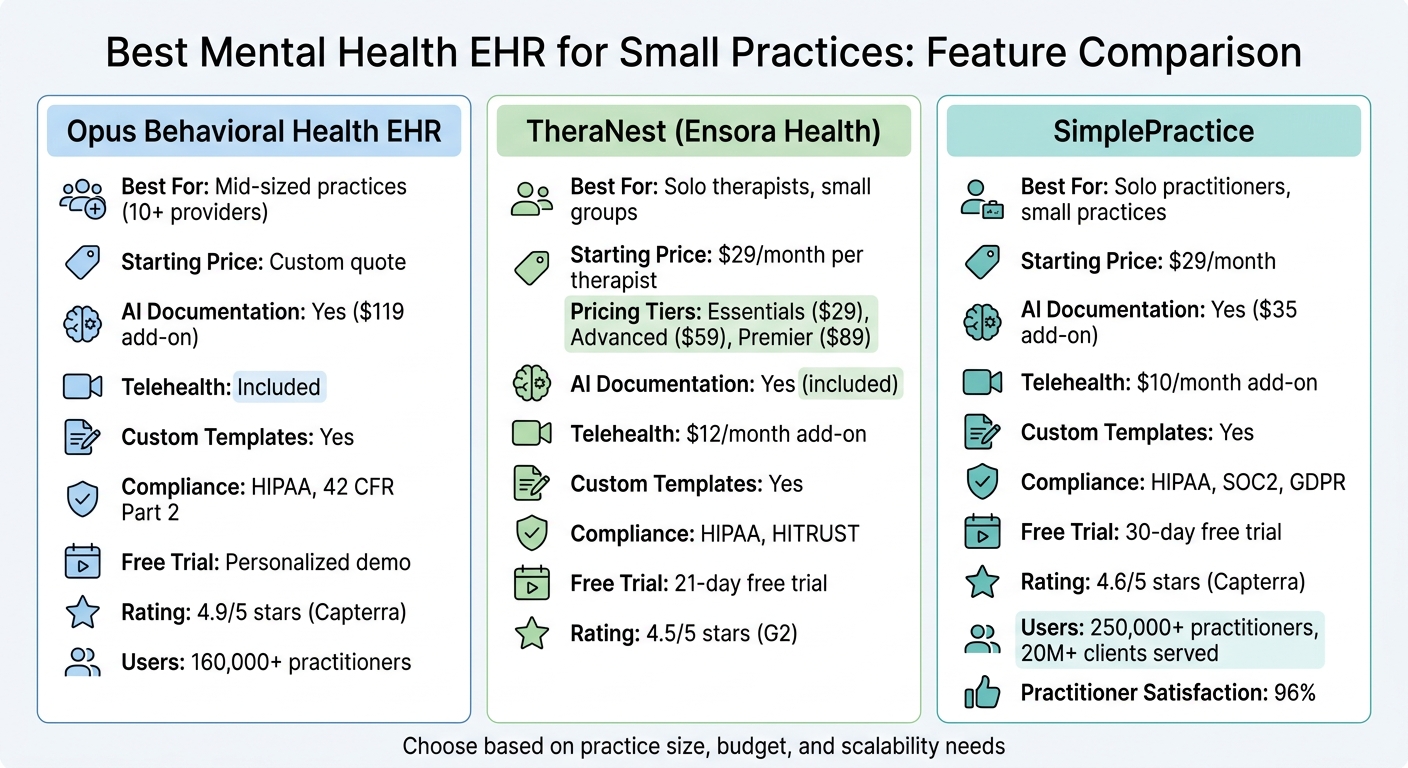
Mental Health EHR Comparison: Opus vs TheraNest vs SimplePractice for Small Practices
1. Opus Behavioral Health EHR
Opus Behavioral Health EHR is a cloud-based system tailored specifically for behavioral health and substance use disorder treatment centers.
With over 160,000 practitioners using it daily and managing data for more than 44 million clients, it’s designed to scale from small practices with just a handful of providers to larger centers with 36 or more clinicians [6].
This flexibility makes it a practical choice for smaller mental health practices looking to expand efficiently.
Behavioral Health Features
One standout feature of Opus is its Copilot AI documentation assistant, which turns session recordings into structured clinical notes.
This tool is compatible with both in-person and telehealth appointments and can reduce documentation time by 40% [5].
For those interested, the AI scribe is available as an add-on for $119 per provider each month [7]. Dr. Jennifer Williams highlighted the benefits, sharing that it cut her documentation time by 35% while allowing her to capture richer clinical data [5].
Opus also provides over 100 customizable assessment tools to track patient progress and measure outcomes. Its specialized behavioral health workflows include flexible templates for SOAP/DAP notes, treatment plans, and standardized measures to monitor progress. Mark Thompson, a clinical director, praised these tools, saying:
"The customizable assessment tools have revolutionized how we track patient progress. We can now visualize treatment outcomes in ways that were impossible with our previous system" [5].
The platform further includes a HIPAA-compliant telehealth solution, a built-in CRM for managing patient inquiries, e-prescribing capabilities, and lab integration for ordering and receiving test results [6].
Compliance and Security
Opus prioritizes compliance, maintaining full HIPAA standards and supporting 42 CFR Part 2 workflows [8][1].
Its secure cloud-based system protects sensitive information like patient records, clinical notes, and lab results. Jennifer Gozy, PsyD, LP, Director of Clinical Systems and Compliance at Care Counseling Clinics, remarked:
"These new processes will help review to ensure the clinical integrity of clinical documents... it will cut back on errors to not miss a thing" [6].
The platform also supports electronic signatures with audit trails and offers over 140 detailed reports to assist practices in monitoring compliance and tracking outcomes. As of March 2026, Opus boasts a 4.9/5 star rating on Capterra [7], demonstrating its reliability. Flexible pricing options further cater to the needs of smaller practices.
Pricing and Scalability
Opus uses a custom quote pricing model rather than fixed monthly fees [8][2][7]. It offers two tiers: a Complimentary User option with basic features like scheduling, billing, and patient portal access, and an Unlimited Access tier for full EHR functionality.
While Opus supports practices with as few as one clinician, feedback suggests it may be better suited for mid-sized centers with at least 10 providers [2][1]. Lisa Chen, a practice administrator, shared how the platform improved their operations:
"Having our EHR seamlessly connected with billing has eliminated the documentation gaps that used to cause claim denials" [5].
However, some users have noted challenges, such as the scheduling system being difficult to configure for complex programs and limitations in custom data extraction beyond the pre-built reports [7].
2. TheraNest
TheraNest, now known as Ensora Health as of 2025 [3], is a cloud-based EHR platform designed for solo therapists and small group practices. It simplifies administrative tasks while helping practices manage costs effectively. The platform has earned a 4.5/5 rating on G2 [4].
Behavioral Health Features
TheraNest includes an AI Session Assistant tailored for mental health documentation. This feature generates structured SOAP notes from telehealth sessions, ensuring client data is not used for training purposes. Its Dynamic Form Builder allows clinicians to create custom intake forms, progress notes, and case documentation that fit their specific workflows.
Additionally, the platform integrates Wiley Treatment Planners, offering pre-built treatment goals and objectives to support evidence-based care. Rebecca Houser from Blank Slate Therapy shared her experience:
"What attracted me to the software was that we could file claims, in addition to keeping our progress notes, treatment plans, and our calendar all in one place." [9]
Beyond documentation, TheraNest is designed to improve overall operational efficiency.
Scheduling, Billing, and Client Engagement
TheraNest’s scheduling system handles recurring sessions, group therapy appointments, and room assignments while offering automated reminders.
The integrated client portal simplifies processes like completing digital intake forms, secure messaging, and making balance payments - all without requiring a separate app. The platform’s billing automation is particularly helpful for outpatient mental health services, managing CMS-1500 claim submissions and ERA posting [9][10].
Compliance and Security
TheraNest prioritizes security and compliance, meeting stringent healthcare standards. It is both HITRUST certified and fully HIPAA compliant [9]. The platform offers five distinct permission categories - Default, Billing, Therapist, Administration, and Organization Administration - allowing practices to control data access based on staff roles. New users benefit from guided setup by implementation specialists who configure roles, permissions, and billing settings correctly from the start. Marty Goehring, M.A., Ph.D. from Formation Counseling Services, highlighted its impact:
"TheraNest has brought much-needed harmony to our practice - it quietly handles the administrative work in the background so we can focus fully on care." [9]
Pricing and Scalability
TheraNest uses a tiered pricing model based on the number of therapists, offering unlimited client management at all levels [3].
Essentials Plan: $29 per month per therapist, covering core scheduling, documentation, and credit card payments.
Advanced Plan: $59 per month, adding secure messaging, custom forms, and up to 30 monthly insurance claims.
Premier Plan: $89 per month, including Wiley Treatment Planners, unlimited claims, and full telehealth capabilities.
TheraNest only charges for clinicians and administrators ($19–$29 per month), not for scheduling or billing roles. Optional add-ons include telehealth for $12 per month, Wiley Treatment Planners for $25 per month, and ePrescribe with PDMP support, which costs a $135 setup fee plus $45 per month [3][11]. Stacey Keslar from Sanderson Psychological praised the platform:
"Managing multiple providers' schedules and documentation can be challenging. With TheraNest we've been able to optimize workflows to make life easier for our staff." [12]
TheraNest also offers a 21-day free trial. Practices needing additional support can opt for the "Quick Start Plus" package for $300, which includes live one-on-one sessions with a specialist.
3. SimplePractice
SimplePractice has earned a solid reputation with a large user base and consistent recognition for its performance. With over 250,000 mental health practitioners relying on the platform and more than 20 million clients served, its impact on the industry is clear[13][17].
It was named the #1 EHR Software of 2025 by TechRadar[17] and maintains a high practitioner satisfaction rate of 96%[13]. Reviews back up this acclaim, with a 4.6/5 rating on Capterra from 2,811 reviews[16] and a 4.4/5 rating on Trustpilot based on 1,520 reviews[15].
Behavioral Health Features
SimplePractice offers a range of tools designed specifically for behavioral health professionals. It includes customizable templates for SOAP notes, DAP notes, progress notes, and intake forms, all tailored to meet the needs of mental health workflows.
The integration of Wiley Treatment Planners gives practitioners access to over 1,000 pre-written treatment goals and interventions, supporting evidence-based care[19].
To streamline documentation, the platform features an AI-powered Note Taker, while measurement-based tools like the PHQ-9 and GAD-7 help track client progress over time[18].
Other key features include HIPAA-compliant telehealth, ePrescribing for psychiatric providers, and a secure client portal for booking appointments, completing digital intake forms, signing documents, and making payments. Highlighting its effectiveness, Dr. Reina Olivera, OT, notes:
"Over 88% of practitioners see fewer no-shows with SimplePractice appointment reminders"[17].
Automated reminders can reduce no-show rates by up to 50%, making it a valuable tool for improving attendance[14].
Compliance and Security
Security and compliance are at the core of SimplePractice. The platform is fully HIPAA-compliant and provides a Business Associate Agreement for all users[18].
It also meets ONC certification standards for health information technology and adheres to SOC2 and GDPR requirements. Communication and data storage are encrypted, and a built-in change log ensures accountability by tracking all modifications to client records[16][15].
These features are included across all subscription plans, ensuring every user benefits from the same level of security.
Pricing and Scalability
SimplePractice offers three subscription tiers to accommodate different practice needs.
Starter Plan: $29 per month for solo practitioners, covering core EHR features, the client portal, and online payment processing[13].
Essentials Plan: $39 per month, which adds customizable notes[15].
Professional Plan: $59 per month, offering the most comprehensive features[15].Optional add-ons include telehealth for $10 per month per clinician, a professional website for $15 per month, and AI Notes for $35 per month[15].
All plans support unlimited clients, allowing practices to grow without additional subscription costs[13]. New users can take advantage of a 30-day free trial and often receive a 50% discount for the first three months if they sign up within the first week of their trial[20][21].
Pros and Cons
Let’s dive into the standout features and challenges of using Opus Behavioral Health EHR for small mental health practices.
Opus has several strengths. It’s particularly well-suited for treatment centers offering multiple levels of care, such as residential, PHP, IOP, and outpatient services. The platform integrates admission management seamlessly with clinical workflows and adheres to 42 CFR Part 2 regulations, ensuring compliance when dealing with co-occurring substance use disorders [2].
Another big plus is the Copilot AI documentation assistant, which can cut documentation time by up to 40% [5]. On top of that, Opus offers over 100 customizable assessment tools, making it easier to track patient progress effectively.
That said, there are some drawbacks. Opus doesn’t include built-in ERP tools for non-clinical tasks like HR or property management, meaning users will need additional software [2]. Pricing isn’t straightforward either - it’s only available through custom quotes, which can make budgeting tricky [2][8][7].
Some users have also reported that the scheduling system can be hard to configure for more complex programs, and the ability to extract custom data is limited to pre-built reports [7]. While Opus supports small practices, feedback indicates it’s better suited for centers with at least 10 providers [2][1].
Key Strengths:
Supports multi-level care with integrated admissions management [2].
Ensures compliance with 42 CFR Part 2 for substance use disorder treatment [2][8][1].
AI-powered documentation assistant reduces time by 40% [5].
Offers over 100 customizable assessment tools and 140+ detailed reports [6].
Includes HIPAA-compliant telehealth, e-prescribing, and lab integration [6].
Main Limitations:
Lacks native ERP tools for non-clinical operations [2].Pricing is available only through custom quotes, not as monthly rates [2][8][7].
Scheduling system can be challenging for complex programs [7].
Limited options for custom data extraction beyond pre-built reports [7].
Best suited for mid-sized practices with 10 or more providers [2][1].
For mental health practices prioritizing compliance and efficiency, Opus offers robust tools tailored to behavioral health needs. However, its pricing model and operational flexibility leave some room for improvement.
Conclusion
This review has highlighted how Opus Behavioral Health EHR simplifies workflows and enhances clinical efficiency, making it a strong contender for practices focused on behavioral health. Selecting the right EHR means finding a solution tailored to your practice's specific clinical and operational demands.
What sets Opus apart is its targeted design for behavioral health, addiction, and substance use disorder workflows. The Basic Plan is particularly appealing for small practices, offering a combination of CRM, EHR, and RCM functions in one platform - eliminating the hassle of juggling multiple subscriptions.
Beyond its all-in-one structure, Opus provides extensive customization and advanced tools often seen in larger enterprise systems. Features like Copilot AI, which cuts note-taking time by 40%, integrated lab ordering, e-prescribing with EPCS, and over 140 detailed reports all contribute to smoother operations.
Jennifer Gozy, PsyD, LP, Director of Clinical Systems and Compliance at Care Counseling Clinics, shared her experience:
"We chose Opus because it is user-friendly and highly configurable. We are looking forward to designing a system that meets our agency's unique needs."
For small practices seeking a solution that balances behavioral health specialization with scalability, the Basic Plan from Opus Behavioral Health EHR offers an excellent mix of flexibility, compliance, and efficiency.
With over 160,000 practitioners relying on it and more than 44 million client sessions supported [22], Opus also provides personalized demos and round-the-clock support to ensure the system aligns with your practice's needs before you commit. This thoughtful approach ensures you have the tools to deliver outstanding patient care while meeting essential compliance standards in behavioral health.
FAQs
How do I know if my practice is too small for Opus?
Opus EHR might not be the ideal choice for solo therapists or very small outpatient practices. Its features are tailored to meet the needs of practices with more extensive operational requirements, ensuring they can run smoothly and efficiently.
What should I ask for in an Opus pricing quote?
When reaching out for an Opus Behavioral Health EHR pricing quote, it's smart to ask for a detailed breakdown of costs. This should include setup fees, subscription charges, and any expenses tied to adding extra features or users. Don't forget to inquire about fees for telehealth services, billing tools, and customer support.
It's also worth asking about potential hidden costs, like those for customization, training, or software upgrades. Lastly, make sure to clarify whether the pricing is fixed or if it changes based on the size of your practice or how much you use the system. This way, you'll have a clear picture of what you're signing up for.
How can I tell if an EHR really supports 42 CFR Part 2?
To determine if an EHR complies with 42 CFR Part 2, make sure it includes features designed for securely managing substance use disorder (SUD) records. Key functionalities to check for include:
Patient consent management: Tools that allow patients to provide and withdraw consent for sharing their SUD records.
Disclosure controls: Options to limit access and control how information is shared.
Confidentiality safeguards: Measures that align with the strict privacy requirements outlined in the regulations.Additionally, consulting official resources, such as guidance from the Department of Health and Human Services (HHS), can help confirm whether the EHR meets these regulatory standards



- Behavioral Health
- EHR Systems
- Addiction Treatment EHR
- Telehealth
- mental health
- addiction treatment
- Substance Abuse Disorder
- behavioral Health center
- Behavioral health facility
- HIPPA Compliant
- ehrsoftware
- PTSD
- behavioral health ehr
- Depression
- hipaa
- Anxiety
- MentalHealthMatters
- RCM
- claim denials
- clinical documentation
- mental health awareness
- screening tools

August 28, 2026

August 27, 2026

August 26, 2026

August 25, 2026

August 24, 2026

August 21, 2026
Recommended Posts

Tuesday, June 09, 2026
EHR Mental Health Platforms That Reduce Admin Burden
Behavioral health providers spend 37% of their time on administrative tasks like documentation, cutting into patient ...

Sunday, April 12, 2026
Comparing the Best EMR for Behavioral Health for Small Clinics
Choosing the right EMR for a small behavioral health clinic can save time, reduce costs, and improve patient care.

Wednesday, April 29, 2026
Best Scheduling Tools for Behavioral Health Providers
Scheduling tools designed for behavioral health providers solve complex challenges like high no-show rates, HIPAA ...