

Mental health EHRs are specialized tools designed for behavioral health professionals, addressing unique challenges like compliance, clinical documentation, and patient engagement.
Unlike general EHRs, they cater to ongoing care, privacy regulations like 42 CFR Part 2, and specific documentation formats such as DAP and SOAP. Here's what you need to know:
Clinical Documentation: Supports mental health-specific formats (e.g., DAP, BIRP) and integrates tools like PHQ-9 and GAD-7 for tracking patient progress.
Treatment Planning: Links progress notes to treatment goals, ensuring alignment across care teams and payer audits.
Telehealth: Built-in video conferencing, group therapy tools, and e-prescribing streamline remote care.
Compliance: Meets HIPAA and 42 CFR Part 2 standards with features like data segmentation, consent tracking, and audit logs.
Patient Portals: Enable appointment reminders, secure messaging, and digital intake forms to enhance engagement.
Billing & Analytics: Automates claims, tracks outcomes, and reduces errors for better financial and clinical performance.
These systems save time, improve workflows, and ensure compliance, making them essential for modern behavioral health practices.
Choose the Best Psychiatry EHR for your Mental Health Practice (Ask these 5 questions)
Core Clinical Documentation Features
Efficient documentation tools are a cornerstone of quality behavioral health care. A mental health EHR should simplify charting, making it faster and more structured while ensuring it remains clinically relevant. These tools should allow providers to prioritize patient care by streamlining their workflow.
Mental Health-Specific Charting
Behavioral health documentation often requires a different approach compared to general medicine. Mental health EHRs need to accommodate note formats that are tailored to this specialty, such as DAP (Data, Assessment, Plan), BIRP (Behavior, Intervention, Response, Plan), GIRP (Goal, Intervention, Response, Plan), and SOAP formats [2][5].
In addition to supporting these formats, top-tier systems include structured content tools that help clinicians create detailed, personalized progress notes with minimal effort. As ICANotes explains:
"The best behavioral health EHR systems let clinicians complete a detailed, clinically individualized progress note in two to three minutes using structured content tools." [2]
These systems also integrate outcome measures like the PHQ-9, GAD-7, and BDI-II directly into the workflow, making it easier to track patient progress over time. Features like carry-forward functionality, which pulls relevant data from prior sessions into new notes, further streamline the process.
These charting tools naturally integrate with treatment planning and care coordination, ensuring a cohesive approach to patient care.
Treatment Planning and Care Coordination
In behavioral health, a treatment plan serves as more than just a document - it’s a shared agreement between the patient, the clinical team, and the payer.
As Behave Health describes, "Treatment plans are the clinical contract between the patient, the clinical team, and the payer" [9]. Effective EHRs support a Problem-Goal-Objective-Intervention (PGOI) framework, keeping the care team aligned on the patient’s goals.
One particularly impactful feature is the ability to link progress notes directly to treatment plan goals. This ensures that every session contributes to the patient’s established objectives, which is not only beneficial for outcomes but also critical for payer audits [8].
Additionally, treatment plans should be portable across different levels of care. For example, when a patient transitions from a residential program to a partial hospitalization program (PHP), their goals and objectives should transfer seamlessly [9].
Clinical decision support (CDS) alerts are another valuable feature, flagging high-priority risks like a positive suicide screening or a severe drug interaction. These alerts ensure that the appropriate clinician can address urgent issues immediately [8].
Patient Engagement Through Client Portals
Engaging patients through digital tools is essential for maintaining continuity of care. A well-designed client portal helps patients stay connected to their treatment between sessions. By accessing visit summaries, reviewing treatment goals, and tracking progress, patients become more invested in their care [1].
Client portals also improve workflows significantly. For instance, digital intake forms completed at home before the first appointment can reduce check-in times by up to 90%, while also eliminating the need for staff to manually enter data.
Automated appointment reminders can cut no-show rates by as much as 50%, and secure messaging enables HIPAA-compliant communication, removing the delays caused by phone tag. These features not only enhance the patient experience but also reduce the administrative workload for clinical teams.
Telehealth and Remote Care Capabilities
Remote care has quickly become a cornerstone of modern healthcare. Providing virtual care effectively means using integrated tools that streamline workflows, protect patient privacy, and comply with HIPAA regulations.
Built-In Telehealth Functionalities
Leading mental health EHR systems now come with built-in telehealth features that simplify everything from session notes to consent forms and scheduling.
These tools are particularly useful for group therapy programs, making it easier to run digital Intensive Outpatient Programs (IOPs). Features like automated attendance tracking and individual participation documentation make managing these sessions far more efficient [9].
Andrea Baskin, a Clinical Director, shared:
"The ability to run groups online has enabled us to create a digital IOP program, with flexible after hours for our clients. We don't have to worry about transportation logistics, office hours, or staff availability." [10]
Integrated video conferencing tools also enhance security by using end-to-end encryption, ensuring sessions remain private. Systems can even be configured to block access until necessary 42 CFR Part 2 consents are verified.
These telehealth capabilities naturally extend to other areas of remote care, creating a seamless experience for both providers and patients.
E-Prescribing and Medication Management
Electronic Prescribing for Controlled Substances (EPCS) is supported with features like two-factor authentication and real-time Prescription Drug Monitoring Program (PDMP) checks. These tools integrate directly with therapy notes and treatment plans, giving clinicians a complete view of patient care.
But effective medication management goes beyond prescriptions - it’s about maintaining consistent engagement with patients.
Remote Monitoring and Communication
Secure, two-way messaging systems allow providers and patients to communicate in a HIPAA-compliant way. Automated tools can send outcome assessments, such as the PHQ-9 and GAD-7, directly to patients, with results tracked in real-time dashboards.
This approach, known as measurement-based care (MBC), helps clinicians monitor patient progress between sessions [11]. Andrea Horwitz, another Clinical Director, highlighted its impact:
"Reviewing weekly treatment results shows me what is really happening with my clients, even if they are not able to express it in session... We were able to work together to prevent a relapse, a crisis, and potential tragedy due to the Opus Patient Engagement system." [11]
In addition, AI-powered tools like Copilot AI can streamline clinical workflows by organizing notes in real time, cutting down charting time by as much as 40% [7].
These advancements demonstrate how technology is reshaping the way care is delivered, making it more efficient and patient-focused.
Compliance and Privacy Features
Mental health records are some of the most sensitive data in healthcare. In 2024, a staggering 184 million healthcare records were breached [12].
This makes privacy and compliance features far more than just a regulatory necessity - they're critical for protecting patient trust. A reliable mental health EHR addresses these concerns with multiple layers of privacy, security, and documentation safeguards.
HIPAA and 42 CFR Part 2 Compliance
While both HIPAA and 42 CFR Part 2 deal with protected health information, they serve different purposes. HIPAA covers general health information, while 42 CFR Part 2 specifically governs substance use disorder (SUD) records and imposes stricter rules. For example:
HIPAA allows information sharing for treatment and payment without explicit consent.
42 CFR Part 2 requires explicit written consent for most disclosures, with stringent restrictions on redisclosure to third parties.
One essential feature for compliance is psychotherapy note segregation, which ensures that sensitive therapist session notes remain separate from a patient’s general medical record [12].
Additionally, EHR systems must support fine-grained data segmentation. This allows clinicians to tag SUD-related records so they can be excluded when sharing other parts of a patient’s chart. On top of this, unique user IDs are mandatory for all staff, as sharing credentials violates HIPAA’s standards for unique user identification [12].
Here’s a quick comparison of the two frameworks:
|
Feature |
HIPAA Requirement |
42 CFR Part 2 Requirement |
|---|---|---|
|
Consent |
Allows sharing for treatment/payment without explicit consent |
Requires explicit written consent for most disclosures |
|
Access Control |
Role-based "minimum necessary" access |
Granular control; patients can restrict access to certain providers |
|
Encryption |
AES-256 at rest, TLS 1.2+ in transit |
Same encryption standards, applied specifically to SUD data |
|
Audit Logs |
Tracks all ePHI access |
Tracks access and can be subpoenaed for Part 2 investigations |
Security, Access Control, and Auditing
In addition to compliance measures like consent and data segmentation, robust security features are essential for safeguarding sensitive records.
Role-Based Access Control (RBAC) ensures that staff members only see the information relevant to their roles. For example, a billing specialist may access claim-related data, but not a patient’s clinical notes. This "minimum necessary" principle is required by both HIPAA and 42 CFR Part 2.
Modern systems go beyond basic passwords by incorporating multi-factor authentication (MFA) and biometric options, which help prevent unauthorized access even if credentials are compromised.
Real-time, tamper-evident audit trails document every access, modification, or disclosure, recording details like timestamps, user IDs, and specific actions. These logs aren’t just internal records; under 42 CFR Part 2, they can be subpoenaed during federal investigations.
To maintain security over time, quarterly access reviews are crucial. These reviews help prevent "privilege creep", where staff inadvertently gain access to data beyond what their role requires.
Additionally, it’s vital to ensure that third-party vendors have a Business Associate Agreement (BAA) that explicitly covers both HIPAA and 42 CFR Part 2 standards.
Together, these controls reduce the need for manual oversight while keeping sensitive records secure.
Regulatory Documentation and Accreditation Support
Beyond technical safeguards, thorough documentation is key to meeting accreditation and regulatory standards.
Whether it’s The Joint Commission, state licensing boards, or federal payers, mental health EHRs help ensure compliance with structured templates that prompt clinicians to capture required details during patient visits.
This reduces the risk of incomplete records, even during busy times.
For 42 CFR Part 2 compliance, consent management tools are indispensable. These tools track patient authorizations and automatically block record-sharing if consent has expired or is missing.
Automated alerts notify staff when authorizations are about to expire, ensuring uninterrupted compliance.
Advanced EHR systems also meet stringent standards like PCI DSS Level 1, ISO 27001, FISMA Moderate, and SOC 1/SSAE 16/ISAE 3402 [14].
Additionally, they can generate over 140 reports [13] to support reporting requirements for federal, state, and grant-specific programs.
"Having our EHR seamlessly connected with billing has eliminated the documentation gaps that used to cause claim denials." - Lisa Chen, Practice Administrator, Behavioral Health Center [7]
Scheduling, Billing, and Analytics
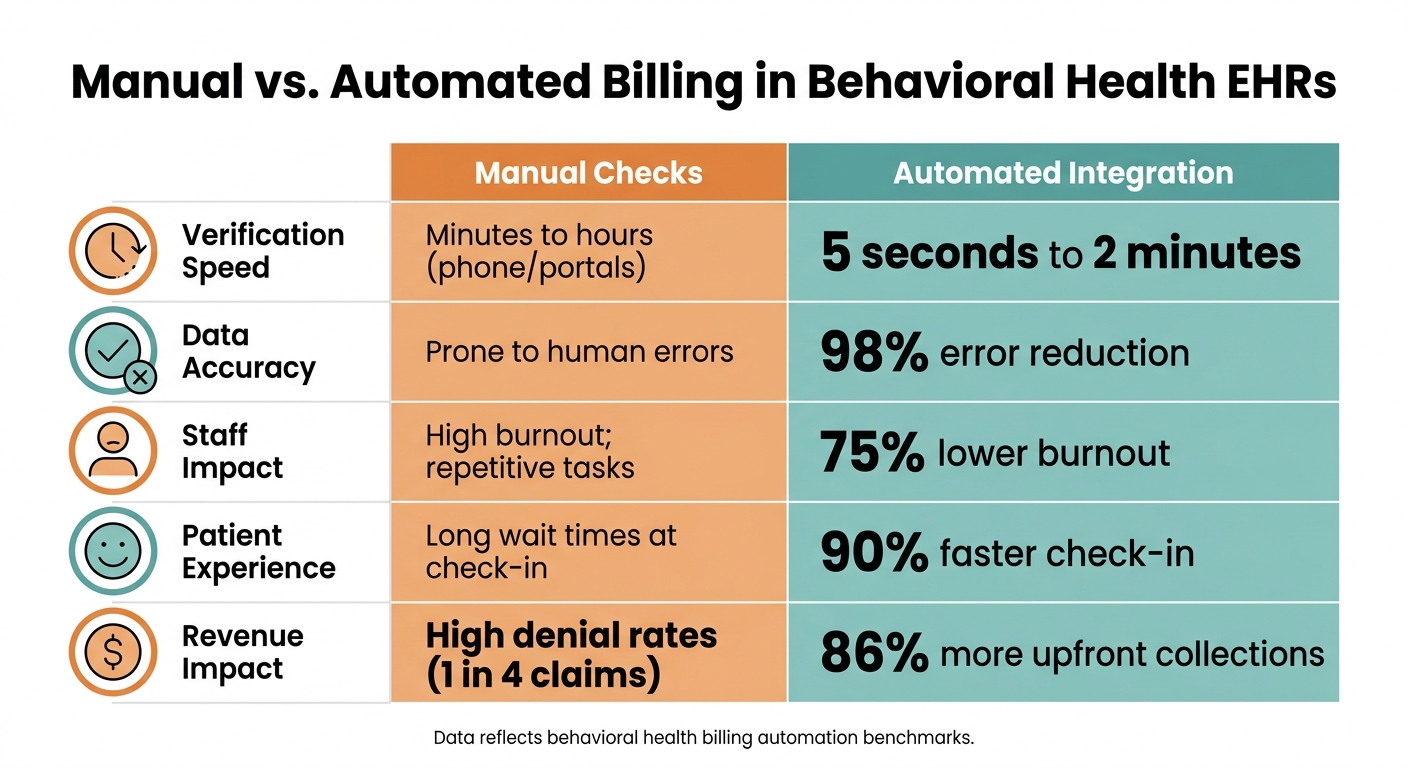
Manual vs. Automated Billing in Behavioral Health EHRs
Having strong compliance features is great, but they won’t mean much if a practice’s daily operations are bogged down with manual tasks.
This is where a mental health EHR shines - by simplifying scheduling, billing, and reporting. These tools help cut down on administrative work, reduce claim denials, and provide clinicians with clear insights into patient progress.
Scheduling and Workflow Automation
Scheduling tools today go far beyond just booking appointments. Mental health EHRs make it easy to manage both individual and group sessions from one interface.
They also send out automated reminders via SMS or email to reduce no-shows. Plus, two-way SMS allows patients to respond immediately, cutting down on phone calls [16]. If there’s an unexpected change, broadcast messaging can notify all affected patients instantly [16].
On the clinician’s side, AI tools like Copilot AI can draft progress notes directly from the scheduling interface, whether the session was in-person or through telehealth [15][7]. This kind of integration between scheduling and clinical documentation saves time and keeps workflows efficient.
Streamlined scheduling naturally leads to smoother billing, minimizing administrative holdups.
Behavioral Health Billing and Revenue Cycle Management
Billing in behavioral health comes with its own set of challenges. From mental health-specific CPT codes (like the 908xx series) to tracking prior authorizations and handling substance use disorder billing rules, these complexities require a system tailored to the field. Automated billing systems offer major advantages over manual processes:
|
Metric |
Manual Checks |
Automated Integration |
|---|---|---|
|
Verification Speed |
Minutes to hours (phone/portals) |
5 seconds to 2 minutes |
|
Data Accuracy |
Prone to human errors |
98% error reduction |
|
Staff Impact |
High burnout; repetitive tasks |
75% lower burnout |
|
Patient Experience |
Long wait times at check-in |
90% faster check-in |
|
Revenue Impact |
High denial rates (1 in 4) |
86% more upfront collections |
Automated systems perform batch eligibility checks 24–48 hours before appointments, catching coverage issues early. They also scrub claims for errors - like missing modifiers or incorrect NPIs - before submission.
Payments are posted automatically through Electronic Remittance Advice (ERA), and denial codes are flagged for follow-up. For private-pay clients, systems can generate superbills automatically, ensuring all necessary details are included and reducing manual effort.
"By automating the quality of internal data, and applying an algorithm, it will cut back on errors to not miss a thing, especially from group sessions." - Judd Carey, Director of Operations, VirtualServices, Mindful Health [13]
Beyond billing, the data these systems generate feeds into analytics that drive both clinical and financial improvements.
Analytics and Outcome Tracking
EHR reporting tools make it easy to track both clinical outcomes and financial performance. Clinically, tools like PHQ-9 and GAD-7 are delivered through the patient portal, with results displayed as trend lines. This gives clinicians objective data to guide treatment decisions between sessions.
"Reviewing weekly treatment results shows me what is really happening with my clients, even if they are not able to express it in session." - Andrea Horwitz, Clinical Director [11]
On the operational side, EHRs can produce over 140 management reports [6][5]. These reports cover everything from detailed accounting summaries to payer rate compliance. Linking clinical outcome data, like PHQ-9 scores, to billing records also helps demonstrate treatment effectiveness to payers - a critical factor as value-based care models continue to grow in behavioral health.
Key Takeaways for Choosing a Mental Health EHR
When selecting an EHR for behavioral health, it's essential to recognize how these systems differ from those used in general medicine. From specialized note formats like DAP and BIRP to mental health CPT codes and 42 CFR Part 2 compliance, the needs of mental health practices require a tailored approach.
"Revisit your choice in an EHR. Your decision has a ripple effect on the providers, administrators, and patients in your practice." - Kristin Trick, MA, LPC-S, RPT, Private Practice Therapist [4]
Start by mapping out your current workflows - intake, assessment, documentation, billing - to identify the features your practice absolutely needs versus those that are simply nice to have.
During the evaluation process, request a live demo that uses your actual note templates and CPT codes. This approach helps uncover potential workflow challenges that might not be evident in a vendor-prepared walkthrough [5].
Cost considerations are another critical factor. Monthly subscriptions typically range between $50 and $300 per provider as of 2026.
However, don't overlook additional expenses like implementation fees, data migration, and training, which can increase first-year costs by 40–60% [3]. Switching platforms later can be even pricier, with migration costs for small- to mid-sized practices ranging from $5,000 to $25,000 [3].
Here's a quick look at how different EHR features contribute to both clinical and operational success:
|
Feature Category |
Role in Workflow |
Impact on Outcomes |
|---|---|---|
|
Clinical Documentation |
Reduces note time using SOAP/DAP templates |
Ensures continuity of care and clinical accuracy |
|
Telehealth |
Integrates video directly into patient charts |
Expands access for remote and underserved patients |
|
Billing/RCM |
Automates claims and eligibility checks |
Reduces claim denials and financial stress |
|
Compliance |
Automates HIPAA and 42 CFR Part 2 controls |
Protects patient privacy and builds therapeutic trust |
|
Analytics |
Tracks PHQ-9/GAD-7 scores over time |
Supports measurement-based care and treatment adjustments |
The EHR you choose will directly impact clinician efficiency, patient outcomes, and your practice's financial health. Instead of relying on generic feature lists, focus on how each system aligns with your specific program needs.
This decision will influence every aspect of your practice, from patient care to operational workflows and financial performance.
FAQs
How is a mental health EHR different from a general EHR?
A mental health EHR is specifically designed to meet the unique requirements of behavioral health practices, setting it apart from general EHRs commonly used in primary care. These systems prioritize capturing longitudinal narrative data, which includes details like session progress notes and therapeutic interactions over time.
They also come equipped with tools tailored to behavioral health needs, such as:
Documentation for group therapy sessions
Features for managing multi-phase treatment plans
Systems to track patient outcomes effectively
Built-in compliance with stricter regulations, including 42 CFR Part 2
This specialized focus ensures mental health providers have the tools they need to deliver effective care while staying compliant.
What should I look for to meet HIPAA and 42 CFR Part 2?
To meet the requirements of HIPAA and 42 CFR Part 2, it's essential to select an EHR system that offers granular consent management and data segmentation. The system should allow for capturing, versioning, and revoking consent at both the document and data-element levels.
Key features to prioritize include:
Role-based access control (RBAC): Ensures that only authorized personnel can access specific data.
Tamper-proof audit trails: Tracks every action taken within the system to maintain accountability.
AES-256 encryption: Protects sensitive data both at rest and in transit.
Multi-factor authentication: Adds an extra layer of security to prevent unauthorized access.
Automated exclusion tools: Helps exclude sensitive counseling notes from routine disclosures, maintaining compliance with privacy regulations.These capabilities are critical for safeguarding sensitive information while adhering to regulatory standards.
How can a mental health EHR reduce note time and claim denials?
Opus Behavioral Health EHR makes managing workflows easier by leveraging AI-driven tools to cut down on documentation time. It can automatically pre-fill records, arrange notes, and provide structured templates, significantly reducing the need for manual input.
When it comes to claims, the system goes a step further. It suggests billing codes based on the documented care, verifies insurance details in real time, and catches errors during the claims process.
These tools not only speed up operations but also help maintain compliance with standards like CPT and ICD-10, ensuring accuracy and efficiency.



- Behavioral Health
- EHR Systems
- Addiction Treatment EHR
- Telehealth
- mental health
- addiction treatment
- Substance Abuse Disorder
- behavioral Health center
- Behavioral health facility
- HIPPA Compliant
- ehrsoftware
- PTSD
- behavioral health ehr
- Depression
- hipaa
- Anxiety
- MentalHealthMatters
- RCM
- claim denials
- clinical documentation
- mental health awareness
- screening tools

August 28, 2026

August 27, 2026
August 26, 2026

August 25, 2026

August 24, 2026

August 21, 2026
Recommended Posts
Tuesday, December 09, 2025
AI-Powered EHR Tools for Behavioral Health
AI-powered EHR tools are transforming behavioral health practices. These tools reduce paperwork, improve documentation ...
Friday, February 11, 2022
Top Considerations for Behavioral Health Treatment Centers When Switching EHR Systems
The world is cautiously beginning to open again after the Covid-19 shelter-in-place orders are lifted. While it’s ...

Wednesday, June 17, 2026
The Hidden ROI of Getting Your Mental Health EHR Right
When it comes to mental health EHR systems, the true value lies in more than just reducing documentation time or ...