

When it comes to mental health EHR systems, the true value lies in more than just reducing documentation time or improving billing accuracy.
A well-suited EHR improves clinician efficiency, reduces burnout, ensures compliance, and directly impacts patient outcomes. Here’s what you need to know:
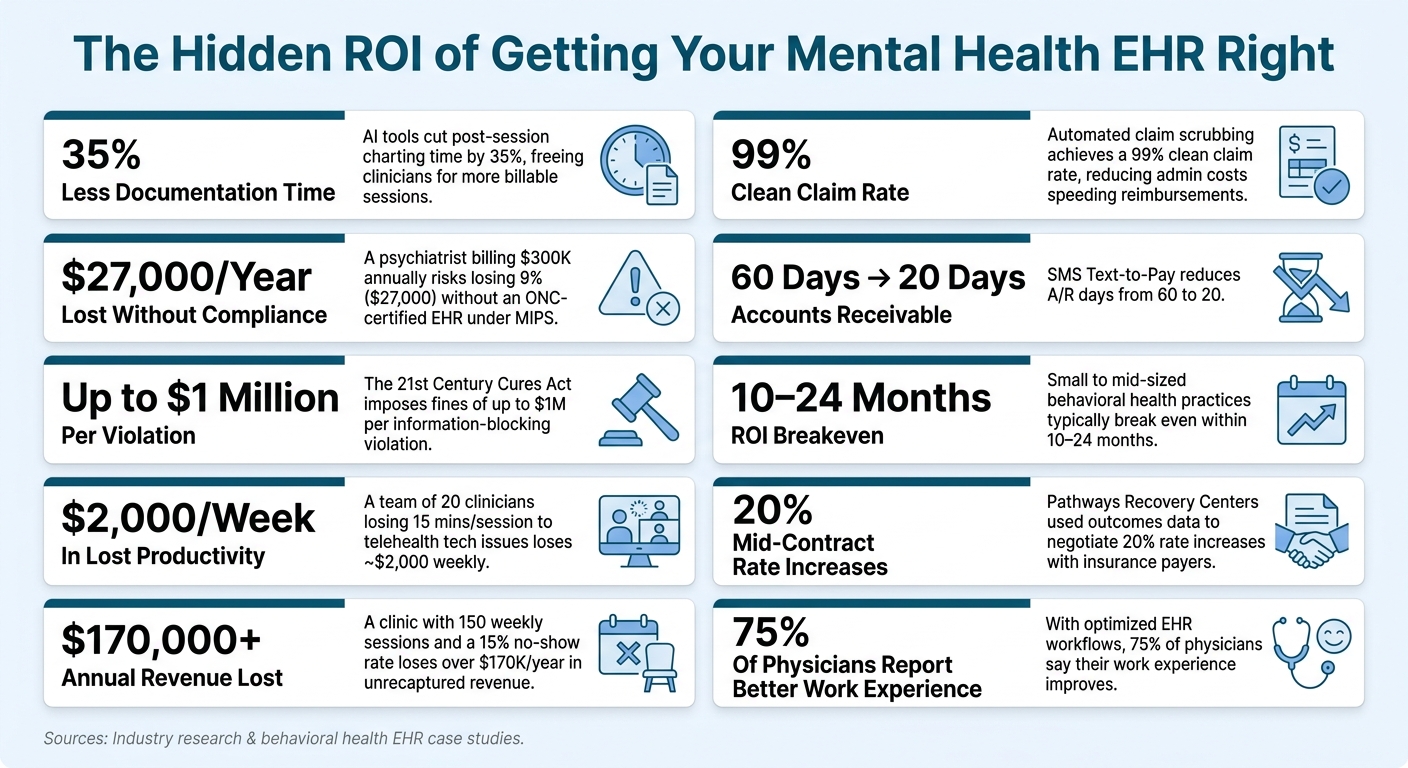
Time Savings: AI tools can cut documentation time by 35%, freeing up clinicians for more billable sessions.
Financial Impact: Improved billing accuracy reduces claim denials, and automated processes recover lost revenue like no-show fees.
Compliance Benefits: Avoid penalties by meeting Medicare and 21st Century Cures Act requirements.
Better Patient Care: Tools like PHQ-9 tracking improve outcomes, which can secure higher insurance reimbursements.
For small to mid-sized practices, ROI typically occurs within 12–24 months, especially when the system is tailored to behavioral health needs and implemented with proper training.
Mental Health EHR ROI: Key Stats & Financial Impact at a Glance
What ROI Means for Mental Health EHRs
Return on investment (ROI) for behavioral health EHRs goes beyond just financial metrics - it also includes operational and clinical improvements that align with the unique workflows of mental health practices.
Unlike primary care or hospital systems, mental health providers face distinct challenges and opportunities. Let’s break down the financial and operational benefits in more detail.
Direct Financial Returns
One of the clearest financial benefits comes from better billing accuracy and higher claim approval rates. Avoiding penalties is another major factor. For instance, practices billing Medicare must use an ONC-certified EHR to avoid MIPS adjustments, which can cost up to 9% of Medicare reimbursements[8]. To put that into perspective, a psychiatrist billing $300,000 annually could lose $27,000 each year without compliance[8].
Compliance risks don’t stop there. The 21st Century Cures Act imposes fines of up to $1 million per violation for information-blocking. Many providers mistakenly believe that all progress notes qualify as "psychotherapy notes", which are exempt from sharing requirements. Misunderstanding these rules can lead to expensive compliance mistakes.
Workflow and Clinical Gains
Operational improvements also contribute significantly to ROI. Tools like AI-assisted documentation can cut down post-session charting time from 20–40 minutes to just a quick review and sign-off. Over time, these savings add up across multiple sessions[1].
This streamlined workflow directly enhances clinical efficiency:
"Since implementing Opus EHR, our providers spend 35% less time on documentation while capturing more comprehensive clinical data. The AI documentation assistant feels like having an extra team member in every patient encounter." - Dr. Jennifer Williams, Mental Health Practice Owner[9]
Even small inefficiencies can add up. For example, manually chasing a $50 co-pay can cost around $15 in labor. Multiply that by hundreds of transactions a year, and the financial impact becomes clear[4].
A well-designed EHR eliminates these inefficiencies, ensuring smoother operations and better financial outcomes.
Where EHR ROI Comes From
The return on investment (ROI) from a mental health EHR stems from several interconnected advantages. The largest benefits typically fall into three main areas: improving team efficiency, enhancing patient outcomes, and optimizing revenue collection.
Faster Documentation and Workflow Efficiency
Documentation eats up a significant chunk of time in any mental health practice. With AI-powered documentation tools, clinicians can reduce charting time by 35% [9]. That saved time can directly translate into more billable sessions.
Telehealth inefficiencies are another time drain. Browser-based telehealth platforms can save 10–15 minutes per session that would otherwise be spent troubleshooting technical issues [7]. For a team of 20 clinicians, those lost minutes add up to $2,000 per week [7].
"When a clinician earns $100 per hour but spends 15 minutes on tech support, that's $25 lost per session. Across a team of 20 providers, this adds up to thousands of dollars each week." - Mira Gwehn Revilla, Curogram [7]
These workflow improvements not only save time but also create the foundation for better clinical care.
Better Patient Outcomes
A well-designed EHR does more than organize records - it actively supports smarter clinical decision-making. For example, real-time alerts can identify high-risk patients or flag potential medication interactions, helping to prevent costly emergency interventions [3].
Additionally, business intelligence tools can uncover trends across patient populations that might otherwise go unnoticed.
Tracking patient outcomes has financial benefits, too. With the rise of value-based reimbursement models, practices that can’t provide structured outcomes data risk losing out on better contract rates or even being excluded from insurance networks [1][3].
For instance, Pathways Recovery Centers used outcomes data to negotiate 20% mid-contract rate increases with insurance payers. They demonstrated that AI-assisted documentation allowed clinicians to focus more on direct care, which improved patient results [11].
To achieve this, consistent use of structured tools like the PHQ-9 and GAD-7 is critical. These tools make it easier to report outcomes to payers and accrediting bodies, avoiding the inefficiencies of unstructured, free-text notes [1].
Revenue Cycle Management Gains
The efficiency and patient care improvements from EHRs naturally lead to better revenue cycle management. Clean claims and faster reimbursements are where the financial benefits of an EHR become most apparent.
For example, a clinic with 150 weekly sessions and a 15% no-show rate could lose over $170,000 annually in unrecaptured revenue [5]. Automated insurance eligibility checks - run 48 hours before appointments - can catch changes in coverage, preventing many of these losses [5].
Billing practices also play a big role. Switching from paper statements to secure SMS payment links helps recover small balances that are often written off because manual follow-up costs too much.
For instance, chasing a $50 co-pay manually can cost $15 in labor [4].
"If you're making moves on your organization's performance at the end of a quarter, and your competitor is doing it at the end of the week, you're not going to survive." - DJ Prince, Chief Strategy Officer, Guardian Recovery [11]
The table below highlights how specific EHR features directly contribute to measurable financial benefits:
|
Feature |
Efficiency Impact |
Key ROI Metric |
|---|---|---|
|
AI Scribe (Copilot) |
40% reduction in charting time |
More billable hours, reduced clinician burnout |
|
SMS Text-to-Pay |
Reduces accounts receivable days from 60 to 20 |
Improved cash flow, lower bad debt |
|
Automated Claim Scrubbing |
99% clean claim rate |
Faster reimbursements, lower admin costs |
|
No-App Telehealth |
Saves 10–15 mins per session |
Higher session completion, lower IT overhead |
How to Measure ROI in Mental Health EHRs
Once you've identified the potential sources of ROI, the next step is to create a clear framework for measuring both direct and indirect benefits. This requires accounting for all costs and returns to get an accurate picture.
Costs to Account For
It’s easy to focus solely on subscription fees, but that doesn’t tell the whole story. Here’s a breakdown of the key cost categories you should consider:
|
Cost Category |
What It Includes |
Typical Range |
|---|---|---|
|
Acquisition |
Licensing, setup fees, hardware |
$15,000–$70,000/provider (Year 1) |
|
Implementation |
Configuration, data migration, training |
$20,000–$200,000 |
|
Operations |
Support, maintenance, IT labor, updates |
$60,000–$100,000/year |
|
Indirect/Hidden |
Productivity loss, overtime, opportunity cost |
$50,000–$200,000 |
For example, training might cost $500 to $1,500 per staff member, while data migration expenses can range from $10,000 to $100,000 depending on the volume and complexity of your data.
One of the most significant hidden costs is the productivity dip right after the system goes live. During the first 3–6 months, practices typically see 20% to 30% fewer patients, with reductions of up to 50% during the first week.
To minimize burnout and billing errors, consider reducing your schedule by 25% to 50% during that initial week [13].
Return Categories and Metrics
The benefits of a well-implemented EHR generally fall into three main areas: revenue recovery, cost reduction, and clinical performance. Here are some examples:
Revenue Recovery: Improved coding accuracy can bring in over $20,000 in net revenue per full-time provider annually.
Cost Reduction: Cutting claim denial rates from 10% to under 5% can save approximately $118 for each reworked claim. Switching from paper processes could save between $3,000 and $15,000 annually.
Clinical Performance: About 75% of physicians report that optimized EHR workflows improve their work experience, which can help reduce expensive staff turnover [12][13].How to Calculate ROI in Practice
The standard ROI formula is:
ROI = ((Total Benefits − Total Costs) / Total Costs) × 100 [13]
For example, a 10-provider behavioral health clinic might invest $150,000 in its first year (covering licensing, implementation, training, and productivity loss). If the clinic recovers $200,000 through reduced denials, faster collections, and additional billable hours, the ROI would be about 33%. This calculation doesn’t even factor in long-term benefits.
To determine the payback period, use this formula:
Payback Period = Initial Investment / Annual Net Benefit [12]
On average, primary care clinics with cloud-based systems break even in about 10 months. For small to mid-sized behavioral health practices, the breakeven point is typically 10 to 24 months [13].
To measure these improvements accurately, establish baseline metrics - like Days in A/R, denial rates, and average documentation time - for at least six months before going live. Up next, we’ll dive into the specific EHR features that contribute to these measurable returns.
EHR Features That Drive the Most ROI
EHR systems come with a variety of features, but not all deliver the same return on investment (ROI). To get the most out of your investment, focus on tools that provide measurable benefits and help avoid costly inefficiencies. Identifying these features before purchasing can save significant time and money down the road.
Behavioral Health-Specific Documentation Tools
For behavioral health practices, documentation tools tailored to their specific needs are a game-changer.
Features like support for group therapy sessions, compliance with 42 CFR Part 2, and workflows for substance use disorders are essential. Generic EHR systems often require staff to create time-consuming workarounds, which can drain both resources and morale.
Customizable templates designed for behavioral health can eliminate these inefficiencies. With accurate templates, clinicians can document faster, saving valuable time across numerous sessions.
Additionally, AI-powered ambient scribing captures clinical notes automatically, reducing after-hours charting and helping providers avoid burnout [9][3].
"The customizable assessment tools have revolutionized how we track patient progress. We can now visualize treatment outcomes in ways that were impossible with our previous system, and patients appreciate the more focused interactions." - Mark Thompson, Clinical Director, Family Medicine Group [9]
When assessing documentation tools, have your team test the system in a sandbox environment. Pay attention to how many clicks it takes to complete a standard intake note. If the process is more cumbersome than your current system, it’s a red flag for inefficiency.
Telehealth, E-Prescribing, and Lab Integration
Integrated features like telehealth, e-prescribing, and lab connectivity can significantly boost ROI. These tools streamline workflows while directly contributing to operational and financial improvements. Native integration is key - embedded features work seamlessly, avoiding the hassle of separate logins or duplicated documentation [1].
Here’s how these integrations deliver measurable benefits:
|
Feature |
Operational Gain |
Financial Gain |
|---|---|---|
|
Telehealth |
Automated scheduling; reduced travel burden |
Lower no-show rates; recovered "empty chair" revenue |
|
E-Prescribing |
Fewer pharmacy callbacks; automated billing logs |
Reduced medication errors and associated liability |
|
Lab Integration |
Results delivered directly to the chart |
Reduced duplicate testing; streamlined lab billing |
When choosing a vendor, look for support of standards like FHIR R4, HL7 v2 (for lab results), and e-prescribing through national networks. These ensure smooth communication with external providers and pharmacies [1].
"Having our EHR seamlessly connected with billing has eliminated the documentation gaps that used to cause claim denials." - Lisa Chen, Practice Administrator, Behavioral Health Center [9]
Reporting and Outcomes Measurement
Robust reporting tools are essential for improving both financial performance and clinical outcomes. These tools can identify revenue leaks and demonstrate clinical value, which is critical as payers move toward value-based care models.
The most effective reporting systems go beyond basic dashboards. Drill-down reporting allows you to pinpoint specific payers, providers, or service lines responsible for high denial rates or delays in accounts receivable [6]. Without this level of detail, you’re managing averages rather than addressing root causes.
Outcomes measurement is also becoming increasingly tied to reimbursement. Tracking Social Determinants of Health (SDOH) and Health-Related Social Needs (HRSN) is now a standard requirement for proving improved patient outcomes. Systems with built-in outcomes tracking ensure your clinical data directly supports your revenue strategy, rather than sitting unused in spreadsheets [3].
These features lay the groundwork for the implementation strategies covered in the next section.
What Makes an EHR Implementation Succeed
Even the most advanced EHR system won’t deliver meaningful returns if the implementation process stumbles. The key to success lies in thorough preparation, efficient workflows, and strong team collaboration.
Getting Buy-In Across Your Organization
Gaining support across your organization is crucial for a smooth EHR rollout. Start by forming a steering committee that includes representatives from clinical, administrative, and leadership teams. This ensures all user groups have input before the system goes live [1][14].
Executive sponsorship plays a particularly important role. Kayla Briones, a behavioral health technology expert, highlights its value:
"Without an executive sponsor, implementations are two to three times less likely to hit projected ROI" [10]
When leaders actively support the project, staff are more likely to embrace new workflows instead of clinging to outdated methods. Partnering with clinical leads to map out real-world workflows before configuring the system ensures it aligns with actual care delivery needs [1].
From there, focus on adapting workflows to the new system.
Redesigning Workflows Around the New System
A common pitfall is trying to fit outdated processes into a modern EHR system. Instead, use the opportunity to rethink how work gets done. The EHR should enhance workflows, not just digitize old practices. By reviewing and adjusting workflows step by step, you can improve adoption and reduce the need for workarounds [1].
Setting realistic timelines is also essential. For example:
Small clinics: Typically require 2–4 months for full implementation.
Midsize organizations: Often need 4–9 months.
Large health systems: May take anywhere from 9–18 months [10].Rushing the process can undermine long-term success, so it’s better to allocate the time needed for a thoughtful rollout.
Ongoing training and support are equally important to sustain efficiency.
Training and Ongoing Support
Effective training builds on earlier workflow optimizations and ensures lasting success. Many organizations underestimate the importance of training, which can lead to hidden costs.
For instance, troubleshooting technical issues can eat into billable hours. For a team of 20 clinicians, losing just 15 minutes a day to tech problems could result in a $2,000 weekly productivity loss [7].
One way to minimize these issues is by adopting a superuser model. Train a small group of internal champions intensively and have them provide peer shadowing and on-site support during the first week of go-live.
This approach reduces frustration and encourages adoption [1][10]. Additionally, role-specific training tends to be more effective than generic sessions, as it better addresses the unique needs of each team member.
The work doesn’t end once the system is live. A well-structured 90-day post-launch plan can help refine the implementation process.
For example:
Weeks 0–2: Monitor ticket volume to identify common issues.Weeks 3–8: Assess documentation completeness.
Weeks 9–12: Track billing claim acceptance rates [10].
This structured approach ensures that implementation evolves into a process of continuous improvement, helping you maximize the ROI of your mental health EHR system.
Conclusion: Making Your Mental Health EHR Work for You
To get the most out of your mental health EHR, it’s essential to focus on the right strategies and configurations.
When implemented thoughtfully, these systems can improve finances, streamline workflows, and enhance clinical outcomes. But the key is ensuring the system is tailored to behavioral health needs and supported by a well-prepared team.
Research shows that well-integrated EHR systems deliver measurable benefits [2]. However, these results depend on how well the system aligns with your practice.
Generic platforms that rely on workarounds, lack interoperability, or are paired with insufficient training often fail to deliver. For smaller practices, the return on investment typically occurs within 12–24 months, while larger organizations may see results in 18–36 months [1].
The Institute of Medicine emphasizes this point clearly:
"Realizing full value of the [EMR] system typically depends not only on successful deployment of the system but also on adaptation of other organizational processes and workflows." [15]
To ensure success, evaluate all associated costs - subscription fees, time spent on documentation, and claim denials [7].
Look for features that address these challenges, such as billing tools designed for behavioral health, AI-powered documentation, telehealth that doesn’t require extra apps, and FHIR R4 interoperability [1].
Ultimately, the goal isn’t to find the “perfect” EHR but to make deliberate, informed decisions and follow through with strong implementation. With this approach, your EHR can evolve from a simple tool into an essential part of your practice’s success.
FAQs
What baseline numbers should we track before switching EHRs?
Before making the switch to a new EHR system, it’s crucial to measure key performance metrics. These benchmarks provide a clear picture of how your clinical, operational, and financial workflows are performing. Here are the areas to focus on:
Charting time per encounter: Keep track of how long it takes for clinicians to complete documentation. This helps identify current efficiency levels.
Revenue cycle performance: Pay attention to clean-claim rates and the average number of days claims spend in accounts receivable.
Billing accuracy: Examine patterns in claim denials to pinpoint issues in the billing process.
Productivity: Monitor metrics like billable hours and session completion rates to gauge overall output.
Clinician satisfaction: Use surveys to assess morale and retention to understand how staff feels about current workflows.By collecting this data ahead of time, you’ll have a solid foundation to evaluate the impact of your new EHR system.
How do we estimate ROI if our main issues are no-shows and denials?
To figure out ROI, start by calculating the annual revenue lost due to no-shows and claim denials. Then, weigh that against the cost of implementing automation.
For example, automated appointment reminders can cut no-show rates by as much as 75%. Similarly, automated claim scrubbing can help you reach a 99% clean bill rate. Use integrated financial reporting tools to track denial trends and monitor recovery progress in real time. This will give you a clear picture of how much improvement automation brings.
Which EHR features matter most for behavioral health compliance?
When it comes to compliance, an EHR system needs to do more than just store patient records - it must ensure accurate documentation and meet strict regulatory standards.
Here are some key features to prioritize:
Support for DSM-5, ICD-10 F-codes, and 908xx CPT codes: These coding systems are essential for proper diagnosis and billing.
Telehealth modifiers (GT, -95): Critical for coding telehealth services correctly.
Payer-specific rule engines: These help ensure claims meet the unique requirements of different insurance providers.
Automated claim scrubbing: Reduces errors before claims are submitted, saving time and minimizing rejections.
Robust audit trails: Tracks all changes and activities within the system, ensuring transparency and accountability.
HIPAA and 42 CFR Part 2 compliance: Protects sensitive patient information while adhering to privacy regulations.
Configurable controls and immutable logs: These tools are invaluable for preparing for audits and surveys, offering both flexibility and secure record-keeping.By focusing on these features, you can ensure your EHR system supports compliance while streamlining administrative processes.



- Behavioral Health
- EHR Systems
- Addiction Treatment EHR
- mental health
- Telehealth
- addiction treatment
- Behavioral health facility
- Substance Abuse Disorder
- behavioral Health center
- HIPPA Compliant
- ehrsoftware
- PTSD
- behavioral health ehr
- Depression
- hipaa
- Anxiety
- MentalHealthMatters
- RCM
- claim denials
- clinical documentation
- mental health awareness
- screening tools

September 15, 2026

September 15, 2026

September 14, 2026

September 11, 2026

September 10, 2026

September 09, 2026
Recommended Posts

Monday, June 15, 2026
Essential Features in Mental Health EHR Systems
Mental health EHRs are specialized tools designed for behavioral health professionals, addressing unique challenges ...

Tuesday, June 30, 2026
Save Thousands With These Mental Health EHR Features
A mental health EHR can cut costs in four main places: charting time, no-shows, claim denials, and unpaid patient ...

Monday, June 22, 2026
Signs Your Mental Health EHR Has Aged Out
Outdated EHR systems can hurt your practice more than you think. If your system slows down workflows, struggles with ...