
70% of people globally experience trauma, but most tools miss how different groups express it.
Standard assessments often fail to account for cultural differences, leading to misdiagnoses and ineffective care. This guide explains how to use trauma tools tailored for diverse populations, improving accuracy and trust in patient care.
Key Points:
Challenges: Language barriers, stigma, and systemic inequities hinder effective trauma care.
Cultural expressions of trauma: Symptoms like "thinking too much" or somatic complaints (e.g., headaches) are common in some groups but overlooked by Western tools.
Tools discussed:
PCL-5: Effective but may miss physical symptoms in non-Western contexts.
HTQ: Designed for refugees, includes local stressors like caste-based violence.
CFI: Uses open-ended questions to explore patients' unique perspectives.
Actionable Steps:
1. Train staff in cultural humility to build trust and reduce biases.
2. Use tailored tools like the CFI to understand patients' unique experiences.
3. Leverage technology for translations, data tracking, and accessibility.By using these strategies, clinicians can provide trauma care that respects diverse experiences and improves outcomes.
Principles of Culturally-Sensitive Trauma-Informed Care
What Is Cultural Competence in Trauma Care
In the past, healthcare often focused on cultural competence, which implied that clinicians could "master" a culture by learning about it. However, the conversation has shifted toward cultural humility. This approach acknowledges that culture is intricate and ever-evolving, requiring ongoing learning and a deep respect for individuals' lived experiences[2].
"Cultural humility entails admitting that cultural experience is something one cannot fully analyze or understand but can seek to appreciate and respect." – Psychiatry Online[2]
This perspective is especially critical in trauma care, where power dynamics between clinicians and patients can mirror past traumatic experiences.
Clinicians need to recognize these imbalances, examine their own biases, and treat patients as the true experts on their cultural identities.
Instead of assuming based on a patient’s background, clinicians can ask questions like, "How does your culture understand this condition?" or "What healing practices are most meaningful to you?" These inquiries foster trust, particularly in communities that may have historical reasons to distrust medical systems.
For many marginalized groups, trauma isn't just personal - it can also include historical trauma (generational wounds from events like colonization), racial trauma (caused by discrimination and microaggressions), and additional challenges like poverty or displacement.
Consider this: around 40% of Americans belong to a racial or ethnic minority group, and between 80% and 90% of women in substance abuse and public mental health services report personal experiences of violence and trauma[2]. These numbers highlight why understanding cultural context is so important for effective care.
Trauma-informed care builds on cultural humility by turning it into actionable practices.
Core Elements of Trauma-Informed Care
Trauma-informed care applies cultural awareness through five guiding principles: safety, trustworthiness, choice, collaboration, and empowerment.
These principles must be thoughtfully adapted to reflect cultural nuances in diverse settings.
Safety: This involves reducing the impact of past power imbalances. Clinicians might adjust their environment or pay attention to nonverbal communication to create a sense of security.
Trustworthiness: Clear communication and consistent follow-through are key. This is especially important for communities with a history of mistrusting medical institutions.
Choice: Offering multiple treatment options ensures patients feel in control of their care. It's crucial not to make assumptions based on someone’s cultural background or financial situation.
Collaboration: Integrating cultural perspectives into the healing process is essential.
Western medicine often focuses on individual treatment, but many cultures emphasize collective healing. For patients from collectivist backgrounds, involving family, community leaders, or traditional healers can make care more effective. Research even shows that group therapy can work as well as individual therapy for refugees and people in conflict-affected areas.
Empowerment: This principle focuses on recognizing and building on patients' cultural strengths, helping them take an active role in their healing journey.Additionally, using universal trauma precautions in all interactions is critical.
This means assuming that anyone could have a trauma history, even if they don’t disclose it. By fostering a safe and respectful environment from the start, clinicians can better support patients.
For instance, studies show that over 90% of individuals seeking treatment for anxiety, depression, or substance abuse have experienced significant childhood trauma, though many may not openly share this without a trauma-informed approach[2].
Incorporating these principles into care practices is essential for better assessments and outcomes, particularly in diverse communities.
Trauma Assessment Tools for Multicultural Populations
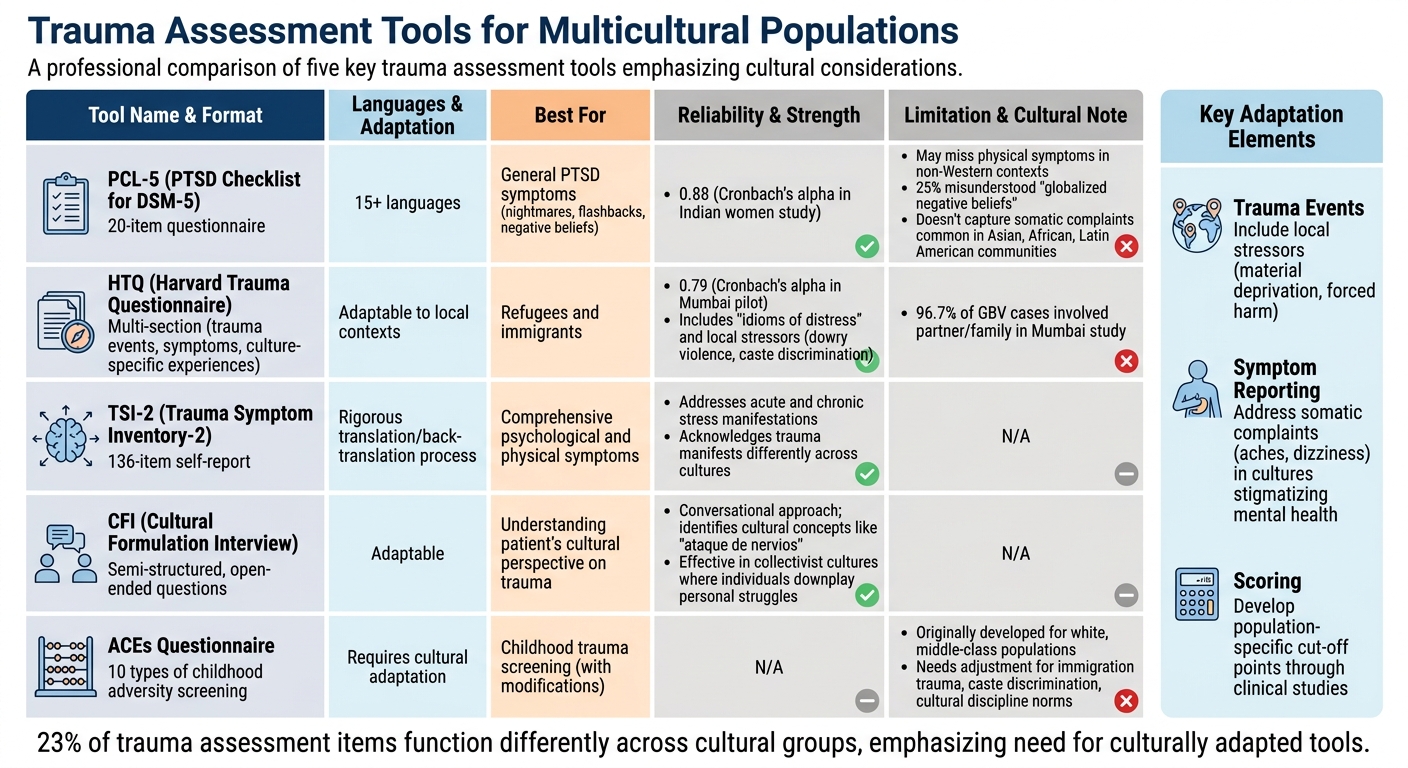
Comparison of Trauma Assessment Tools for Multicultural Populations
Selecting the right tool for trauma assessment can make the difference between an accurate diagnosis and missed opportunities for healing.
Below are examples of tools designed to address trauma within diverse cultural contexts.
PTSD Checklist for DSM-5 (PCL-5)
The PCL-5 is a 20-item questionnaire that evaluates symptoms such as nightmares, flashbacks, and negative beliefs over the past month. Available in over 15 languages, it aims to improve accessibility for global populations [4].
However, cultural differences can shape how symptoms are reported and understood.
For example, a 2022 study involving Indian women found the PCL-5 to be reliable (Cronbach's alpha = 0.88) [5].
While symptoms like nightmares and flashbacks were consistently recognized, others - such as "globalized negative beliefs" - were misunderstood by 25% of participants [4][5].
"Culture provides the lens through which we experience, interpret, and communicate distress." – Camila Jensen [4]
In many Asian, African, and Latin American communities, trauma often manifests through physical symptoms like headaches or fatigue. If a patient scores low on the PCL-5 but seems visibly distressed, clinicians should explore physical complaints and interpersonal challenges to gain a more complete understanding of their experience [4].
Harvard Trauma Questionnaire (HTQ)
The Harvard Trauma Questionnaire is specifically designed for refugees and immigrants, incorporating "idioms of distress" - expressions of suffering unique to specific cultures [5].
The tool includes sections that address trauma events, symptoms, and culture-specific experiences, making it adaptable to various contexts. For example, it can include stressors like dowry-related violence or caste-based discrimination [3][5].
A pilot study in Mumbai tailored the HTQ to local experiences, achieving a reliability score of 0.79 (Cronbach's alpha). This version added a 12-item scale for symptoms such as tension and "heat in the head", reflecting culturally relevant expressions of distress [5].
"Idioms of distress are locally shaped and culturally recognizable forms of suffering... not included in psychiatric diagnostic criteria precisely due to their local - rather than universal - relevance." – BMC Women's Health [5]
The HTQ also evaluates ongoing stressors like poverty or family abuse.
For instance, a study in Mumbai revealed that 96.7% of gender-based violence cases involved a partner or family member, emphasizing the importance of family-centered trauma assessments in multicultural settings [5].
Trauma Symptom Inventory-2 (TSI-2)
The TSI-2 is a 136-item self-report tool that assesses a wide range of trauma-related symptoms, including those linked to acute and chronic stress.
Its strength lies in addressing both psychological and physical symptoms, acknowledging that trauma can manifest differently across cultures.
To ensure its effectiveness in diverse populations, the TSI-2 undergoes rigorous translation and back-translation processes, along with expert reviews. This ensures that the tool is both linguistically accurate and culturally relevant [3][4].
Cultural Formulation Interview (CFI) from DSM-5
The CFI is a semi-structured interview designed to explore how a patient's cultural background influences their trauma experiences and treatment preferences.
Unlike standardized questionnaires, the CFI uses open-ended questions, encouraging patients to describe their distress in their own words.
The interview covers areas such as the cultural definition of the problem, perceptions of its cause, and factors affecting coping and help-seeking.
For example, it helps identify "cultural concepts of distress" like ataque de nervios to prevent misdiagnosis [4]. This conversational approach is especially effective in collectivist cultures, where individuals might downplay personal struggles to avoid burdening their families [4].
"Cultures have different worldviews, and different ways of describing and labeling emotional distress and human suffering." – Harvard Program in Refugee Trauma [3]
Adverse Childhood Experiences (ACEs) Questionnaire
Originally developed for white, middle-class populations, the ACEs Questionnaire requires adjustments to address culturally specific stressors like immigration trauma or caste-based discrimination. The tool screens for ten types of childhood adversity, including abuse, neglect, and household dysfunction.
However, cultural norms can influence how questions are interpreted. For instance, practices considered abusive in one culture might be seen as acceptable discipline in another. While high ACEs scores are linked to poorer health outcomes, their clinical significance may vary by population. Clinicians should use the questionnaire as a starting point, supplementing it with open-ended questions to explore how childhood experiences shape the patient’s current well-being.
|
Adaptation Element |
Consideration for Multicultural Care |
|---|---|
|
Trauma Events |
Include local stressors (e.g., material deprivation, forced harm) [3] |
|
Symptom Reporting |
Address somatic complaints (e.g., aches, dizziness) in cultures that stigmatize mental health issues [4][5] |
|
Scoring |
Develop population-specific cut-off points through clinical studies [3] |
How to Implement Trauma Tools in Multicultural Care
Selecting tools that respect cultural differences is essential, but the real challenge lies in integrating these tools into everyday practice. This process involves deliberate staff training, adapting tools to meet diverse needs, and using technology to streamline implementation. All of this works toward honoring cultural differences and improving patient outcomes.
Training Staff in Cultural Competence
The starting point for implementation is cultural humility - a commitment to ongoing self-reflection and addressing power imbalances in the patient-provider dynamic. Clinicians must accept that they’ll never fully understand another culture but can stay open to learning from each patient’s unique perspective.
It’s also vital to recognize that trauma for multicultural populations often has collective and historical roots. Events like forced migration, colonization, or systemic discrimination shape the trauma experience. Training programs should help clinicians see these broader contexts instead of viewing trauma as solely personal or isolated.
Another key skill is understanding cultural idioms of distress - the specific ways different cultures express emotional pain. For example, some individuals may describe "heaviness" or "heart pain" instead of using terms like "anxiety" or "depression." Teaching staff to listen for and validate these expressions helps avoid misdiagnosis and builds trust with patients.
Adapting Tools to Fit Different Populations
Once cultural competence is established, tools must be tailored to reflect the experiences of diverse populations. Achieving linguistic equivalence means going beyond literal translations to ensure that terms like "flashbacks" or "numbing" carry the same emotional and psychological meaning in the target language. The back-translation method is a helpful strategy: one bilingual expert translates the tool into the target language, and another translates it back to the original language to catch discrepancies.
"A culturally responsive assessment is not just a translated form; it is a process of understanding the patient's world." – American Psychological Association
Cultural adaptation goes deeper by incorporating the social, historical, and cultural factors that shape trauma. For instance, questions might address migration stress, caste discrimination, or other specific stressors relevant to the population.
Partnering with cultural brokers, such as community leaders or trusted members of the target group, ensures the tool resonates with patients and reflects their lived experiences.
Before rolling out the adapted tools, conduct pilot testing with a focus group from the target population. This step ensures the tools are clear, respectful, and relevant. For patients with low literacy, oral administration through trained interpreters can make the process more accessible.
Using Technology for Integration
Technology plays a powerful role in making these tools more accessible and effective. Platforms like Opus Behavioral Health EHR offer multiple translated versions of assessments, allowing clinicians to seamlessly switch between languages while maintaining consistent data.
The system’s outcomes measurement tools track standardized metrics like the PCL-5 or HTQ across demographic groups, delivering real-time dashboards to monitor progress and identify trends.
Automated templates streamline trauma-informed workflows, reducing manual errors and giving clinicians more time to focus on patients.
For individuals facing barriers like transportation or scheduling conflicts, telehealth integration and patient portals allow remote completion of assessments and follow-ups.
The platform also features field-level record segmentation, which protects sensitive trauma data by restricting access based on patient consent, in compliance with 42 CFR Part 2 regulations. When patients transition between care levels, their trauma histories and assessment scores move with them, ensuring seamless continuity for the care team.
Benefits and Evidence Supporting Multicultural Trauma Assessments
1. More Accurate Diagnoses
Standard PTSD criteria developed in Western contexts often fail to capture the full range of trauma responses across cultures.
For example, Vietnamese refugees and Kalahari bushmen were frequently underdiagnosed because they didn’t report "numbing-avoidance" symptoms, despite experiencing high levels of intrusive symptoms [1]. This mismatch, referred to as a "category fallacy", highlights the flawed assumption that Western psychiatric categories apply universally.
Culturally adapted tools help bridge this gap by addressing symptoms that standard checklists might miss, such as somatic complaints.
Research has shown that 23% of trauma assessment items function differently across cultural groups, emphasizing the need for tools that reflect culturally specific trauma expressions. A meta-analysis of 47 studies involving 12,487 participants from the Middle East found that rigorous linguistic adaptations significantly improved the validity of these instruments (β = 0.43, p < 0.001) [7].
These advancements in diagnosis not only enhance accuracy but also lay the groundwork for stronger patient-clinician relationships.
2. Better Patient Engagement and Trust
When trauma assessments align with cultural contexts, they do more than just improve diagnostic accuracy - they foster trust between patients and providers. Clinicians who practice cultural humility can create a safer environment where patients feel more comfortable sharing deeply personal experiences. This approach is especially critical for patients who might otherwise feel alienated or misunderstood [6].
Language plays a central role in this dynamic. Using culturally familiar terms like "thinking too much" or "khyâl attacks" instead of strictly Western psychiatric jargon can help reduce stigma and build mutual understanding [1].
As noted in an analysis:
"Understanding the client's interpretation of reactions - invariably influenced by the prevailing cultural interpretation - and providing treatment congruent with the client's explanatory model appears to be the most 'active ingredient' in culturally adapted treatment." - Psychiatry Online [1]
When clinicians align their assessments with a patient’s worldview, it fosters a collaborative dialogue rooted in respect and shared understanding.
3. Improved Outcomes Through Personalized Care
Tailored trauma assessments set the stage for culturally adapted interventions, which have been shown to deliver better results.
A meta-analysis of 21 studies revealed that culturally adapted treatments outperformed standard approaches (d = 0.32) [1].
Another analysis found these interventions significantly reduced PTSD symptoms (standardized mean difference of -0.67) and anxiety symptoms (difference of -1.92) [6]. Additionally, culturally adapted tools demonstrated stable measurement invariance (CFI change < 0.01), ensuring consistent and reliable results [7].
Conclusion: Advancing Multicultural Trauma Care with the Right Tools
Key Takeaways
Providing effective trauma care for multicultural populations means moving beyond conventional Western frameworks.
This involves practicing cultural humility and understanding how different communities express and experience distress. Standard diagnostic tools often overlook culturally specific symptoms, which are vital for accurate assessments. A key step is understanding each patient’s explanatory model - how they perceive the cause and nature of their suffering.
Technology plays a pivotal role in delivering culturally responsive care. Modern behavioral health platforms can feature adapted screening tools, visual analog scales for patients who struggle with numeric ratings, and comprehensive documentation of medical, behavioral, and social needs.
For example, Opus Behavioral Health EHR offers customizable workflows that allow organizations to tailor forms and processes to align with the cultural needs of diverse patient groups. Its AI-powered documentation tools also help clinicians manage complex reporting requirements without sacrificing care quality.
Research shows that culturally adapted treatments are more effective than standard approaches (d=0.32) [1].
True adaptation goes beyond translation - it involves creating environments that prioritize cultural safety. This includes respectful communication, welcoming physical spaces, and addressing power imbalances between providers and patients.
Next Steps
To bring these strategies into practice, begin by incorporating tools like the DSM-5 Cultural Formulation Interview (CFI), which bridges Western diagnostic methods with the cultural perspectives of individual patients.
Training staff is equally important, focusing on both cultural competence and cultural humility - an ongoing process of self-reflection and addressing inequities in care. Assess your current trauma evaluation methods to identify gaps in recognizing culturally specific expressions of distress.
Invest in platforms that support these efforts with features like configurable workflows, multilingual support, and outcomes tracking.
With roughly 70% of the global population experiencing traumatic events [1], the effectiveness of care depends on tools and training that align with patients’ lived experiences. Moving forward requires continuous learning, thoughtful adjustments, and a commitment to centering patients’ voices in their healing process.
FAQs
How do I choose the right trauma assessment tool for a specific cultural group?
When selecting a trauma assessment tool, it's essential to focus on relevance and sensitivity to the individual's cultural background. While widely used instruments like CAPS-5 align with DSM-5 criteria, they might not fully capture how distress is expressed in different cultural contexts.
Look for tools that incorporate local idioms, culturally specific explanatory models, and unique emotional or behavioral responses.
At the same time, prioritize cultural safety by approaching assessments with humility, genuine curiosity, and a deep respect for the patient's cultural traditions and practices. This approach ensures that the assessment process is both respectful and effective.
How can clinicians adapt tools without changing what they measure?
Clinicians can modify trauma assessment tools to better serve diverse populations while keeping their core measurements intact. This involves integrating practices that respect and acknowledge a patient’s cultural background, beliefs, and ways of expressing distress.
For instance, asking questions that are culturally relevant and interpreting symptoms through the lens of the patient’s cultural context can make a significant difference.
Using language that is considerate and sensitive further ensures that assessments are both accurate and respectful. In some cases, consulting with cultural experts can provide additional insight, helping to refine the process and improve its effectiveness for patients from various backgrounds.
What’s the best way to handle somatic symptoms when PTSD screens look “normal”?
When PTSD screenings show no obvious signs but physical symptoms linger, trauma could still be a factor, manifesting through the body. It's important to use trauma-informed assessments that recognize how different cultures may express distress, often through physical complaints.
Tools like the Clinician-Administered PTSD Scale (CAPS-5) are useful, but combining them with culturally aware methods - such as practicing cultural safety and humility - can provide a deeper and more nuanced understanding of trauma-related physical symptoms.



- Behavioral Health
- EHR Systems
- Addiction Treatment EHR
- mental health
- Telehealth
- addiction treatment
- Behavioral health facility
- Substance Abuse Disorder
- behavioral Health center
- HIPPA Compliant
- ehrsoftware
- PTSD
- behavioral health ehr
- Depression
- hipaa
- Anxiety
- MentalHealthMatters
- RCM
- claim denials
- clinical documentation
- mental health awareness
- screening tools

September 15, 2026
September 15, 2026

September 14, 2026

September 11, 2026

September 10, 2026
September 09, 2026
Recommended Posts
Tuesday, March 10, 2026
How PTSD Screening Tools Improve Patient Outcomes
PTSD often goes undiagnosed, leading to severe health issues and higher costs. Screening tools like PC-PTSD-5 and PCL-5 ...
Tuesday, July 28, 2026
5 of the Best Free PTSD Assessment Tools— Ranked
Tired of PTSD tools that overpromise and underdeliver? Start with these three free, clinician-trusted options for ...

Thursday, July 02, 2026
Best Practices for Child PTSD Screening
Child PTSD screening is essential for identifying trauma responses early, ensuring children receive appropriate ...