

Behavioral health practices face unique billing challenges that general medical software often overlooks.
High claim denial rates, coding errors, and compliance hurdles can severely impact revenue. Specialized billing software addresses these issues by automating processes, ensuring compliance with regulations like 42 CFR Part 2, and improving efficiency.
This guide compares six top platforms tailored for behavioral health billing:
Opus Behavioral Health EHR: Combines EHR, CRM, and billing tools with AI-powered documentation and real-time insurance checks.
Passage Health: Focused on ABA therapy with robust authorization tracking and automated claim submission.
TherapyNotes: Ideal for small practices, offering structured note templates and basic claim management.
CentralReach: Designed for large ABA and autism care organizations, featuring AI-driven compliance tools and multi-location support.
Ensora Health: Offers flexible plans for mental health providers, with automated claims and built-in billing checks.
TherapyPM: Affordable option for solo and growing practices, with claim scrubbing and Medicaid billing tools.
Each platform is designed to reduce errors, improve claim approval rates, and streamline workflows. Below is a quick comparison to help you choose the best fit for your practice.
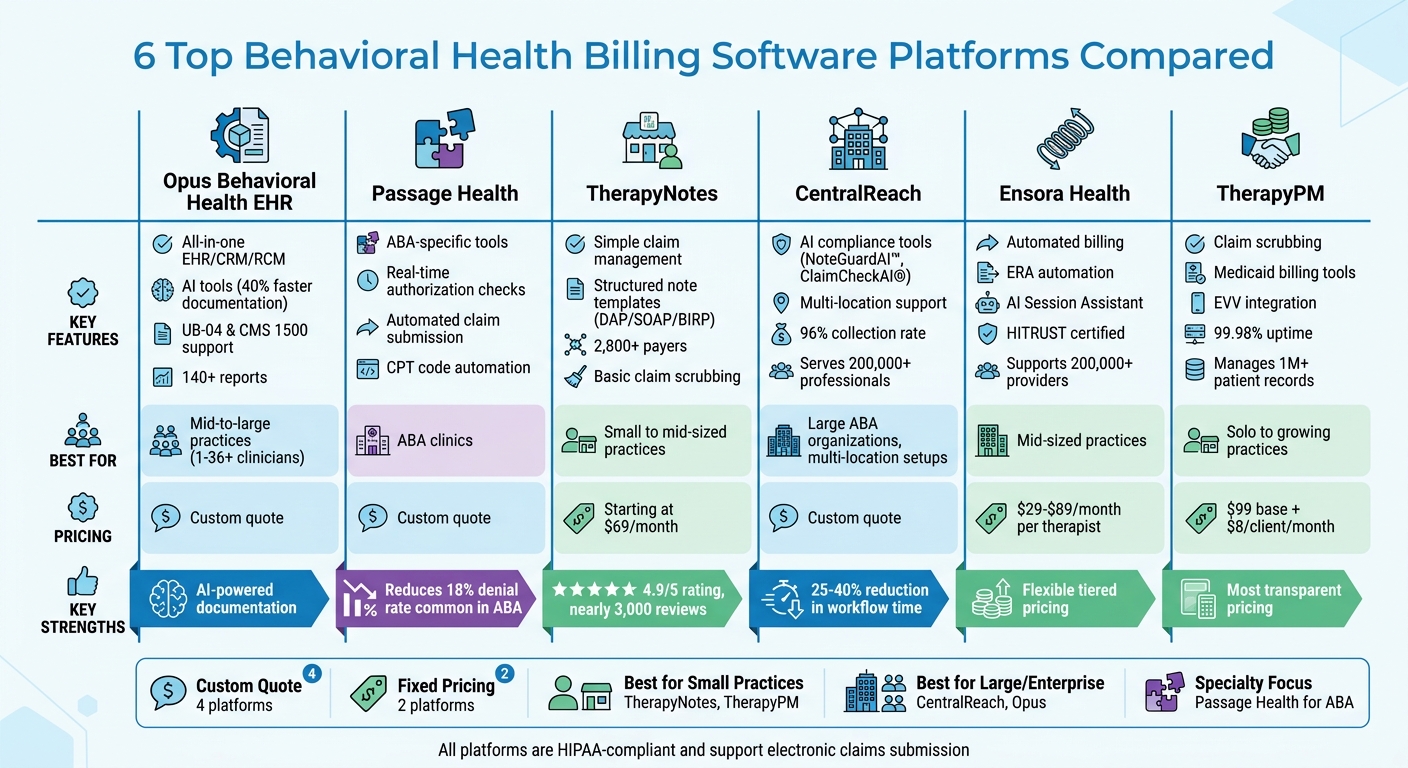
Behavioral Health Billing Software Comparison: Features, Pricing & Best Use Cases
Quick Comparison
|
Software |
Key Features |
Best For |
Pricing |
|---|---|---|---|
|
Opus Behavioral Health EHR |
All-in-one EHR/CRM/RCM, AI tools, UB-04 & CMS 1500 support |
Mid-to-large practices |
Custom quote |
|
Passage Health |
ABA-specific tools, real-time authorization checks |
ABA clinics |
Custom quote |
|
TherapyNotes |
Simple claim management, note templates |
Small practices |
Starting at $69/month |
|
CentralReach |
AI compliance tools, multi-location support |
Large ABA organizations |
Custom quote |
|
Ensora Health |
Automated billing, flexible plans |
Mid-sized practices |
$29–$89/month per therapist |
|
TherapyPM |
Medicaid billing, affordable pricing |
Solo to small practices |
$99 base + $8/client/month |
Use these insights to find the right software to simplify billing, reduce denials, and boost your practice's financial health.
1. Opus Behavioral Health EHR
Opus Behavioral Health EHR offers an all-in-one solution tailored for addiction, substance use disorder (SUD), and behavioral health treatment centers. It combines clinical documentation, customer relationship management (CRM), and revenue cycle management (RCM) into a single platform, simplifying care management from intake to billing [3].
Compliance & Security
Opus meets stringent industry standards, holding certifications like PCI DSS Level 1, ISO 27001, FISMA Moderate, and SOC 1/SSAE 16/ISAE 3402. It employs advanced security measures, including 2048-bit encryption for TLS communications and 256-bit encryption for session tokens (using JWT with HMAC-SHA256).
Administrators can enforce location, IP, and time-based access restrictions to comply with state residency laws. Built on enterprise-grade cloud infrastructure, the platform features 24/7 intrusion monitoring, integrated threat intelligence, multi-factor authentication (MFA), and single sign-on (SSO) for maximum data protection.
"As a customer of Opus, you own and control your data. Opus does not use your data for anything other than providing you with the service that you have subscribed to."
Opus Behavioral Health [3]
Automated Claims Management
Opus simplifies billing by supporting both UB-04 and CMS 1500 claim forms for inpatient and outpatient services.
Its Automated Verification of Benefits (VOB) tool ensures insurance coverage is confirmed before treatment begins, minimizing eligibility-related denials. The platform’s AI-powered "Copilot AI" scribe reduces documentation time by 40% by automating progress note creation.
Collaborating with Collect Rx,Opus delivers billing and coding solutions specifically designed for behavioral health and SUD clinics.
Integrated telehealth features automatically log session details - start and end times, attendance records - providing proof of care for insurance claims.
Additionally, its Text-to-Pay functionality enables patients to quickly pay balances via SMS links. With over 140 practice management reports, administrators can track billing efficiency, catch errors, and refine revenue cycles.
"Having our EHR seamlessly connected with billing has eliminated the documentation gaps that used to cause claim denials."
Lisa Chen, Practice Administrator, Behavioral Health Center [5]
Integration Features
Opus streamlines workflows through integrations that reduce redundancy. Its Lab Module allows users to order tests and view results directly within the EHR, removing the need for external portals.
The e-prescribe feature links with clinical notes and diagnoses, helping to minimize errors. Through its partnership with Curogram, the platform enables HIPAA-compliant SMS-based payment links that connect directly to Opus.
This integration allows billing staff to manage payments from within the system, avoiding the hassle of switching between tools or re-entering data.
"Curogram gives Opus EHR practices a single platform to handle patient payments without the usual headaches. The system connects directly to Opus, so your billing staff does not need to switch between tools or enter data twice."
Curogram [4]
Pricing Options
Opus offers flexible pricing plans to accommodate practices of varying sizes:
Basic Plan: Designed for smaller practices with up to 10 clinicians, this plan includes essential EHR, CRM, basic RCM, telehealth, and customizable workflows.
Standard Plan: Ideal for mid-sized practices with 11–20 clinicians, it builds on the Basic plan by adding advanced RCM, AI-powered documentation, and lab integration.
Premium Plan: Geared toward larger organizations with 21 or more clinicians, this plan features enhanced reporting and outcomes measurement tools.
All plans typically include installation, training, customer support, and data migration to ensure a smooth onboarding experience [1][6].
2. Passage Health
Passage Health is tailored specifically for Applied Behavior Analysis (ABA) practices, addressing the unique challenges of authorizations and coding that often lead to higher denial rates - well above the 18% average seen in other areas of healthcare [2].
By integrating scheduling, clinical documentation, and billing into one streamlined workflow, the platform eliminates the inefficiencies that arise when these functions operate independently.
Compliance & Regulations
The software helps practices avoid compliance issues by monitoring authorization limits in real-time, ensuring sessions are scheduled within approved hours before claims are even submitted [2].
This proactive approach reduces denials caused by exceeding authorized hours. It also automatically links therapy sessions with the appropriate provider credentials and CPT codes, applying payer-specific rules to minimize manual errors that can lead to regulatory scrutiny [2].
To maintain HIPAA compliance, Passage Health uses encrypted data transmission, secure logins, detailed access controls, and thorough audit logs [2].
"With Passage we are able to move more efficiently, it is a game changer. The system is seamless. The onboarding experience was amazing and ongoing support is really proactive."
Liza Ozowara, Executive Director, Agape [7]
Claims Management & Automation
Passage Health simplifies the claims process by automating the transition from therapy sessions to claim submission. It pulls session details, provider credentials, unit counts, and payer-specific rules into claims, eliminating the need for repetitive data entry [2].
Billing teams can submit claims in bulk with just a few clicks, while the system flags compliance issues or missing documentation before submission [8].
By tracking denials and identifying their root causes - such as incorrect coding or incomplete documentation - practices can address recurring problems and protect their revenue streams [2].
Integration Capabilities
The platform’s mobile app allows therapists to document sessions and capture required information on-site, syncing instantly with the billing system [3, 13].
This real-time connection ensures that clinical documentation aligns with billing codes as care is delivered. Passage Health also supports multi-location practices, coordinating billing workflows and payer routing seamlessly as organizations grow [2].
Additionally, its credential tracking feature keeps provider certifications organized, ensuring that billing is always tied to appropriately qualified team members [8].
3. TherapyNotes
TherapyNotes is tailored to meet the specific needs of solo practitioners and small group therapy practices. It combines scheduling, documentation, and billing into one platform to address the unique challenges of behavioral health care [9].
With nearly 3,000 reviews and an impressive 4.9/5 rating, it’s particularly valued for its structured clinical note-taking, designed to align with payer requirements [10].
Compliance & Regulations
TherapyNotes is ONC-certified and adheres to HIPAA standards through secure telehealth, encrypted messaging, and a client portal. It also supports 42 CFR Part 2 requirements, ensuring privacy for substance use treatment records [9][12].
The platform offers templates for DAP, SOAP, and BIRP notes, guiding clinicians through necessary documentation sections to help prevent incomplete records. Integration with the Wiley Practice Planners library allows clinicians to incorporate evidence-based goals and interventions into treatment plans effortlessly [12].
Additionally, TherapyNotes includes features to assist with compliance under the No Surprises Act [9].
Claims Management & Automation
TherapyNotes simplifies the claims process with electronic submission to over 2,800 payers nationwide through a national clearinghouse [11]. The system flags potential billing issues - errors are marked in red, while discrepancies are highlighted in yellow - before claims are submitted [13].
Insurance payments are automatically posted via Electronic Remittance Advice (ERA) files, eliminating the need for manual data entry [12]. The platform also calculates appointment rates based on insurance schedules, patient-specific rates, or set defaults, and generates superbills directly from clinical notes [12].
To avoid billing disputes, practices can verify patient insurance coverage in advance with the Real-Time Eligibility (RTE) feature [11]. For billing, TherapyNotes charges $0.14 per electronic claim under the standard plan or offers an unlimited claims plan for $65/month, with a break-even point at roughly 465 claims per month [12].
Integration Capabilities
TherapyNotes functions as an all-in-one system, minimizing the need for additional third-party tools [12]. Its primary external integration is with the Wiley Practice Planners library, which ensures treatment plans meet payer documentation standards [12].
The platform also includes built-in payment processing and integrates with a national clearinghouse for claim tracking [12]. Providers can use the free TherapyNotes Mobile app to manage schedules and access records on the go [12].
Patient demographics and insurance data can be imported via CSV files, with free migration assistance available [12].
However, the system does not support UB-04 claim forms required for Intensive Outpatient Programs (IOP) or residential facilities, making it suitable only for practices that handle CMS-1500 professional claims [9].
Pricing & Scalability
TherapyNotes costs $69/month for solo practitioners, with additional users priced at $39/month each [12]. Telehealth and patient portal features are included in the base subscription [12].
The platform is ideal for solo and small-to-mid-size practices with up to 15–20 clinicians. However, it lacks advanced tools for multi-site management or detailed role-based controls, which larger enterprise organizations may require [12].
Most solo practitioners can begin using the platform within one to three days, making it a straightforward solution for smaller teams [12]. These pricing and operational features highlight TherapyNotes' focus on streamlining workflows and maintaining compliance.
4. CentralReach
CentralReach supports over 4,000 ABA and multidisciplinary practices, serving more than 200,000 professionals [17].
The platform is designed specifically for ABA providers and autism care organizations, focusing on compliance-first workflows and AI-powered automation to ease administrative tasks.
Compliance & Regulations
CentralReach adheres to strict compliance standards, including HIPAA, SOC2, FERPA, and PCI, with annual evaluations conducted by BDO, a respected accounting and consulting firm [15].
Tools like NoteGuardAI™ and ClaimCheckAI® help ensure compliance by reviewing documentation for errors and auditing claims for inaccuracies [17].
The platform also aligns with BACB Ethics Standard 2.06, which mandates accuracy in billing and reporting. Its authorization management features validate scheduling to ensure services stay within payor-approved limits for frequency and units [14][16].
Claims Management & Automation
CentralReach simplifies claims processing with AI-driven tools. ClaimAcceleratorAI™ automates claim checks and routes clean submissions to payors, speeding up reimbursement times [17].
The platform integrates with Change Healthcare for electronic claims processing, eligibility checks, and remittance advice [18]. Clinical session data is automatically populated into CMS-1500 forms, reducing the risk of manual errors [18].
For example, in March 2026, Affinity Autism Services implemented CentralReach’s revenue cycle tools and saw a 25–40% reduction in workflow time. Operations Manager Darcie Bugden shared:
"What used to take hours of manual review now happens in minutes. The AI doesn't just identify issues, it prepares everything we need to bill" [23].
Additionally, practices using CR BillMax managed billing services have achieved collection rates of up to 96% for insurance payor billing [19].
Integration Capabilities
Beyond claims management, CentralReach enhances workflows with its integration features. It connects scheduling, clinical documentation, and billing systems into a unified platform [16].
Its REST-based Public API enables integration with third-party payroll and Human Capital Management systems, using HTTPS and JSON Web Tokens to ensure HIPAA-compliant data exchanges [20].
Digital assessments like ABLLS-R® and AFLS® seamlessly integrate behavior data, while the AI assistant cari™, trained on over a billion data points, further boosts efficiency [17][21][22].
Pricing & Scalability
CentralReach’s pricing is not publicly listed; instead, practices must schedule a consultation for a quote tailored to their specific needs [17][19].
The platform supports multi-office setups with centralized dashboards, making it a strong choice for larger organizations managing multiple locations [18]. However, its specialization in ABA and autism care means it may not be as effective for practices outside this focus area.
5. Ensora Health
Ensora Health supports over 200,000 providers across 28,000 U.S. practices [27]. It operates two specialized EHR platforms: TheraNest, focused on mental and behavioral health, and Fusion, designed for rehabilitative therapy needs [27].
Both platforms are HITRUST certified and fully HIPAA-compliant, ensuring a secure environment for managing sensitive patient information [25].
Compliance & Regulations
Ensora’s Clearinghouse streamlines claims processing by automating claims scrubbing and verifying patient eligibility instantly [24].
For mental health professionals, the AI Session Assistant generates SOAP notes while ensuring client data is excluded from AI training, prioritizing patient privacy [25]. Additionally, ERA automation monitors reimbursements and flags potential coding issues, reducing the risk of compliance audits [24][25].
These tools integrate seamlessly into Ensora’s billing processes, creating a more efficient and compliant workflow.
Claims Management & Automation
TheraNest simplifies billing by automating tasks like invoice creation, claim submission, ERA posting, and even batch processing. Any flagged exceptions are consolidated into a single, easy-to-manage queue [24][25][28][29].
Dr. Stephanie Milne, CEO of Emery Milne Psychological Group, highlighted the platform’s impact:
"Ensora RCM has decreased the number of [rejected] claims and payment processing times, [allowing me] to focus on my clients" [26].
Similarly, Ryan Camlin from Alta Pediatrics shared:
"We've gotten to a place where we had tons of open invoices or services that we provided that we didn't really get paid for, to now, we're really getting paid almost every single day" [26].
Pricing & Scalability
Ensora offers flexible pricing to accommodate practices of all sizes while optimizing compliance and automation.
Essentials plan: $29/month per therapist, includes unlimited clients and scheduling but excludes insurance billing [28].
Advanced plan: $59/month per therapist, covers 30 claims and 30 eligibility checks monthly, with additional claims priced at $0.23 each [28].
Premier plan: $89/month per therapist, provides unlimited claims and eligibility checks along with full automation tools [28].
For practices seeking additional support, RCM Essentials offers flat-fee insurance claim management, while RCM Advanced provides comprehensive billing assistance, including monthly meetings [26]. Credit card processing fees are set at 2.99% + $0.30 per transaction [28].
6. TherapyPM
TherapyPM supports over 500 therapy clinics across the U.S. and Canada, managing more than 1 million patient records with a 99.98% uptime rate [31].
Designed specifically for the unique challenges of behavioral health billing, the platform delivers advanced features for compliance, automation, and integration. It caters to multi-provider practices, including ABA, speech, occupational, physical, and mental health services [32].
Compliance & Regulations
TherapyPM prioritizes security and compliance, holding certifications such as HIPAA, HITRUST, SOC 2, and GDPR [30]. With role-based access controls and detailed audit trails, the platform ensures secure data management. Every practice also receives a Business Associate Agreement (BAA) [31].
For those handling Medicaid billing, TherapyPM integrates with Sandata for Electronic Visit Verification (EVV) - a must for ABA and home-based services [31].
Its documentation tools, covering progress notes, treatment plans, and assessments, are built to withstand audits [31]. Additionally, the platform includes coding checks to cross-reference claims against payer standards, helping to minimize denials [30].
Claims Management & Automation
TherapyPM streamlines the revenue cycle by automating key processes. It scrubs claims for errors before submission, verifies insurance eligibility instantly, generates CMS-1500 forms, and simplifies reconciliation with ERA and 277 CA report scrubbing [30][32][33].
Keith B. from Lassen ABA highlighted its practical benefits:
"We are able to use TherapyPM practice management software to manage multiple sites in various counties. The most impactful features are scheduling and the ability to conduct payroll from the scheduling" [31].
Integration Capabilities
TherapyPM integrates with various tools to enhance workflows as practices grow. It connects with data partners like HiRasmus and Motivity, clearinghouses such as Inovalon and Etactics, and financial tools like QuickBooks, Paycom, and Paystri [32][33].
These integrations make scaling operations more efficient.
Pricing & Scalability
TherapyPM offers a flexible pricing model. The monthly base fee is $99, with an additional $8 per active client [31][32]. It includes a 30-day free trial, requires no credit card, and has no long-term contracts [31].
For practices needing clearinghouse services, an optional $50 monthly plan covers 75 electronic claims and 20 eligibility checks, with extra claims priced between $0.25 and $0.35, depending on volume [34]. The setup includes a one-time $25 enrollment fee, while training and data migration are free [34][33].
Hannah from Adult Speech Therapy shared her positive experience:
"I love the fact that it is so easy to use. The system itself isn't outdated like most others are. Very easy to navigate and move through!" [31].
Strengths and Weaknesses
This comparison helps you decide which platform aligns best with your billing needs. Each option brings its own benefits and compromises to the table.
Opus Behavioral Health EHR combines CRM, EHR, and RCM into one system. Its AI-driven documentation feature cuts note-taking time by 40%, making it suitable for practices ranging from solo providers to those with over 36 clinicians [1]. Pricing is available through custom quotes.
Passage Health caters specifically to ABA-focused practices. By verifying authorizations before sessions are scheduled and automating the mapping of session data to billing codes, it helps reduce claim denials. This is especially important in ABA therapy, where coding errors often lead to an 18% in-network claim denial rate [2]. Pricing is also based on custom quotes.
TherapyNotes is tailored for small to mid-sized practices, while CentralReach serves enterprise-level organizations. CentralReach offers advanced financial reporting and multi-location claims routing, but its setup can be complex for large-scale billing [2].
Ensora Health appeals to mid-sized practices, with users highlighting its easy-to-navigate interface that simplifies access to key billing features [2].
TherapyPM specializes in revenue cycle management, offering automated claim scrubbing to catch issues like missing modifiers or invalid codes before submission. Its pricing is straightforward: $99 as a base fee, plus $8 per active client each month [2].
Here’s a table summarizing the key points to help you compare:
|
Software |
Key Strengths |
Seamless Integration for Workflow Efficiency |
Pricing |
Best For |
|---|---|---|---|---|
|
Opus Behavioral Health EHR |
AI-driven documentation; supports UB-04 and CMS 1500; 140+ reports |
All-in-one CRM/EHR/RCM |
Custom quote |
Mid- to large-sized practices (1–36+ clinicians) |
|
Passage Health |
Pre-session authorization checks; CPT code automation |
ABA-specific integrations |
Custom quote |
ABA clinics |
|
TherapyNotes |
Basic claim scrubbing |
Limited third-party connections |
Custom quote |
Small to mid-sized practices |
|
CentralReach |
Automated compliance checks; multi-location claims routing |
Enterprise-level financial tools |
Custom quote |
Large, multi-location organizations |
|
Ensora Health |
Built-in billing rule checks |
Reliable payer integrations |
Custom quote; 21-day trial |
Mid-sized practices |
|
TherapyPM |
Automated claim scrubbing |
Standard integrations |
$99 base + $8/client/month |
Solo to growing practices |
Conclusion
Opus Behavioral Health EHR offers a streamlined, tailored billing solution that aligns with the unique needs of your practice. Designed to accommodate practices of all sizes, it ensures billing processes are precise and efficient.
For smaller practices with up to 10 clinicians, the Basic Plan includes core features like EHR, CRM, telehealth, basic RCM, and customizable workflows. Mid-sized practices with 11–20 clinicians benefit from the Standard Plan, which introduces advanced RCM, AI-powered documentation (cutting note-taking time by 40%), and lab integration [1].
Larger organizations with 21 or more clinicians can take advantage of the Premium Plan, featuring enhanced reporting tools with access to over 140 specialized reports to monitor billing performance and uncover revenue opportunities [1].
Opus tackles common billing hurdles through its integrated tools. The platform supports both UB-04 and CMS 1500 claim forms, simplifies complex authorization processes, and uses AI to close documentation gaps that often lead to claim denials. Its Automated Verification of Benefits (VOB) tool ensures insurance coverage is confirmed before treatment begins, while real-time eligibility checks help avoid authorization-related denials.
By combining CRM, EHR, and RCM systems into one cohesive platform, Opus eliminates inefficiencies caused by disconnected workflows. Clinical documentation is automatically linked to billing, reducing manual errors and ensuring compliance with regulations like 42 CFR Part 2
and HIPAA
.
To maximize your practice's revenue cycle management, evaluate your current denial rates and identify specific billing challenges, such as authorization limits, CPT coding errors, or documentation issues. Test Opus using scenario-based workflows that mimic your practice's billing complexities to see how it addresses your unique needs and prevents revenue leaks.
FAQs
How do I choose the right billing software for my behavioral health practice size?
To pick the best billing software for your practice, start by assessing how well it fits your current and future needs.
Look at factors such as your revenue model, the complexity of your workflows, and the volume of claims you handle.
For smaller practices, straightforward and budget-friendly options might be enough. On the other hand, larger practices often need more robust tools, including features for managing the entire revenue cycle and telehealth services. Choosing software that can grow with your practice is key - it helps streamline billing, reduce claim denials, and keep cash flow steady.
What features help prevent behavioral health claim denials the most?
To minimize behavioral health claim denials, certain tools and processes can make a big difference. These include:
Real-time insurance verification: This ensures that a patient's coverage details are accurate and up-to-date before services are provided, reducing the chance of claim rejections.
Automated claims scrubbing: This feature checks claims for errors, like incorrect codes or missing information, before submission, helping to catch issues early.
Advanced tools for common issues: These tools tackle problems like incomplete documentation, coding mistakes, and prior authorization requirements, which are often the reasons claims get denied.
Together, these features simplify the billing process, cut down on errors, and increase the likelihood of claims being accepted.
How can billing software support 42 CFR Part 2 and HIPAA compliance?
Billing software ensures compliance with 42 CFR Part 2 and HIPAA by incorporating key features like data encryption, secure claim tracking, and strict privacy protocols.
These measures safeguard sensitive patient data while meeting the legal requirements essential for behavioral health practices.



- Behavioral Health
- EHR Systems
- Addiction Treatment EHR
- mental health
- Telehealth
- addiction treatment
- Behavioral health facility
- Substance Abuse Disorder
- behavioral Health center
- HIPPA Compliant
- ehrsoftware
- PTSD
- behavioral health ehr
- Depression
- hipaa
- Anxiety
- MentalHealthMatters
- RCM
- claim denials
- clinical documentation
- mental health awareness
- screening tools

September 15, 2026

September 15, 2026

September 14, 2026

September 11, 2026

September 10, 2026

September 09, 2026
Recommended Posts

Tuesday, April 21, 2026
Best Behavioral Health Billing Software for Growing Clinics
Behavioral health clinics face billing challenges like high claim denial rates (18% on average), lengthy accounts ...

Monday, May 04, 2026
Behavioral Health Billing Software Reviews That Expose Real Gaps
Behavioral health practices face unique billing challenges, like complex authorization tracking, specialized CPT codes, ...

Tuesday, May 05, 2026
Billing Software Behavioral Health Clinics Use to Get Paid Fast
Behavioral health clinics face complex billing challenges, such as high claim denial rates (18%+), delays in rejections ...