
Behavioral health centers need tools to track where potential patients come from. This is crucial for improving admissions and ensuring marketing resources aren't wasted.
Modern CRMs offer features like lead tracking, follow-ups, and detailed reporting to help treatment centers increase conversions and reduce delays.
Here are six CRMs tailored for behavioral health:
Opus Behavioral Health EHR: Combines lead tracking with EHR and billing for a unified system.
LeadSquared Behavioral Health CRM: Focuses on multi-channel lead capture and marketing ROI.
New Resilience CRM: Simplifies admissions with real-time tracking and referral insights.
Nimble CRM: Affordable option for small teams, with strong automation and marketing tools.
Dazos Behavioral Health CRM: Advanced marketing automation and lead scoring for behavioral health.
Insightly Healthcare CRM: General-purpose CRM with customizable reporting and marketing features.
Quick Comparison:
|
CRM |
Best For |
Key Feature |
Limitation |
|---|---|---|---|
|
Opus Behavioral Health |
Clinical integration |
EHR and billing integration |
Limited marketing tools |
|
LeadSquared |
Marketing-focused centers |
Multi-channel tracking |
Requires API for EHR |
|
New Resilience |
Referral-driven growth |
Real-time iOS app tracking |
Lacks advanced automation |
|
Nimble |
Small teams or solopreneurs |
Affordable automation |
Needs HIPAA configuration |
|
Dazos |
Marketing-heavy facilities |
AI-powered lead scoring |
No built-in clinical tools |
|
Insightly |
General healthcare use |
Power BI integration |
Not designed for HIPAA |
Each platform has strengths for specific needs, from clinical workflows to marketing automation. Choose based on your center's priorities, whether it's simplifying admissions, tracking leads, or improving marketing ROI.
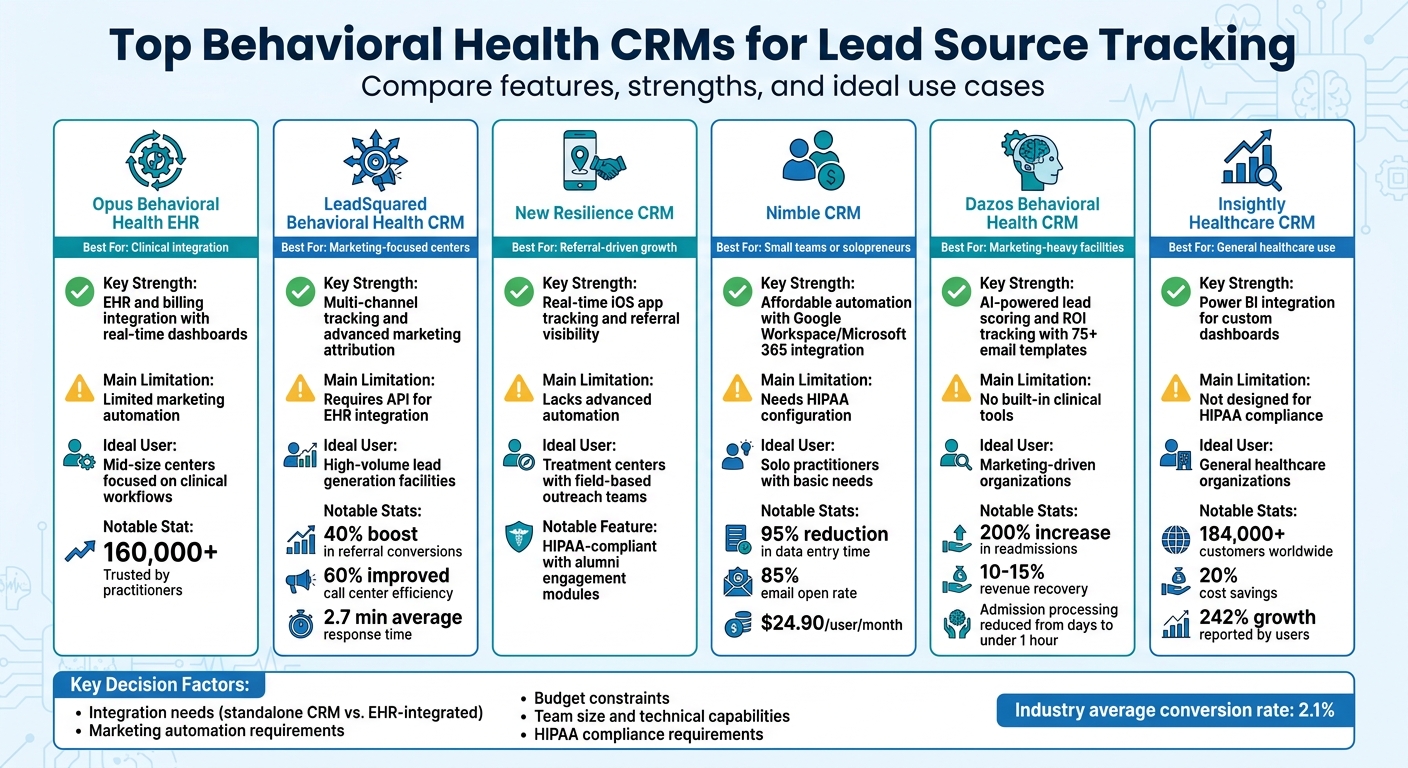
Behavioral Health CRM Comparison: Features, Strengths and Best Use Cases
1. Opus Behavioral Health EHR
Opus combines lead tracking with a unified platform that integrates EHR, billing, and clinical workflows.
This setup eliminates the hassle of duplicate data entry. When a potential patient reaches out, their information seamlessly transitions from the initial inquiry to admission and into their clinical record [1].
This streamlined approach helps treatment centers avoid the inefficiencies of juggling multiple systems and minimizes the risk of losing leads during manual data transfers. The result? Every lead is effectively tracked, nurtured, and converted.
Real-Time Tracking
Opus offers real-time insights into the entire patient journey, starting from the first inquiry all the way to admission [5][7]. When paired with tools like Curogram, admissions teams can receive instant updates on verification of benefits (VOB) while still engaging with the lead. This ensures managers can quickly pinpoint and address any delays in the process [5].
Automated Follow-Ups
Timing is everything. Opus sends instant auto-responses as soon as a lead is entered into the system [6]. It supports HIPAA-compliant texting, email, and calls to automate reminders, helping to reduce no-show rates and secure leads faster.
Text messages sent through the platform achieve an impressive 98% open rate [6]. Additionally, responding to inquiries within five minutes can boost conversion rates by 50% or more [6].
With intelligent lead routing, inquiries are directed to the right team member without delay, improving response times and increasing lead conversion [5].
Reporting Customization
Opus includes over 140 practice management reports, offering detailed insights into lead performance and marketing effectiveness [5].
It enables precise tracking of which channels and campaigns deliver the best ROI.
For example, Jennifer Gozy, PsyD, LP, Director of Clinical Systems and Compliance at Care Counseling Clinics, noted:
"We are excited to expand our ability to track and report on data so that we can improve our quality assurance and reporting processes" [5].
This level of reporting supports data-driven decisions that directly enhance admissions strategies.
Integration with EHR Systems
Unlike standalone CRMs that depend on complex third-party integrations, Opus’s CRM is built directly into its EHR system [1].
This integration automates the admissions process, including program assignments, care levels, and bed placements, eliminating manual steps [9]. The system also connects seamlessly with the Revenue Cycle Management (RCM) engine, ensuring data flows smoothly from lead capture through treatment and billing. This reduces the chances of revenue leakage and simplifies the entire process [8].
2. LeadSquared Behavioral Health CRM
LeadSquared brings all inquiries together in one place, capturing leads from various channels like web forms, chat, SMS, email, phone calls, and social media [10].
It also tracks the marketing source or campaign for each lead, helping practices pinpoint which strategies generate the most interest [10].
This multi-channel approach ensures no leads are overlooked and offers a clear view of where potential patients are coming from.
Real-Time Tracking
With interactive dashboards, users can monitor team productivity, appointment statuses, conversion metrics, and campaign ROI in real time [10][11][12].
The system has been shown to significantly improve response times, cutting them down to an average of 2.7 minutes [11].
This quick turnaround is crucial since faster follow-ups often lead to better conversion rates. As Tamara Young, Director of Marketing, explained:
"We're able to cut down our turnaround time responding to inquiries and reach out to and communicate with many more leads" [10][12].
Automated Follow-Ups
LeadSquared automatically routes leads to the right team member based on factors like service interest or location [11][13].
It also handles appointment reminders via SMS and email, along with re-engagement campaigns for waitlisted patients [15].
Organizations using this system have reported a 40% boost in referral conversions through automation [11][13], and call center efficiency has improved by 60% [10]. These automated processes not only save time but also enable highly detailed and customizable reporting.
Reporting Customization
The platform includes a Custom Report Builder and an Analytics Catalog, giving users the ability to create personalized reports with tailored metrics and visualizations [14].
Data from all tools can be consolidated into one central hub using pre-designed templates or custom insights [4][11].
This feature allows behavioral health providers to generate comprehensive reports on patient trends, marketing ROI, and team performance - no coding required [13][15]. Plus, this reporting functionality integrates seamlessly with EHR systems.
Integration with EHR Systems
LeadSquared ensures smooth, two-way integration with major EHR systems like AdvancedMD, Athena Health, and DrChrono [15].
Through its EHR-HL7 Connector and reliable APIs, the platform enables effortless data sharing between the CRM and clinical systems [13][15].
Appointments scheduled in the CRM are instantly updated in the EHR calendar, and communication history syncs back to offer a complete view of the patient journey [13][15]. As Kiran Ramakrishna, Assistant Manager, noted:
"LeadSquared's APIs and connectors help us collect detailed patient data and integrate it with our EHR system effortlessly" [15].
3. New Resilience Behavioral Health CRM
New Resilience offers a HIPAA-compliant CRM specifically designed for behavioral health organizations.
By replacing spreadsheets and generic CRMs, it centralizes admissions data to reduce the risk of missed leads and improve efficiency [16]. Let’s take a closer look at how its features enhance tracking, referrals, and reporting.
Real-Time Tracking
This CRM includes a dedicated iOS app that allows outreach and business development teams to log interactions in real time.
By doing so, it bridges the gap between fieldwork and office systems, ensuring no interaction goes undocumented. Kristin Calderon, from Averte’s Business Development team, shared:
"The iOS app has been a life saver with being able to document all of my Outreach and not lose out on any leads." [16]
Referral Visibility
The platform also provides detailed insights into marketing activities, tying them directly to referral growth. This level of transparency ensures organizations can see which efforts are driving results. Sarah Summey, CEO of Lakewood Center, highlighted this benefit:
"This is the first time we have real visibility into our Marketing efforts down to the last detail, while being able to correlate it to referral growth." [16]
Beyond analytics, the New Resilience Community fosters collaboration among treatment centers. This network helps organizations exchange referrals and connect clients with the right level of care more efficiently, ultimately speeding up the admissions process [16].
Reporting Customization
With its robust analytics tools, New Resilience empowers leaders to make informed, data-driven decisions.
These tools simplify admissions and marketing planning, offering the insights needed for strategic growth.
Dr. Michael Groat, CEO of Linder Center of Hope, emphasized its impact:
"Having analytics into our admissions and marketing processes provides us the right observability and leverage to take the right decisions. This is a game changer for us." [16]
The CRM tracks every step of the referral process - from the initial outreach to final admission - ensuring every lead is accounted for.
It also includes alumni engagement modules, enabling organizations to maintain communication with former clients at scale, turning them into a steady source of referrals [16].
4. Nimble CRM for Mental Health
Nimble builds on the tracking features found in other behavioral health CRMs by focusing on real-time insights and automation, making lead management more efficient.
Designed as a relationship-centered CRM, Nimble works seamlessly with Google Workspace and Microsoft 365, offering strong lead source tracking for mental health organizations.
In 2024, Forbes recognized Nimble as the Best CRM for Solopreneurs and Small Teams, while G2 named it a Leader in CRM for Spring 2024 [18].
Real-Time Tracking
Nimble excels at tracking lead sources by integrating with marketing attribution tools like Attributer.io. These tools capture UTM parameters to categorize website visitors as Paid, Organic, or Referral [17]. When a visitor submits a form, this attribution data is instantly sent to Nimble using connectors like Zapier or Make. This setup provides immediate insights into which marketing efforts are driving leads. Additionally, users can monitor email opens and clicks, helping them prioritize follow-ups with the most engaged prospects [17][2][19]. This level of real-time tracking lays the groundwork for Nimble's automated follow-up features.
Automated Follow-Ups
Nimble simplifies lead nurturing with customizable workflows that automate follow-ups [2][19]. Email sequences can be triggered based on client actions, ensuring consistent outreach without manual intervention. Ivana Taylor, Founder of DIYMarketers, described her experience:
"Nimble's email sequences and smart workflows turned my follow-ups into a fully automated, referral-generating machine." [18]
Another success story comes from Sandra Karamitelios, Director at Recruitment Central, who utilized Nimble's group messaging and tracking metrics in 2024.
By refining her strategy based on real-time feedback from the CRM, she achieved a 100% deliverability rate and an 85% open rate on her communications [18].
Reporting Customization
Nimble also stands out with its customizable reporting features. Clinics can analyze ROI with reports such as "Revenue by Facebook Ads Campaign" or "Customers by Google Ads Campaign", giving a clear view of marketing effectiveness [17].
The "Leads by Channel" report provides a month-over-month breakdown of lead growth, helping organizations allocate budgets wisely. Custom fields and Saved Segments allow for targeted data analysis [20][21].
Additionally, visual pipelines make it easy to track conversion rates at different stages of the intake process [2][19].
The Prospector tool further enhances efficiency by significantly reducing data entry time. In 2024, Tim Hughes, CEO and Co-Founder of DLA Ignite, reported cutting his team’s data entry time by 95% with this feature, which creates contact records instantly by hovering over names on LinkedIn [18].
Pricing starts at $24.90 per user per month for annual plans, with a 14-day free trial available [19][18].
Considerations for Mental Health Organizations
While Nimble offers powerful features, it is a general-purpose CRM and not specifically tailored for mental health. This means additional configuration may be necessary to ensure HIPAA compliance.
Furthermore, it lacks advanced healthcare-specific analytics and does not provide native integration with EHR systems, focusing instead on productivity tools [2][1].
5. Dazos Behavioral Health CRM
Dazos is specifically designed for behavioral health facilities, offering advanced marketing automation and lead nurturing tools that go far beyond simple tracking.
Established in 2018, the platform aims to meet the unique needs of addiction treatment and behavioral health providers. It combines real-time dashboards with revenue-focused analytics to not only track lead sources but also identify which ones drive admissions.
The system captures every step of patient interaction - from initial inquiry to billing - making it a powerful tool for optimizing lead conversion strategies [22][23].
Real-Time Tracking
With live dashboards, Dazos delivers up-to-the-minute insights into admissions, marketing, and billing metrics [22].
Its integration with CallRail automatically logs call data and links it to specific leads or campaigns, tracking key details like call duration, source, and outcomes [23]. Additionally, the Dazos IQ feature flags unpaid or underpaid claims in real time, enabling facilities to recover 10–15% more revenue [22].
Automated Follow-Ups
Dazos includes iCampaign, which offers over 75 pre-designed email templates for automated outreach [22].
Drip campaigns guide leads through personalized sequences, while automated task assignments ensure admissions teams follow up on all inquiries [1][23]. The iVerify tool simplifies insurance verification through a mobile app, cutting down on time spent on manual verification processes [22][23].
For example, Pathways Recovery Centers, a Midwest leader in detox and outpatient care, reduced its admission processing time from several days to under an hour and saw a 200% increase in readmissions after adopting Dazos in March 2026 [22].
Reporting Customization
Dazos allows users to customize fields, reports, and dashboards through a drag-and-drop interface, making it adaptable to specific workflows [23][24].
Its specialized Marketing Reports link campaign performance to referral sources, providing accurate ROI measurements. The platform also evaluates lead quality by showing the revenue generated from each referral source [22][23].
"Harmony needed a system that could analyze data across various locations to ensure optimal client placement based on reimbursement rates", says Mike Colasuonno, VP of Admissions and Growth Strategy at Harmony Health Group [22].
Referral Visibility
The platform’s marketing attribution reporting ties advertising spend directly to admissions, offering clear insights into which channels provide the best return [1].
For example, Atlas Healthcare Group in Los Angeles resolved integration issues with Google Ads and used Dazos IQ's claim flagging feature to boost its overall collection rate by 3.5–4% [22].
The system also tracks year-over-year metrics and long-term trends, helping facilities make informed decisions about staffing and marketing budgets [22]. This detailed attribution paves the way for seamless integrations that align admissions with clinical operations.
Integration with EHR Systems
Dazos supports bi-directional EMR integration through an open API, ensuring that admissions data flows smoothly into clinical records and that post-discharge updates are sent back to the CRM for alumni management [23][25].
This eliminates data silos between departments, allowing patient information to be easily accessible without manual re-entry.
While Dazos does require third-party integrations for clinical functions - unlike all-in-one platforms with built-in EHR capabilities - it offers more advanced marketing automation than standard CRM modules found in clinical systems [1].
Pricing is customized, with the iVerify VOB tool available on a pay-as-you-go basis [1][23].
6. Insightly Healthcare CRM
Insightly is a versatile CRM platform used by over 184,000 customers worldwide. It combines lead tracking, pipeline management, and automated marketing workflows into one system [27].
While it’s not specifically tailored for behavioral health, Insightly’s marketing automation tools and customizable reporting features can help treatment centers improve their lead tracking and referral management.
The platform's flexibility allows behavioral health centers to identify which referral channels work best. Insightly operates on a freemium model for basic tools, with healthcare-focused plans available via custom pricing. Many users have reported cost savings thanks to its all-in-one design [26].
Reporting Customization
Insightly excels at turning raw data into meaningful insights. By consolidating customer and pipeline data, it provides a clear view of lead status, contact details, and deal progress - all in one place [26].
One of its standout features is the integration with Power BI, which allows users to create detailed visual reports and custom dashboards to measure ROI by lead source [27].
Additionally, the AppConnect integration tool makes it easy to build custom workflows and connect with other systems without needing coding skills [26]. Insightly’s marketing automation also includes lead scoring, which helps admissions teams assess the quality of referral sources [26].
"We've improved sales velocity, access to actionable insights, and saved 20% by switching to Insightly's unified CRM and marketing platform", says Keith Gardner, Vice President of Sales & Marketing at Hurst Review [26].
These features make Insightly a strong option for organizations looking to streamline reporting and integrate data across departments.
Integration with EHR Systems
As a general-purpose CRM, Insightly wasn’t originally built with HIPAA compliance in mind [1][2].
Behavioral health centers using the platform should confirm whether it supports a Business Associate Agreement (BAA) and may need to implement additional security measures to comply with federal privacy regulations [1][2].
Additionally, Insightly doesn’t have built-in support for the complex referral networks common in addiction and mental health care, often requiring significant customization [1].
However, its scalability has been proven. For example, Sport Court Las Vegas reported a 242% growth after adopting Insightly’s full suite of tools, including CRM, marketing, and AppConnect integrations [26].
Strengths and Weaknesses
This section highlights the trade-offs each platform presents when it comes to behavioral health lead tracking and conversion.
Integrated platforms like Opus Behavioral Health EHR merge lead data with clinical records and billing, reducing duplicate entries and streamlining workflows [1][3]. That said, these systems often fall short in advanced marketing automation compared to CRM-first solutions [1].
On the other hand, CRM-first platforms such as Dazos and LeadSquared excel in marketing attribution and lead scoring, making it easier to connect advertising spend directly to admissions [1][4].
For instance, one facility using LeadSquared saw a 40% increase in responsiveness and managed double its previous lead volume [4].
The downside?
These platforms typically require third-party integrations to handle clinical functions, which can result in fragmented data [1].
Cost is another factor to consider. Some platforms charge separately for CRM modules, potentially driving up costs. However, options like Nimble are budget-friendly for solo practitioners, though they require extra setup to meet HIPAA compliance standards [2][28].
User experience also varies. Dazos has been praised for its simple, user-friendly modules that required minimal customization for organizations like Atlas Healthcare Group [22].
Meanwhile, Opus Behavioral Health EHR stands out for its intuitive design and automation features tailored to healthcare professionals [3].
Here’s a quick comparison of key platforms:
|
Platform |
Key Strength |
Main Limitation |
Best For |
|---|---|---|---|
|
Opus Behavioral Health EHR |
Seamless EHR integration with real-time dashboards [3] |
Limited marketing automation [1] |
Mid-size centers focused on clinical workflows |
|
LeadSquared |
Advanced marketing attribution across campaigns [4] |
Relies on API connectors [4] |
High-volume lead generation |
|
Dazos |
No native EHR/RCM functions [1] |
Marketing-driven organizations |
|
|
Nimble |
Requires configuration for HIPAA compliance [28] |
Solo practitioners with basic needs |
|
|
Insightly Healthcare CRM |
Power BI integration for custom dashboards [27] |
General healthcare organizations |
These comparisons can help organizations quickly identify which platform aligns with their specific operational priorities.
Conclusion
Selecting the best CRM for lead source tracking hinges on your organization’s specific needs and operational setup.
For facilities aiming to simplify their processes, a CRM that directly integrates lead data with clinical records can offer clear benefits, such as smoother workflows and fewer data entry mistakes.
A fully integrated CRM system enhances patient engagement at every step by aligning seamlessly with clinical workflows.
Take Opus Behavioral Health EHR for example. This platform embeds CRM features directly into its clinical tools, making it a great fit for mid-size centers. It eliminates the hassle of juggling separate systems while providing real-time analytics.
Trusted by more than 160,000 practitioners, Opus also includes automated follow-ups and referral tracking - without the added complexity of standalone CRM tools [3].
Well-designed CRM solutions can also help improve engagement and conversion rates by identifying weak points in the pipeline and enabling faster responses to inquiries. Considering the industry’s average conversion rate is just 2.1% [29], even small improvements can make a big difference.
Look for solutions with native integration to break down data silos and enhance compliance. It’s also critical to ensure the CRM supports both HIPAA and 42 CFR Part 2 compliance, especially when dealing with substance use disorder records. In behavioral health operations, native integration is key to boosting both efficiency and compliance.
FAQs
What lead sources should a behavioral health CRM track?
A behavioral health CRM should monitor essential lead sources to efficiently manage and analyze patient inquiries.
These sources include online campaigns like Google Ads and social media, referral partnerships, insurance companies, community outreach programs, and patient or alumni referrals.
By tracking these, treatment centers can evaluate marketing ROI, pinpoint the most effective channels, and refine their outreach strategies. This approach helps boost patient acquisition while simplifying the admissions process.
How can a CRM improve admissions conversion rates?
A CRM can improve admissions conversion rates by simplifying tasks such as inquiry routing and follow-ups, cutting down the time it takes to move from inquiry to admission through automated workflows.
CRMs tailored for behavioral health bring even more benefits, like tracking leads, pinpointing the most effective referral sources, and providing real-time insights into the admissions pipeline.
These features reduce manual efforts, eliminate delays, and speed up bed assignments, making the entire admissions process smoother and more efficient.
What should I verify for HIPAA and 42 CFR Part 2 compliance?
To ensure the CRM handles electronic protected health information (ePHI) securely, look for features like data encryption, strict access controls, and comprehensive audit trails.
These are essential for meeting HIPAA standards and safeguarding sensitive information.
Additionally, confirm the CRM complies with 42 CFR Part 2, which focuses on protecting the privacy and security of records related to substance use disorder treatments. This ensures that the system respects confidentiality while adhering to legal requirements.



- Behavioral Health
- EHR Systems
- Addiction Treatment EHR
- mental health
- Telehealth
- addiction treatment
- Behavioral health facility
- Substance Abuse Disorder
- behavioral Health center
- HIPPA Compliant
- ehrsoftware
- PTSD
- behavioral health ehr
- Depression
- hipaa
- Anxiety
- MentalHealthMatters
- RCM
- claim denials
- clinical documentation
- mental health awareness
- screening tools

September 15, 2026

September 15, 2026

September 14, 2026

September 11, 2026

September 10, 2026

September 09, 2026
Recommended Posts

Wednesday, July 22, 2026
Behavioral Health CRM for Referral Management
Behavioral health referral management affects census, staff workload, billing flow, and patient access.
Monday, August 03, 2026
Top Metrics to Track in Behavioral Health CRMs
If you want more admissions, track the points where leads slow down or drop out.

Wednesday, June 10, 2026
EHR Integration for Pediatric Behavioral Screening Tools
Electronic health record (EHR) systems are transforming pediatric behavioral health care by integrating screening tools ...