

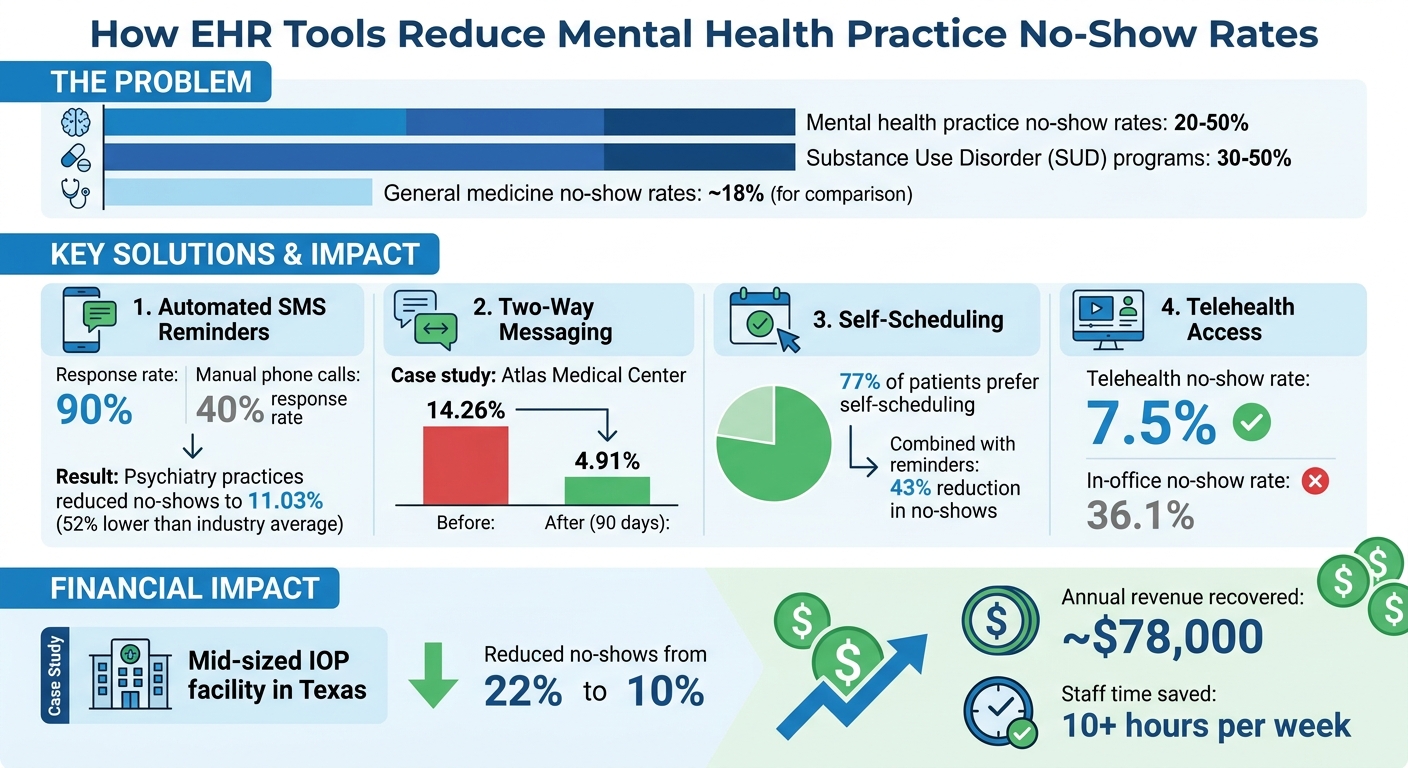
Missed appointments are a costly issue for mental health practices, with no-show rates ranging from 20% to 50%.
These absences disrupt care, reduce revenue, and waste valuable staff time. However, modern EHR software offers tools to address this challenge effectively.
Key solutions include:
Automated SMS reminders: Achieve up to 90% response rates, compared to 40% for manual calls.
Self-scheduling and rescheduling: Empower patients to manage appointments 24/7, reducing barriers.
Telehealth options: Virtual sessions lower missed appointments by removing transportation and scheduling hurdles.
Analytics tools: Identify trends, optimize scheduling, and track improvements in real-time.
For example, practices using automated reminders and telehealth have reduced no-show rates by over 50%, saving thousands annually while improving patient care.
These tools not only recover lost revenue but also ensure patients receive timely care, which is critical in behavioral health.
How EHR Tools Reduce Mental Health Practice No-Show Rates
EHR Features That Lower No-Show Rates
Automated Appointment Reminders
Modern EHR systems have transformed how practices communicate with patients by sending reminders through multiple channels.
One standout feature is two-way SMS, which allows patients to confirm, cancel, or reschedule appointments with a simple reply (e.g., texting "C" to confirm). Unlike one-way alerts, this interaction creates a small but meaningful commitment, increasing the chances that patients will show up [3][6][2].
Many practices use a "3-1-1" reminder schedule: sending messages three days before, one day prior, and one hour before the appointment [2]. This approach ensures the appointment stays on the patient’s radar, which is especially helpful for those managing anxiety or juggling busy lives.
For example, Atlas Medical Center saw a dramatic improvement in their no-show rate, dropping from 14.26% to 4.91% in just 90 days by adopting two-way messaging tools. This reduction was three times better than the industry average for manual workflows [6].
To build on this success, enhanced self-scheduling options further empower patients to manage their appointments effectively.
Patient Self-Scheduling and Rescheduling
Allowing patients to book and adjust their appointments gives them greater control, which helps eliminate common barriers. Research shows that 77% of patients prefer self-scheduling, as it allows them to book discreetly without explaining sensitive health concerns [7].
The most effective systems operate 24/7, capturing patient demand at any hour - especially crucial for mental health needs that often arise outside standard business hours.
When patients can reschedule via text or an online portal, they're more likely to adjust their plans rather than skip the appointment altogether. In fact, combining automated reminders with easy rescheduling options can cut no-show rates by as much as 43% [8].
"Ability to self-schedule, ability to communicate with patients via text and email, ability to adjust schedules with very little notice."
– Mckenzie H., Mend Testimonials [7]
Additionally, when a patient cancels through the system, the EHR can automatically notify waitlisted patients about the open slot. This not only helps maintain practice revenue but also ensures timely care for others in need [1][8].
Integrated telehealth options further enhance accessibility, removing even more barriers to care.
Telehealth Options to Remove Access Barriers
Virtual appointments have become a game-changer for reducing no-show rates. By eliminating challenges like transportation, childcare, and rigid schedules, telehealth makes healthcare more accessible. During the pandemic, telehealth visits had a no-show rate of just 7.5%, compared to 36.1% for in-office visits [10].
To maximize attendance, telehealth platforms should be as user-friendly as possible. Browser-based systems that don’t require downloads or logins allow patients to join appointments with a single click from a text message.
Sending secure video links in "just-in-time" reminders- about two hours before the session - further simplifies the process [9][1].
Take Dr. Ruth Felton, founder of Brain and Body Connections in Texas, as an example. In October 2025, she used an integrated EHR and telehealth platform to expand her practice across state lines.
By offering online booking and secure, browser-based telehealth sessions, her clinic enabled patients to attend visits and receive electronic prescriptions without technical hurdles. These features not only improved access for new patients but also helped lower no-show rates [11].
Streamlined telehealth access, combined with robust scheduling tools, creates a more seamless experience for patients and practices alike, directly reducing missed appointments and enhancing care delivery.
How to Implement EHR Tools to Reduce No-Shows
To make the most of your EHR system and cut down on no-shows, consider implementing these focused strategies.
1. Create a Clear No-Show Policy
Before diving into automated solutions, it's important to have a firm, written cancellation policy
in place. This policy should outline how much notice patients need to give, any fees for missed appointments, and steps for handling repeated no-shows.
Your EHR can help track patterns,allowing you to offer some flexibility - like waiving the first missed appointment as a goodwill gesture - while applying fees for repeated issues [12].
Make sure your staff is trained to explain this policy during patient intake. Additionally, include the policy in automated welcome messages. When patients understand the expectations upfront, they’re more likely to reschedule instead of simply skipping their appointment.
2. Configure Reminders for Different Appointment Types
Different appointments call for different reminder strategies. Tailor your reminder workflows based on the type of visit. For example:
Initial intake evaluations: Send reminders 72 hours in advance with detailed instructions.
Routine follow-ups: Use a "3-1-1" cadence - reminders 3 days, 1 day, and 1 hour before the appointment [8].
Enable two-way SMS reminders so patients can confirm, cancel, or reschedule quickly. This approach has proven effective; psychiatry practices using two-way messaging have seen no-show rates drop to 11.03%, which is 52% lower than the industry average
[6].
For telehealth visits, include the secure video link in the one-hour reminder, making it easy for patients to join with a single click [3].
Use warm, friendly language in your reminders. For instance, a message like "We look forward to seeing you" helps establish a positive connection and encourages patient engagement [8]. Also, offer multiple reminder channels - text, email, or voice - so patients can choose their preferred method [8].
3. Use Analytics to Track and Improve Results
Once your reminder system is up and running, use your EHR’s analytics tools to fine-tune your strategies. Start by establishing a 30-day baseline and analyze no-show rates by provider, appointment type, day, and time.
This can help you spot trends, like higher no-shows on Monday mornings compared to Wednesday afternoons [5].
Your EHR dashboard can also reveal which communication channels work best. For instance, if SMS campaigns bring 35% of lapsed patients back for appointments, prioritize text messaging for re-engagement [6]. If certain providers face higher no-show rates, consider tweaking their communication approach [2].
4. Tracking Results with EHR Software
Once you've implemented EHR tools, the next step is to gauge their impact. By analyzing appointment data, your system can turn raw numbers into actionable insights, helping you refine your strategies and showcase the value of your investment. Focusing on measurable metrics is key to understanding these improvements.
Metrics to Track
Start by keeping an eye on your no-show rate - the percentage of appointments where patients don't show up. In mental health practices, this rate often ranges from 20% to 50%, significantly higher than the roughly 18% seen in general medicine [6]. Substance Use Disorder (SUD) programs face similar challenges, with no-show rates between 30% and 50% [6].
Beyond the overall rate, it’s helpful to track the ratio of cancellations to no-shows. Cancellations can often be filled with waitlisted patients, while no-shows result in lost revenue. Another essential metric is the confirmation rate, which measures how many patients engage with appointment reminders. For example, SMS reminders typically see a 90% response rate, compared to only about 40% for phone calls [1].
Financial metrics are equally important. Calculate the revenue per appointment slot and monitor the cost of lost billable hours. For instance, if a clinician misses five sessions per week at $150 each, that adds up to nearly $39,000 annually. Additionally, automating reminders can save staff 2–3 hours daily, providing another measure of efficiency [1][3].
Using Dashboards to Monitor Progress
Dashboards take these metrics a step further by offering real-time insights. Modern EHR dashboards let you track attendance patterns in the moment, showing which appointments are confirmed, canceled, or pending [1][3]. They also allow for deeper analysis, such as identifying trends by provider, appointment type, or specific time slots [2][5]. If certain time slots consistently experience higher no-show rates, you can adjust your scheduling - perhaps reserving those times for reliable patients or increasing reminders for higher-risk slots.
For example, between February and April 2026, Atlas Medical Center used dashboards to slash its no-show rate from 14.26% to 4.91% in just 90 days - well above the typical industry improvement rate [6]. Dashboards also support proactive scheduling. If a patient cancels via text, your front desk can receive an instant alert and offer the slot to someone on the waitlist, turning a potential loss into same-day revenue [1][4].
Long-Term Benefits of Lower No-Show Rates
Reducing no-show rates isn’t just about short-term financial gains - it also brings lasting clinical and operational advantages.
For behavioral health practices, consistent attendance is crucial for maintaining therapeutic progress, as missed appointments can disrupt care and increase relapse risks [3][2]. Over time, fewer no-shows can also enhance staff satisfaction by cutting down on manual tasks like reminder calls. Some practices have reported reclaiming over 10 hours of staff time per week [1][3].
Additionally, the data your EHR collects serves as a valuable audit trail. Every text and response is logged, providing documentation for insurance purposes and accreditation reviews [3][2]. For instance, a mid-sized Intensive Outpatient Program (IOP) facility in Texas reduced its no-show rate from 22% to 10% by switching to automated SMS reminders, recovering approximately $78,000 annually in revenue [1]. These sustained improvements not only make operations smoother but also help advance the broader goal of delivering better mental health care.
Conclusion
Main Points to Remember:
No-show rates in mental health practices -ranging from 20% to 50%- are more than just scheduling inconveniences; they can disrupt recovery and cost practices tens of thousands of dollars each year.
As discussed earlier, effective EHR tools tackle this issue head-on. Features like automated two-way SMS reminders significantly outperform traditional phone calls in securing patient responses [1]. Additionally, browser-based telehealth access with one-click links eliminates tech-related obstacles, such as login fatigue or outdated devices, that often lead to missed sessions [13].
Other features, such as real-time backfilling, transform last-minute cancellations into opportunities by notifying staff to fill open slots with waitlisted patients.
AI-powered risk prediction takes it a step further by identifying patients at risk of missing appointments, enabling proactive measures to prevent revenue loss. These tools do more than just optimize scheduling - they ensure continuity of care, especially during the critical first 90 days when missed appointments often signal a relapse risk [3].
The financial benefits are clear. For example, a mid-sized IOP facility successfully reduced no-show rates and reclaimed significant revenue through automated SMS reminders [1].
Automation also saves over 10 hours of staff time each week by eliminating the need for manual reminder calls, freeing up your team to focus on patient care rather than chasing down appointments [1]. These strategies underscore the importance of a well-implemented EHR system.
Next Steps for Your Practice
To improve patient engagement and revenue, consider taking the following steps: integrate automated communication tools into your EHR system to streamline processes, and set up a multi-touch reminder sequence - at 72 hours, 24 hours, and 2 hours before appointments - to keep patients on track [6].
Ensure your telehealth platform supports browser-based access, allowing patients to join sessions through a single SMS link without requiring downloads or logins [13].
Opus Behavioral Health EHR offers the tools behavioral health practices need, including built-in compliance with HIPAA and 42 CFR Part 2 standards. By combining AI-powered documentation, integrated telehealth, and automated reminders, you can reduce no-shows and enhance clinical efficiency [14]. These tools help keep patients connected to care when it matters most.
FAQs
What reminder schedule works best for mental health appointments?
The best way to ensure patients remember their mental health appointments is by sending automated reminders at three crucial times: 48 hours, 24 hours, and 2 hours before the scheduled appointment. This system helps patients stay on track and has been shown to drastically cut down on no-shows.
How can telehealth in an EHR reduce no-shows without tech hassles?
Telehealth integrated into an EHR system helps cut down on no-shows by automating appointment reminders and pre-visit notifications.
These features keep patients informed and engaged, reducing the chances of missed appointments. With a user-friendly design, these systems make communication easier and remove technical hurdles, allowing smoother interactions without piling extra tasks onto staff.
Which EHR metrics should I track to prove no-show improvements?
To measure improvements in no-show rates, focus on tracking key metrics like reduced no-show percentages, higher appointment attendance, patient responsiveness to reminders, and cancellation or rescheduling trends.
These numbers offer a clear picture of how well your EHR system is enhancing patient engagement and ensuring better attendance.



- Behavioral Health
- EHR Systems
- Addiction Treatment EHR
- mental health
- Telehealth
- addiction treatment
- Behavioral health facility
- Substance Abuse Disorder
- behavioral Health center
- HIPPA Compliant
- ehrsoftware
- PTSD
- behavioral health ehr
- Depression
- hipaa
- Anxiety
- MentalHealthMatters
- RCM
- claim denials
- clinical documentation
- mental health awareness
- screening tools

September 15, 2026

September 15, 2026

September 14, 2026

September 11, 2026

September 10, 2026

September 09, 2026
Recommended Posts

Friday, July 10, 2026
The Numbers Don't Lie: What Clinics Save After Switching EHRs
An EHR switch is a money call before it is a software call. If I were sizing up a change, I’d focus on seven numbers: ...

Sunday, March 15, 2026
Best Practices for Patient Appointment Reminders that Reduce No-Shows
Patient no-shows cost healthcare providers billions annually, with missed appointments averaging $200 each.

Thursday, July 30, 2026
How AI Enhances Online Appointment Booking Systems
AI booking does more than let patients pick a time. It helps clinics cut no-shows, fill canceled slots, match patients ...