
Mental health symptoms often change between visits, and that gap can lead to missed risk.
For behavioral health leaders, AI symptom tracking can help teams spot relapse risk, discharge decline, medication issues, and no-show patterns before the next appointment.
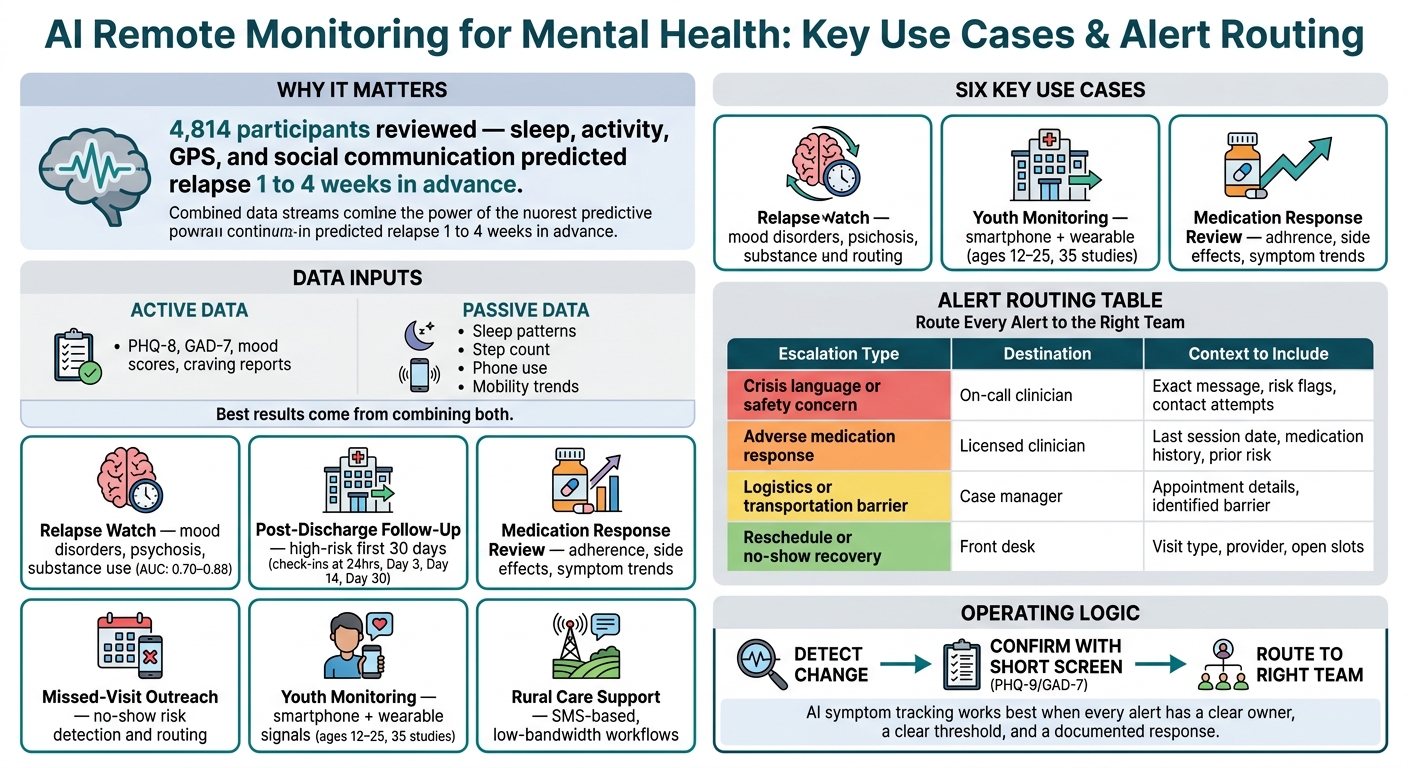
This matters because the article points to a review of 4,814 participants, where sleep, activity, GPS movement, and social communication were among the strongest relapse signals, with models predicting relapse 1 to 4 weeks ahead.
In most settings, the best results come from mixing active data like PHQ-8, GAD-7, mood scores, and craving reports with passive data like sleep, step count, phone use, and mobility trends.
The main point is simple: remote monitoring is not about replacing clinicians. It is about giving care teams more signal between visits so they can route follow-up sooner, sort outreach by risk, and document action inside the systems they already use.
Key use cases include:
- Relapse watch for mood disorders, psychosis, and substance use risk
- Post-discharge follow-up during the high-risk first 30 days
- Medication response review for side effects, adherence, and symptom change
- Missed-visit outreach based on disengagement and no-show risk
- Youth monitoring using smartphone and wearable signals
- Rural care support through low-bandwidth SMS workflows
Key leadership issues include:
- HIPAA-compliant data flow, encryption, access controls, and vendor BAAs
- Clear alert thresholds and named owners
- Routing alerts to the right team, such as clinicians, care coordinators, case managers, or front desk staff
- Tying alerts to charting, task queues, attendance logs, and reporting
For treatment centers, mental health practices, and telehealth programs, the article’s core message is direct: AI symptom tracking can help turn between-visit blind spots into action, but only when the workflow, consent model, and documentation process are set up to support fast follow-up.
AI Remote Monitoring for Mental Health: Key Use Cases & Alert Routing
Use Cases: Relapse Watch and Post-Discharge Follow-Up
Relapse Watch for Mood, Psychosis, and Substance Use Risk
The clearest value shows up when clinical teams use these signals to spot relapse early and respond before the next scheduled visit. AI symptom tracking can flag relapse risk by pulling together shifts in sleep, movement, social contact, and self-reported symptoms. Its role is straightforward: it brings these patterns into one earlier warning signal that may be harder to see in routine follow-up alone.
In schizophrenia, passive smartphone data often performs better than self-report by itself. In mood disorders, lower mobility and late-night phone use tend to matter most. In substance use care, higher craving scores and proximity to known trigger locations can point to deterioration [4].
Each data source plays a different role.
Passive sensing is often best for continuous trend detection.
Wearables add physiologic context.
EMAs capture direct symptom input.
EHR data can help teams spot engagement and adherence risk.
Across these modalities, predictive performance usually falls within an AUC range of 0.70 to 0.88, and the strongest results tend to come from models that combine passive sensing with active self-report rather than using either one alone [1]. When those signals begin to shift, the case should be routed to the clinical team for same-day review.
That same monitoring model becomes even more useful after discharge, when risk tends to climb and follow-up gaps are more common.
Post-Discharge Monitoring After Higher-Acuity Care
After discharge, the aim is simple: catch deterioration early enough to reduce avoidable readmission. The period right after discharge is a high-risk window for relapse, readmission, and suicide, which makes it a strong fit for remote monitoring.
Post-discharge monitoring should combine brief daily or weekly check-ins on mood, sleep, cravings, and stress with passive smartphone or wearable data. Higher symptom scores, missed check-ins, and worsening combined stress signals should trigger direct review by a care coordinator or clinician [2][3].
A practical cadence often includes:
- The first check-in within 24 hours of discharge
- Follow-up check-ins on day 3, day 14, and day 30
Use Cases: Medication Response Review and Missed-Visit Outreach
Medication Adherence, Side Effects, and Response Trends
AI symptom tracking brings together self-reported symptoms and medication adherence data to show whether a medication appears to be helping, losing momentum, or causing side effects between visits.
That matters in behavioral health, where a patient’s condition can shift before the next scheduled appointment. These signals can also point to cases that may need earlier follow-up instead of waiting for the next routine check-in.
Weekly monitoring gives clinical teams earlier visibility into treatment response and relapse risk. For treatment centers and mental health providers, that can support tighter oversight between sessions, especially when providers are managing medication changes, side effects, or inconsistent adherence.
The same symptom and adherence signals can also help identify patients who may be more likely to miss the next visit. That creates a practical link between clinical monitoring and operations. If a patient is disengaging, showing side effects, or reporting worsening symptoms, outreach teams may need to act before that patient becomes a no-show.
Missed-Visit Risk Detection and Outreach Prioritization
AI monitoring can also help spot patterns that suggest a patient is at higher risk of missing a visit. For behavioral health organizations, that is not just a scheduling issue. Missed visits can affect continuity of care, staff time, reimbursement, and authorization support. Routing outreach by risk level helps teams respond faster and with better context.
Route each alert to the right team immediately. Use this routing logic for missed visits and symptom alerts:
|
Escalation Type |
Destination |
Context to Include |
|---|---|---|
|
Crisis language or safety concern |
On-call clinician |
Exact message, risk flags, contact attempts |
|
Adverse medication response |
Licensed clinician |
Last session date, medication history, prior risk |
|
Logistics or transportation barrier |
Case manager |
Appointment details, identified barrier |
|
Reschedule or no-show recovery |
Front desk |
Visit type, provider, open slots |
This kind of routing can reduce handoff delays. A front desk team may be best positioned to recover a no-show, while a licensed clinician needs direct access to medication response issues or safety concerns. Without that separation, alerts can sit too long or land with the wrong team.
Automated SMS reminders can significantly reduce missed sessions, and attendance records and show rates are critical for insurance continued-stay authorizations, as high attendance demonstrates patient engagement to reviewers [5].
Beyond outreach, attendance data also matters for authorization and reporting. Attendance records and outreach logs also support continued-stay documentation and billing workflows in Opus Behavioral Health EHR.
Use Cases: Youth Access and Rural Care Support
Between-visit monitoring can be especially useful for two groups that often face stronger engagement barriers: adolescents and patients in rural communities.
Youth Monitoring with Mobile and Wearable Signals
Most adolescents in the United States already carry a smartphone.
That makes the phone a practical tool for passive monitoring between visits, without relying on frequent manual check-ins. AI models can use GPS logs, accelerometer data, screen state, app usage, and texting and calling patterns to track behavior linked to symptoms.
For youth, the most useful symptom areas often include sleep timing and duration, daily activity and step count, time spent at home or away, and patterns in social communication [6][8].
A sharp drop in location variety over several days, more late-night screen use, or fewer outgoing messages may point to depressive worsening or social withdrawal before a clinician would otherwise see it.
A scoping review of 35 studies covering youth ages 12 to 25 found that combining mobility, sociability, and sleep features performed better than single-sensor models for predicting anxiety and depression [6].
In practice, this makes teen monitoring a workable extension of relapse watch. The goal is simple: identify change early, then move sooner.
A tiered escalation model often fits this setting well:
- Low-risk changes can trigger in-app nudges.
- Moderate signals can prompt a brief PHQ-9 or GAD-7.
- High-risk patterns can route alerts straight to the care team.
That approach follows the same remote monitoring logic used in other settings: detect change, confirm it with a short screen, and direct outreach to the right team.
Youth monitoring also requires tighter consent and privacy controls. Adolescents need assent along with parent or guardian consent, and the explanation of what is being tracked should use plain language.
Caregiver access should vary by age. Younger teens may have caregivers receive sleep and activity summaries, while older adolescents often keep more control over shared information. School timing matters as well. Surveys and prompts should not interrupt class hours, and school counselors may help coordinate on-campus support when risk increases [7][9].
Rural Monitoring with Low-Friction Telehealth Workflows
For rural patients, the main barriers tend to be access, infrastructure, and stigma. Long travel times, provider shortages, weak broadband, and privacy concerns all shape what can work in daily operations [10][11].
SMS-based check-ins are often the most practical place to start. Text messaging works on almost any phone, does not require an app download, and can function on basic cellular service where broadband is unreliable [10][11]. A short weekly text for mood or craving check-ins, paired with a pre-visit SMS message before telehealth, can give clinicians current symptom context without asking the patient to travel [10][11]. Neutral phrasing such as "How are you feeling this week?" helps avoid putting a diagnosis on the screen [10][11].
The same workflow can also support outreach after missed visits, especially when travel, bandwidth limits, or stigma make attendance less stable. In many cases, low-friction SMS check-ins can flag disengagement before a no-show happens.
The channel may differ by setting, but the operating model stays the same. Youth monitoring leans on smartphone and wearable signals. Rural monitoring leans on SMS and low-bandwidth telehealth workflows.
In both cases, signal quality matters less than workflow speed. Data only helps when it reaches the right team in time to act.
Putting It Into Practice: Workflow Integration, Compliance, and Next Steps
Connecting Remote Symptom Tracking to Behavioral Health Software
Remote monitoring only helps care teams when alerts land in the chart, task queue, or staff workflow fast enough to prompt action. That becomes especially important when relapse watch, post-discharge follow-up, and no-show risk all rely on the same signal reaching the right person without delay.
A practical routing model often looks like this:
- Low-risk trends go to the chart for review.
- Moderate trends move to a daily task list.
- High-risk signals trigger real-time alerts.
The next step is making that routing work inside the behavioral health software teams already depend on. Opus Behavioral Health EHR brings EHR documentation, telehealth, e-prescribing, outcomes measurement, and reporting into a single workflow, which can help symptom alerts move into the chart and task queue without extra handoffs.
When a cancellation comes in by text, the system can alert the front desk and make that opening available to a waitlist patient. That helps protect schedule utilization. Attendance records and outreach logs can also support continued-stay documentation and billing workflows in Opus Behavioral Health EHR.
Key Takeaways for Clinical and Administrative Leaders
The use cases covered across this article - relapse watch, post-discharge follow-up, medication response review, missed-visit outreach, and youth and rural care support - follow the same operating logic: detect change, then route the right action to the right team member.
For behavioral health leaders, that means keeping the model simple and accountable. Use consented, HIPAA-compliant data collection. Set clear thresholds. Assign named owners so alerts do not sit in a queue without action.
Once routing is in place, the next job is defining who responds to each signal and how that response is documented. AI symptom tracking works best when every alert has a clear owner, a clear threshold, and a documented response.
FAQs
How does AI spot relapse risk early?
AI can help treatment teams identify relapse risk earlier by monitoring both structured and unstructured data for small behavioral or physiological changes before they turn into a crisis.
It looks for patterns across clinical history, medication adherence, lab results, and patient-reported outcomes. That may include missed appointments, irregular sleep, or symptoms that stop improving. In Opus Behavioral Health EHR, these insights can trigger real-time alerts, giving care teams a chance to step in sooner.
What data is used in remote mental health monitoring?
Remote mental health monitoring draws on several types of data to track patient progress and identify potential risk earlier.
Common inputs include clinical history, treatment attendance, patient engagement, and medication adherence. These data points help clinical and operations teams see whether a patient is staying connected to care, following the treatment plan, and showing signs of change over time.
Remote monitoring may also pull in data from wearables or mobile apps, such as:
- Sleep patterns
- Heart rate
- Physical activity
- Stress levels
- Location data
In many behavioral health settings, providers also rely on patient-reported outcomes to add context that passive data alone cannot provide. That can include reported mood, cravings, coping confidence, and standard assessments such as PHQ-9 and GAD-7.
Who should respond to high-risk alerts?
High-risk alerts should reach clinical staff at once, based on the organization’s staffing model and response protocols.
Alerts tied to crisis language, suicide or homicide concerns, relapse indicators, or adverse medication reactions call for an urgent, structured response. Depending on the case, that may involve the assigned counselor or the broader care team updating the treatment plan, increasing check-ins, or conducting a safety review.



- Behavioral Health
- EHR Systems
- Addiction Treatment EHR
- mental health
- Telehealth
- addiction treatment
- Behavioral health facility
- Substance Abuse Disorder
- behavioral Health center
- HIPPA Compliant
- ehrsoftware
- PTSD
- behavioral health ehr
- Depression
- hipaa
- Anxiety
- MentalHealthMatters
- RCM
- claim denials
- clinical documentation
- mental health awareness
- screening tools

September 15, 2026
September 15, 2026

September 14, 2026

September 11, 2026

September 10, 2026

September 09, 2026
Recommended Posts
Friday, September 11, 2026
AI Risk Models for Suicide and Relapse
Suicide risk models and relapse risk models should not be treated as the same tool.

Wednesday, September 10, 2025
World Suicide Prevention Day | Resources To Support You And Your Loved Ones
World Suicide Prevention Day | Resources to Help You and Your Loved Ones Every year on World Suicide Prevention Day, ...

Tuesday, August 25, 2026
Personalization in mHealth for Behavioral Health Teams
Personalized mHealth only works when patient data leads to clear staff action.