

Patient engagement tools are transforming behavioral health care by addressing challenges like no-shows, low treatment adherence, and administrative burdens.
These tools streamline communication, scheduling, and telehealth services, improving patient outcomes and provider efficiency.
Here are the top seven platforms:
Opus Behavioral Health EHR: Integrated system for addiction and mental health centers, featuring SMS reminders, no-app telehealth, AI-powered notes, and outcome tracking.
Mend: Focuses on automated communication, with tools like AI-predicted attendance scores and seamless EHR integration.
Valant: Offers tools for group therapy, outcome tracking, and AI-assisted documentation, tailored for behavioral health practices.
SimplePractice: Ideal for solo practitioners, combining scheduling, billing, telehealth, and patient portals.
Televox: AI-powered communication platform for large health systems, supporting multilingual outreach and automated workflows.
Nuna: Therapist-friendly platform with secure messaging, HIPAA-compliant telehealth, and patient engagement features like nudges and badges.
CarePaths: All-in-one solution with telehealth, ePrescribing, and measurement-based care tools, designed for high-volume practices.These platforms help reduce administrative tasks, improve patient engagement, and boost revenue. Choose the one that aligns with your practice's size and needs.
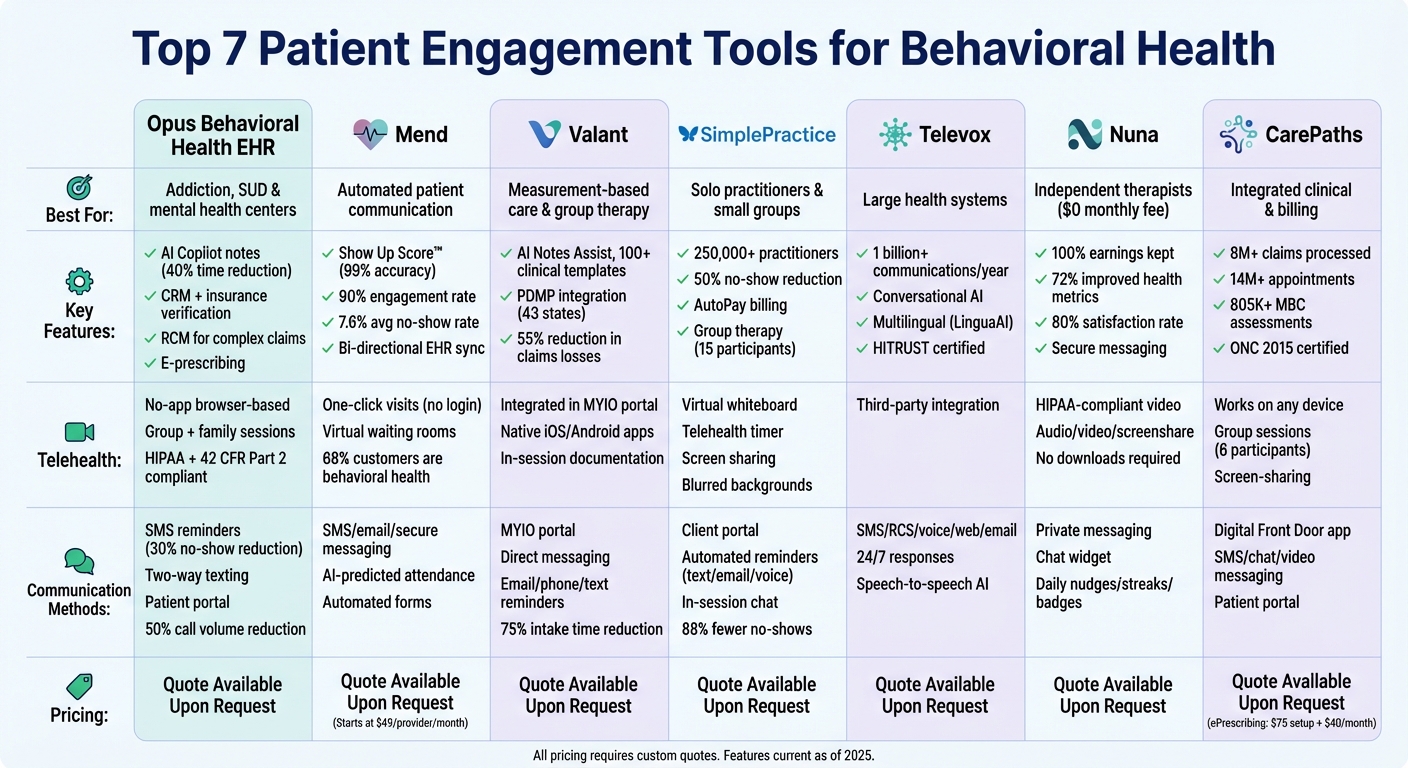
Comparison of Top 7 Patient Engagement Tools for Behavioral Health Practices
How Patient Engagement Improves the Behavioral Health Experience for Clients & Clinicians
1. Opus Behavioral Health EHR
Opus Behavioral Health EHR is a specialized platform designed for behavioral health and substance use disorder centers. It combines clinical documentation, patient communication, telehealth, and outcome tracking into one streamlined system. This integration simplifies administrative tasks and improves patient engagement. Let’s dive into the features that make Opus stand out.
Patient Communication Features
Opus enhances patient communication by integrating with platforms like Curogram to provide real-time SMS appointment reminders. These reminders are customizable based on visit type, whether it’s a detox check-in or group therapy session.
This personalized approach can reduce no-show rates by up to 30% and significantly cut phone call volumes by up to 50% [3].
Patients can confirm, cancel, or reschedule appointments directly through two-way SMS - no need for additional apps or portals.
This feature helps staff quickly fill open slots, which is especially beneficial for residential programs managing bed availability [3].
"By linking your Opus system with Curogram's two-way SMS platform, you can reach patients where they already are: their phones." - Mira Gwehn Revilla, Curogram [3]
Telehealth Capabilities
Opus offers a no-app telehealth solution that simplifies virtual care. Patients receive a secure link via SMS, allowing them to join sessions with a single click in their browser.
This feature supports individual, group, and family therapy sessions, all while adhering to HIPAA and 42 CFR Part 2 privacy standards, which are crucial for substance use disorder records [4]. Additionally, session details are automatically logged for insurance claims [4].
"Telehealth is opening up doors for clients that we weren't able to extend help to before... we are able to continue our therapeutic and psychiatric services from the first day of residential treatment, to the last day of outpatient treatment." - Andrea Baskin, Clinical Director [5]
Integration with Behavioral Health Workflows
Opus goes beyond virtual care by streamlining clinical workflows to improve efficiency.
Its Copilot AI feature acts as an AI-powered scribe, drafting progress notes for both in-person and telehealth sessions. This reduces documentation time by 40% and improves the quality of notes [2].
The platform also integrates e-prescribing, lab modules, and offers comprehensive practice management reports [2].
The system includes a built-in CRM for automating lead routing and insurance verification. Its Revenue Cycle Management suite handles complex claims like UB-04 and CMS 1500, simplifying billing processes [2].
"This is the best EMR I have ever used, and every department at my company agrees. Very easy to learn, use, and navigate." - Cory N., Executive VP of Operations [2]
Outcome Measurement Tools
Opus provides custom patient engagement assessments, enabling patients to share real-time updates on their condition. These insights are sent directly to care teams, helping to prevent crises and tailor treatment plans [2]. The platform also employs AI sentiment analysis to predict outcomes and identify early risks [2].
Real-time clinical alerts keep clinicians informed of critical changes in patient conditions. By analyzing EHR data, lab results, and clinical notes, the system provides timely notifications. For substance use treatment, Opus evaluates six key areas: intoxication, medical/psychiatric conditions, readiness to change, relapse risks, and recovery environments [2].
2. Mend
Mend is a platform designed to enhance behavioral health engagement by simplifying scheduling, digital intake, payment processes, and reminders.
It works seamlessly with existing EHR systems and has supported over 15 million appointments, achieving an impressive 90% patient engagement rate [8]. This integrated approach strengthens communication between patients and providers.
Patient Communication Features
Mend's Engage Agent takes care of appointment reminders, forms, and checklists automatically, helping patients show up prepared [6]. Patients can RSVP, cancel, or complete intake forms via text - no need for logins or portals [7]. This straightforward process has helped organizations lower no-show rates from double digits to an average of 7.6% [8].
One standout feature is the Show Up Score™, an AI tool that predicts patient attendance with 99% accuracy [6].
If the score indicates a patient might miss their appointment, the system sends additional reminders to re-engage them. For example, Easterseals used this feature to recover $200,000 monthly in revenue and serve more than 3,000 additional patients [6].
"Patient engagement platforms must prioritize all the moments in between those that a patient spends with their provider. Information exchange in those moments is critical: scheduling, payments, intake, and assessments." - Warren Bates, CEO, Mend [7]
In addition to communication, Mend also simplifies virtual care.
Telehealth Capabilities
Mend offers one-click virtual visits that don’t require app downloads or logins, making it user-friendly for patients who may face tech challenges or are in crisis [9].
The platform supports both individual and group therapy sessions, featuring virtual waiting rooms with engaging content and a transfer queue for smooth handoffs between providers [6]. Notably, 68% of Mend's customers are behavioral health organizations [9].
Integration with Behavioral Health Workflows
Mend ensures that every interaction - from reminders to virtual visits - is recorded seamlessly within the care continuum. It integrates bi-directionally with major behavioral health EHRs such as Kipu, Streamline SmartCare, NextGen, and athenaOne [6].
The platform automatically syncs client data and transfers completed forms back into the EHR as structured data. In March 2025, Mend introduced a Measurement-Based Care (MBC) solution that tracks symptom changes in real-time and provides AI-powered summaries for clinicians [7].
Organizations like Henry J Austin Health Center expanded care access in under 30 days by adopting Mend's tools, while Cyti Psychological achieved an impressive 2% no-show rate through its automation features [6].
Pricing for Mend starts at $49 per provider per month, and it holds a 4.6/5 star rating on Software Advice based on 920 reviews [10].
3. Valant
Valant is an all-in-one behavioral health platform designed to simplify the patient journey, from intake to billing. It caters to practices of all sizes, offering tools for psychiatry, therapy, and acute care settings like IOP and PHP.
Patient Communication Features
The MYIO Patient Portal brings everything together - appointment scheduling, billing, and medical record access - while supporting HIPAA-compliant direct messaging. Automated reminders via email, phone, and text help reduce no-shows, and the built-in CRM with automated intake can cut down new patient communication time by as much as 75% [12].
Patients can complete intake packets and consent forms digitally, with their data flowing directly into the EHR, minimizing manual entry errors. These features create a smoother communication process, paving the way for efficient virtual care.
"The system has truly exceeded my expectations in almost every way. The company constantly works to keep it up to date, tech assistance is prompt and always helpful, and in general it's a beautiful, well-designed system." - Stephen S., Owner [11]
Telehealth Capabilities
Valant’s telehealth tools integrate seamlessly within the MYIO portal. Clinicians can launch sessions, document visits, and process payments - all within a single workflow.
For patients, native Android and iOS apps make it easy to join telehealth sessions or message providers directly from their mobile devices, enhancing accessibility and engagement.
Integration with Behavioral Health Workflows
Valant goes beyond communication and telehealth by streamlining clinical workflows with features like AI Notes Assist and other AI-powered tools that reduce documentation time.
The platform includes over 100 clinical templates tailored for evidence-based therapies such as DBT, CBT, MFT, TMS, and treatments for eating disorders [12].
It also supports ePrescribing with PDMP integration across 43 states and offers secure API connections for real-time data exchange with labs, imaging services, and billing systems [12]. One mental health center using Valant’s practice management and RCM solutions reported a 55% reduction in claims losses [13].
"I have used 10 EMRs throughout my career - Valant is by far the best. Great product for the money." - Georgina R., Owner and Nurse Practitioner [11]
Outcome Measurement Tools
Valant includes tools for measurement-based care, allowing clinicians to track patient progress over time. Patients can complete assessments and outcome measures directly in the MYIO portal, with results automatically integrated into their charts and practice reports.
This enables clinicians to monitor both clinical outcomes and financial performance, making treatment adjustments based on real-time data without the need for manual entry.
4. SimplePractice
SimplePractice provides a comprehensive platform for over 250,000 practitioners, combining scheduling, documentation, billing, and patient engagement tools into one system [19].
Its user-friendly design is especially appealing to solo practitioners and small group practices looking to streamline administrative tasks and focus on patient care.
Patient Communication Features
The Client Portal allows patients to handle key tasks like requesting appointments, completing paperless intake forms, and managing billing in a HIPAA-compliant environment [14][17]. Automated reminders - via text, email, or voice - help reduce no-show rates by up to 50%, with 88% of practitioners reporting fewer missed appointments [14][15].
For telehealth sessions, the platform includes an in-session chat for real-time communication, while the AutoPay feature simplifies billing by automatically charging stored payment methods [14][16][17].
Telehealth Capabilities
SimplePractice integrates telehealth features directly into its EHR calendar, making virtual care seamless. Tools like a virtual whiteboard support interactive exercises such as mind mapping or reviewing coping strategies, and screen-sharing enhances document discussions [16].
The Telehealth Timer helps manage session time effectively, while group therapy features accommodate up to 15 participants with automated reminders and organized notes [19].
Privacy options include virtual waiting rooms, blurred backgrounds, and multiple camera views for added security [16][19].
Integration with Behavioral Health Workflows
This platform combines clinical and administrative tasks into a single system, saving time and improving efficiency.
Features like an AI-powered Note Taker and customizable SOAP and progress note templates make documentation faster and easier. Additionally, Wiley Treatment Planners provide evidence-based resources for treatment planning [14][20].
The system also supports ePrescribe and includes tools for creating, submitting, and managing insurance claims without needing external software [14][18][20].
Outcome Measurement Tools
SimplePractice supports data-driven care by offering tools to measure client progress through integrated assessments [14][16].
Its library includes diagnostic descriptions, risk assessments, and customizable goals, allowing clinicians to track outcomes and adjust treatment plans in real time. These features help reinforce treatment adherence and improve overall patient care [20].
5. Televox
Televox handles over 1 billion patient communications every year, working with more than 2,000 health systems and practices [21]. The platform focuses on AI-powered automation to lighten staff workloads while keeping patients engaged.
Patient Communication Features
The Engage Conversational AI system enables speech-to-speech interactions that recognize tone and intent, creating natural conversations with patients [21].
This feature is supported by LinguaAI, which facilitates multilingual communication [21]. Televox integrates SMS, RCS, voice, web, and email into one seamless system [22]. Its two-way messaging allows patients to schedule appointments, confirm visits, and receive 24/7 responses - all without staff involvement [22].
Considering that 292 million people in the U.S. use text messaging and 69% want more care reminders, these tools address a clear need [21]. These communication capabilities integrate smoothly into workflows, simplifying patient management.
Integration with Behavioral Health Workflows
Televox works directly with major EHR systems like Epic, automatically logging self-reported patient information collected through SMS into clinical records [21][22].
"Since adopting HouseCalls Pro to capture real-time, self-reported patient information via SMS and record that in Epic, we have continued to expand the use of automated workflows.
The configurability of the system and the service provided has been excellent." - Anthony Brown, Director of Application Services at Kettering Health Network [21].
The platform is both HIPAA compliant and HITRUST certified, ensuring secure management of sensitive behavioral health data [22].
Its automated workflows cover every stage of the patient experience - from discovery and intake to post-visit follow-ups - eliminating the need for manual outreach and reducing staff fatigue [21]. This seamless EHR integration highlights the platform's focus on minimizing administrative burdens.
Outcome Measurement Tools
Televox offers tools like Journey Insights, which examines patient interaction paths and identifies where automation works well and where human intervention might be needed [21].
Insights360 provides data across the patient journey, helping to pinpoint areas for reducing wait times and improving staff efficiency [21].
These analytics tools give behavioral health providers a clear understanding of patient needs and engagement patterns, allowing them to refine their strategies based on real data. By addressing gaps in engagement, these tools help ensure better care continuity in behavioral health practices.
6. Nuna
Nuna is a mental health platform designed to simplify life for therapists, offering a $0 monthly fee and allowing practitioners to keep 100% of their earnings [24]. It handles client acquisition, scheduling, and invoicing, making it a solid choice for independent therapists and small practices.
Patient Communication Features
Nuna includes secure private messaging, a built-in chat widget, and automated appointment reminders. Patients benefit from a centralized client portal for easy scheduling and communication.
Features like daily nudges, streaks, and badges create an engaging, virtual health coach experience. According to data, 72% of Nuna users improved their health metrics - particularly in lowering and maintaining healthy blood pressure - and 80% reported satisfaction with the platform after a year [23].
Telehealth Capabilities
Nuna provides HIPAA-compliant video conferencing directly within the platform, eliminating the need for external downloads. It supports audio, video, and screensharing to ensure secure and efficient remote sessions.
"Nuna is a safe space for both the patient and me as a therapist. I can meet my patients quickly and easily." - Victoria Niven, psychologist specializing in psychoanalysis and art therapy [24]
Integration with Behavioral Health Workflows
Nuna fits smoothly into behavioral health workflows, offering tools that enhance practice management.
Through its Mindgram integration, the platform uses advanced algorithms to match therapists with clients worldwide. Scheduling syncs with Google Calendar, and therapists can access pre-built note templates tailored for psychologists.
Maria Real Alonso, a clinical psychologist, highlights how Nuna helps her manage appointments, communication, secure video calls, and store medical histories and evaluation tests [24]. The platform also simplifies billing by automating invoicing and transferring funds directly to bank accounts.
Outcome Measurement Tools
Therapists can track patient progress by reviewing session notes, medical histories, and evaluation tests, all within the same platform. Patients, on the other hand, gain access to educational resources that help build health literacy. This streamlined system allows providers to monitor improvements without added complexity.
Next, we take a closer look at CarePaths and its role in enhancing patient engagement.
7. CarePaths
CarePaths offers a complete solution tailored for behavioral health practices, combining clinical documentation, billing, telehealth, and patient engagement in one platform.
With over 8 million claims processed and 14 million patient appointments managed, it handles high volumes with ease [31].
Its ONC 2015 Cures Edition certification ensures compliance with federal interoperability standards [30]. These features work together to improve communication, telehealth services, and workflow efficiency.
Patient Communication Features
CarePaths provides tools designed to enhance patient engagement at every stage of treatment. Its "Digital Front Door" mobile app allows patients to self-refer, schedule appointments, and complete pre-visit registration [27][30].
Patients also gain access to a portal where they can review treatment plans, track progress through graphs, and view crisis plans. Secure communication options include SMS, chat, and video messaging [26].
"CarePaths is a one stop shop for our practice. We are able to submit claims, write clinical notes, send appointment reminders to clients, and have clients pay their bill all in one place." - Katerina Rios [25]
Telehealth Capabilities
The platform features a HIPAA-compliant teletherapy system that works seamlessly on any device, with no downloads required [26][30]. It supports group sessions for up to six participants and includes screen-sharing capabilities to facilitate group therapy activities [27][30].
Integration with Behavioral Health Workflows
CarePaths simplifies workflows with tools like "if-then" logic and pre-populated forms, reducing repetitive data entry [30].
The system integrates DrFirst ePrescribing, which automatically checks for drug interactions and allergies, achieving a 92% patient satisfaction rate [29][30]. Automated insurance checks and integrated billing streamline claim submissions [27].
Additionally, the platform supports reporting for MIPS/MACRA and Clinical Quality Measures, and it’s ready for the upcoming CMS codes for Remote Treatment Monitoring [30].
"Data entry is easy. The forms are accurate. The scheduler is excellent, with customizable client alerts. My billing is out the door each day." - Mark Steiner [25]
Outcome Measurement Tools
CarePaths also excels in helping practitioners track patient outcomes. Its built-in Measurement-Based Care (MBC) tools have facilitated over 805,000 completed assessments [31].
Automated tools like the PHQ-9 and GAD-7 assessments are scored and displayed as visual progress graphs, helping clinicians monitor improvement over time [28][29]. Patients can complete these assessments through the mobile app or portal, making the process seamless.
ePrescribing is available for a $75 setup fee and $40 monthly, with discounts for nonprofits, large organizations, and academic centers [25][30].
Comparison Table
This table provides a quick overview of each platform's main features, telehealth options, communication tools, and pricing. Use it to find the best fit for your practice.
|
Platform |
Best For |
Core Features |
Telehealth |
Communication Methods |
Pricing |
|---|---|---|---|---|---|
|
Opus Behavioral Health EHR |
Addiction, SUD, and mental health treatment centers |
Comprehensive suite with CRM for lead routing, insurance verification, AI-powered Copilot for progress notes, and RCM tools for UB-04 and CMS 1500 claims; includes e-prescribing and lab integration |
Built-in video sessions with group check-in and automated session note linking |
HIPAA-compliant messaging, 42 CFR Part 2–compliant messaging for SUD programs, and a patient portal with online intake forms |
Quote Available Upon Request (Basic, Standard, Premium plans available) |
|
Mend |
Practices focusing on automated patient communication |
Features like appointment reminders, two-way texting, digital intake forms, and payment collection |
Integrated video visits |
SMS, email, and secure messaging |
Quote Available Upon Request |
|
Valant |
Clinicians prioritizing measurement-based care and group therapy |
Tools for automated intake, outcome tracking, group therapy, and clinical documentation |
Integrated telehealth platform |
Secure messaging and patient portal |
Quote Available Upon Request |
|
SimplePractice |
Solo practitioners and small group practices |
Scheduling, billing, documentation, client portal, and insurance claim submission |
Built-in video sessions |
Client portal, secure messaging, and automated reminders |
Quote Available Upon Request |
|
Televox |
Large health systems needing multi-channel outreach |
Features include appointment reminders, mass communication campaigns, and patient surveys |
Telehealth via third-party integration |
SMS, email, voice calls, and mobile app |
Quote Available Upon Request |
|
Nuna |
Organizations focusing on advanced data analytics |
Tools for population health management, claims data analysis, and care coordination |
Limited telehealth options |
Data-driven patient outreach |
Quote Available Upon Request |
|
CarePaths |
Behavioral health practices seeking integrated clinical and billing tools |
Features include the Digital Front Door app, conditional logic-based forms, integrated ePrescribing, and measurement-based care tools |
HIPAA-compliant teletherapy with secure screen-sharing |
SMS, chat, video messaging, and patient portal |
Quote Available Upon Request |
Modern platforms emphasize telehealth integration and robust patient portals to simplify care management. Matching the right tools to your practice's needs can improve patient interactions and streamline operations. For a deeper dive, revisit the detailed descriptions earlier in the article.
Conclusion
When selecting patient engagement tools, it's crucial to match them to your practice's size and workflow.
For smaller practices with 1–10 clinicians, integrated solutions that combine scheduling, billing, and documentation are ideal - no need to juggle multiple vendors. Mid-sized and larger behavioral health centers, on the other hand, should look for tools with strong CRM capabilities and detailed reporting to efficiently manage higher patient volumes.
These choices help ensure smoother operations across communication, care, and billing.
In behavioral health, the right features matter more than sheer quantity. For instance,HIPAA-compliant telehealth and secure messaging are non-negotiable for safeguarding sensitive patient information.
Tools tailored for addiction and SUD treatment should also include robust crisis assessment features. Patients often feel more secure and open when receiving care in familiar settings, which can enhance therapy outcomes. Aligning clinical goals with financial efficiency benefits both patients and practice revenues.
Don’t overlook the potential for cost savings beyond subscription fees. Automation in billing has been shown to significantly increase patient revenue, and practices using online payment systems report a 47% higher Patient Pay Yield compared to traditional methods [1]. These savings can often offset initial investment costs.
Take the time to map out your workflows and identify areas where automation can reduce administrative tasks. Involve a selection team with members from administrative, clinical, and IT departments to assess how well a platform integrates with your existing EHR and Health Information Exchanges.
For example, North Scottsdale Pediatrics reported eliminating "thousands of phone calls a day" by adopting self-scheduling tools that allowed parents to book appointments for sick children - even during off-hours [1].
Ultimately, the right platform should deliver measurable improvements in efficiency and patient care. Look for vendors that offer thorough training and establish clear metrics to evaluate your return on investment.
By adopting tools that streamline communication, scheduling, and billing, behavioral health practices can see real progress in both operational efficiency and patient outcomes.
FAQs
Which patient engagement features reduce no-shows most?
Automated SMS reminders that include personalized timing and two-way texting can significantly cut down on no-shows. These tools help keep patients engaged by sending reminders at the right time and making it simple for them to confirm or reschedule their appointments.
This approach improves communication and offers greater flexibility for both patients and providers.
What privacy rules apply to SUD telehealth and texting?
When it comes to telehealth and texting in the context of Substance Use Disorder (SUD) treatment, privacy is a top priority. Two major regulations ensure that patient information remains secure:
42 CFR Part 2: This rule focuses specifically on protecting the confidentiality of SUD treatment records. It ensures that sensitive patient data is not disclosed without proper authorization.
HIPAA: The Health Insurance Portability and Accountability Act sets the standard for secure communication and data protection. It requires that all patient information shared during telehealth sessions or through texting is safeguarded against unauthorized access.
Together, these regulations provide a framework to protect patient privacy and maintain confidentiality in all interactions related to SUD treatment.
How do I choose a tool for my practice size?
When choosing a tool, think about how it aligns with the size of your practice and its specific needs.
For smaller practices, a simple and budget-friendly option might work best. Larger practices, on the other hand, often need tools with advanced features such as automation and detailed reporting.
For example, Opus Behavioral Health EHR provides flexible solutions, offering features like telehealth, automated workflows, and billing support, making it a good match for practices of different sizes. Take a close look at your current workflows and future growth plans to identify the right tool for you.



- Behavioral Health
- EHR Systems
- Addiction Treatment EHR
- Telehealth
- mental health
- addiction treatment
- Substance Abuse Disorder
- behavioral Health center
- Behavioral health facility
- HIPPA Compliant
- ehrsoftware
- PTSD
- behavioral health ehr
- Depression
- hipaa
- Anxiety
- MentalHealthMatters
- RCM
- claim denials
- clinical documentation
- mental health awareness
- screening tools

August 28, 2026

August 27, 2026

August 26, 2026

August 25, 2026

August 24, 2026

August 21, 2026
Recommended Posts

Tuesday, June 09, 2026
EHR Mental Health Platforms That Reduce Admin Burden
Behavioral health providers spend 37% of their time on administrative tasks like documentation, cutting into patient ...

Friday, July 10, 2026
The Numbers Don't Lie: What Clinics Save After Switching EHRs
An EHR switch is a money call before it is a software call. If I were sizing up a change, I’d focus on seven numbers: ...

Wednesday, May 13, 2026
AI in Behavioral Health: Retention Challenges Solved
Behavioral health centers face a big challenge: keeping patients engaged in their care.