

Scheduling tools designed for behavioral health providers solve complex challenges like high no-show rates, HIPAA compliance, and managing multiple calendars.
This article reviews six top tools, highlighting their features, pricing, and benefits for solo practitioners and group practices.
Key Highlights:
Opus Behavioral Health EHR: Integrated scheduling, documentation, and billing; starts at $79/user/month.
Valant: Tailored workflows for mental health practices; pricing starts at $135/month.
TherapyNotes: Affordable for solo practitioners; $49/month for the first clinician.
SimplePractice: Flexible for solo and group practices; starts at $49/month.
CentralReach: Ideal for ABA and autism care; custom pricing based on features.
TheraNest: Budget-friendly with tiered plans starting at $29/month per therapist.
Quick Comparison:
|
Tool |
Starting Price |
Key Features |
User Rating |
|---|---|---|---|
|
Opus EHR |
$79/month |
Color-coded calendars, AI for documentation |
4.8/5 |
|
Valant |
$135/month |
Patient portal, automated reminders |
3.8/5 |
|
TherapyNotes |
$49/month |
Insurance billing integration, secure notes |
4.8/5 |
|
SimplePractice |
$49/month |
Self-booking, customizable templates |
4.6/5 |
|
CentralReach |
Custom Pricing |
AI scheduling, payor tracking |
N/A |
|
TheraNest |
$29/month |
Group therapy tools, telehealth integration |
4/5 |
Choosing the right tool depends on your practice size, budget, and specific needs like telehealth or group scheduling.
Below, we dive into each platform's standout features and pricing.
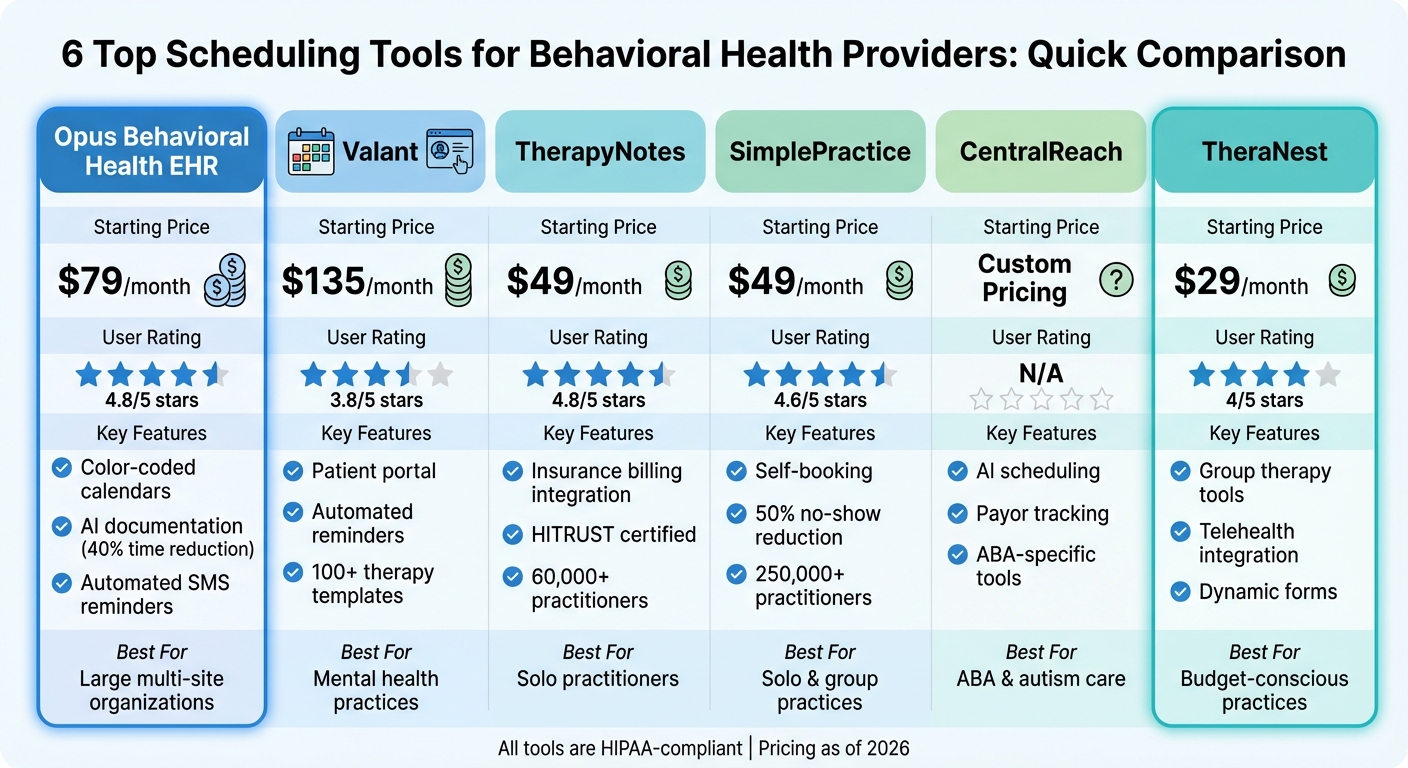
Behavioral Health Scheduling Tools Comparison: Features, Pricing & Ratings
1. Opus Behavioral Health EHR
Opus Behavioral Health EHR combines scheduling, documentation, telehealth, and billing into one HIPAA-compliant platform.
This integration eliminates the hassle of juggling multiple third-party apps. Trusted by over 160,000 practitioners daily, it has supported care for more than 44 million clients [3].
HIPAA Compliance
Opus prioritizes security with strong encryption for scheduling, automated reminders, and patient communications. It supports HIPAA 5010 standards for electronic claim filing and offers DEA-compliant e-prescribing for controlled substances [4].
The built-in Lab Module allows users to order tests and receive results directly within the system, saving time and avoiding extra logins [3].
With these security measures, the platform also includes tools specifically tailored for behavioral health practices.
Behavioral Health-Specific Features
Opus is designed with behavioral health in mind, offering specialized tools like nursing rounds documentation, recovery coaching, and level-of-care step-down management [4].
Its calendar interface is user-friendly, featuring color-coded, drag-and-drop functionality, customizable appointment types, and built-in buffers. Dara Scott, VP of Operations at Mindful Health, shared:
"Standardizing and organizing schedules has been on my list of features and now we will finally have it from Opus EHR" [3].
When paired with tools like Curogram, automated SMS reminders sent 48 hours and 2 hours before appointments can reduce no-shows by up to 30%. This automation also saves staff over 10 hours each week by cutting out manual reminder calls [5].
Instant alerts for cancellations make it easier to fill slots from a waitlist.
Automation and Customization Options
Opus leverages Copilot AI to reduce documentation time by 40% through auto-generated progress notes [3].
The platform is highly customizable, allowing users to tailor intake forms, treatment plans, and more. It also provides access to over 140 reports, enabling data-driven decisions and smoother workflows, which can help reduce missed appointments.
Jennifer Gozy, PsyD, LP, Director of Clinical Systems and Compliance at Care Counseling Clinics, explained:
"We chose Opus because it is user-friendly and highly configurable. We are looking forward to designing a system that meets our agency's unique needs" [3].
Pricing and Scalability for Different Practice Sizes
Opus starts at $79 per user, per month for its core EHR services.
Add-ons like Copilot AI are available for $119 per month, while Outcome Assessment Tools cost $100 per month [4]. For larger facilities with 36 or more clinicians, custom pricing is available to meet specific needs [3].
The platform has earned a 4.8/5 rating from 46 verified reviews, with users praising its intuitive calendar layout and 24/7 customer support [4]. However, some users mentioned a learning curve for new staff and suggested improvements to the billing interface [4].
2. Valant
Valant takes scheduling to the next level with tools specifically crafted for behavioral health practices. It combines scheduling, documentation, and billing into one platform, making it a go-to solution for mental health providers. Starting at around $135.00 per month, the cost scales based on practice size and specialty needs [8]. With a user rating of 3.8/5.0 from 134 reviews, many highlight its tailored workflows for mental health and its robust billing features [8]. This integration creates a secure and efficient system for managing patient care.
HIPAA Compliance
Valant ensures compliance with HIPAA through Business Associate Agreements (BAAs), end-to-end encryption, and secure data storage. It also implements strong user authentication, access controls, and audit trails.
The team actively monitors regulatory updates to maintain compliance [10]. Paul C., a seasoned Physician Assistant in Psychiatry, shared:
"Out of all I have used in my 41 years of practice, this is the finest. It is well designed, well supportive and serves us well in a General Psychiatry and Psychology practice" [6].
Behavioral Health-Specific Features
Valant offers tools tailored for mental health practices, including appointment categories for individual therapy, group sessions, IOP, and PHP [8].
The MYIO Patient Portal allows clients to self-schedule, easing the administrative burden. Meanwhile, the Prospective Patient Management tool uses customizable inquiry forms to pre-screen and match new patients with the right provider [7].
For clinical care, the platform includes over 100 templates for evidence-based therapies like DBT, CBT, and TMS [7].
Automation and Customization Options
Automation is a big win with Valant, reducing manual intake work by up to 75% [7]. The system sends reminders through text, email, or robocall and flags billing errors with a pending transactions queue [7].
To streamline payments, an optional paywall feature collects co-pays or self-pay fees before sessions. For remote sessions, Valant handles timezone coordination between clinicians and patients [9].
Stephen S., a practice owner, remarked:
"The system has truly exceeded my expectations in almost every way. The company constantly works to keep it up to date, tech assistance is prompt and always helpful, and in general it's a beautiful, well-designed system" [6].
Pricing and Scalability for Different Practice Sizes
Valant is built to accommodate practices of all sizes, from solo practitioners to large organizations with 50+ providers [7].
It doesn’t charge implementation fees and offers role-specific customizations for clinicians, practice managers, and billers [8]. However, some users have pointed out a steep learning curve and occasional glitches following updates [8].
Up next, we’ll take a closer look at another scheduling tool designed for behavioral health providers.
3. TherapyNotes
TherapyNotes is a scheduling platform tailored for mental health professionals, currently serving over 60,000 practitioners across the U.S. [12].
Solo practitioners can access the service for $49 per month, while group practices pay $49 for the first clinician and $30 monthly for each additional provider [1].
With a 4.8/5 star rating from over 1,500 reviews, users appreciate its seamless insurance billing integration [12]. While its interface leans more toward functionality than aesthetics, it effectively meets the needs of mental health practices [1].
HIPAA Compliance
TherapyNotes prioritizes security with AES-256 encryption, secure communication channels, two-factor authentication, and role-based access controls [11][14].
A standout privacy feature allows patient initials to appear on the calendar instead of full names (e.g., "John Smith" becomes "JoSm"), helping protect patient privacy in shared office spaces [11].
The platform also tracks user activity through detailed audit trails and uses one-way calendar sync to block third-party apps from accessing sensitive EHR data [11][14]. Its HITRUST Certification demonstrates a commitment to exceeding basic HIPAA standards [17].
Behavioral Health-Specific Features
The platform's scheduling system is designed with mental health workflows in mind. It automatically selects the appropriate note template based on the appointment type - for example, scheduling a Therapy Intake populates a Psychotherapy Intake Note pre-filled with client data [11].
TherapyNotes supports a variety of appointment types, such as Therapy Intake, Therapy Sessions, and Group Therapy, as well as non-clinical events like supervision or training [11]. For group therapy, providers can mark individual participants as "missed" while maintaining the overall session record [11].
The calendar includes provider matching filters by clinician type, payer status, and language, ensuring clients are paired with the right provider [11]. Additionally, a "Missed Appointment Note" feature documents the clinical reason for absences and allows billers to charge cancellation fees instantly [11].
Automation and Customization Options
TherapyNotes helps reduce administrative tasks with automated SMS, email, and voice reminders, which many users report reduce no-shows within the first month [13].
The platform includes a personal To-Do list that generates tasks based on the clinician's schedule and outstanding documentation [17].
Practices can customize their client portal with personalized logos, color themes, and welcome messages, available in both English and Spanish [15]. Custom Progress Note Templates support SOAP, DAP, and BIRP formats, making clinical documentation more efficient [16].
Sessions automatically generate billable events, while features like ERA payment posting and electronic insurance claim submissions further streamline operations [17][1]. These tools are designed to adapt to practices of various sizes.
Pricing and Scalability for Different Practice Sizes
TherapyNotes offers unlimited document storage and typically includes Practice Schedulers and Billers without additional fees [14]. An annual plan costs $490, providing two months of service free [14].
The platform is designed to accommodate practices of all sizes, with role-based permissions for clinicians, billers, schedulers, and supervisors [13].
Optional add-ons like ePrescribe and Premium Telehealth (supporting multi-client sessions) are available for an extra fee [17]. TherapyNotes also provides 24/7 phone and email customer support and maintains a library of over 150 articles and tutorials in its Help Center [14][17].
However, some users mention that its billing features can be challenging for beginners, and the lack of a dedicated mobile app means access is limited to web browsers [14][17].
4. SimplePractice
SimplePractice supports over 250,000 practitioners and has helped more than 20 million clients as of November 2025 [20][21].
Pricing begins at $49, $79, and $99 per month, with new users enjoying a 50% discount for the first three months and a 30-day free trial - no credit card required. It holds strong ratings of 4.6/5 on Capterra and 4.1/5 on G2, with users appreciating its integrated approach [19].
HIPAA Compliance
SimplePractice ensures HIPAA compliance by offering a Business Associate Agreement (BAA) to all users and encrypting both stored and transmitted health data. Its telehealth feature integrates directly with the calendar, providing secure links and virtual waiting rooms. The secure Client Portal allows patients to fill out paperless intake forms and exchange messages safely. These measures complement the platform's scheduling and clinical tools [18].
Behavioral Health-Specific Features
This platform combines scheduling, clinical documentation, and billing into one system. It includes Wiley Treatment Planners® for evidence-based treatment plans, customizable SOAP and progress note templates, and an AI-powered Note Taker add-on for $35 per month.
The Monarch Directory connects clients to providers, enabling direct appointment bookings, while the Client Portal supports 24/7 self-booking, rescheduling, and cancellations. For group practices, the calendar offers filtering by clinician, location, or appointment status and supports group telehealth sessions with multiple participants [1][18][22].
Automation and Customization Options
SimplePractice simplifies daily operations by automating repetitive tasks. Automated SMS and email reminders help reduce no-shows by up to 50% [18].
The system also automates invoicing, superbill generation, and intake form delivery for new clients. Users can customize the appointment request widget with HTML/CSS to match their website design.
The calendar supports recurring appointments with options to make changes to individual sessions or entire series. Additional tools, like keyboard shortcuts (e.g., "D" for Daily view and "W" for Weekly view) and color-coded filters, make scheduling more efficient [22].
Pricing and Scalability for Different Practice Sizes
With flexible pricing and scalable features, SimplePractice caters to solo practitioners and large group practices alike. The platform offers role-based permissions and multi-location management.
The Plus Plan allows for additional clinicians at $74 per month per provider, and an optional ePrescribe add-on is available for $49 per month plus a setup fee. However, some users have mentioned that the billing setup can be complicated and that the pricing might be steep for solo practitioners just starting out.
The mobile app provides on-the-go access for managing schedules and documentation, and free credentialing services are available for practices focused on insurance [19][21].
5. CentralReach
CentralReach is a scheduling platform tailored for behavioral health providers, particularly those focused on Applied Behavior Analysis (ABA) and autism care. It combines scheduling capabilities with clinical data collection, all within a HIPAA-compliant framework.
The platform caters to practices of various sizes, from small clinics to large organizations [28]. In July 2023, Advanced Behavioral Health adopted CentralReach to support its growth. Mike Pearson, the organization’s President and Founder, shared:
"We were looking for a complete system that included practice management and clinical data collection. CentralReach has exceeded our expectations. It has proven invaluable to helping us scale as an organization" [23].
HIPAA Compliance
CentralReach adheres to strict security and compliance standards, including HIPAA, SOC2, FERPA, and PCI [24].
The platform undergoes a yearly HIPAA assessment conducted by BDO, a well-known accounting and consulting firm [24]. Key security features include AES-256 encryption for data storage, SSL protection for data transfers, and robust access controls to safeguard sensitive information [24].
CentralReach also provides Business Associate Agreements (BAAs) to users and employs a multi-layered security approach to protect Protected Health Information (PHI).
Features Designed for Behavioral Health
CentralReach offers a range of tools specifically designed for ABA practices:
AI-Powered Scheduling: The system optimizes staff schedules based on availability and preferences, ensuring efficient use of resources [23].
Payor Authorization Tracking: Real-time tracking of payor authorizations helps practices maximize reimbursable hours and avoid scheduling non-reimbursable services [23].
Credential-Based Restrictions: Appointments are automatically restricted to staff with the required credentials, ensuring compliance with fee schedules [25].
Payor-Specific Blackout Dates: Organizations can block specific dates for individual clients, preventing scheduling conflicts [25].
Multi-View Calendars: Separate views for employees, providers, and clients keep the entire organization synchronized [23].
Place of Service Enforcement: The system prevents appointments from being saved if they don’t meet location-specific requirements [25].
These features are designed to simplify complex scheduling needs and ensure compliance with industry standards.
Automation and Customization
CentralReach takes automation and customization a step further:
Custom Contact Forms: These forms streamline onboarding and client intake by automatically labeling contacts, assigning them to providers, and linking them to service codes and permission groups [27].
CR ScheduleAI: This feature enhances appointment management, making scheduling more efficient [28].
Clinical Program Customization: Practices can modify existing programs, clone them, or upload custom programs via spreadsheets [26][28].
Administrative Overrides: Administrators can bypass credential and authorization warnings when necessary [25].
Automated Documentation Matching: Clinical and billing documentation are automatically aligned, reducing the administrative workload during payor audits [23].These tools make the platform adaptable to a variety of operational needs, helping practices save time and reduce manual tasks.
Pricing and Scalability
CentralReach uses an account-based pricing model, charging monthly fees for employee accounts while keeping generic accounts free [27].
The platform is especially popular among smaller businesses, with 84% of its users generating annual revenues under $50 million [28]. Some advanced features, like uploading custom clinical programs or enhancing CR Elements programs, require a Premium Clinical Program upgrade [26].
Additionally, the CR Mobile app supports field-based data collection, making it ideal for practices operating across multiple locations [28].
6. TheraNest
TheraNest is a scheduling platform tailored for behavioral health professionals, serving both individual therapists and larger multi-clinician practices.
It is HITRUST certified and fully HIPAA compliant, offering a higher level of security than standard HIPAA requirements.
As of March 2026, TheraNest operates on a per-therapist pricing model, starting at $29 per month for its Essentials plan, which includes scheduling, a client portal, and basic billing features. The platform has earned a 73% positive sentiment rating and an average score of 4 out of 5 from 244 reviews [30].
HIPAA Compliance
TheraNest places a strong emphasis on data security. Its HITRUST certification ensures its tools meet stringent security standards.
The platform offers granular access controls, allowing providers to define what specific information authorized contacts can access. For instance, a parent might manage forms and payments without being able to view clinical records.
Secure client communications take place through a portal that supports messaging, appointment scheduling, and document sharing. Additionally, the AI Session Assistant ensures that client data is never used to train AI models [31].
Behavioral Health-Specific Features
TheraNest is designed to tackle the unique scheduling needs of behavioral health professionals. Its calendar supports recurring appointments, group therapy rosters, and room assignments to avoid double bookings.
For group practices, a multi-clinician view consolidates schedules for therapists, interns, and supervisors into one interface, making coordination a breeze.
The platform also includes a built-in telehealth feature, enabling providers to host HIPAA-compliant video sessions directly from the calendar. These sessions can accommodate up to six participants, making it ideal for group or family therapy [30].
As Stacey Keslar from Sanderson Psychological shared:
"Managing multiple providers' schedules and documentation can be challenging. With TheraNest we've been able to optimize workflows to make life easier for our staff." [29]
TheraNest further simplifies operations by automatically applying late cancellation or no-show fees based on preset policies.
Clients can self-schedule appointments via a secure portal, and automated reminders - sent through email, text, or phone - help reduce no-shows. These scheduling tools form the backbone of TheraNest's automation capabilities.
Automation and Customization Options
TheraNest enhances efficiency with its automation features. The Dynamic Form Builder allows practices to create custom intake forms, progress notes, and case documentation tailored to their needs.
The AI Session Assistant helps generate structured SOAP notes from telehealth sessions, while the system automates tasks like invoice creation, insurance claim submissions, and ERA posting, flagging only exceptions for review.
As Marty Goehring from Formation Counseling Services noted:
"TheraNest has brought much-needed harmony to our practice - it quietly handles the administrative work in the background so we can focus fully on care." [29]
Pricing and Scalability for Different Practice Sizes
TheraNest offers tiered pricing to accommodate practices of all sizes. The Essentials plan costs $29 per therapist per month, while the Advanced plan is priced at $59 per therapist per month. The Premier plan, which includes more advanced features, is available for $89 per therapist per month. An optional RCM Essentials add-on is also available for a flat fee, rather than a percentage of earnings. Whether you’re a solo practitioner or managing a multi-location practice, TheraNest is designed to grow alongside your needs [30].
Feature and Pricing Comparison
When it comes to scheduling solutions tailored for behavioral health organizations, Opus Behavioral Health EHR stands out for its thoughtful design and efficiency. Let’s take a closer look at how Opus excels with its scheduling features and pricing structure.
Opus Behavioral Health EHR: Key Scheduling Advantages
Top Scheduling Features:
Color-coded, drag-and-drop calendars for managing multiple sites
Seamless integration of scheduling with admissions and clinical workflows
Flexible appointment types with built-in session buffers
Automated SMS reminders (sent 48 hours and 2 hours before appointments) that can cut no-shows by up to 30%
Instant cancellation notifications for better waitlist managementWhy It Works: Opus adapts to the specific needs of behavioral health agencies, tying scheduling directly into EHR, telehealth, billing, and clinical documentation workflows [3][33].
Its Copilot AI reduces documentation time by 40%, while automated reminders save staff over 10 hours each week by eliminating manual calls [3][5].
Dara Scott, VP of Operations at Mindful Health, shared her enthusiasm, saying:
"Standardizing and organizing schedules has been on my list of features and now we will finally have it from Opus EHR" [3].
Pricing Breakdown
Core EHR services: $79 per user per month
Copilot AI add-on: $119 per month
Outcome Assessment Tools: $100 per month
Custom pricing is available for organizations with 36 or more clinicians [3][4].
The therapy management software market is expected to grow to $20.19 billion by 2026, with AI-powered tools reducing clinical documentation time by as much as 70% [19][32].
Opus is leading this charge, combining cutting-edge scheduling with a full suite of practice management tools.
With 24/7 customer support, a 4.8/5 rating from 46 verified reviews, and access to over 140 detailed reports, Opus offers the scalability and flexibility necessary for large, multi-site behavioral health organizations [4].
These features make Opus a standout choice for agencies looking to streamline their operations and improve their scheduling workflows.
Wrapping It Up
Choosing the right scheduling tool depends on your care model - whether you're running a solo practice, managing residential care, or operating across multiple locations.
When evaluating options, prioritize compliance (such as signed BAAs and HIPAA-compliant workflows), automation (like SMS, email, and voice reminders to cut down on no-shows), and scalability (support for scheduling across multiple locations).
Systems that integrate scheduling, clinical documentation, and billing into a single database minimize data gaps and help avoid billing errors that could impact your revenue. These features align seamlessly with clinical workflows, boosting overall efficiency.
Start by creating a checklist of must-have features like group therapy scheduling, telehealth compatibility, and automated billing capabilities [2].
Request live demos to see how the software handles challenges like recurring appointments or multi-provider scheduling. Don’t forget to calculate the full cost of ownership, factoring in implementation, clearinghouse, and any additional fees [33].
Integrated practice management software can cut administrative burdens by more than 40%, giving you more time to focus on patient care [34]. Plus, it eliminates common issues like data silos and billing mistakes.
Focus on integration, compliance, and automation when making your decision. The right scheduling solution should fit naturally into your practice's workflow, enhancing both efficiency and patient care.
FAQs
How do I pick the right scheduling tool for my practice size?
When selecting a scheduling tool, it's important to match it to the size and specific needs of your practice. For solo practitioners or smaller practices, look for simple, easy-to-use tools that include features like automated reminders and telehealth integration - these can save time and streamline operations.
For larger practices or clinics with multiple locations, you'll need something more robust. Scalable tools that support advanced management features and multiple providers are a better fit. These systems can handle the increased complexity of managing multiple schedules and locations.
Regardless of your practice size, make sure the tool includes essentials like insurance support, recurring appointment options, and secure client communication. These features help keep your operations efficient while supporting your practice's growth.
What should I look for to ensure HIPAA-compliant scheduling?
To keep scheduling in line with HIPAA regulations, it's crucial to prioritize features such as data encryption, secure client portals, detailed activity logs, and signed Business Associate Agreements (BAAs). Additionally, integration with Electronic Health Record (EHR) systems plays a key role in protecting protected health information (PHI). These tools work together to uphold compliance and safeguard sensitive data effectively.
What features are most effective at reducing no-shows?
Automated appointment reminders are a game-changer for reducing no-shows. By reaching patients through multiple channels like email and text messages, these reminders make it easier for people to stay on top of their appointments and avoid forgetting them.



- Behavioral Health
- EHR Systems
- Addiction Treatment EHR
- mental health
- Telehealth
- addiction treatment
- Behavioral health facility
- Substance Abuse Disorder
- behavioral Health center
- HIPPA Compliant
- ehrsoftware
- PTSD
- behavioral health ehr
- Depression
- hipaa
- Anxiety
- MentalHealthMatters
- RCM
- claim denials
- clinical documentation
- mental health awareness
- screening tools

September 15, 2026

September 15, 2026

September 14, 2026

September 11, 2026

September 10, 2026

September 09, 2026
Recommended Posts

Monday, May 18, 2026
Behavioral Health Medical Billing Software You Can Trust
Behavioral health practices face unique billing challenges that general medical software often overlooks. High claim ...

Tuesday, June 09, 2026
EHR Mental Health Platforms That Reduce Admin Burden
Behavioral health providers spend 37% of their time on administrative tasks like documentation, cutting into patient ...

Sunday, April 12, 2026
Comparing the Best EMR for Behavioral Health for Small Clinics
Choosing the right EMR for a small behavioral health clinic can save time, reduce costs, and improve patient care.