

When selecting software vendors for behavioral health, ensuring compliance with HIPAA and 42 CFR Part 2 is non-negotiable.
These regulations protect sensitive patient data, particularly for mental health and substance use disorder (SUD) records. A poor vendor choice can lead to data breaches, legal penalties, and loss of patient trust.
Here's a quick guide to help you navigate vendor evaluation:
Key HIPAA Rules: Privacy, Security, and Breach Notification Rules govern how protected health information (PHI) is handled.
SUD-Specific Rules: 42 CFR Part 2 requires explicit patient consent for record sharing, even between providers.
Critical Vendor Features: Look for AES-256 encryption, multi-factor authentication, role-based access, and tamper-evident audit logs.
Business Associate Agreement (BAA): A signed BAA is mandatory; refusal to sign is a red flag.
Vendor Security Evidence: Request SOC 2 Type II reports, breach response plans, and proof of compliance.
Implementation and Costs: Plan for data migration, training, and Total Cost of Ownership (TCO) - not just subscription fees.
Start by mapping your workflows, defining PHI use cases, and assembling a cross-functional team to identify your organization’s needs. Use a structured RFP to compare vendors and prioritize security, compliance, and operational reliability.
Regularly review vendor performance and update contracts to maintain compliance over time.
HIPAA Rules That Apply to Software Vendors
HIPAA compliance hinges on three main rules: the Privacy Rule, the Security Rule, and the Breach Notification Rule.
The Privacy Rule dictates how Protected Health Information (PHI) can be used and shared.
The Security Rule requires vendors to establish administrative, physical, and technical safeguards to protect electronic PHI (ePHI).
The Breach Notification Rule mandates vendors, as business associates, to inform covered entities of any data breach within 60 days of discovering it [9].It’s crucial to understand that there’s no official government certification for "HIPAA-compliant" software.
As stated by HHS.gov:
"HHS and OCR do not endorse any private consultants' or education providers' seminars, materials, or systems, and do not certify any persons or products as 'HIPAA compliant.'" [11]
If a vendor claims "100% HIPAA certification", it’s a red flag. Compliance depends on how the software is configured and used, not on marketing claims.
These core rules set the foundation for addressing the specific privacy and operational challenges in behavioral health.
Privacy Concerns Specific to Behavioral Health
Behavioral health data brings unique privacy challenges. Information such as diagnoses, psychiatric medications, or Substance Use Disorder (SUD) treatment history can have serious implications for a patient’s employment, housing, or custody arrangements if improperly disclosed.
The HIPAA Privacy Rule requires psychotherapy notes to be stored separately from general medical records and only released with specific patient authorization [13].
For SUD records, 42 CFR Part 2 imposes even stricter limits: redisclosure is prohibited without explicit written patient consent. While a 2024 rule has aligned Part 2 more closely with HIPAA - allowing a single general consent for treatment, payment, and operations - redisclosure restrictions remain stringent [12][13].
Telehealth and e-prescribing further complicate matters. Behavioral health has one of the highest telehealth adoption rates across medical specialties, making it vital for vendors to secure video, scheduling, and documentation within a single HIPAA-compliant environment [13].
For controlled substance prescriptions, vendors must also comply with DEA requirements for electronic prescribing (EPCS), which include identity proofing and multi-factor authentication at the time of signing [5].
Essential Technical Safeguards
Technical safeguards are critical for protecting ePHI. Encryption should meet modern standards: AES-256 for data at rest and TLS 1.2 or 1.3 for data in transit [10].
Vendors must also implement:
Access controls: Unique user IDs, role-based permissions (RBAC), and multi-factor authentication (MFA) for remote or privileged access.
Audit logs: Logs must record who accessed PHI, when, and from which device, and these records should be retained for at least six years [11].
The table below outlines how software features align with HIPAA safeguard categories:
|
Safeguard Category |
Required Software Feature |
|---|---|
|
Technical |
AES-256 encryption, MFA, secure audit logs, automatic session timeouts [10] |
|
Administrative |
RBAC, risk management workflows, employee training logs [9] |
|
Physical |
SOC 2-certified data centers, mobile device management (MDM), workstation auto-lock [10] |
|
Organizational |
Signed BAA, subcontractor oversight, 42 CFR Part 2 acknowledgment for SUD settings [11] |
As ForwardCare explains: "Compliance isn't a checkbox. It's a set of technical controls your software either enforces automatically or leaves entirely in your hands." [4]
When assessing vendors, ask which controls are built-in and enforced by default. This minimizes manual setup and reduces the risk of non-compliance.
How to Build a Vendor Evaluation Framework
Defining Your PHI Scope and Use Cases
Before reaching out to vendors, take the time to define your Protected Health Information (PHI), how it flows, and where it integrates with other systems. Document all the types of PHI your organization handles - like patient names, appointment schedules, billing records, psychotherapy notes, and substance use disorder (SUD) treatment histories [16][10].
Then, map out where this data is created, received, stored, and transmitted, including every integration point and third-party connection [3][15].
Behavioral health workflows differ significantly from primary care.
As the PIMSY Team explains:
"Most EHR comparison guides assume you're running a primary care clinic... That's not how therapy works." [14]
Unlike medical EHRs designed for quick, episodic visits, behavioral health requires detailed, long-term documentation. Sessions often last 45–60 minutes, and care may span months or years. Additionally, therapists and prescribers must coordinate in real time [14].
If your organization handles SUD cases, you’ll need to ensure the vendor can segment data access to comply with 42 CFR Part 2 regulations - not all systems are equipped for this [14][10].
It’s also important to map out user roles early. Different staff members - like front-desk personnel, billers, clinicians, and administrators - require varying levels of access. Applying the principle of least privilege at this stage helps you focus on vendor features that are truly relevant to your organization [8][10].
Once you have a clear picture of your PHI landscape, you’re ready to assess contractual assurances and technical safeguards.
Legal and Contractual Due Diligence
Every vendor contract should include a signed Business Associate Agreement (BAA) and documented security due diligence. According to HIPAA's Security Rule (§ 164.308(b)(3)), organizations must obtain "satisfactory assurances" that vendors will protect PHI.
This means you need to validate data flows and ensure that contractual terms address each data segment explicitly. Ask for a sample BAA early in the process - a vendor that hesitates or refuses to sign is a major red flag [19][16].
"A signed BAA is a contractual protection, not evidence of security due diligence." - ThirdProof [17]
Beyond the BAA, focus on specific contract terms. The table below outlines key requirements and the documentation you should request:
|
Contractual Requirement |
Documentation to Request |
|---|---|
|
Permitted PHI Uses |
Privacy Policy and signed BAA [15] |
|
Breach Notification |
|
|
Subcontractor Oversight |
|
|
Security Safeguards |
|
|
Data Destruction |
|
|
Uptime/Reliability |
Service Level Agreement (SLA) and Disaster Recovery Plan [1][19] |
Two often-overlooked terms are breach notification timelines and data ownership. While HIPAA requires breach notifications "without unreasonable delay" and no later than 60 days, you can negotiate tighter timelines - 24 to 72 hours is common - to align with your reporting needs [1][17].
Additionally, ensure the contract explicitly states that your organization owns the data and outlines how it will be returned or destroyed when the relationship ends [1][15].
Once you’ve secured strong contractual protections, shift your focus to verifying the vendor’s technical and operational controls.
Reviewing Vendor Security and Reliability
Don’t rely on marketing claims - ask for documented evidence. Request the vendor’s most recent SOC 2 Type II report and carefully review any exceptions noted, along with the vendor’s responses.
For those handling sensitive behavioral health data, HITRUST certification is another useful indicator of security maturity.
On the technical side, verify that the vendor uses AES-256 encryption, TLS 1.2 (or higher), enforced multi-factor authentication, and immutable audit logs [10]. Confirm that PHI is stored on servers located in the U.S., as this simplifies compliance and legal oversight [19].
Reliability matters just as much as security. A system outage during a crisis intervention or billing cycle can create serious operational and compliance risks. Look for uptime SLAs of 99.9% or higher, well-defined Recovery Point Objectives (RPO) and Recovery Time Objectives (RTO), and 24/7 support for critical incidents.
Before signing, also verify the vendor’s integration capabilities - particularly their support for FHIR-based data exchange, which is becoming a requirement under ONC’s TEFCA rule [14][3].
A Step-by-Step Vendor Evaluation Process
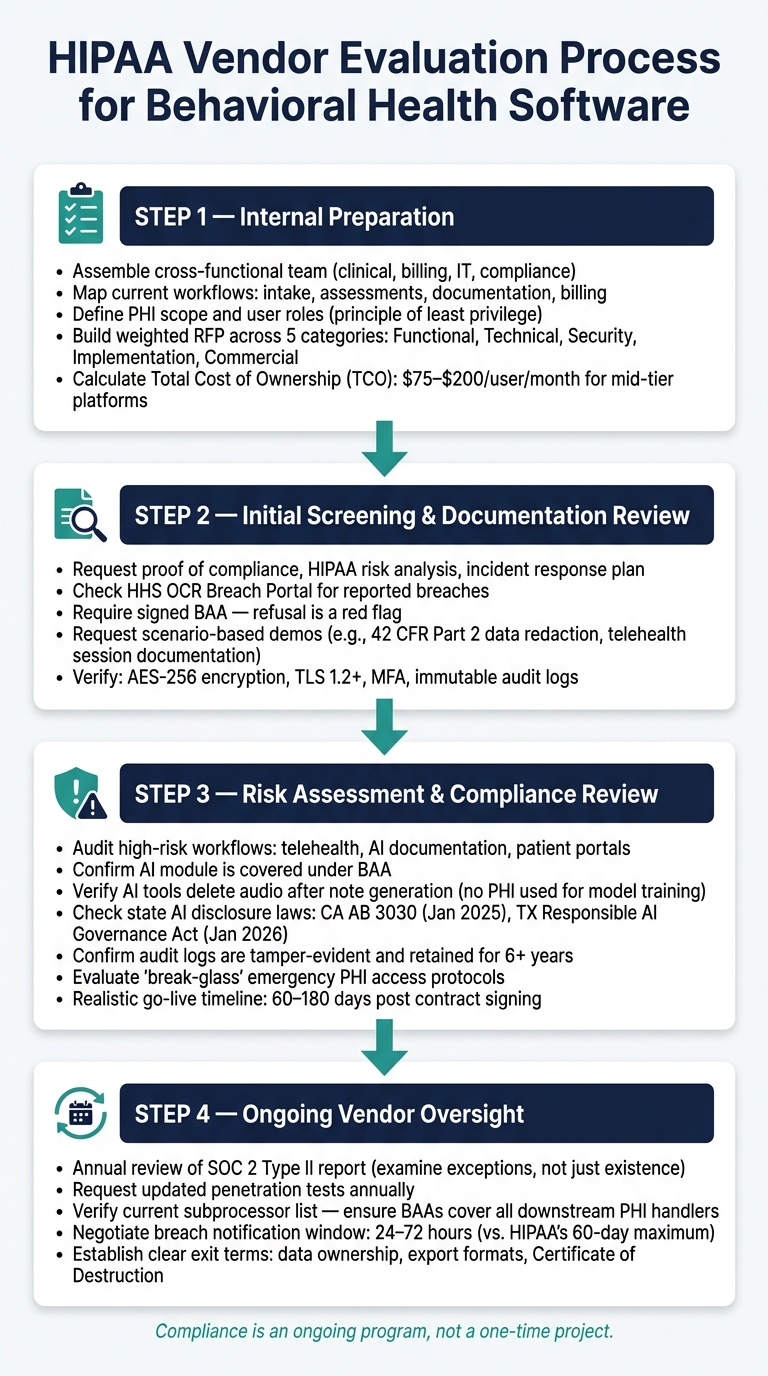
HIPAA Vendor Evaluation Process for Behavioral Health Software
Internal Preparation Before Contacting Vendors
Before engaging with vendors, it's crucial to lay a solid foundation internally.
Start by assembling a cross-functional team that includes representatives from clinical, admissions, billing, IT, and compliance departments.
Each of these areas interacts with protected health information (PHI) differently, so their input will help identify specific needs. For instance, billing might focus on claim logic, clinicians may prioritize streamlined group note documentation, and compliance officers will likely emphasize audit trails.
Next, take a close look at your current clinical workflows. Observe and document how processes like intake, assessments, session documentation, medication management, and billing are actually carried out in practice. This step ensures that any vendor you evaluate aligns with your operational realities.
Once workflows are mapped, create a weighted Request for Proposal (RFP) to score vendors across five key categories:
|
RFP Category |
Key Requirements to Include |
|---|---|
|
Functional |
Clinical documentation, MAT workflows, group notes, telehealth, AI documentation, CRM/RCM |
|
Technical |
APIs, FHIR/SMART support, 42 CFR Part 2 compliance |
|
Security |
BAA, encryption, audit logging, SOC 2, role-based access |
|
Implementation |
Data migration, training plan, timeline, resource commitments |
|
Commercial |
Pricing model, support SLAs, escalation terms, exit costs |
Additionally, calculate your Total Cost of Ownership (TCO) early on.
While enterprise platforms often require custom quotes, mid-tier solutions typically cost between $75 and $200 per user per month as of early 2026. Be sure to include expenses like implementation, data migration, training, and exit costs - not just the subscription fee.
Once you've clearly defined your internal needs, you can begin screening vendors by reviewing their documentation.
Initial Screening and Documentation Review
The first step in vendor screening is separating those who can back up their claims from those who cannot. As Gil Vidals, CEO of HIPAA Vault, explains:
"Determining whether software is HIPAA compliant involves more than a vendor's marketing claims. The U.S. Department of Health and Human Services (HHS) does not 'certify' software." [20]
Request key documentation early in the process, such as proof of compliance, a formal HIPAA risk analysis, and an incident response plan.
Check the HHS OCR Breach Portal to verify any reported breaches, keeping in mind that it typically lists covered entities rather than their vendors.
In addition to reviewing documents, ask for scenario-based demos. Instead of a generic feature walkthrough, request demonstrations of real-world use cases. For example, have vendors show how their system manages a telehealth session with integrated documentation or handles 42 CFR Part 2 data redaction for sensitive substance use disorder records.
These practical demonstrations often uncover gaps that a slideshow might conceal.
Risk Assessment and Compliance Review
After the initial screening, dive deeper into high-risk workflows and compliance measures. Pay special attention to telehealth sessions, AI-generated documentation, and patient portals, as these areas often present unique vulnerabilities.
For AI features, confirm that the vendor maintains auditable training data pipelines and logs outputs. AI tools handling PHI must meet HIPAA Security Rule requirements, just like any other software. Also, be mindful of emerging regulations such as California AB 3030 (effective January 2025) and Texas's Responsible AI Governance Act (effective January 2026), which require patient disclosures when AI is used in clinical documentation.
Evaluate the vendor's emergency PHI access procedures, often referred to as "break-glass" protocols. Ensure they include just-in-time access grants and mandatory post-event reviews. Audit logs should be tamper-evident and retained for at least six years, as HIPAA mandates [11]. Watch out for warning signs like shared login credentials, vague answers about subprocessors, or hesitance to explain security measures.
"Ultimately, your vendor's vulnerabilities are your vulnerabilities." - Marlene M. Maheu, PhD, Telehealth.org [2]
Finally, plan for implementation. For a mid-size behavioral health center, a realistic timeline from contract signing to go-live is typically 60 to 180 days [6]. Assign "super users" in each department to lead the transition and ensure a smoother adoption process.
Vendor Management Best Practices for Behavioral Health
This stage of vendor management ensures that compliance is maintained well beyond the initial due diligence phase.
Protecting SUD and Mental Health Records
Behavioral health records, especially those related to Substance Use Disorder (SUD) under 42 CFR Part 2 require extra care due to the risks they pose.
These records can impact employment, custody arrangements, and insurance eligibility. Unlike general health data, SUD records cannot be re-disclosed to third parties without new patient consent. This makes it essential for vendors to demonstrate strong safeguards, such as technical segregation and encryption.
When assessing vendors, ensure their systems can isolate sensitive records using field-level encryption or tokenization. This ensures that psychotherapy notes and SUD data are only accessible to authorized clinicians with proper role-based permissions.
Vendors unable to provide these capabilities may create serious compliance vulnerabilities.
Evaluating AI and Automation Features for HIPAA Compliance
Since 2025–2026, AI documentation tools have become a standard consideration for behavioral health organizations [21].
These tools are praised for reducing clinicians' cognitive load and speeding up documentation processes. However, it’s crucial to clarify whether the AI module is built into the EHR or offered as a third-party add-on.
If it’s the latter, ensure your Business Associate Agreement (BAA) specifically includes the AI component. A general BAA that doesn’t address the AI module could leave gaps in your compliance framework [21][7].
Another critical question for vendors is whether patient data is used to train shared AI models. HIPAA-compliant systems should delete audio recordings immediately after generating notes, rather than retaining them for model improvement.
State laws like California's AB 3030 and Texas's Responsible AI Governance Act also require notifying patients when AI is used in clinical documentation [21].
Vendors should have built-in workflows for these disclosures, eliminating the need for manual processes.
Ongoing Vendor Oversight and Periodic Reassessment
Vendor selection isn’t a one-and-done process.
As Kevin Henry, HIPAA Specialist at AccountableHQ, explains:
"HIPAA compliance for behavioral health EHR systems is an ongoing program, not a one-time project." [10]
Ongoing oversight is critical for maintaining compliance over time. At a minimum, establish an annual review process as part of your vendor management strategy.
This should include reviewing the vendor’s most recent SOC 2 Type II report- not just confirming its existence, but also examining any noted exceptions and how they were addressed.
Request updated penetration tests and verify the vendor’s current subprocessor list, ensuring BAAs are in place for all downstream handlers of Protected Health Information (PHI)
[15].
From a contractual perspective, there are two key details to negotiate upfront. First, set a specific breach notification window in your BAA - 24 to 72 hours for initial notice is a reasonable benchmark compared to HIPAA’s broader "without unreasonable delay" standard [1].
Second, establish clear exit terms, which should cover data ownership, export formats, retrieval timelines, and the issuance of a signed Certificate of Destruction for PHI and backups upon contract termination [15].
While these details may seem minor during onboarding, they become critical if the vendor relationship ends. This ongoing cycle of assessment and oversight ensures that emerging risks are addressed promptly.
For platforms like Opus Behavioral Health EHR, which integrate EHR, CRM, RCM, and AI-powered tools into a single system, compliance controls such as audit logging, role-based access, and thorough BAA coverage can be managed within one unified environment.
This approach simplifies annual risk analyses and ongoing oversight, reducing the complexity of managing multiple vendors.
Conclusion: Applying This Framework to Your Vendor Selection
Key Takeaways
Choosing a HIPAA-compliant vendor is crucial for protecting patient information and ensuring smooth operations.
This framework provides a structured way to safeguard PHI while keeping your processes efficient. Remember, a signed BAA and compliance with 42 CFR Part 2 are non-negotiable. Technically, vendors should offer AES-256 encryption at rest, TLS 1.2+ encryption in transit, multi-factor authentication, role-based access control, and tamper-evident audit logs as baseline features.
To objectively assess vendors, use a weighted scoring system focusing on security, privacy, architecture, operations, and cost.
Go beyond feature lists by requesting scenario-based demonstrations. For example, ask vendors to show how they handle a 42 CFR Part 2–compliant disclosure or document a group therapy session.
This approach can reveal their platform's real-world capabilities better than a checklist [14].
Keep in mind that compliance is an ongoing responsibility - regularly review SOC 2 Type II reports, conduct updated penetration tests, and ensure clear exit terms are in place.
With these fundamentals covered, here’s how to fine-tune your vendor selection process.
Next Steps for Behavioral Health Organizations
Start by mapping out your workflows. Break down your processes for intake, assessment, group documentation, and billing. This will help you clearly distinguish between essential features and those that are simply nice to have.
Next, follow the evaluation framework step by step: internal preparation, reviewing documentation, performing risk assessments, and maintaining ongoing oversight.
Consider solutions like Opus Behavioral Health EHR, which is tailored specifically for addiction treatment, SUD, and behavioral health. It combines EHR, CRM, RCM, and AI-powered tools in one platform.
Features like Copilot AI, telehealth, e-prescribing, outcomes tracking, and over 140 reporting options are designed for behavioral health workflows.
Compliance tools, including audit logging, role-based access, and built-in BAA coverage, are integrated into the system.
"The cheapest platform on a per-user basis is rarely the cheapest platform after a year of operation." - Behave Health [6]
Lastly, calculate the total cost of ownership before committing. This includes implementation, data migration, training, and exit costs. Choose a vendor that not only meets your current compliance requirements but is also prepared to adapt as regulations, AI standards, and interoperability needs change.
FAQs
How do I confirm a vendor is HIPAA-ready without “HIPAA certification”?
The U.S. Department of Health and Human Services doesn't provide official HIPAA certifications. To ensure a vendor aligns with HIPAA requirements, focus on their security measures and legal commitments.
Business Associate Agreement (BAA): Make sure they provide a signed BAA, which is a legal necessity for HIPAA compliance.
Third-Party Validation: Look for certifications like a SOC 2 Type II report to verify their security practices.
Key Security Features: Evaluate their encryption protocols, U.S.-based data storage, breach notification procedures, and regular risk assessments.Opus Behavioral Health EHR adheres to these rigorous standards, ensuring secure and efficient operations.
What 42 CFR Part 2 capabilities should I require for SUD records?
Complying with 42 CFR Part 2 regulations for substance use disorder (SUD) records requires going beyond standard HIPAA protections. Your system must include several critical features to ensure compliance:
Granular consent management: This enables tracking of specific data types, recipients, and consent expiration dates.
Restricted re-disclosure controls: Prevents unauthorized sharing of sensitive information.
Segmented record access: Limits access to only the necessary parts of a patient's record.
Audit trails: Logs all access and actions to maintain transparency and accountability.
Opus Behavioral Health EHR simplifies this process by integrating these tools directly into its platform. It streamlines consent workflows and ensures all access is logged, helping you meet federal requirements efficiently.
What contract terms are most important beyond the BAA?
When drafting contracts beyond the Business Associate Agreement (BAA), it's important to include specific provisions that address critical aspects of data handling and security.
Here's a breakdown of key terms to focus on:
Breach Response Timelines: Ensure the contract specifies a clear timeline for reporting breaches, such as requiring notification "without unreasonable delay" and within a defined window.
Subcontractor Obligations: Include clauses that require subcontractors to comply with the same privacy and security standards outlined in the agreement.
Data Ownership and Secure Destruction: Define who owns the data and include terms for certified deletion of Protected Health Information (PHI) after the contract ends.
Exit and Transition Support: Add provisions for data portability to facilitate smooth transitions when the agreement terminates.
Audit Rights: Grant rights to audit logs and other records to monitor compliance and address potential issues.
Risk Allocation: Address indemnities and cyber insurance to clarify who bears responsibility in case of security incidents.
Uptime and Support Commitments: Establish guarantees for system availability and support to ensure PHI remains accessible when needed.These terms help safeguard sensitive data while ensuring accountability and operational continuity.



- Behavioral Health
- EHR Systems
- Addiction Treatment EHR
- mental health
- Telehealth
- addiction treatment
- Behavioral health facility
- Substance Abuse Disorder
- behavioral Health center
- HIPPA Compliant
- ehrsoftware
- PTSD
- behavioral health ehr
- Depression
- hipaa
- Anxiety
- MentalHealthMatters
- RCM
- claim denials
- clinical documentation
- mental health awareness
- screening tools

September 15, 2026

September 15, 2026

September 14, 2026

September 11, 2026

September 10, 2026

September 09, 2026
Recommended Posts

Tuesday, August 11, 2026
Telehealth Vendor HIPAA Review: Do it Right in 5 Steps
If a telehealth vendor touches ePHI, I treat the review like a HIPAA risk check before any patient data moves.

Monday, June 29, 2026
Lab Data Security Trends in Behavioral Health
Lab data in behavioral health is under stricter scrutiny due to its sensitive nature, especially when tied to substance ...

Thursday, September 03, 2026
7 Vendor Steps for Behavioral Health Data Exchange
Behavioral health data exchange fails less from standards alone and more from vendor setup, consent controls, and ...