

AI relapse prediction can help treatment centers spot post-discharge risk earlier, before missed visits or treatment drift turn into a return to use.
In SUD care, the strongest systems usually depend on five things: structured data, clear relapse windows, tested model performance, workflow-based alerts, and tight privacy controls.
Data first: records need clean inputs like attendance, MOUD adherence, labs, and patient-reported measures.
Model discipline matters: one cited model reached 0.81 sensitivity at 90 days and 0.86 at 120 days using 108 factors.
Workflow matters just as much as model accuracy: scores need to trigger follow-up tasks, dashboard lists, or chart flags that staff can act on.
Governance cannot be skipped: SUD programs need role-based access, audit logs, bias checks, and regular recalibration.
For behavioral health executives, the issue is not whether AI can score relapse risk. The issue is whether the organization has the data, workflow, and compliance structure to turn those scores into timely clinical action without adding staff burden.
AI relapse prediction in SUD treatment is best viewed as a decision-support layer. It may help clinical teams focus outreach, support leadership visibility into post-treatment risk, and improve follow-up consistency across programs.
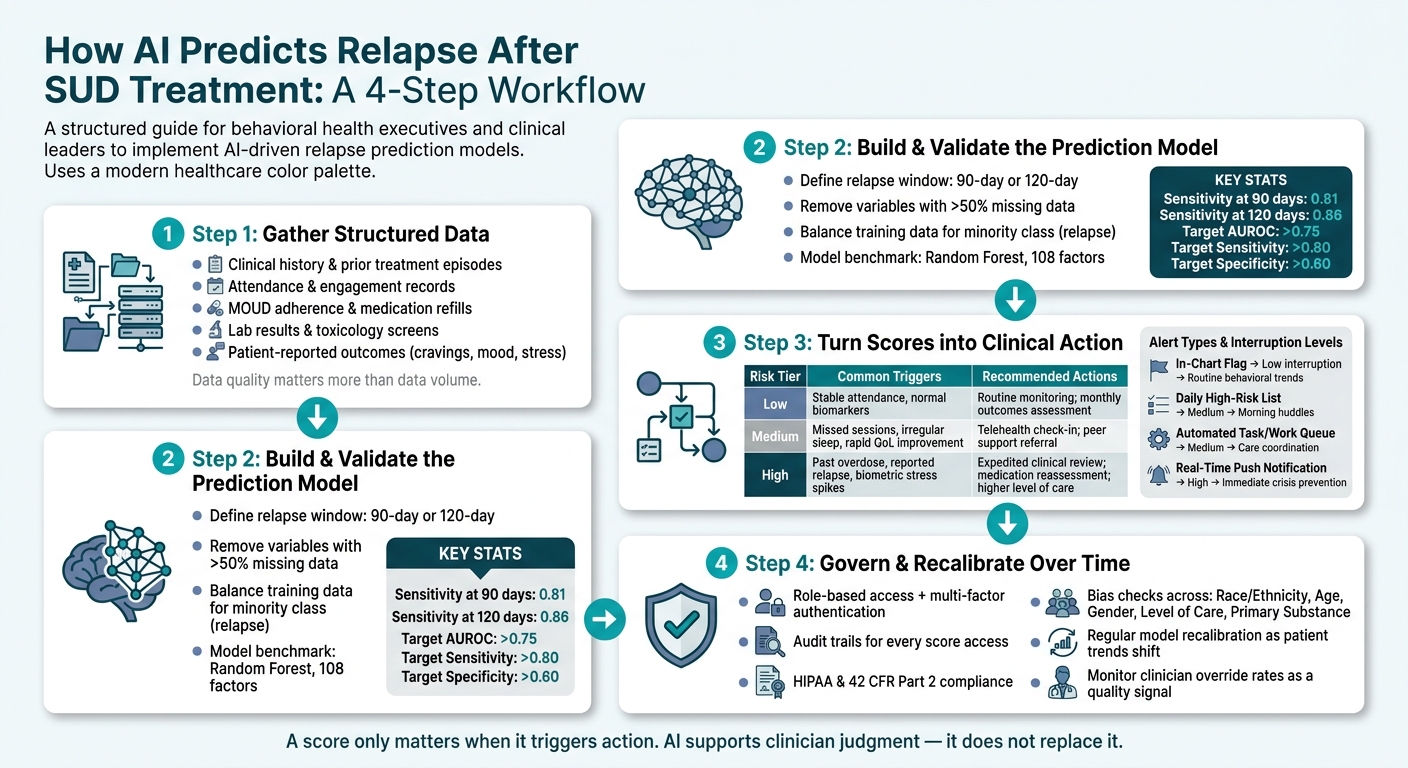
AI Relapse Prediction in SUD Treatment: 4-Step Workflow
Step 1: Gather the data AI needs to predict relapse
Clinical history, attendance, medications, labs, and patient-reported outcomes
AI relapse forecasts depend on consistent, structured data. Before any model can flag rising risk, treatment centers need to capture the right inputs across the full patient journey, from intake through follow-up care.
Clinical history sets the baseline. Prior treatment episodes, co-occurring mental health conditions, social factors, and criminal-justice involvement help the model estimate a patient’s starting level of risk. In the HEROES study, past overdose history was a top risk factor for dropout at 120 days [1].
Attendance and engagement data often give some of the earliest warning signs. Missed groups, therapy no-shows, and drops in participation may point to disengagement before a patient says anything directly. Medication records add another signal. MOUD adherence and refill activity can show whether the treatment plan is being followed with consistency.
Lab results and toxicology screens add an objective layer that supports self-reported data. Patient-reported measures such as cravings, mood, stress, and coping confidence help surface what clinical observation may miss. Changes in those signals can appear early, sometimes before relapse risk shows up elsewhere.
These inputs become the signals the model learns from in Step 2.
Why structured, integrated records improve model inputs
For relapse prediction, data quality matters more than data volume. A model can only learn from information that is entered in a clear, consistent format. Unstructured notes are much harder to use than standardized fields, especially when the model depends on clean inputs across many patients and encounters.
Fragmented records weaken the dataset. If attendance sits in one system, labs in another, and outcomes data somewhere else, gaps become part of the record by default. That can limit risk visibility and make forecast accuracy harder to trust.
Opus Behavioral Health EHR centralizes EHR, telehealth, labs, e-prescribing, and outcomes data in one record. For behavioral health leaders, that kind of connected documentation can support cleaner model inputs and better reporting across clinical and operations teams.
Once the data are structured, the next step is turning them into validated risk tiers.
Step 2: Build and validate the relapse prediction model
Prepare data, define relapse windows, and build useful signals
After Step 1, the next job is to turn structured data into features a model can use. Teams should define relapse or dropout within a 90-day or 120-day window, since that time frame stays close enough to care delivery to support action by clinical and operations teams [1].
Those labels, paired with the input data, form the model training set.
Feature engineering matters here. Categorical fields should be encoded as binary indicators. Raw records should also be turned into signals tied to medication history, including MOUD use, use of other substances such as benzodiazepines, clinical history, and patient-reported outcomes [1].
Some patterns may point to a higher dropout risk, including prior overdoses, prior relapses, and even rapid improvement in quality of life [1].
Data quality also needs tighter control before model training begins. Variables with more than 50% missing data should be removed. For the rest, missing values can be filled with means or positive-rate values, based on the data type and the modeling plan [1].
Choose models, measure performance, and avoid data leakage
Because relapse is often the minority class, the training data should be balanced before model fitting. Cross-validation should then be used to test performance across different splits of the data [1].
In one study, a Random Forest model trained on 108 factors reached 0.81 sensitivity at 90 days and 0.86 at 120 days [1]. For hyperparameter tuning, nested cross-validation can help reduce overfitting [1].
"The model allows for a system of classification; therefore, resources can be allocated efficiently, and treatment plans can be tailored to the individual." - Assaf Gottlieb et al. [1]
For behavioral health providers, sensitivity often deserves the most attention. Missing a high-risk patient can carry more operational and clinical cost than reviewing an extra alert, so teams may accept more false positives in exchange for catching more at-risk patients [1].
A practical benchmark is an AUROC above 0.75, along with predicted probabilities that line up closely with what happens in practice [1].
One of the biggest risks in this step is data leakage. A model may look strong on paper if it uses information that would not have been available at the time of prediction.
Common examples include discharge summaries or lab results recorded after the relapse event. To avoid that problem, training data should include only pre-event information, and final testing should be done on a held-out dataset.
|
Metric |
What It Measures |
Practical Target |
|---|---|---|
|
Sensitivity (Recall) |
Catches true high-risk patients |
>0.80 [1] |
|
Specificity |
Avoids over-alerting on low-risk patients |
>0.60 [1] |
|
AUROC |
Overall model discrimination ability |
>0.75 preferred [1] |
|
Calibration |
Predicted probability vs. actual relapse rate |
High alignment [1] |
Once model scores are dependable, the next step is to turn them into categories staff can use in daily workflow.
Convert probabilities into practical risk tiers
Raw probabilities are not always useful at the point of care. Staff usually need low-, medium-, and high-risk tiers so they can sort follow-up work, focus outreach, and route patients into the right level of attention [1]. These tiers then become the basis for the alert logic and follow-up steps covered in Step 3.
Step 3: Put AI risk scores into daily clinical workflows
Risk tiers do not help on their own. They matter when they lead to a clear, documented next step inside the care delivery system. For behavioral health organizations, that means turning a score into action that staff can see, complete, and record in the patient record. A score only matters when it triggers action.
Design alerts, dashboards, and work queues that staff will use
Alert design should match the urgency of the issue. That simple rule can reduce alert fatigue and make risk scoring more usable in day-to-day care.
A low-urgency in-chart flag works well for behavioral trends that do not need an immediate response. Clinicians can review that flag during a scheduled visit without adding another interruption to the day.
A daily high-risk list in the clinical dashboard gives supervisors a practical view for morning huddles, shift changes, and caseload balancing.
Automated tasks or work queue entries fit care coordination steps that must be completed and tracked, such as a required follow-up call. Real-time alerts should be saved for situations that call for immediate action, such as missed medication doses or biometric red flags, and they should only be used when a named staff member is ready to respond [2].
The key point is simple: match the alert type to the speed of the needed response.
|
Alert Type |
Interruption Level |
Best Use Case |
Operational Consideration |
|---|---|---|---|
|
In-Chart Flag |
Low |
Routine review during sessions |
Best for non-urgent behavioral trends or mood shifts |
|
Daily High-Risk List |
Medium |
Morning huddles / Shift changes |
Helps supervisors distribute caseloads based on acuity |
|
Automated Task / Work Queue |
Medium |
Care coordination |
Ensures a documented follow-up is completed |
|
Real-Time Push Notification |
High |
Immediate crisis prevention |
Use for biometric red flags or missed medication doses |
Map each risk tier to follow-up actions
Each risk tier should connect to a set response path. Without that link, staff may see the score but handle it differently from one shift, team, or site to the next.
Low-risk patients with steady attendance and stable biomarkers can remain on routine monitoring, with standard monthly outcomes assessments.
Medium-risk patients may show signs such as missed sessions, irregular sleep patterns, or a rapid improvement in quality of life that could point to early non-adherence risk. In those cases, teams should increase outreach, schedule a telehealth check-in, and add a peer support referral [1][2].
High-risk patients need a faster and more structured response. That may include expedited clinical review, medication reassessment, more frequent peer recovery coaching, and a formal review for a higher level of care [1].
|
Risk Tier |
Common Triggers |
Recommended Actions |
|---|---|---|
|
Low Risk |
Consistent attendance, stable biomarkers |
Routine monitoring; monthly outcomes assessment |
|
Medium Risk |
Missed group session, irregular sleep patterns, rapid QoL improvement |
Increased outreach; telehealth check-in; peer support referral |
|
High Risk |
Past overdose, reported relapse, biometric stress spikes |
Expedited clinical review; medication reassessment; higher level of care evaluation |
Use integrated behavioral health software to support execution
Consistent execution depends on software that connects the risk score to the next step. If staff have to move between disconnected tools, follow-up can slow down, tasks can get missed, and leadership may lose sight of completion rates.
Opus Behavioral Health EHR routes risk-triggered tasks into documented workflows, allowing follow-up calls, telehealth appointments, and lab orders to be assigned, tracked, and linked to the patient record in one system. That kind of workflow connection can help treatment centers keep action tied to accountability.
Every recommendation and follow-up step should be logged so teams can review response rates, monitor completion, and support auditability [2].
Step 4: Govern, monitor, and improve the system over time
Once relapse scores are live, leaders need a plan to keep them accurate, fair, and compliant in U.S. SUD care. A score that fits the workflow on day one can drift over time as patient needs, staffing patterns, payer pressure, and substance-use trends shift. Governance is what keeps the system reliable instead of letting it become background noise.
Protect privacy and align with HIPAA and 42 CFR Part 2
SUD records call for tight privacy controls under HIPAA and 42 CFR Part 2. Relapse risk scores and alert histories should be handled as sensitive clinical data, with access limited to the minimum necessary.
In day-to-day operations, that usually means role-based access and multi-factor authentication so only approved staff can view relapse risk data. Audit trails should log who accessed each score and when.
That helps support compliance review and internal accountability. Training and monitoring processes should also use only the minimum necessary data needed to produce accurate predictions.
Check for bias, recalibrate models, and review false alerts
Privacy controls protect data. Bias checks protect decisions.
Model performance should be tested on a regular basis across race, ethnicity, age, gender, level of care, and primary substance.
That review matters because a model can look strong at the top line while falling short for a specific patient group. In behavioral health operations, that kind of gap can affect care planning, staff trust, and documentation quality.
When clinicians often override or ignore alerts, that signal should not be brushed aside. High override rates may point to a threshold problem, unclear scoring logic, or risk tiers that do not match clinical reality.
They may also show that the model is firing too often in one setting, such as outpatient care, or missing context tied to a certain substance pattern.
|
Bias Check Category |
What to Measure |
Mitigation Actions |
|---|---|---|
|
Race & Ethnicity |
Disparities in flagging rates or accuracy |
Retrain with diverse datasets; adjust feature weights |
|
Age Groups |
Performance variance across age cohorts |
Revise features to include age-specific markers |
|
Gender |
Differences in sensitivity or false alert rates |
Review thresholds; recalibrate for gender-specific data |
|
Level of Care |
Accuracy in outpatient vs. residential settings |
Segment models by setting; update training data |
|
Primary Substance |
Reliability across opioids, alcohol, and other substances |
Add substance-specific markers; refine alert parameters |
Conclusion: What a reliable AI relapse prediction workflow looks like
AI works best in SUD care when it supports clinician judgment rather than taking its place. The aim is a monitored system that stays useful as patients, staff, and substance-use patterns change.
FAQs
How much data is needed to predict relapse risk?
Predicting relapse risk usually depends on longitudinal, patient-level data pulled from more than one source. A single signal rarely gives treatment teams enough context to judge risk with confidence.
That data may include clinical history, treatment attendance or adherence, medication records, lab results, and patient-reported measures. In practice, models learn patterns from large datasets built from past relapse cases, then adjust risk scores as new information enters the record.
For behavioral health organizations, that matters because relapse risk does not sit in one workflow. It often shows up across documentation, attendance, medication activity, and patient feedback over time. A model built on disconnected or incomplete data may miss changes that matter to clinical teams and care managers.
How often should relapse risk models be updated?
There is no fixed update schedule. Modern relapse risk models are built for continuous monitoring, using real-time data from wearables, mobile apps, and clinical assessments to support ongoing visibility rather than periodic updates.
Some models use sliding windows, such as 7-day intervals, to predict near-term outcomes. In practice, the main clinical goal is real-time monitoring and timely alerts that can help care teams intervene before risk escalates.
Who should act on a high-risk relapse alert?
When a high-risk relapse alert is triggered, clinicians and the broader care team need to act fast.
That response may include more frequent check-ins, changes to the treatment plan, added therapy sessions, or extra peer support. Opus Behavioral Health EHR supports this workflow with integrated AI-powered tools that notify providers in real time when patient trends or patterns point to rising concern.



- Behavioral Health
- EHR Systems
- Addiction Treatment EHR
- mental health
- Telehealth
- addiction treatment
- Behavioral health facility
- Substance Abuse Disorder
- behavioral Health center
- HIPPA Compliant
- ehrsoftware
- PTSD
- behavioral health ehr
- Depression
- hipaa
- Anxiety
- MentalHealthMatters
- RCM
- claim denials
- clinical documentation
- mental health awareness
- screening tools

September 15, 2026

September 15, 2026

September 14, 2026

September 11, 2026

September 10, 2026

September 09, 2026
Recommended Posts

Thursday, August 27, 2026
How Predictive Analytics Guides SUD Care Plans
Predictive analytics helps SUD providers act before relapse, dropout, overdose, or readmission.

Thursday, November 27, 2025
AI-Powered Billing for SUD Treatment Centers
AI is transforming billing for substance use disorder (SUD) treatment centers by solving common challenges like high ...
.jpg)
Wednesday, November 12, 2025
Ethical AI in Behavioral Health: Balancing Innovation with Patient Trust
Artificial intelligence (AI) is transforming behavioral health care, offering tools that improve access, streamline ...