

Behavioral health data exchange still lags far behind general medical care.
In 2024, only 19% of mental health facilities took part in HIE, versus 70% of hospitals. At the same time, about one-third of the U.S. population had a mental illness or substance use disorder.
Behavioral health groups should focus on five steps first.
That’s how I’d improve care handoffs without weakening HIPAA or 42 CFR Part 2 protections.
Summary:
1. Use standards first: build around USCDI v3, USCDI+ Behavioral Health, and FHIR2. Connect outside systems: link with HIEs, hospitals, labs, pharmacies, and referral partners
3. Set consent rules early: apply field-level controls, audit logs, and emergency access rules
4. Fix internal data flow: connect EHR, billing, labs, telehealth, CRM, and e-prescribing
5. Track what fails: watch latency, error rates, referral closure, denials, and medication history
FHIR is usually the best fit for new behavioral health exchange because it supports data-level sharing instead of whole-document sharing.
That matters when one part of a record can move, but another part must stay blocked.
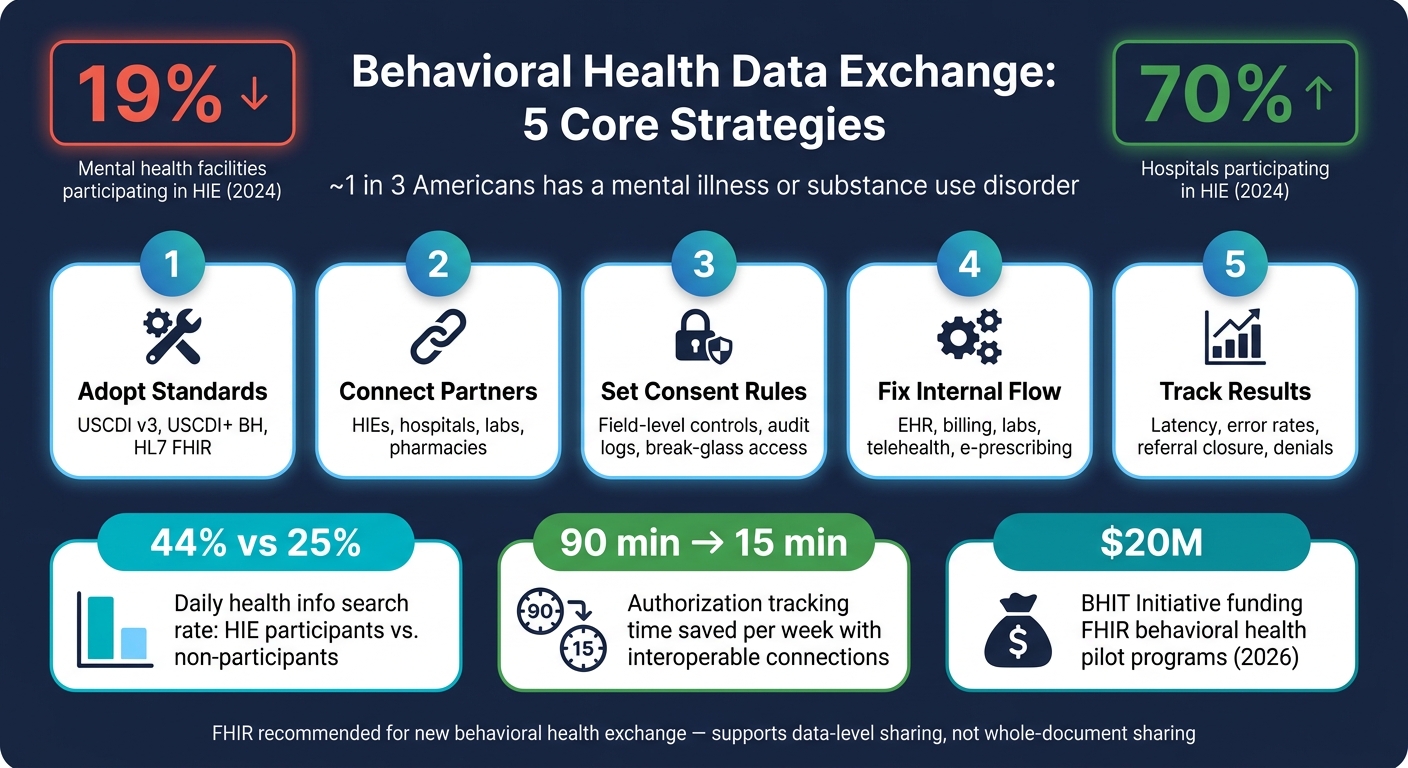
Behavioral Health Data Exchange: 5 Core Strategies at a Glance
Quick Comparison
|
Area |
Main Focus |
Why It Matters |
|---|---|---|
|
Standards |
FHIR, USCDI v3, USCDI+ BH |
Supports cleaner data sharing and less custom interface work |
|
Outside exchange |
HIEs, partner APIs, Direct messaging |
Helps with discharges, referrals, labs, and med history |
|
Privacy |
HIPAA + 42 CFR Part 2 + state rules |
Controls who can see SUD data and when |
|
Internal integration |
EHR, CRM, billing, labs, telehealth |
Cuts duplicate entry and lowers error risk |
|
Reporting |
KPIs, audit logs, AI-supported checks |
Shows where exchange is slow, broken, or out of compliance |
There’s also a practical thread running through the piece: start with the handoffs that affect safety and access most, like ADT alerts, lab results, referrals, and medication reconciliation. Then review progress at 30, 90, and 180 days.
Common Data Exchange Scenarios in U.S. Behavioral Health
Behavioral health data exchange tends to break at the same handoffs again and again. And each handoff carries its own kind of risk. If you want to see where exchange fails first, look at these moments.
Hospital discharge often triggers ADT alerts so providers can follow up fast.
PCP referrals need treatment history and crisis plans to move with the patient. Medication reconciliation keeps prescribers up to date on psychotropics and allergies, which matters when you're trying to avoid dangerous drug interactions.
Lab results, including lab monitoring and toxicology results, need to get to clinicians without delay so they can adjust treatment when needed. Outcomes reporting, using measures like the PHQ-9 and GAD-7, supports payer and quality reporting.
Here’s what happens when those handoffs fall apart:
|
Scenario |
Data Exchanged |
Impact of Poor Interoperability |
|---|---|---|
|
Hospital discharge |
ADT alerts, discharge summaries |
|
|
PCP referral |
Treatment history, crisis plans |
|
|
Medication reconciliation |
Current psychotropics, allergies |
|
|
Lab results |
Lab monitoring, toxicology results |
|
|
Outcomes reporting |
PHQ-9/GAD-7 scores, SUD trends |
Why Behavioral Health Interoperability Is Harder Than General Medical Exchange
This gap isn't only a tech problem. It's built into the system.
Behavioral health works under tighter privacy rules and more fragmented systems than general medicine.
General medical exchange is mostly governed by HIPAA.
Substance use disorder treatment, though, also falls under 42 CFR Part 2, which requires specific patient consent for each disclosure [3]. That changes the game.
Many legacy EHRs still push teams into a bad choice: share too much or rely on manual redaction. And manual redaction usually leads to one of two outcomes: oversharing or undersharing.
That’s why behavioral health exchange is harder to scale than general medical exchange.
Aligning Privacy, Usability, and Workflow
The answer is not more sharing. It’s controlled sharing.
Modern systems use data-level segmentation. In plain English, that means a SUD diagnosis can be tagged as restricted while a medication list still reaches an ER physician. That’s a big step up from all-or-nothing document sharing.
Consent enforcement also needs to happen automatically. When a system filters data in real time at query time, staff don’t have to make split-second judgment calls under pressure. And in emergencies, a traceable break-glass override can allow access to restricted data while still keeping a full audit trail.
Manual redact-print-scan-reenter workflows are the kind of process people skip when things get busy. So compliance can't sit off to the side as a separate task. It has to be built into the workflow itself. These limits shape the five strategies below.
1. Adopt Standards-Based Interoperability Frameworks
Start with shared data standards. They set the ground rules for what can be shared, with whom, and under what consent. Without them, every new connection turns into a one-off build. That means more upkeep, more cost, and more friction as you grow. Standards make controlled sharing possible without opening the floodgates.
As of January 1, 2026, USCDI Version 3 is required for all ONC-certified EHRs [8]. For behavioral health, that’s a big deal. USCDI v3 adds mental and cognitive status plus disability status, which helps fill gaps that have lingered in behavioral health data for years.
ONC and SAMHSA have also built USCDI+ Behavioral Health (USCDI+ BH), a focused dataset that standardizes items like substance use, mental status, and social determinants of health (SDOH) [1][14]. If you map your internal fields to USCDI+ BH, you can cut down on custom integration work and make federal and state reporting less painful [7].
For discrete data exchange, HL7 FHIR should be the first choice. Document-based formats often send too much or too little. FHIR works at the data-element level, so teams can share what care coordination needs while keeping psychotherapy notes locked down. That matters in behavioral health, where the line between useful sharing and over-sharing can get thin fast.
The FHIR Behavioral Health Profiles Implementation Guide (BH IG) is the main technical spec now being tested in nine pilot programs in 2026 [1][7]. That work is backed by a $20 million Behavioral Health IT (BHIT) Initiative [1][2]. In February 2026, Delaware's Division of Substance Abuse and Mental Health launched the "DTRN 360 BH Interoperability" project, using FHIR APIs to automate state consumer reporting forms and cut manual data entry for providers [7].
Compliance Impact
FHIR can also help apply consent rules and Part 2 limits at the data-element level. In plain English, modern setups can strip out restricted segments based on recipient permissions and the patient’s consent on file. That lowers the risk of manual redaction mistakes and supports the single-consent model that took effect on February 16, 2026 [8].
Efficiency Gain
There’s a clear workflow upside too. Facilities that take part in standards-based exchange search for health information daily at almost twice the rate of non-participants - 44% vs. 25% [5].
Implementation Complexity
The starting point varies a lot across organizations. As of 2024, EHR adoption was 97% among federal mental health facilities but only 38% among state government facilities [5]. That gap tells you something: not everyone is building from the same place.
A phased rollout tends to work best:
Start with a narrow pilot group
Test mappings in a sandbox
Scale only after clinical user acceptance testing is donePlan for 2–8 weeks for connector buildout, plus possible API or adapter costs [12].
Scalability for Cross-System Exchange
Standards-based frameworks are built to expand over time. SMART on FHIR uses OAuth2 scopes to limit third-party access, which makes it easier to add connections one step at a time as your governance model gets tighter and more mature.
Once your data model is stable, you’re in a much better position to move into secure partner connectivity.
2. Build Secure Connections With Health Information Exchanges and Partners
Once your standards framework is set, the next move is to connect with state HIEs, hospitals, labs, pharmacies, and referral partners. This is where data exchange starts to work in day-to-day care. But there’s a catch: many older HIE setups still depend on all-or-nothing document exchange, which makes it tough to control exactly what gets shared [10].
A better path is to use FHIR API connections. These let you share approved data elements without sending restricted data along with the rest of the feed [10][3]. That said, the connection itself isn’t enough. Consent rules and data restrictions have to travel with the exchange, or the whole setup can fall apart.
Compliance Impact
Even under the 2026 single-consent rule, partner agreements still need explicit Part 2 language. On top of that, the EHR must tag SUD data so restricted fields do not leave the system without consent [8][9]. Penalties matter here too: violations can bring $500 per violation for a first offense [9].
Your EHR should tag records automatically, including labs, diagnoses, and clinical notes, based on program type. That way, restricted data stays out of outbound feeds unless the right consent is on file [3]. Connecticut's Connie HIE is piloting enhanced consent tools for Part 2 data, giving providers a way to test new methods for sharing SUD information securely while still meeting strict federal privacy rules [7].
Efficiency Gain
Interoperable connections can cut authorization tracking time from 90 minutes per week to 15 minutes. That’s a big shift for staff time. Still, adoption remains low. As of 2024, only 19% of behavioral health facilities took part in a state, regional, or local HIE, and 67% were either unfamiliar with HIEs in their area or didn’t know whether one was available [11].
Those time savings depend on more than just turning on an interface. You also need clear consent rules and partner governance.
Implementation Complexity
Read-only connections, which work well for pulling in demographics, can go live in under 8 weeks. Bidirectional integrations are a different story. If you need custom field mapping, expect a 12–20 week timeline, along with strict data ownership rules so systems don’t overwrite each other or create conflicts [12].
Costs vary based on scope and setup:
$5,000–$50,000 one-time flat fee for defined, narrow-scope builds
$50–$500 per provider per month for ongoing connections in growing organizations [12]
Scalability for Cross-System Exchange
TEFCA now gives behavioral health providers a national framework for exchange across different systems, without overriding 42 CFR Part 2 consent rules [8]. That opens the door to broader exchange while still keeping privacy controls in place.
Platforms like Opus Behavioral Health EHR can support layered exchange with lab integration, e-prescribing, and HIPAA workflows. Once the connection is live, consent and governance decide what can move through it.
3. Set Up Consent, Privacy, and Data Governance Models
Once your connections are live, governance decides what can actually move through them. A connected system can still break down if consent and privacy rules don’t spell out what data can be shared, who can see it, and what gives them the right to access it.
Compliance Impact
The February 16, 2026 Part 2 update permits a single consent for future treatment, payment, and operations disclosures. But separate consent still remains in place for certain counseling notes [8][16]. Governance also needs a traceable break-glass path for emergencies [3].
The simplest way to apply those rules is at the data level, not through manual review.
Efficiency Gain
Automated field-level controls cut down on manual redaction. They also keep restricted data protected without holding back unrelated clinical information [3].
That means stronger access control, clear auditability, and tighter record segmentation.
Implementation Complexity
Build element-level segmentation instead of blocking whole documents. Then pair that with role-based access controls and readable audit logs that show who accessed restricted data and when [12][3].
Patients can ask for a three-year accounting of electronic disclosures, so audit trails need to be complete and easy to retrieve [16]. You also need to update your Notice of Privacy Practices (NPP) so it reflects HIPAA standards and Part 2 protections [16].
Scalability for Cross-System Exchange
FHIR security labels can carry sensitivity context across exchanges and support automated policy enforcement for multiple provider teams [3].
4. Connect Internal Systems Using API-Driven Integration and Data Quality Controls
Once governance is in place, your internal systems still need clean, automated data flow. Consent rules decide what can move. Internal integration decides whether that data moves cleanly.
When EHR, billing, CRM, labs, telehealth, and e-prescribing operate as separate tools with weak connections, staff end up entering the same information again and again. And even then, key details can still slip through the cracks.
Compliance Impact
API-driven integration lets you control data at the field level instead of sending entire documents. That matters a lot in healthcare. A FHIR-based API can share a medication list while keeping SUD-related notes restricted under 42 CFR Part 2.
Automated audit logs also record who accessed what data, when they accessed it, and which application they used. That helps with audit-readiness and supports the HIPAA minimum necessary principle.
Standard vocabularies keep data aligned across systems:
SNOMED CT for diagnosesLOINC for lab results
RxNorm for medications
When data is mapped to standard value sets, sensitive fields are easier to spot and protect during exchange.
Efficiency Gain
Connecting CRM, EHR, billing, labs, and e-prescribing cuts duplicate entry, shortens referral-to-admit time, and reduces denials and medication errors. Interoperable systems have been shown to reduce authorization tracking time from 90 minutes per week to 15 minutes [8].
Implementation Complexity
Start by deciding where read-only access makes sense and where bidirectional exchange is worth the added risk. Read-only interfaces can go live in under 8 weeks, while bidirectional integrations with custom field mapping usually take 12–20 weeks [12].
For bidirectional connections, you need to designate a system of record for high-risk fields such as medication orders. If two systems can update the same field without a clear source of truth, conflicting changes can create a patient safety risk [12].
Use SMART on FHIR when third-party apps need limited, auditable access.
Scalability for Cross-System Exchange
Data quality controls help keep mappings aligned as you add more systems. If a diagnosis is entered in one system, standardized terminologies help make sure it carries the same meaning in another system without manual reconciliation.
Start with the connections that create the most friction:
|
System Connection |
Data Direction |
Primary Impact |
|---|---|---|
|
CRM → EHR |
Bidirectional |
Eliminates duplicate intake entry; speeds referral-to-admit [12] |
|
EHR → Billing (RCM) |
Bidirectional |
Reduces claim denials; automates eligibility verification [12] |
|
EHR → Labs |
Read/Write |
Real-time results in chart; reduces medication errors [8][12] |
|
EHR → e-Prescribing |
Bidirectional |
Supports medication reconciliation; critical for SUD safety [8] |
|
EHR → Telehealth |
Integrated |
Single source of truth for sessions, notes, and billing [8] |
With internal data stabilized, reporting can show where exchange is still breaking down.
5. Use Analytics, Reporting, and AI to Track and Improve Data Exchange
Clean integrations matter, but they only help if you can see what’s moving, what’s failing, and what those failures are costing your team. That’s where reporting comes in. It helps you find bottlenecks, check compliance, and decide what to fix first.
Compliance Impact
Start by checking whether data exchange is safe. Then check whether it actually works.
AI-driven tools can support the 42 CFR Part 2 single-consent framework by managing granular consent and automatically stripping restricted data segments from C-CDAs or FHIR API responses based on the recipient's permissions [8][3]. After the February 16, 2026 deadline, organizations should track consent capture rates and enforce redisclosure rules automatically [8]. Analytics can then confirm that consent rules, redaction, and redisclosure controls are doing what they’re supposed to do.
Log every export, access event, and consent decision.
Efficiency Gain
Keep your eye on a small group of operating metrics. You don’t need a giant dashboard full of noise. You need a few numbers that show whether the system is getting better or slipping.
|
KPI |
What It Measures |
Target Signal |
|---|---|---|
|
Data Latency |
End-to-end message and bulk transfer time |
Sustained reduction from baseline [12] |
|
Error Rate |
Failed transactions by type and source |
Trending toward zero [12] |
|
Admin Hours Saved |
Staff time per task before vs. after integration |
Measurable reduction by 90 days [12] |
|
Claim Denial Rate |
Denials linked to integration-related data errors |
Declining trend by 90 days [12] |
|
Time to Schedule |
Referral receipt to confirmed appointment |
Decreasing within 30 days [12] |
|
Portal Usage |
Patient logins and message volume |
Growing month-over-month [12] |
Opus Behavioral Health EHR supports reporting, outcomes measurement, and AI documentation, helping behavioral health organizations monitor clinical and operational data flows.
Implementation Complexity
A simple rollout window works well here: 30 days to set baselines and fix the biggest errors, 90 days to cut latency and denials, and 180 days to confirm that the gains hold.
Deploy AI tools through PHI-compliant pipelines with role-based access and immutable audit logs [12]. Use SMART on FHIR scopes to limit analytics apps to approved data [10].
Scalability for Cross-System Exchange
As data exchange grows, your measurement approach shouldn’t fall apart. The same KPIs should still make sense across teams, sites, and systems.
Meaningful behavioral health measurement requires timely claims and clinical data, plus clear ways to act on the results [6].
That means core data should stay standardized so dashboards can compare systems without manual cleanup. Regional HIEs are also increasingly used as infrastructure for statewide trend analysis, such as tracking SUD patterns across populations [7].
And because turnover is high in many organizations, analytics training needs to be treated as an operating task tied to dashboard use, not a one-time onboarding event [6].
HL7 FHIR vs. HL7 v2 vs. CDA: A Side-by-Side Comparison
Choosing the right exchange standard affects privacy, workflow speed, and analytics. In behavioral health, that matters even more because consent rules and care handoffs can get messy fast.
This comparison shows where each standard fits best: FHIR for new discrete exchange, v2 for legacy feeds, and CDA for document-based exchange.
Match the standard to the workflow below.
|
Standard |
Typical Use Cases |
Data Types Exchanged |
Implementation Complexity |
Analytics and value-based care flexibility |
|---|---|---|---|---|
|
HL7 FHIR |
Modern app integration, patient portals, real-time data access, 42 CFR Part 2 consent segmentation |
Discrete resources (Patient, Observation, MedicationRequest, Condition) |
Lower - uses REST APIs and scoped access [12] |
High - Bulk FHIR exports structured data for outcomes tracking and population health [10] |
|
HL7 v2 |
Legacy lab interfaces, ADT feeds, pharmacy orders |
HL7 messages with pipe-delimited fields |
Higher - requires custom adapters and middleware [12] |
Low - data is often siloed in message feeds [12] |
|
CDA / C-CDA |
Transitions of care, HIE document exchange, discharge summaries |
XML-based document bundles |
Moderate - standardized but relies on whole-document sharing [10] |
Moderate - extracting discrete data elements for value-based care metrics requires complex XML parsing [10] |
The big difference is data granularity. FHIR works at the element level, while v2 and CDA are mostly document-level.
That gives FHIR an edge when a provider needs to share one part of a record but hold back another. For 42 CFR Part 2 workflows, that level of control is hard to ignore.
There’s also a timing issue here. As of January 1, 2026, ONC-certified EHRs must support USCDI v3 and FHIR APIs [8].
HL7 v2 isn’t going away anytime soon, especially for legacy lab and pharmacy feeds. But for new exchange, FHIR gives organizations a better base to build on. From there, the next choice becomes more practical: point-to-point interfaces, HIE connections, or Direct secure messaging.
Point-to-Point Interfaces vs. HIE Connections vs. Direct Secure Messaging
After you pick a standard, the next step is choosing the transport model that matches the partner and the workflow.
Point-to-point (P2P) interfaces are direct, custom-built connections between two specific systems, like your EHR and a specific lab. You get tight control over what goes out and when it goes out. That makes P2P a strong fit for high-volume workflows such as lab results and e-prescribing. The tradeoff is simple: every new partner needs its own build, and a system change on either side can knock the connection offline.
For broad coordination, HIE connections can do the job well, but there’s a catch. Consent controls need to travel with the data.
HIEs use a hub-and-spoke model, so one connection can reach many partners. That sounds efficient, and it often is. But many HIEs still exchange C-CDA documents, which can create compliance risk under 42 CFR Part 2 when a system can’t segment data at the element level. In plain English, that can mean sharing more than the patient’s consent allows.
For partners with limited tech capacity, Direct Secure Messaging (DSM) is usually the easiest path. It’s the lowest-complexity option and is often already built into certified EHRs. That makes it a practical way to send referrals, care summaries, or court-related records to courts, social service organizations, or small private practices that don’t have much technical infrastructure.
The rule of thumb is pretty simple:
P2P for narrow, high-volume exchange
HIE for broad coordination
DSM for low-tech partners
|
Exchange Model |
Partner Types |
Build Effort |
Ongoing Effort |
Compliance and Audit Value |
Best Behavioral Health Use Case |
|---|---|---|---|---|---|
|
Point-to-Point (P2P) |
Labs, pharmacies |
High - custom build per partner |
High - each link maintained separately |
High - granular control over what data is sent |
High-volume lab results and e-prescribing with specific pharmacies |
|
HIE Connection |
Hospitals, ERs, primary care networks |
Moderate - one connection reaches many partners |
Low - the HIE manages the network |
Moderate - automated audit logs, but document-level sharing can create Part 2 risk |
Discharge notifications (ADT alerts) and broad care coordination |
|
Direct Secure Messaging |
Courts, social services, small private practices |
Low - standardized, often built into EHRs |
Low - minimal technical upkeep |
Low/Manual - audit trails often rely on message logs |
Referrals, care summaries, and court-related records |
The right transport model comes down to three things: the standard you’re using, the type of data being exchanged, and how much segmentation the situation calls for.
Privacy and Governance Requirements: HIPAA, 42 CFR Part 2, and State Laws
Once you’ve picked a transport model, the next issue is legal. Behavioral health programs in the U.S. have to follow HIPAA, 42 CFR Part 2, and state law at the same time. And those rules don’t all work the same way.
So the transport decision solves only part of the problem. The data itself still has to meet the legal rules that sit on top of that transport.
On February 16, 2026, the updated 42 CFR Part 2 Final Rule took effect. Under that update, SUD programs can use one broad consent for future treatment, payment, and healthcare operations (TPO) disclosures [19].
That said, Part 2 is still stricter than HIPAA. HIPAA allows TPO sharing. Part 2 still limits redisclosure of SUD records unless the patient says yes. Those redisclosure limits stayed in place after the 2026 update.
The same rule applies inside TEFCA. Part 2 data still needs explicit patient consent before it can move through a Qualified Health Information Network (QHIN) [17].
Use these rules to sort data into three buckets:
- what can move- what must stay segmented
-what needs separate consent
The table below maps the main legal layers to the controls and records you’ll need.
|
Requirement Layer |
Data Exchange Implications |
Required Technical Controls |
Recommended Documentation |
|---|---|---|---|
|
HIPAA |
Allows TPO sharing without specific patient authorization |
Role-based access control (RBAC), AES-256 encryption, audit logs |
Business Associate Agreements (BAAs), Notice of Privacy Practices (NPP) |
|
42 CFR Part 2 |
Requires explicit consent for SUD records; strict redisclosure limits; SUD counseling notes need separate consent |
Data Segmentation for Privacy (DS4P), metadata tagging, consent management modules, "Break Glass" emergency access workflows |
Single TPO Consent form (2026 version), separate Counseling Note Consent, Qualified Service Organization Agreements (QSOAs), Prohibition on Redisclosure notice |
|
State Privacy Laws |
May impose stricter rules on minors' records or mental health conditions |
Jurisdiction-aware compliance logic, granular access controls |
State-specific authorization forms, legal counsel compliance reviews |
|
Internal Policies |
Defines internal data ownership, staff training requirements, and annual risk review |
Immutable, human-readable audit trails, SIEM integration |
Internal SOPs, staff training logs, "Break Glass" incident reports, annual risk assessments |
There’s another issue here: information blocking. Under the 21st Century Cures Act, you can’t withhold electronic health information unless you have a documented legal basis. If a Part 2 rule blocks disclosure, document the exact legal reason the data was withheld [15].
Systems also need to tag restricted data elements, such as SUD diagnoses and counseling notes, so nonrestricted data can still move [3].
That logic should live in the integration layer. If you wait until after data leaves the system, you’re already too late.
Internal Systems and Integration Priorities in Behavioral Health
Legal compliance sets the rules for data sharing. But in day-to-day care, data only moves if your systems can talk to each other.
That’s where many behavioral health groups run into trouble. Internal integration is often the weak spot. So instead of trying to connect everything at once, rank interfaces by patient safety, referral speed, and revenue impact.
Just remember: Start with the systems that create the most clinical risk when they break.
|
Internal System / Data Domain |
Common Integration Maturity |
Risk if Siloed |
Priority Level |
|---|---|---|---|
|
Medications and Allergies |
Moderate |
Medication errors; adverse drug interactions; prescribers making decisions without full patient history [8][12] |
Critical |
|
Clinical Notes / Care Plans |
High (recording); Low (exchange) |
Fragmented care; redundant assessments; crisis response delays [8][12] |
High |
|
Billing and Revenue Cycle (RCM) |
High (standardized X12/EDI) |
Revenue leakage; high claim denial rates; manual authorization tracking [12] |
High |
|
Referral Management |
Low (mostly manual fax/phone) |
3- to 5-day latency; patients repeat trauma history to each new provider; lost patient data during transitions [10] |
High |
|
Lab Results |
Low to Medium (71–78% adoption) |
Duplicate lab orders; delayed treatment planning; manual data entry errors [5][18] |
Medium |
|
Scheduling |
Medium |
Double bookings; insurance eligibility mismatches; slower time-to-admit [12] |
Medium |
|
Outcomes / MBC Dashboards |
Low |
Inability to participate in value-based payment models; poor audit readiness [12][6] |
Medium |
Medications and allergies belong at the top of the list for a reason. If a prescriber can’t see a patient’s full medication history, they’re making calls with part of the picture missing. In behavioral health, that’s a direct patient safety issue [8].
Clinical notes and care plans matter for a different reason. Many teams document inside the EHR just fine, but the information still doesn’t move where it needs to go. That gap can lead to fragmented care, repeat assessments, and slower crisis response [8][12].
Referral management is another pain point. In many organizations, it still runs through fax and phone. That can add a 3- to 5-day delay, force patients to repeat trauma history at each handoff, and increase the odds that key records get lost during transitions [10].
It’s hard to call that a smooth handoff when the patient has to start over every time.
A smart first move is to map your top five manual data exchanges, then turn those into your first automation targets. That might include faxes to primary care physicians, pharmacies, or hospitals [10]. This gives you a short list tied to daily work, not a giant wish list that never gets done.
Opus Behavioral Health EHR supports this connected workflow across EHR, RCM, labs, e-prescribing, telehealth, and outcomes reporting.
Interoperability Metrics and Dashboards: Key KPIs to Track
Once you've mapped the highest-risk exchanges, the next job is simple: check whether those exchanges are actually closing the loop.
Focus on the workflows that drive day-to-day care and billing: external summaries, labs, medications, referrals, and claims.
The table below lays out the main KPIs to watch, the data you need for each one, and the day-to-day problem each metric can reveal.
|
KPI |
Data Source Required |
Why It Matters |
Benchmark Target |
|---|---|---|---|
|
% Encounters with External Summaries Available |
HIE query logs, EHR "Outside Info" integration logs, USCDI+ BH datasets |
Clinical Quality |
>70% of encounters [4] |
|
Time to Reconcile Lab Results |
Lab interface engine logs (HL7/FHIR), EHR clinician sign-off timestamps |
Efficiency |
Improving versus the 30-day baseline by day 90 [12] |
|
Medication History Completeness |
PBM feeds, Surescripts/e-prescribing logs, HIE medication resources |
Clinical Quality |
>95% of new admissions [5] |
|
Referral Loop Closure Rate |
CRM/Referral system logs, EHR scheduling data, HIE Transition of Care (CCD) receipts |
Efficiency |
>90% closure within 7 days [11] |
|
Interface Failure Rate |
Interface engine error logs, API gateway/OAuth2 audit logs |
Efficiency / Compliance |
<1% failure rate [10] |
|
Required Field Completion |
USCDI v3 compliance reports, EHR field validation audits |
Compliance |
These targets also make one thing plain: data exchange still has a long way to go.
Only 16–17% of hospitals routinely send care summaries to behavioral health providers [8]. And only 48% of EHR-using behavioral health facilities can bring outside information into the chart without manual entry [5].
If your external summary availability rate is low, that's not some abstract dashboard problem. It's where this gap shows up in black and white.
A simple 30/90/180-day cadence works well here:
30 days: set your baseline90 days: check whether workflow fixes are moving the numbers
180 days: confirm the gains hold up over time
If error rates climb and stay up, treat that as an immediate signal to escalate with the vendor and run a root-cause review [12]. Small failures in interfaces have a way of turning into big workflow messes fast.
Opus Behavioral Health EHR supports this visibility with reporting across EHR, RCM, labs, and outcomes data.
These KPIs tell you whether exchange is working; the next step is picking the standard and transport model that can move the data.
Conclusion
These five strategies work best as a phased roadmap. Start with the exchange points that give you the most value first.
That usually means beginning with ADT alerts, lab interfaces, and referrals, then checking progress at 30, 90, and 180 days. But there’s a catch: that kind of rollout only works if consent and privacy controls are in place from the start.
USCDI v3 and the Part 2 single-consent rule now set the baseline for privacy-aware exchange. And that’s exactly why current state projects matter. They show this model can work in live care settings, not just in test runs.
Delaware and Connecticut are good examples. They show that FHIR-based exchange and consent tooling are moving from pilot to practice. These are active implementations.
The aim isn’t perfect interoperability on day one. It’s steady, measurable progress on the exchanges that matter most. Opus Behavioral Health EHR supports phased, compliance-aware exchange with lab integration, e-prescribing, outcomes measurement, and reporting.
FAQs
Why is FHIR better for behavioral health exchange?
FHIR is a better fit for behavioral health exchange because work like ONC’s USCDI+ Behavioral Health dataset and the FHIR Behavioral Health Profiles guide uses it to standardize behavioral health data and technical specs across care settings.
Just as important, FHIR supports more efficient, consent-driven, element-level sharing. That means care teams can share the right data with the right people at the right time, while helping protect sensitive SUD and behavioral health information. In practice, that supports care coordination, patient safety, and day-to-day clinical decision-making without opening up more data than needed.
What data should we connect first?
Start with the clinical data that matters most for safe care coordination: patient demographics, medications and allergies, active diagnoses, and recent labs and test results. After that, add structured care summaries for provider-to-provider exchange.
Use standards-based FHIR APIs, and enforce 42 CFR Part 2 with data-level, consent-driven segmentation. That way, restricted SUD and therapy notes stay out of external exchanges when the receiving party only needs safety-related information.
How do we share data without violating Part 2?
Get explicit patient consent before sharing SUD records, and make sure the consent matches the exact purpose of the disclosure.
Use consent-driven data segmentation so only non-restricted data gets shared, while Part 2-restricted notes remain blocked. Check consent at the time of exchange, including through FHIR and HIE workflows. Keep audit logs for access and sharing, and use secure, protected channels for clinical messaging instead of SMS.



- Behavioral Health
- EHR Systems
- Addiction Treatment EHR
- mental health
- Telehealth
- addiction treatment
- Behavioral health facility
- Substance Abuse Disorder
- behavioral Health center
- HIPPA Compliant
- ehrsoftware
- PTSD
- behavioral health ehr
- Depression
- hipaa
- Anxiety
- MentalHealthMatters
- RCM
- claim denials
- clinical documentation
- mental health awareness
- screening tools

September 15, 2026

September 15, 2026

September 14, 2026

September 11, 2026

September 10, 2026

September 09, 2026
Recommended Posts
Thursday, September 10, 2026
Why Behavioral Health Data Stays Fragmented
Behavioral health datåa stays fragmented because privacy rules, weak system connections, uneven data standards, and ...
Tuesday, September 15, 2026
5 HIPAA Rules for Family Disclosures in SUD Care
In SUD care, staff should not answer family questions by default.

Thursday, September 03, 2026
7 Vendor Steps for Behavioral Health Data Exchange
Behavioral health data exchange fails less from standards alone and more from vendor setup, consent controls, and ...