
Best EHR for Behavioral Health: A Treatment Center Guide
 By: Adi Tawari
Thursday, June 11, 2026

The best EHR for behavioral health depends on the kind of organization you run. A solo therapist needs scheduling, notes, and simple claims. A treatment center running Detox, Residential, PHP, IOP, and OP needs one record that follows each client through every level of care, bills per day and per visit, and protects substance use records under 42 CFR Part 2. Those are very different systems, and picking the wrong type costs you in staff time and denied claims. This guide is for treatment centers and behavioral health organizations with 10 or more providers. It compares the main types of systems, explains how size and levels of care change what you need, and gives you the questions to ask vendors.
In this guide
What you'll learn
-
Which type of behavioral health EHR fits your organization, with examples
-
Why your real number of EHR users is several times your provider count
-
How levels of care and billing models change what you need
-
The questions your owner, clinical director, and CFO should ask vendors
-
How Opus works for treatment centers with 10 or more providers
What is the best EHR for behavioral health?
The best EHR for behavioral health is the one built for how you deliver care. Small outpatient practices do best with a practice management EHR. Treatment centers with 10+ providers and several levels of care need a platform that keeps one record from Detox to OP, bills per day and per visit, and handles Part 2 consent.
Behavioral Health EHR Comparison by Organization Type
|
Organization type |
What it needs most |
Type of system that fits |
Examples |
|---|---|---|---|
|
Solo therapist or small group (1 to 5 clinicians) |
Scheduling, notes, simple claims |
Practice management EHR |
SimplePractice, TherapyNotes |
|
Outpatient mental health or psychiatry group |
E-prescribing, outcome tracking, per-visit billing |
Outpatient behavioral health EHR |
Valant, ICANotes |
|
Community mental health agency or CCBHC |
State reporting, Medicaid and grant workflows |
Large agency system |
Qualifacts |
|
SUD and multi-level treatment centers (10+ providers) |
Detox to OP in one record, per-diem and per-visit billing, Part 2 consent, admissions CRM |
Treatment center platform |
Opus, Kipu, Ritten |
|
Hospital systems |
Full medical records |
General medical EHR with a behavioral health add-on |
Epic, Oracle Health |
As of November 2026.
Running more than one level of care? See how Opus handles Detox through OP in one record. Explore the Opus EHR
How Size, Levels of Care and Users Affect Your EHR Choice
Provider count is the number most vendors ask for, and it's misleading. Therapists and prescribers aren't the only people in the EHR. Nurses, behavioral health techs, admissions coordinators, utilization reviewers, and billers all work in it every day, so your real number of users is much higher.
How Many Staff Will Use Your EHR Every Day
A center with around 10 providers usually has around 60 people using the EHR. That changes three things. Training has to work for every role, not just clinicians, and new hires need to get up to speed fast. Permissions have to match each role, so a tech can chart vitals without seeing billing, and a biller can work claims without opening therapy notes. And price: ask whether you're quoted per provider or per user, because the gap between 10 and 60 seats can change the total cost a lot.
How Detox, Residential, PHP, IOP, and OP Change Your EHR Needs
Each level of care documents and bills differently:
-
Detox: medically monitored withdrawal, usually lasting a few days.
-
Residential: 24-hour care while the client lives at the facility.
-
PHP (partial hospitalization): treatment for most of the day, with the client going home at night.
-
IOP (intensive outpatient): a few hours a day, several days a week. Despite the name, IOP counts as outpatient care.
-
OP (outpatient): scheduled sessions, usually once or twice a week.
Detox, Residential, PHP, and IOP are usually billed per day, while OP is billed per visit. When a client steps down from IOP to OP, billing switches models, so your EHR needs to handle both side by side.
Best EHR for Mental Health, SUD and Eating Disorder Programs
The programs you run shape what the EHR has to do. SUD programs need 42 CFR Part 2 consent and drug-screen results that flow straight into the chart. Psychiatry programs need e-prescribing, including controlled substances. Eating disorder programs often run Residential and PHP at the same time, so the system has to track clients in both without splitting the record.
If you run SUD programs, our guide on addiction treatment software covers Part 2 consent, drug screens, and per diem billing in more detail.
Behavioral Health EHR Checklist: Questions to Ask Vendors
Good vendor questions cover what each decision-maker owns. The owner owns operations, the clinical director owns documentation, and the CFO owns billing. Bring all three to the demo and work through the questions below.
|
Question to ask |
Why it matters |
Who cares most |
|---|---|---|
|
Does it support all our levels of care, billing per day and per visit side by side? |
Detox through IOP bill per day; OP bills per visit. A client stepping down from Residential to IOP mid-month needs both. |
CFO, clinical director |
|
Do group and progress notes tie back to each client's treatment plan? |
A group of 10 clients should create 10 notes, each linked to that client's plan. That link proves the care was needed. |
Clinical director |
|
How does it handle 42 CFR Part 2 consent? |
According to HHS, the updated Part 2 rule took effect April 16, 2024, and compliance was required by February 16, 2026. |
Clinical director, owner |
|
Does it flag missing documentation before utilization reviews and claims? |
Gaps found early can be fixed. Strong documentation wins more approved days and fewer denials. |
CFO, clinical director |
|
Do admissions, clinical care, and billing share one record? |
Separate systems mean staff retype information and claims get denied. See how EHR billing integration works from admission to payment. |
Owner, CFO |
|
Can our own team build and change forms? |
Waiting on a vendor support ticket slows every change. |
Clinical director |
|
Which reports come built in, and can we build our own? |
Leaders shouldn't have to build reports by hand in spreadsheets. |
Owner, CFO |
|
What does switching involve, in time and in cost? |
Ask about moving your charts over, training around 60 staff, contract length, and which features cost extra. |
Owner, CFO |
For the full requirements list, read our guide to the EHR features treatment centers need.
Red Flags When Choosing a Behavioral Health EHR
Some problems show up in the demo if you know what to look for.
-
The demo only shows outpatient workflows. If the vendor can't walk you through a Residential day or a step-down to IOP, the system probably wasn't built for more than one level of care.
-
Billing runs in a separate system. If claims are built somewhere else, staff will retype information and you'll spend more time working denials.
Shortlisting vendors? Download the EHR checklist your owner, clinical director, and CFO can all use. Get the checklist
How Opus Fits Treatment Centers With 10+ Providers
Opus is built for treatment centers with 10 or more providers running more than one level of care across SUD, mental health, eating disorder, and psychiatry programs. It was built by people who ran treatment programs themselves, so it follows how a center actually works, from the first call through billing. If you run a solo or 1 to 5 provider practice, the tools in the comparison table above will fit you better.
What Opus Includes for Treatment Centers
Opus keeps everything on one client record:
-
CRM for admissions
-
EHR for the clinical record
-
RCM software for billing, included with the EHR
-
Genie AI™ for chart checks
-
An AI scribe that drafts notes
-
E-prescribing, labs, and telehealth
-
100+ outcome measures and built-in reports
Genie AI™ checks each chart against the rules for that client's level of care, insurer, state, and accreditation. It flags gaps before billing, so staff can fix them before a claim goes out.
In Opus, the CRM handles admissions, the behavioral health EHR holds the clinical record, and RCM handles billing, all on one patient record.
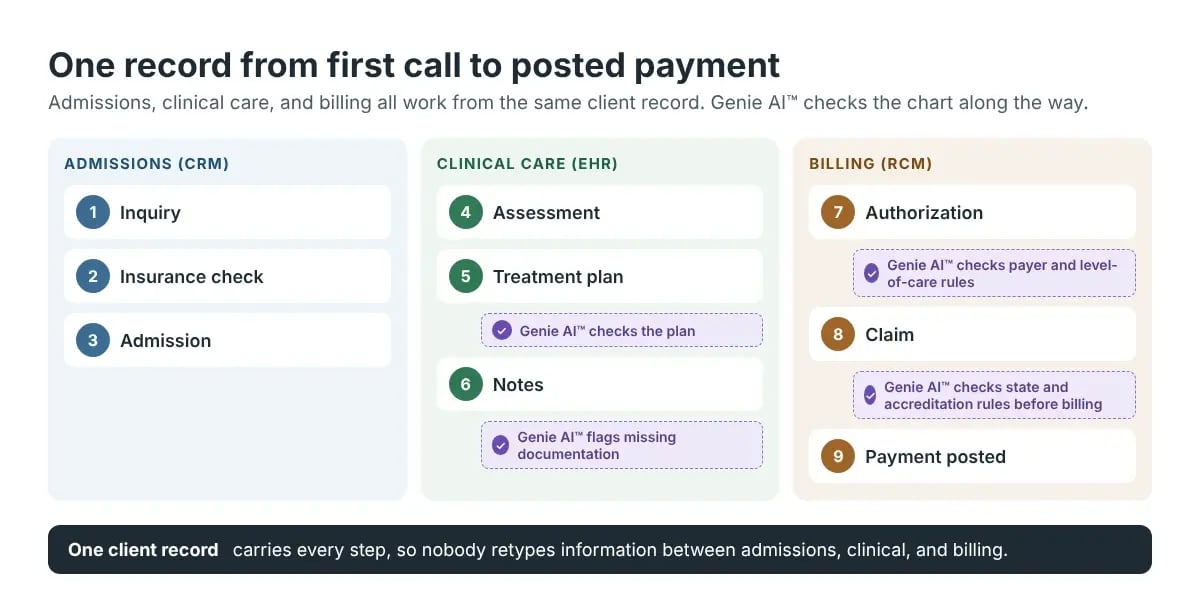
One client record carries every step, from the first call to the posted payment.
Opus Results and Customer Ratings
When a behavioral health treatment organization in Florida switched to Opus, the share of services it captured and billed rose from 85% to 95%. Its cost to admit each new client dropped from about $5,000 to $2,000, and it collected 90% of the money owed to it within 60 days.
Opus is rated 4.8 out of 5 on Capterra, Software Advice, GetApp, and G2, with a 4.9 score for ease of use on GetApp. In 2025, Opus was named a Software Advice FrontRunner in Mental Health and a GetApp Category Leader in Mental Health.




"We chose Opus because it is user-friendly and highly configurable." - Jennifer Gozy, PsyD, LP, Director of Clinical Systems and Compliance, Care Counseling Clinics
Switching to Opus: Onboarding and the Opus Promise
Switching doesn't mean starting over. Opus moves your charts and templates over for you, and a dedicated onboarding team works with you from kickoff to go-live. After launch, support runs 24/7/365, and the 100% satisfaction guarantee is written into your contract.
Key Takeaways
-
There's no single best EHR for every behavioral health organization. Match the type of system to how you deliver care.
-
Plan for every user, not just providers. Ten providers usually means around 60 people in the EHR.
-
IOP is outpatient care but is usually billed per day, so multi-level centers need per-day and per-visit billing in one system.
-
Part 2 compliance has been required since February 16, 2026. Ask every vendor to show how consent works.
-
When admissions, clinical care, and billing share one record, staff stop retyping information and fewer claims get denied.
Choose an EHR Built for How You Deliver Care
The right behavioral health EHR fits your levels of care, your billing models, and every person on your team who uses it. Use the comparison table to find the type of system that fits your organization, then take the checklist into every demo. If you run a treatment center with more than one level of care, see how Opus handles Detox through OP on one record.
Shortlisting vendors? Book a demo with a team that has run treatment programs. Book a demo
FAQs
What is an EHR for behavioral health?
A behavioral health EHR is an electronic health record built for mental health and substance use treatment. Beyond the clinical chart, it handles therapy and group notes, treatment plans, outcome measures, 42 CFR Part 2 consent, and behavioral health billing. Treatment center platforms also add admissions and per-day billing for each level of care.
What is the easiest behavioral health EHR to use?
The easiest EHR is the one that fits your workflows, so staff don't need workarounds. For small practices, that's usually a simple practice management EHR. For treatment centers, look for role-based screens, forms your team can change, and strong ease-of-use ratings. Opus has a 4.9 ease-of-use score on GetApp.
How can I tell if an EHR supports 42 CFR Part 2?
Ask the vendor to show it in the demo. The system should keep SUD records separate, record patient consent for each disclosure, let patients withdraw consent, and block sharing without it. In Opus, general health information and SUD records have separate consents. Check the HHS Part 2 fact sheet for current requirements.
What should I ask for in a behavioral health EHR pricing quote?
Ask for an itemized quote that shows whether pricing is per provider or per user, plus setup, data migration, training, and contract length. Confirm which features cost extra, such as billing, e-prescribing, labs, telehealth, or an AI scribe, so a treatment center with 60 users can compare the total cost across vendors.
Related Resources



- Behavioral Health
- EHR Systems
- Addiction Treatment EHR
- mental health
- Telehealth
- Behavioral health facility
- addiction treatment
- Substance Abuse Disorder
- behavioral Health center
- HIPPA Compliant
- ehrsoftware
- PTSD
- behavioral health ehr
- Depression
- hipaa
- Anxiety
- MentalHealthMatters
- RCM
- claim denials
- clinical documentation
- mental health awareness
- screening tools

September 15, 2026

September 15, 2026

September 14, 2026

September 11, 2026

September 10, 2026

September 09, 2026
Recommended Posts

Friday, February 11, 2022
Top Considerations for Behavioral Health Treatment Centers When Switching EHR Systems
The world is cautiously beginning to open again after the Covid-19 shelter-in-place orders are lifted. While it’s ...

Tuesday, December 09, 2025
AI-Powered EHR Tools for Behavioral Health
AI-powered EHR tools are transforming behavioral health practices. These tools reduce paperwork, improve documentation ...

Friday, December 05, 2025
Real-Time vs. Manual Payment Reconciliation
Payment reconciliation ensures financial accuracy by matching incoming payments to claims or invoices. In healthcare, ...